October True Crime: The Onion Field (dir by Harold Becker)


This 1979 true crime drama opens in Los Angeles in 1963.

Rookie Detective Karl Hettinger (John Savage) has just joined the Felony Squad and met his new partner, Ian Campbell (Ted Danson, making his film debut).  Ian is a tall, somewhat eccentric detective, the type who practices playing the bagpipes in the basement and who takes Hettinger under his wing.

Meanwhile, Jimmy Smith (Franklyn Seales) has just been released from prison.  The nervous and easily-led Jimmy almost immediately runs into Gregory Powell (James Woods), a small-time hood with delusions of grandeur.  Powell is the type who talks a big game but who really isn’t even that good of a thief.  Smith and Powell form an uneasy criminal partnership.  They are easily annoyed with each other but they also share an instant bond.  Though the film doesn’t actually come out and say what most viewers will be thinking, there’s a lot of subtext to a brief scene where Powell appears to caress Smith’s shoulder.

One night, Hettinger and Campbell are kidnapped by Smith and Powell.  Smith and Powell drive them out to an onion field.  Because he’s misinterpreted the Federal Kidnapping Act and incorrectly believes that he and Smith are already eligible for the death penalty because they kidnapped two police officers, Powell shoots and kills Campbell.  (The close-up image of Campbell falling dead is a disturbing one, not the least because he’s played by the instantly likable Ted Danson.)  Hettinger runs and manages to escape.  He saves his life but he’s now haunted by the feeling that he abandoned his partner.

The rest of the film deals with the years that follow that one terrible moment in the onion field.  Treated as a pariah by his fellow cops, Hettinger sinks into alcoholism and eventually becomes a compulsive shoplifter.  Smith and Powell, meanwhile, use a variety of tricks to continually escape the death penalty and to keep their case moving through the California justice system.  Powell, for instance, defends himself and then later complains that he had incompetent counsel.  Smith, meanwhile, is defended by the infamous Irving Karanek, a legendary California attorney who specialized in filing nuisances motions.  (Later Karanek found a measure of fame as Charles Manson’s attorney.  Eventually, he had a nervous breakdown in 1989, lived in his car, and was briefly suspended by practicing law.)  While Smith and especially Powell quickly adjust to being imprisoned, Hettinger spends the next decade trapped in a mental prison of guilty and bitterness.

Based on a non-fiction book by Joseph Wambaugh, The Onion Field is a compelling look at a true crime case that continue to resonate today.  The film can be a bit heavy-handed in its comparisons between the two partnerships that define the story.  Both Hettinger and Smith are young and neurotic men who find themselves working with a more confident mentor.  The difference is that Hettinger’s mentor is the cool, composed, and compassionate Ian Campbell while Smith’s sad fate is to be forever linked to the erratic Gregory Powell.  While the film may have the flat look of something that was made for television, it’s elevated by the performances of its lead actors.  James Woods give an especially strong performance as the cocky Powell, a loser in the streets who becomes a winner behind bars.  Over the course of the film, he goes from being a joke to being the prisoner that others come to for legal advice.  John Savage, meanwhile, poignantly captures Hettinger’s descent as the trauma from that night leaves him as shell of the man that he once was.

The film’s supporting cast is full of familiar faces.  Christopher Lloyd and William Sanderson show up as prisoners.  Ronny Cox plays the detective in charge of the onion field investigation.  David Huffman plays a district attorney who is pushed to his breaking point by the obstructive tactics of Smith’s attorney.  Priscilla Pointer play Ian Campbell’s haunted mother.  All of them do their part to bring this sad story to life.

The Onion Field is a chillingly effective true crime drama and a look at a murder that was inspired by one man’s inability to understand federal law.
Late Night Retro Television Review: Highway to Heaven 3.19 “Normal People”


Welcome to Late Night Retro Television Reviews, a feature where we review some of our favorite and least favorite shows of the past!  On Thursdays, I will be reviewing Highway to Heaven, which aired on NBC from 1984 to 1989.  The entire show is currently streaming on Tubi and several other services!

This week, Jonathan and Mark help out at a halfway house.

Episode 3.19 “Normal People”

(Dir by Michael Landon, originally aired on February 11th,  1987)

This week, Jonathan and Mark find themselves assigned to work as handymen at a halfway house for patients who have recently been released from a mental hospital but who are still not quite ready to reenter the society.  As usual, Mark is skeptical about working with anyone outside of his comfort zone but Jonathan soon shows him the error of his ways.  It seems like almost every assignment was really about teaching Mark to be more tolerant of people who were different than him.

The neighbors aren’t happy about having a halfway house in their neighborhood.  They vandalize the yard.  They blame the patients for every little thing.  When some neighborhood kids accidentally start a fire, the blame is put on a teenager at the halfway house.  Jonathan encourages the patients to try to leave the house and socialize and show everyone that they are just like normal people.  Jonathan also punishes one snobbish neighbor by causing her to have mishap with a stack of melons at a grocery store.  I’ve noticed that, during the third season, Jonathan and the Boss seem to take an extra delight in humiliating people.

Eventually, the stupid kids start another fire, which gives one of the patients that chance to save their lives.  It also reveals that the patient was not responsible for the earlier fires.  Everyone comes to realize the error of the ways.  Hurray!

This was a good example of how Highway to Heaven‘s earnestness often made up for scripts that were a bit obvious and heavy-handed.  There’s nothing subtle about this episode but it’s still so achingly sincere in its message of tolerance that it’s hard not appreciate it.  The show’s good intentions stand the test of time.

Embracing the Melodrama Part II #63: American Gigolo (dir by Paul Schrader)


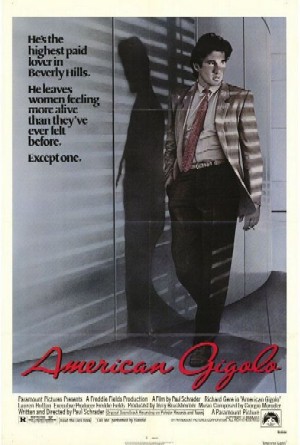
American_gigolo_postWell, here we are!  A month and two days ago, I announced the start of Embracing the Melodrama Part II, a 126-film series of reviews.  At the time, I somewhat foolishly declared that I would manage to review all of these films in just three weeks!  Four weeks later and we have finally reached the halfway point.

So yeah…

Anyway!  We started this series of reviews with 1927’s Sunrise and we have worked our way through the films of the 30s, the 40s, the 50s, the 60s, and the 70s.  And now, as we hit the halfway point, it’s appropriate that we start a new cinematic decade.

In other words, welcome to the 80s!

Let’s start the 80s off with the 1980 film, American Gigolo.  Directed by Paul Schrader, American Gigolo is — much like Schrader’s Hardcore and The Canyons — a look at the sleazier side of life in California.  Julian Kaye (Richard Gere) is the most successful male escort in Los Angeles.  He’s handsome, he’s confident, he speaks multiple languages, and he maintains a proper emotional distance from … well, from everyone.  He’s got a fast car, expensive clothes, a great apartment, and — because it is the 80s after all — a small mirror that is perpetually coated in cocaine residue.

We don’t really learn much about Julian’s past.  We don’t know much about who he was before he became the American Gigolo.  (If this movie were made today, American Gigolo would be a part of the MCU and would end up joining The Avengers.)  However, the film is littered with clues.  For instance, we know that he used to work exclusively for Anne (Nina Van Pallandt) but he’s become so successful that Anne has lost her hold over him.  Before Julian worked for Anne, he worked for Leon (Bill Duke), a gay pimp.

Julian’s sexuality is a big question mark throughout the entire film.  Though all of his current clients are female and Julian brags about his ability to leave a woman feeling sexually satisifed, the film leaves it ambiguous as to whether or not he actually likes women.  (It’s suggested — though never explicitly stated — that Julian slept with men while he was working for Leon.)  Ultimately, for someone who has sex for a living, Julian seems oddly asexual.  It’s hard not to feel that Julian is only truly capable of desiring his own carefully constructed image.

Is Julian capable of love?  That’s the question that Michelle Stratton (Lauren Hutton) has to consider.  Michelle is unhappily married to a member of the U.S. Senate but she’s having an affair with Julian.

Michelle’s relationship with Julian is tested when Julian is accused of murdering one of his clients.  While Julian begs both his clients and his business associated to provide him with an alibi, he discovers that he’s basically alone.  Convinced that someone’s trying to frame him, Julian destroys his apartment and his car searching for clues.  As he grows more and more paranoid, his perfect image starts to crack and Michelle has to decide whether or not to sacrifice her marriage to protect him.

American Gigolo is technically a murder mystery but the murder doesn’t really matter.  Instead, it’s a character study of a man who is empty inside until, in Job-like fashion, he loses everything.  It’s also a very watchable exercise in pure, sleek, and probably cocaine-fueled style.  Richard Gere has always been an oddly hollow actor (and that’s not necessarily meant as a criticism) and that suggestion of inner emptiness makes him the perfect choice for the role of Julian Kaye.

American Gigolo is making the premium cable rounds right now.  Keep an eye out for it and don’t be surprised if you find yourself singing Call Me afterwards.