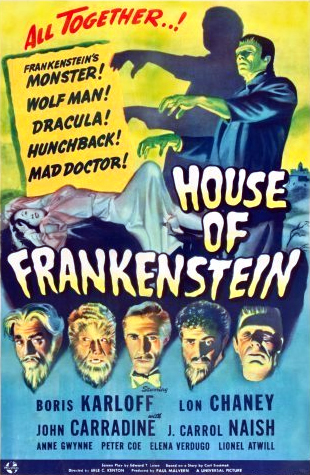
House of Frankenstein opens in a prison. Dr. Gustav Neimann (Boris Karloff), the bother of one of Baron Frankenstein’s assistants, has been convicted of robbing graves and attempting to carry on the Baron’s work. Dr. Neimann’s faithful assistant is the hunchback, Daniel (J. Carroll Naish). Daniel is loyal to Neimann because Neimann has promised to someday place Daniel’s brain in a stronger body.
When a sudden earthquake allows Neimann and Daniel to escape, they waste no time in getting revenge on Neimann’s enemies. First, they murder a traveling showman named Prof. Lampini (George Zucco) and steal both his identity and his mobile horror exhibit. Included in the exhibit is a coffin that Lampini claimed held the skeleton of Dracula. (There’s even a stake sticking out of the skeleton’s chest.) When Neimann returns to his original hometown, he removes the stake from the skeleton so that he might use it on the Burgomaster, Hussman (Sig Ruman). The skeleton transforms into Dracula (John Carradine). Because he is relieved to have been brought back to life, Dracula does not attack Neimann but instead agrees to help Neimann get revenge on Hussman in return for Neimann looking after his coffin. Dracula soon learns that he should have thought twice before trusting either Neimann or Daniel.
Neimann moves on, stopping off at Frankenstein’s village and recovering the bodies of both Frankenstein’s Monster (Glenn Strange) and Larry Talbot (Lon Chaney, Jr.) from the frozen chamber in which they were trapped at the end of Frankenstein Meets The Wolf Man. Revived from suspended animation, Larry immediately starts whining about how much his life sucks. (I love The Wolf Man but subsequent films turned Larry into the whiniest of the Universal monsters.) Neimann promises to put Larry’s brain in a new body if he helps to revive the Monster. Larry agrees. Meanwhile, Daniel falls in love with a gypsy girl named Ilonka (Elena Verdugo) while Ilonka falls in love with Larry. Daniel wants Neimann to put his brain in Larry’s body, Larry won’t stop whining about the approaching full moon, and the villagers are getting suspicious!
House of Frankenstein has never been a favorite of critics or horror historians and the film does have its share of flaws. For instance, though it would have been fun to see Bela Lugosi return to his signature role, John Carradine seems like ideal casting for Dracula. Unfortunately, Dracula is only in the film for about ten minutes and he comes to an end that really doesn’t feel worthy of a character of his stature. The film reduces Larry Talbot to just being a dumb lug who won’t stop feeling sorry for himself. Finally, Glenn Strange has the right physique for the Monster but, much as with John Carradine, he is underused.
That said, I still enjoyed House of Frankenstein. A lot of that is because of Boris Karloff, who brings a lot of sly humor to his performance as the mad scientist. (That said, Karloff himself later said that he did the role solely for the money and was bored with the whole thing.) J. Carroll Naish turns Daniel into a rather sympathetic henchman, one who is so desperate to be “normal” that he’s willfully blinded himself to the fact that Neiman really doesn’t care about anyone other than himself. (In many ways, he’s the equivalent of the hapless characters that Michael Ripper later played for Hammer Films.) Finally, Elena Verdugo brings a lot of life to the stock role of the dancing gypsy girl who falls in love with Larry Talbot despite the fact that Larry is kind of a dumb lug.
For a modern viewer, the main appeal of House of Frankenstein is that it is one of the original Universal horror films, even if it came out long after the first Dracula and Frankenstein films. As such, it has all the things that we associate with and love about those films. There’s a ruined castle. There’s angry villagers. The cast is full of Universal horror mainstays, including Lionel Atwell and Anne Gwynne. And, yes, the film features a mob descending on the castle with torches. Flaws and all, House of Frankenstein is an enjoyable time capsule. It’s a horror film from a far more innocent age and it’s one that remains a fun watch.
Previous Universal Horror Reviews:
- Dracula (1931)
- Dracula (Spanish Language Version) (1931)
- Frankenstein (1931)
- Island of Lost Souls (1932)
- The Mummy (1932)
- The Invisible Man (1933)
- The Bride of Frankenstein (1935)
- Dracula’s Daughter (1936)
- Son of Frankenstein (1939)
- The Wolf Man (1941)
- Ghost of Frankenstein (1942)
- Frankenstein Meets The Wolf Man (1943)
- Son of Dracula (1943)
- Creature From The Black Lagoon (1954)
 Through the Shattered Lens