In turn of the century Russia, there lived a man named Grigori Rasputin.
He was a monk, though some considered him to be more a servant of the devil than of God. Legend has it that he was a man who rarely bathed and who made it a point to live in the wild, a part of nature. His hair was long and unkempt and he was known for his wild eyes. Depending on who is telling the story, Rasputin’s stare is described as either being seductive or frightening. Rasputin had a reputation for being a great healer, as well as a great seducer. (It is said that Rasputin offered up as his defense that it was necessary to sin so that he could be forgiven by God.)
Despite being a controversial figure (and, in the eyes of same, an instrument of the devil), the charismatic Rasputin became well-known in Russian social circles. In fact, the stories of his powers as a healer eventually reached the household the Tsar. The Tsar’s son suffered from hemophilia and was frequently ill. Rasputin was brought into the royal palace to cure him and, according to contemporary accounts, he was somehow able to do just that. It was said that only Rasputin could stop the boy’s bleeding.
It was also said that Rasputin grow to have a good deal of influence over the Tsarina. In fact, he was seen as having so much influence that certain members of the royal court started to view him as being a threat to their own power. On December 30th, 1916, Rasputin was murdered. There are many stories about how Rasputin was murdered but it’s generally agreed that the conspirators first tried to poison him, just to discover that Rasputin was apparently immune to cyanide! Eventually, Rasputin was shot twice and then dumped in the Malaya Nevka River. Stories about how difficult it had been to kill Rasputin only added to his legend.
After his death (and the subsequent communist revolution that led to the murders of the Tsar and his family), Rasputin became a legendary figure. Because of his connection to the occult, it’s perhaps not surprising that he’s also been the subject of a number of biopics. Everyone from Klaus Kinski to Lionel Barrymore to Alan Rickman has played the mad monk. (Apparently, Leonardo DiCaprio has been attached to an up coming film about Rasputin.)
And then there’s Christopher Lee. Christopher Lee played Rasputin in the 1966 Hammer Film, Rasputin, The Mad Monk. It’s probably one of Lee’s best performances, as well as one of his most lively. Lee plays Rasputin as being a cunning charlatan, one who may act like a madman but who always know exactly what he’s doing. The film makes perfect use of Lee’s imposing physical presence and, when Rasputin uses his powers of hypnotism, Lee stares with such intensity that you never doubt that he’s a man who knows how to get exactly what he wants. Lee makes you believe that, through sheer willpower, Grigori Rasputin very well could have become one of the most important men in Russia.
As for the film itself, it’s a briskly paced retelling of Rasputin’s final years, hitting all of the expected points without ever digging too far beneath the surface. Rasputin cures the sick and seduces their mothers, wives, and sisters and uses his powers of hypnotism to hold most of St. Petersburg under his control. Many of the usual Hammer performers (including Barbara Shelley, as the Tsarina’s servant and Joss Ackland as a bishop) make an appearance and the fact that no one makes the least bit of effort to sound Russian just adds to the film’s charm. It’s an entertaining look at a fascinating historical story and, most importantly, it features Christopher Lee at his chilling best.

 How do you solve a crime in a society that refuses to admit that crime exists?
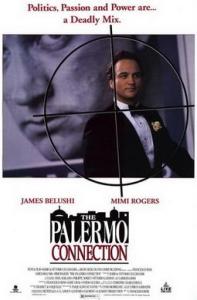 Carmine Bonavia (James Belushi) is an idealistic New York City councilman who wants to be mayor. Despite an easily understood slogan — “Make A Difference!” — his reform campaign is running behind in the polls. Having nothing to lose, Carmine announces that he supports the legalization of drugs. By taking out the profit motive, the Sicilian Mafia will no longer have any incentive to sell drugs in the inner city. Carmine shoots to top of the polls. Now leading by 11%, Carmine marries his campaign manager (Mimi Rogers) and returns to his ancestral home of Sicily for a combination honeymoon and fact-finding tour. The Mafia, realizing that Carmine is serious about legalizing drugs, conspires to frame him for the murder of a flower boy. If that doesn’t work, they are willing to resort to other, more permanent, methods to prevent Carmine from ever becoming mayor.
 Through the Shattered Lens