 The teens of Angel Beach, Florida are back! They’re still trying to get laid, they’re still playing pranks on each other, and, this time, they’re …. FIGHTING THE KLAN!?
Porky’s II continues with the first Porky’s mix of raunchiness and social commentary. While Pee Wee (Dan Monahan) tries to get back at his friends for spending the whole previous movie making fun of the size of his dick, the other members of the large ensemble cast thwart an attempt by the Klan to keep them from putting on a Shakespearean showcase. The Klan is upset that a Seminole has been cast as Romeo so they burn a cross and do everything they can to sabotage the production. Also trying to keep the show from going on is the hypocritical Rev. Bubba Flavel (Bill Wiley) and Mrs. Balbricker (Nancy Parsons), who both consider Shakespeare’s plays to be obscene. When Wendy (Kaki Hunter) discovers that one of the county commissioners has been lying about supporting the play, she humiliates him in public by pretending to vomit in a fountain and accusing him of impregnating her. It’s slightly funnier than it sounds but just slightly.
The first Porky’s took a stand against anti-Semitism while the second Porky’s takes a stand against censorship and the Klan. That’s actually pretty cool when you consider that both of these films are usually just thought of as being dumb sex comedies. Just like the first film, Porky’s II may be raunchy but it has a conscience. That was due to director Bob Clark, who obviously meant for the Porky’s films to be about more than just T&A.
Unfortunately, Porky’s II is never as funny as the first Porky’s. Too many of the jokes are recycled from the first film and the cast’s habit of laughing at their own “humorous” lines is even more grating the second time around. Even the film’s most famous scene, where Wendy humiliates the duplicitous commissioner, goes on for too long and doesn’t have as much of a payoff as it should. The best scenes in the film are the scenes that were lifted from Hamlet, Romero & Juliet, and A Midsummer Night’s Dream. You wouldn’t expect the ensemble of Porky’s to feature that many Shakespearean actors but apparently it did. Fans of A Christmas Story, which was also directed by Clark and which came out the same year as Porky’s II, will especially want to pay attention to the MacBeth sword fight scene just because the famous holiday leg lamp makes an appearance.
Porky’s II is nowhere near as good or memorable as the first Porky’s but its heart is in the right place. While not as big of a success as the first Porky’s, it still did well enough to lead to Porky’s III, which I’ll review tomorrow.
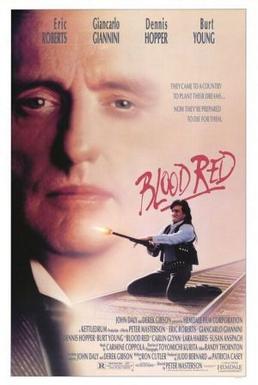 The time is the 1890s. The place is California. Sicilian immigrant Sebastian Collogero (Giancarlo Giannini) has just been sworn in as an American citizen and owns his own vineyard. When Irish immigrant William Bradford Berrigan (Dennis Hopper) demands that Sebastian give up his land so Berrigan run a railroad through it, Sebastian refuses. Berrigan hires a group of thugs led by Andrews (Burt Young) to make Sebastian see the error of his ways. When Sebastian ends up dead, his wayward son, Marco (Eric Roberts), takes up arms and seeks revenge.
 Through the Shattered Lens