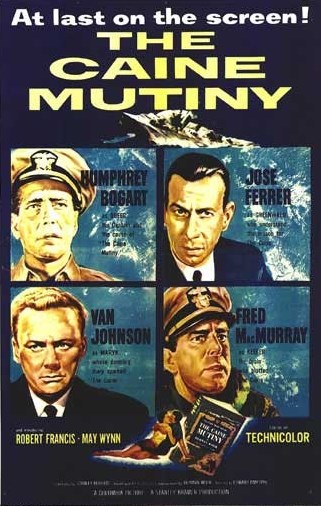
Lisa Reviews An Oscar Nominee: The Caine Mutiny (dir by Edward Dmytryk)


Mutiny_0

It’s the 1940s and World War II is raging.  The U.S. Navy is model of military discipline and efficiency.  Well, except for the U.S.S. Caine, that is.  The Caine is something of a disorganized mess, where no one takes his job seriously and sailors have names like Meatball (Lee Marvin) and Horrible (Claude Akins).  The men love Lt. Commander DeVriess (Tom Tully), largely because he has given up on trying to enforce any sort of discipline.  However, DeVriess has recently been relieved of his command.  As he leaves, Meatball gives him a new watch, a gift from all the men.  DeVriess admonishes them, snapping that the gift is violation of Naval regulations.  He then puts the watch on his wrist and leaves the ship.

DeVriess’s replacement is Captain Francis Queeg and, at first, we have reason to be hopeful because Captain Queeg is being played by Humphrey Bogart.  Surely, if anyone can get this ship into shape, it’ll be Humphrey Bogart!  From the moment he arrives, Queeg announces that he’s going to enforce discipline on the Caine and if that means spending hours yelling at a man for not having his shirt tucked in, that’s exactly what Queeg is prepared to do.  However, it also quickly becomes apparent that the awkward Queeg has no idea how to talk to people.  He is also overly sensitive and quick to take offense.  Whenever Queeg makes a mistake (and he does make a few), he’s quick to blame everyone else.
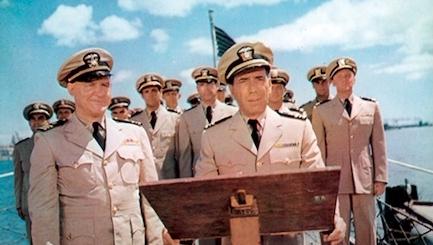
the-caine-mutiny-deck

Realizing that the men are turning against him, Queeg even begs his officers for their help.  He asks them if they have any suggestions.  They all sit silently, their heads bowed as Queeg somewhat poignantly rambles on about how his wife and his dog both like him but the crew of the Caine does not.

Queeg’s officers are a diverse bunch, none of whom are quite sure what to make of Queeg or the state of the Caine.  Ensign Willie Keith (Robert Francis) is a wealthy graduate of Princeton University who, at first, likes Queeg but quickly comes to doubt his abilities.  On the other hand, Lt. Steve Marsyk (Van Johnson) has doubts about Queeg from the start but, as a career Navy man, his natural instinct is to respect the chain of command above all else.

And then there’s Lt. Tom Keefer (Fred MacMurray).  Keefer is a self-styled intellectual, a novelist who is always quick with a snarky comment and a cynical observation.  (If The Caine Mutiny were remade as a B-horror film, Lt. Keefer’s name would probably be Lt. Sardonicus.)  From the minute the viewers meet Lt. Keefer, our inclination is to like him.  After all, he seems to be the only person in the film who has a sense of humor.  If we had to pick someone to have dinner with, most of us would definitely pick the erudite Tom Keefer over the humorless and socially awkward Francis Queeg.  As such, when Keefer starts to suggest that Queeg might be mentally unstable, our natural impulse is to agree with him.

It’s Tom Keefer who first suggests that it may be necessary to take the command away from Queeg.  And yet, when it comes time to take action, it’s Keith and Marsyk who do so while Keefer stands to the side and quietly watches.  And, once the Caine arrives back in the U.S., it Keith and Marsyk who are court martialed.  Will they be found guilty of treason or will their lawyer, Lt. Barney Greenwald (Jose Ferrer), prove that Queeg was unfit for command?
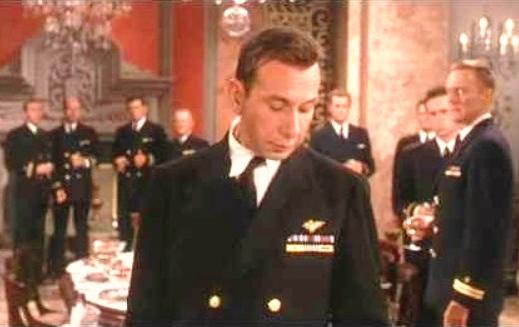
the-caine-mutiny-ferrer

Made in 1954 and based on a novel by Herman Wouk, The Caine Mutiny is one of those big and glossy 1950s productions that holds up a lot better than you might expect.  The film has its flaws.  In the role of Keith, Robert Francis is a bit on the dull side and a subplot in which he courts May Wynn feels unneccessary and only serves to distract from the main story.  But, for the most part, it’s an intelligent and well-directed film.  Humphrey Bogart turns Queeg into a pathetic and lonely figure and you can’t help but feel sorry for him when he talks about how his dog loves him.  Van Johnson also does well as Marsyk, effectively portraying a well-meaning character who is in over his head.  Jose Ferrer gets a great drunk scene at the end of the film and, of course, you can’t go wrong with Lee Marvin as a smirking sailor, even if Marvin only appears for a handful of minutes.
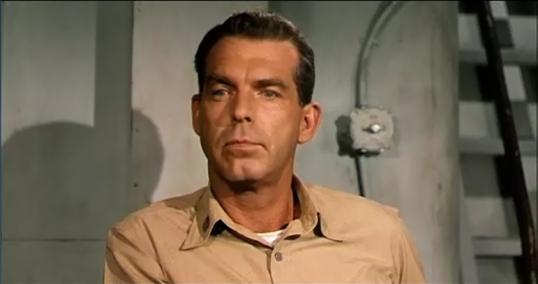
Fred MacMurray The Caine Mutiny

But for me, my favorite character (and performance) was Fred MacMurray’s Tom Keefer.  Technically, Keefer is not meant to be a likable character.  He’s totally passive aggressive.  He’s pretentious.  He’s smug.  At times, he’s rather cowardly.  And yet, Tom Keefer remains the most memorable and interesting character in the entire film.  He gets all of the good one-lines and MacMurray delivers them with just the right amount of barely concealed venom.  (“If only the strawberries were poisoned…” he says as he considers dinner aboard the Caine.)  It’s a great role and Fred MacMurray gives a great performance.  And you know what?  I don’t care how bad a character he may have been.  I still want to read Tom Keefer’s book!

The Caine Mutiny was nominated for best picture of 1954.  However, it lost to On The Waterfront.
Horror Film Review: Zoltan, Hound of Dracula (dir by Albert Band)


Were you aware that Dracula owned a dog?  And that dog was a vampire?  And that dog’s name was Zoltan?

It’s true!  Or, at least, it’s true according to a low-budget 1977 film called Zoltan, the Hound of Dracula.

Zoltan opens with a bunch of Russians unearthing an underground tomb that, we’re told, once housed Dracula.  Inside the tomb, they find two coffins.  One contains a man with a stake in his chest.  The other contains the body of a dog that has a stake in its chest.  Foolishly, the Russians remove the stakes and bring back to life both Zoltan and Veidt Smit (played by a very creepy-looking actor named Reggie Nalder, who also played the vampire in the made-for-tv adaptation of Stephen King’s Salem’s Lot).  Veidt is a former servant of Dracula who can walk around in the daylight.  As for Zoltan — well, he’s Dracula’s dog.  His eyes glow.  He has gigantic fangs.  He’s a vampire dog!

It turns out that, in order to survive, Veidt and Zoltan have to find the last human descendant of Dracula and turn him into a vampire.  So, Veidt and Zoltan had to Los Angeles and start to stalk family man Michael Drake (Michael Pataki).  Drake (and yes, his last name was shortened from Dracula) has little knowledge of his heritage.  Oddly enough, we’re told repeatedly that he’s the last member of the Dracula bloodline but he has two kids so it seems like they would actually be the last descendants of Dracula and…

Oh, who cares!?  Why are we worrying about logic when it comes to reviewing a film called Zoltan, the Hound of Dracula?

Michael and his family leave Los Angeles so that they can spend the weekend at a campground and, needless to say, they are followed by Zoltan and Veidt.  Soon, Zoltan is turning every other dog in California into a vampire and chasing Michael and his family.

Fortunately, a vampire hunter (played by Jose Ferrer) shows up and offers to help Michael survive.  But will his help be enough?

Okay, so Zoltan, the Hound of Dracula is technically a pretty bad film.  The budget is very low.  Director Albert Band doesn’t really bother much with things like subtext or suspense.  With the exception of the genuinely intimidating Reggie Nadler, the actors pretty much just go through the motions.  But, with all that in mind — how can you not love a film called Zoltan, the Hound of Dracula?  It’s fun because the film is just so ludicrous.  Criticizing a film like this for being bad ultimately feels like being way too much of a scold.

Add to that, there’s a vampire puppy!  And yes, he is just adorable!

I have to say that I am very disappointed that Zoltan did not make an appearance in last year’s Dracula Untold.  Hopefully, any future Dracula movies will make room for Zoltan. He may have been a vampire but seriously, Zoltan was a good dog!


http://www.youtube.com/watch?v=Hebcn3hD50M

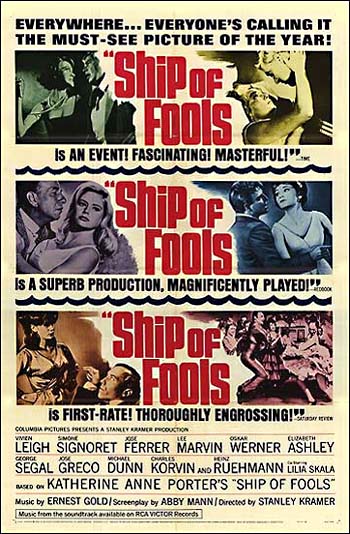
Embracing the Melodrama #20: Ship of Fools (dir by Stanley Kramer)


ship-of-fools-poster

The 1965 best picture nominee Ship of Fools follows a group of passengers as they take a cruise.  The year is 1933 and the luxury liner, which has just left Mexico, is heading for Nazi Germany.  Both the passengers and the crew represent a microcosm of a world that doesn’t realize it’s on the verge of war.

There’s Carl Glocken (played by Michael Dunn), a dwarf who has the ability to break the fourth wall and talk directly to the audience about all of the fools that have found themselves on this ship.  He alone seems to understand what the future holds.

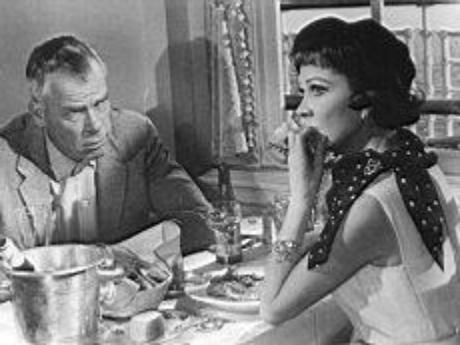
There’s Mary Treadwell (Vivien Leigh), an aging Southern belle who spends almost the entire cruise flirting with the crew and other passengers, desperate to recapture her fading youth.  That also seems to be the main goal of Bill Tenney (Lee Marvin), an unsophisticated former baseball player who spends most of the cruise brooding about his failed career.

There’s the Countess (Simone Signoret), a political prisoner who is being transported to an island prison.  She falls in love with the ship’s doctor (Oskar Werner).  The doctor’s dueling scar suggests that he is a member of the old aristocracy and he is literally the film’s only good German.  Perhaps not surprisingly, he is also in the process of dying from a heart condition.

And then there’s David (George Segal) and his girlfriend Jenny (Elizabeth Ashley).  David is a frustrated and depressed painter while Jenny is far more determined to enjoy life, which should be pretty easy because the boat is also full of performers and dancers.

Finally, there’s the buffoonish Rieber (Jose Ferrer), a German industrialist whose dinner table talk hints at the horrors that are soon to come.

Ship of Fools is a big, long film in which a large cast of stars deal with big issues in the safest way possible.  In short, it’s a Stanley Kramer film.  As one can tell from watching some of the other films that he directed (Judgment at Nuremberg, Guess Who’s Coming To Dinner, and R.P.M.), Stanley Kramer made films that were often easier to admire than to actually enjoy.  As the critic Mark Harris points out in his book Pictures At A Revolution, Kramer started out as a producer and he retained the sensibility of a producer even after he stared directing.  As such, his films would address issues that were certain to generate a lot of free publicity but, at the same time, he would never run the risk of alienating his audience by digging too deeply into those issues.  His films would have the type of all-star casts that would, again, bring in an audience but Kramer rarely seemed to give thought as to whether or not an all-star cast would distract from the film’s message.  Finally, unlike the truly great directors, Kramer never really figured out how to tell a story with images.  As a result, his movies were often full of characters whose sole purpose was to explain the film’s themes.

Does that mean that Stanley Kramer never made a good film?  No, not at all.  Judgment at Nuremberg remains powerful and R.P.M. is a guilty pleasure of mine.  Kramer was usually smart enough to work with talented professionals and, as a result, his films were rarely truly bad.  Some of them even have isolated moments of greatness.  It’s just that his films were rarely memorable and truly innovative and, therefore, they are easy for us to dismiss, especially when compared to some of the other films that were being made at the same time.

With all that in mind and for reasons both good and bad, Ship of Fools is perhaps the most Stanley-Kramerish of all the Stanley Kramer films that I’ve seen.  The film was apparently quite acclaimed and popular when it was originally released in 1965 but watched today, it’s an occasionally watchable relic of a bygone age.  How you react to Ship of Fools today will probably depend on whether or not you’re an admirer of any of the actors in large cast.  For the most part, all of them do a good job though you can tell that, as a director, Kramer struggled with how to make their multiple storylines flow naturally into an overall theme.  Not surprisingly, Vivien Leigh and Lee Marvin give the two most entertaining performances and Jose Ferrer makes for a wonderfully hissable villain.  Oddly enough, I find myself most responding to the characters played by George Segal and Elizabeth Ashley.  I’m not sure why — their storyline is rather predictable.  Maybe it was just because Elizabeth Ashley’s character goes wild and starts dancing at one point.  That’s what I would do if I found myself stuck on a boat with a tortured painted.

(What is especially interesting is that neither Oskar Werner or Simone Signoret are particularly memorable and yet they both received Oscar nominations.  Perhaps 1965 was a weak year for acting.)

In the end, Ship of Fools is a movie that will be best appreciated by those of us who enjoy watching old movies on TCM and take a special delight in spotting all of the wonderful actors that, though they may no longer be with us, have at least had their talent preserved on film.  Ship of Fools may not be a great film but it does feature Vivien Leigh doing an impromptu and joyful solo dance in a hallway and how can you not appreciate that?

ship-of-fools-1-1