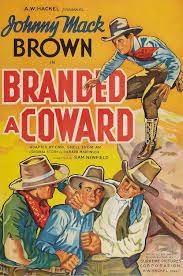
Branded A Coward (1935, directed by Sam Newfield)


When Johnny Hume was just a young boy, he witnessed his entire family being killed by a group of bandits led by the mysterious Cat.  Johnny grows up to be a trick-shot artist but, despite his skill with a gun, he can’t stand to point it at anyone or to be near any sort of gunfights.  When a fight breaks out in a saloon, he hides behind a bar and is labeled a coward.

Still, Johnny and his sidekick (Syd Saylor) somehow find the strength to run off a bunch of stagecoach robbers and save passenger Ethel Carson (Billie Seward).  Johnny is offered a chance to become the new town marshal.  Johnny, despite his fear of gunfights, accepts after he hears that the Cat is back in business.  Johnny wants revenge but the Cat turns out to be not who he was expecting.

Branded A Coward may be a zero-budget Poverty Row western but it’s actually has an interesting story and a good (if not entirely unexpected) twist towards the end.  Johnny Mack Brown was one of the better actors amongst the cowboys who starred in the westerns put out by PRC and directed by Sam Newfield.  Brown does a good job portraying Johnny’s fear and also his determination to get justice for his family.  Johnny proves he’s no coward but at what cost?

The plot here is a little darker than most of the westerns that were coming out at this time.  Every Poverty Row western featured a comic relief sidekick but this might be the only to feature the sidekick getting killed.  In the role of Oscar, Syd Saylor leaned very heavily on his fake stuttering shtick, to the extent that it actually got offensive.  I wasn’t sorry to see his character go.  Johnny Mack Brown didn’t need any help to get justice.

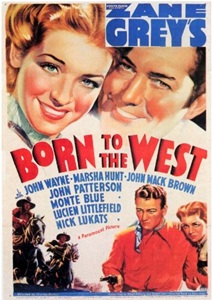
Born To The West (1937, directed by Charles Barton)


John Wayne plays Dare Rudd, a friendly rogue who aspires to be the best poker player west of the Mississippi.  When he and his sidekick, Dinkey Hooley (Syd Saylor), ride into Montana, they meet up with Dare’s cousin, Tom Filmore (Johnny Mack Brown, billed as John here).  Filmore needs some help on his cattle drive and Dare sure does like Tom’s girl, Judy (Marsha Hunt).  Dare replaces Lynn Hardy (John Patterson) as head of the cattle drive and Lynn teams up with rustler Bart Hammond (Monte Blue) to try to get revenge.  While Dinkey tries to sell lightning rods, Dare moves the herd and even finds time to play poker with notorious gambler Buck Brady (James Craig).

This is another one of the B-westerns that John Wayne made before John Ford made him a stars by casting him in Stagecoach.  This one is interesting because Wayne is not playing his usual stolid do-gooder or even an expert marksman.  Instead, Dare is impulsive and reckless and he’s ultimately not as smart a card player as he thinks he is.  It’s rare to see John Wayne need help from anyone but that’s what he gets from Johnny Mack Brown, who shows up in time to reveal that Dare is getting cheated in his poker game.  For fans of the genre, this short oater is worth watching for the chance to see two western icons acting opposite each other.  Johnny Mack Brown and John Wayne would both go on to appear in a countless number of westerns.  Wayne became a superstar, appearing in big budget studio films.  Brown remained a mainstay on the B-circuit.  They’re amusing to watch in this film as they bounce dialogue off of each other and continually try to steal scenes from one another.  Brown is playing the type of no-nonsense, hard-working westerner who would later become John Wayne’s trademark character.

Based on a novel by Zane Grey, Born to the West is a fast-paced western featuring two of the best to ever ride a horse.

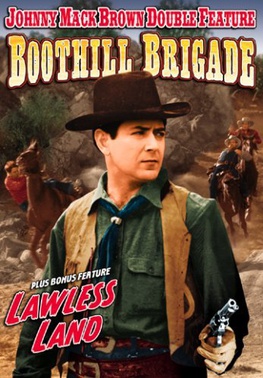
Boothill Brigade (1937, directed by Sam Newfield)


Rancher Jeff Reynolds (Frank LaRue) used to be one of the good guys on the frontier but he’s recently changed.  He fired all of his loyal ranch hands and instead hired a motely crew of outlaws.  He’s buying up land and evicting the squatters who have been living there.  About the only good thing he does is hire Lon Cardigan (Johnny Mack Brown) to be his new herd boss.  Lon is engaged to Reynolds’s daughter, Bobbie (Claire Rochelle).  With the help of Bobbie and comic relief cook Calico Haynes (Horace Murphy), Lon tries to figure out why Reynolds is now doing the bidding of the evil John Porter (Ed Cassidy).

The title is the most exciting thing about this movie, which is one of those old B-movies that puts the “creak” in creaky.  There’s surprisingly little gunplay but there is a lot of horse riding.  For a film that runs less than an hour, a surprising amount of it is just shots of people riding from one location to another.  The horses’ hooves sound impressive on the soundtrack but it’s not exactly exciting.  As always, Johnny Mack Brown is a convincing cowboy.  It’s a good thing he looks like he knows what he’s doing when he’s riding a horse!  The plot was standard B-western fluff.  Johnny Mack Brown appeared in a ton of westerns and almost all of them seemed to feature the same range war.  There are better Johnny Mack Brown movies out there.  This one is for completists only.

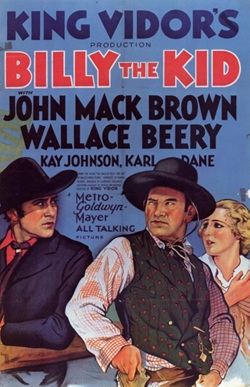
Billy The Kid (1930, directed by King Vidor)


In a frontier town, land baron William P. Donavon (James A. Marcus) finds his control challenged by the arrival of a English cattleman named John W. Tunston (Wyndham Standing).  Donavon orders his henchmen to gun down Tunston on the same day that Tunston was to marry the lovely Claire (Kay Johnson).  Tunston’s employee, an earnest young man named Billy The Kid (Johnny Mack Brown), sets out to avenge Tunston’s murder.  When Billy starts killing Donavon’s henchmen, it falls to Deputy Sheriff Pat Garrett (Wallace Beery) to arrest him.  When Billy escape from jail and rides off to be with Claire, Garrett pursues him.  Garrett is a friend of Billy’s and he knows that Billy’s killings were justified.  But he’s also a man of the law.  Will he be able to arrest or, if he has to be, even kill Billy?  Or will Garrett let his friend escape?

There were two silent biopics made about Billy the Kid but neither of them are around anymore.  This sound movie, directed by King Vidor, appears to the earliest surviving Billy the Kid film.  It’s a loose retelling of Billy’s life and his friendship with Pat Garrett and it doesn’t bother with sticking close to the established facts but that’s to be expected.  It’s an early sound film and, seen today, the action and some of the acting feels creaky.  Wallace Beery was miscast as Pat Garrett but I did like Johnny Mack Brown’s performance as the callow Billy.  The movie goes out of its way to justify Billy’s murders and it helps that Billy is played by the fresh-faced Brown.  King Vidor shows a good eye for western landscapes, a skill that would come in handy when he directed Duel In The Sun seventeen years later.

There are better westerns but, for fans of the genre, this film is important as the earliest surviving film  about one of the most iconic outlaws not named Jesse James.  It’s interesting to see Brown, usually cast as the clean-cut hero, playing a killer here.  The film’s ending is pure fantasy but I bet audiences loved it.

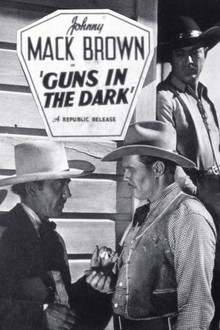
Guns In The Dark (1937, directed by Sam Newfield)


In Mexico, two American cowboys, Johnny Darrel (Johnny Mack Brown) and Dick Martin (Julian Madison) join a poker game to try to win some money and help out their buddy, Oscar (Sid Saylor).  When they discover that cantina owner Manuel Mendez (Ted Adams) has rigged the game, a fight breaks out.  The lights turn off.  In the darkness, several guns are fired.  When the lights come back up, Dick is dead.  Mendez convinces Johnny that he accidentally shot his friend in the fight.  Guilt-stricken, Johnny tosses aside his guns and returns to Texas.

Johnny has sworn that he will never shoot another gun but when he’s hired to work at a ranch owned by Joan Williams (Claire Rochelle), he finds himself in the middle of a range war between Joan and Brace Stevens (Dick Curtis), with Mendez also making an unwelcome return to Johnny’s life.  Even after Johnny discovers the truth about what happened that night at the cantina, he doesn’t pick up a gun.  Instead, Johnny fights the bad guys with lassos and plates.

Guns In The Dark is only 54 minutes long and it features actors who will be familiar to any fan of the old B-westerns.  Sidekcick Sid Saylor’s stuttering schtick gets old quickly but Johnny Mack Brown is as likable as always in Guns In The Dark and he comes across as being an authentic cowboy even when he’s not carrying a gun  Given that this film features even more horse chases than the typical Johnny Mack Brown b-western, it’s good that Brown is so convincing.  What isn’t convincing is how stupid Johnny Darrel is required to be in order for him to fall for Mendez’s lie in the first place.  I appreciated the change of pace from Brown just using a gun to stop the bad guys but I wish the reason behind it had been more convincing.  This isn’t one of Johnny Mack Brown’s more memorable westerns though, as always, it’s easy to see why he was one of the early stars of the genre.


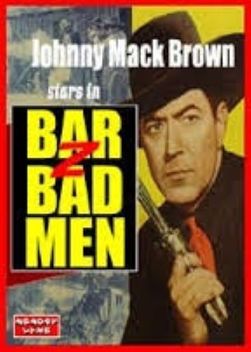
Bar-Z Bad Men (1937, directed by Sam Newfield)


After getting kicked out of town for shooting the place up during a night of friendly fun, cowboy Jim Waters (Johnny Mack Brown) drops in on his old friend, rancher Ed Parks (Jack Rothwell).  Ed has got a strange problem.  There are cattle rustlers about but instead of stealing Ed’s cattle, they’re adding cattle to Ed’s herd.  It’s an obvious scheme to try to create a feud between Ed and his neighbor, rancher Hamp Harvey (Frank LaRue).  Before Jim and Ed can solve the problem, Ed is gunned down.  Harvey is the number one suspect but Jim figures out the truth, that Harvey has been betrayed by one of his own employees and that all of this is a part of a scheme by Sig Bostell (Tom London) to take control of both ranches.

Bar-Z Bad Man is a B-western with a notably twisty plot as Bostell plays both sides against each other for his own benefit.  As usual, Johnny Mack Brown makes for a good and convincing western hero.  Whether he’s chasing someone on his horse or drawing his guns, Brown is always a convincing cowboy.  What makes this film interesting is that it opens with Johnny Mack Brown engaging in the type of behavior that most B-western heroes would never think of doing.  Shooting up the town and then getting exiled for his actions adds an element of redemption to Jim’s efforts to get to the bottom of Bostell’s schemes.  Or it would if Jim ever really seemed to feel bad about shooting the town up.  His excuse is that he was just having a good time.  Try to get away with that in the real old west, Jim!

Bar-Z Bad Men is a good B-western for those who like the genre.  The story is solid and Johnny Mack Brown is as convincing saving the west as he was shooting it up.


Chip of the Flying U (1939, directed by Ralph Staub)


In this B-western, Johnny Mack Brown plays Chip Bennett, the foreman of the Flying U Ranch.  The ranch is owned by J.G. Whitmore (Forrest Taylor) and his daughter (Doris Weston), who has just returned from college and who has eyes for Dusty (Bob Baker), a singing ranchhand.

Ed Duncan (Anthony Warde) and his gang are in the arms smuggling business.  To make their business a success, they need access to the ranch, which sits on the shore of a lake.  Knowing that Chip would never let them take over, Duncan tries to frame Chip for a bank robbery and murder.  Chip responds by kidnapping two of Duncan’s men, leading to a final and explosive shootout.

Chip of the Flying U is a western that doesn’t seem to know what era it’s supposed to be taking place in.  Chip, Duncan, and all of the other ranch hands dress like they’re in the late 1800s.  Doris Weston dresses like she’s just stepped out of a 1930s photoshoot.  Duncan is trying to smuggle hand grenades, which were invented in 1908 but not commonly used until World War I.  The movie’s time period is all over the place but that was frequently the case with the B-westerns of the 30s.  Shot on studio backlots and for a very low budget, these films were not concerned with historical accuracy.  Instead, they were about shootouts and a few songs.  Chip of the Flying U offers up both, along with Fuzzy Knight as the comedic sidekick who turns out to be very good with a rifle.

With lots of horse chases and bloodless shoot-outs and not too much romance, this movie may seem creaky by today’s standards but probably thrilled the kids who caught while spending an afternoon at the movies in 1939.  Today, the appeal of movies like this is that the good guys are unquestionably good and the bad guys are unquestionably bad.  They remind us of a simpler time that may have never existed but we all hope it did.

Pre Code Confidential #6: Jean Harlow in THE SECRET SIX (MGM 1931)


gary loggins's avatarcracked rear viewer

six1

(Once again, your Cracked Rear Viewer is taking part in the TCM Summer Under The Stars Blogathon, hosted by Kristen at Journeys in Classic Film. Just like last year, I’ll be posting on two stars of Hollywood’s Golden Age: Jean Harlow (8/7) and Boris Karloff (8/26).)

Before she became The Platinum Blonde Bombshell of 1930’s Hollywood, Jean Harlow played a pivotal role in early gangster films. She was James Cagney’s second moll in the essential THE PUBLIC ENEMY, and a slutty seductress in THE BEAST OF THE CITY. In THE SECRET SIX, Jean plays a temptress who turns on the mob in a wild Pre-Code film that represents another milestone for Miss Harlow: it’s her first of six with costar Clark Gable.

THE SECRET SIX [US 1931] WALLACE BEERY, JOHNNY MACK BROWN, JEAN HARLOW

Wallace Beery plays Slaughterhouse Scorpio, who rises from the stockyards to the top of the gangster heap. He accomplishes this by brute force, bribery, and rubbing out his…

View original post 508 more words