Tell ’em, Johnny!
Johnny Cash got it.
Tell ’em, Johnny!
Johnny Cash got it.
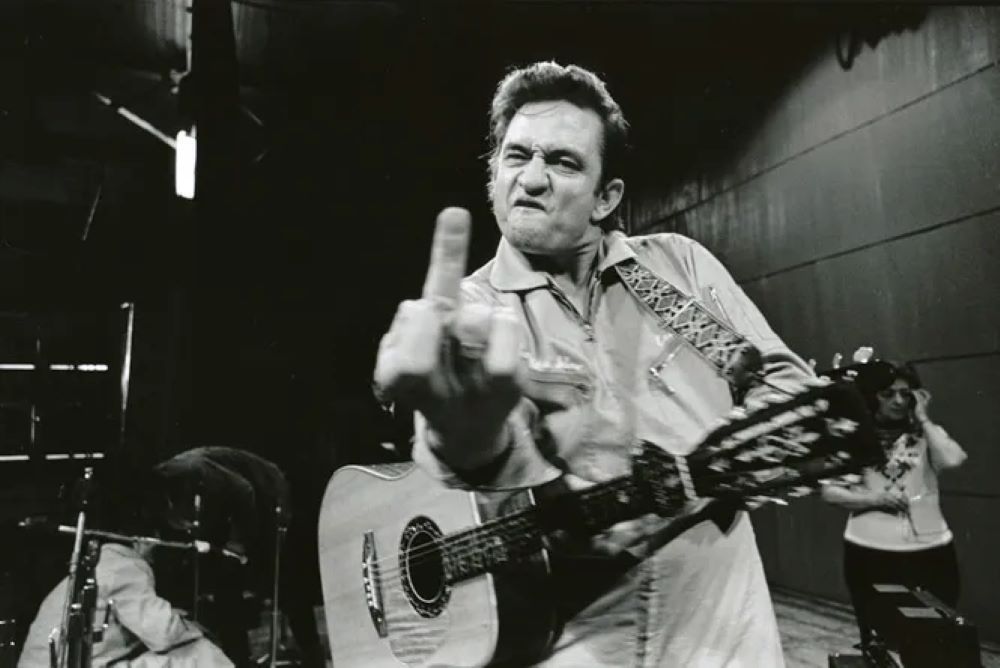
Today would have been Johnny Cash’s birthday so here’s a wholesome song and video from the Man in Black.
Enjoy!
Johnny Cash’s “Cocaine Blues” rolling over Lucy gleefully mowing down the ghoul Elvis-faction is one of those perfectly twisted Fallout moments — absurd, violent, and darkly funny. The song’s tale of a killer singing about his own crimes while Lucy grins through the carnage gives the whole scene a warped playfulness. Cash’s deliberate rhythm, all swagger and doom, turns what could’ve been grim into something closer to a dance — a gunslinging ballet where the wasteland’s chaos feels almost celebratory. That contrast is what makes it pop.
In that moment, “Cocaine Blues” becomes more than just needle-drop nostalgia; it’s commentary on Lucy’s transformation. She’s still got that vault-born cheer in her step, but now there’s something unhinged behind it — she’s caught up in the thrill. The imagery of her gunning down rhinestoned ghouls to Cash’s steady beat blurs innocence and indulgence — she’s no longer reacting to the brutality around her, she’s participating in it with genuine abandon. The song’s tale of killing and comeuppance hangs over her like prophecy, reminding us that even the brightest smile in the wasteland can cast a long shadow.
As the gunfire fades and Cash’s voice trails off, the irony hangs in the dust. Fallout has always thrived on these juxtapositions — the sunny Americana soundtrack to utter moral decay. “Cocaine Blues” leaves the scene pulsing with contradictions: joy and violence, freedom and madness, music and mayhem. It’s the sound of Lucy crossing another invisible line while smiling all the way through it, and Cash is there to make sure we don’t miss the joke.
Cocaine Blues
Early one mornin’ while makin’ the rounds
Took a shot of cocaine and I shot my woman down
Went right home and I went to bed
I stuck that lovin’ 44 beneath my head
Got up next mornin’ and I grabbed that gun
Took a shot of cocaine and away I run
Made a good run, but ran too slow
They overtook me down in Juarez, Mexico
Laid in the hot joints takin’ the pill
In walked the sheriff from Jericho Hill
He said, “Willy Lee, your name is not Jack Brown
You’re the dirty hop that shot your woman down”
Said, “Yes, sir, yes, my name is Willy Lee
If you’ve got a warrant, just read it to me
Shot her down because she made me sore
I thought I was her daddy, but she had five more”
When I was arrested, I was dressed in black
They put me on a train and it took me back
Had no friends for to go my bail
They slapped my dried up carcass in that county jail
Got up next mornin’ ’bout a half past nine
Spied the sheriff coming down the line
Hopped and he coughed as he cleared his throat
He said, “Come on you dirty hop into that district court”
Into the courtroom, my trial began
Where I was handled by 12 honest men
Just before the jury started out
I saw that little judge commence to look about
In about five minutes in walked the man
Holding the verdict in his right hand
The verdict read in the first degree
I hollered, “Lordy, Lordy, have mercy on me”
The judge he smiled as he picked up his pen
99 years in the Folsom pen’
99 years underneath that ground
I can’t forget the day I shot that bad bitch down
Come on you hops and listen unto me
Lay off that whiskey and let that cocaine be

In 1948, one of the richest men in Georgia committed a murder.
John Wallace was a landowner, back when that title actually meant something. He was known as the boss of Meriweather County. Everyone in the county seemed to work for Wallace in one way or another. He controlled the county officials. The sheriff enforced the law only as far as John Wallace would allow him. The bootleggers had to pay Wallace for protection. When one bootlegger, a sharecropper named Wilson Turner, failed to do so, he was fired and kicked off of Wallace’s land.
Turner retaliated by stealing two of Wallace’s cows.
Wallace responded by murdering Turner.
Because Turner attempted to flee and Wallace chased after him, Wallace committed the murder not in Meriweather County but in neighboring Coweta County. What Wallace didn’t realize was that this meant the investigation didn’t fall under the jurisdiction of his hand-picked sheriff. Instead, Sheriff Lamar Potts of Coweta County headed up the investigation. John Wallace was eventually arrested by Sheriff Potts and he was eventually convicted of murdering Wilson Turner. At the time, the case drew a lot of attention both because of Wallace’s wealth but also because two of the main witnesses for the prosecution were the two black men who Wallace forced to help him dispose of Wallace’s body.
It’s an interesting story, largely because the history of America is full of men like John Wallace, people who set up their own little dictatorships. It’s often portrayed as being a Southern phenomena but John Wallace really wasn’t that much different from the crude political bosses who, for decades, dominated politics in city like New York and Chicago, the type who held onto power through a combination of intimidation and patronage. In my home state of Texas, George Berham Parr inherited the political machine that controlled Duval and Jim Wells County. Parr committed numerous crimes during his time as the “Duke of Duval” but he had important friends. He was the one who “found” the votes necessary for Lyndon Johnson to win a senate seat in 1948. (In return, Johnson got Harry Truman to pardon Parr for failing to pay his taxes.) Parr is also suspected of having been involved in at least one murder but it wasn’t until LBJ himself retired from politics that anyone truly investigated Parr’s activities. In 1974, he was again convicted of failing to pay his taxes and Parr was later found dead at his ranch. Suicide was the official police ruling.
As for the story of John Wallace, it was turned into a made-for-TV movie in 1983. Murder in Coweta County stars Andy Griffith as John Wallace and Johnny Cash as Sheriff Potts. Griffith, playing a soulless villain, is chilling as John Wallace. Wallace is all-smiles and good ol’ boy charisma whenever there’s a crowd around but, once it’s just him and his cronies, a different side comes out. Wallace thinks that he can get away with murder because he’s been able to get away with everything else. Sheriff Potts is determined to see that justice is done. Murder in Coweta County is an atmospheric Southern crime story, one that is so full of atmosphere that you can feel the humidity. While Johnny Cash was definitely a better singer than an actor, Andy Griffith’s villainous turn makes the film worth watching.
“I thank God for all the freedom we have in this country, I cherish them and treasure them – even the right to burn the flag. We also got the right to bear arms and if you burn my flag – I’ll shoot you. But I’ll shoot you with a lot of love, like a good American.”
— Johnny Cash
I walked through a county courthouse square
On a park bench an old man was sitting there
I said, your old courthouse is kinda run down
He said, naw, it’ll do for our little town
I said, your old flagpole has leaned a little bit
And that’s a ragged old flag you got hanging on it
He said, have a seat, and I sat down
Is this the first time you’ve been to our little town?
I said, I think it is
He said, I don’t like to brag
But we’re kinda proud of that ragged old flag
You see, we got a little hole in that flag there when
Washington took it across the Delaware
And it got powder-burned the night Francis Scott Key
Sat watching it writing say can you see
And it got a bad rip in New Orleans
With Packingham and Jackson tuggin’ at its seams
And it almost fell at the Alamo
Beside the Texas flag, but she waved on though
She got cut with a sword at Chancellorsville
And she got cut again at Shiloh Hill
There was Robert E. Lee, Beauregard, and Bragg
And the south wind blew hard on that ragged old flag
On Flanders field in World War one
She got a big hole from a Bertha gun
She turned blood red in World War Two
She hung limp and low a time or two
She was in Korea and Vietnam
She went where she was sent by Uncle Sam
She waved from our ships upon the Briny foam
And now they’ve about quit waving her back here at home
In her own good land here she’s been abused
She’s been burned, dishonored, denied, and refused
And the government for which she stands
Is scandalized throughout the land
And she’s getting threadbare and wearing thin
But she’s in good shape for the shape she’s in
‘Cause she’s been through the fire before
And I believe she can take a whole lot more
So we raise her up every morning
We take her down every night
We don’t let her touch the ground and we fold her up right
On second thought, I do like to brag
‘Cause I’m mighty proud of that ragged old flag
Arkansas’s own Johnny Cash would have been 93 years old today so it seems appropriate that his voice should also be featured in our song of the day. Here is Folsom Prison Blues, a song that Johnny actually sang while performing at the prison for people who very may have shot a man in Reno just to watch him die.
Really, that’s what makes Johnny Cash such an American icon. On the one hand, he was a religious country boy who wrote songs about his spiritual troubles and his everlasting faith. On the other, he could make you cheer at the idea of shooting a man in Reno just to watch him die.
That’s talent.
I hear the train a comin’
It’s rolling round the bend
And I ain’t seen the sunshine since I don’t know when
I’m stuck in Folsom prison, and time keeps draggin’ on
But that train keeps a rollin’ on down to San Antone
When I was just a baby my mama told me
“Son, always be a good boy, don’t ever play with guns”
But I shot a man in Reno just to watch him die
When I hear that whistle blowing, I hang my head and cry
I bet there’s rich folks eating in a fancy dining car
They’re probably drinkin’ coffee and smoking big cigars
Well I know I had it coming, I know I can’t be free
But those people keep a movin’
And that’s what tortures me
Well if they freed me from this prison
If that railroad train was mine
I bet I’d move it on a little farther down the line
Far from Folsom prison, that’s where I want to stay
And I’d let that lonesome whistle blow my blues away
I meant to share this yesterday for Johnny Cash’s birthday but I was pretty tired when we got home from the lake and I missed my chance to do so. But the voice of Johnny Cash was so strong that it can justify a song of the day even after his birthday.
So, with a belated happy birthday to the spirit of Johnny Cash, here is today’s song of the day!
Tell ’em, Johnny!
Today is Tax Day, the worst day of the year. This when we’re all told to pay our “fair share.” Of course, no one bothered to ask us what that fair share should be. Instead, as citizens, we’re expected to do what we’re told and not to question why.
Anyway, Johnny Cash got it.
Enjoy!
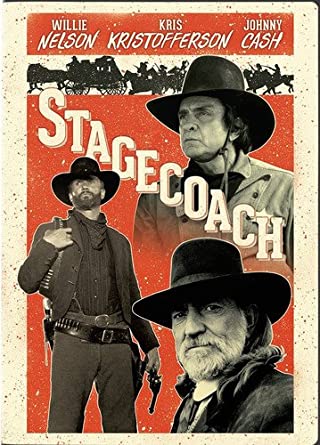 The year is 1880 and Geronimo and his Apaches are on a warpath against the people who have taken their land. Despite the warnings of the local Calvary officers, one stagecoach tries to make the long journey from Arizona to New Mexico. The seven passengers may start out as strangers but they’re going to have to work together to survive the journey. The most famous passenger is dentist-turned-gunslinger Doc Holliday (Willie Nelson). The most infamous is the Ringo Kid (Kris Kristofferson), an outlaw who has recently escaped from prison and who is looking for revenge against the men who framed him for a crime that he didn’t commit. Henry Gatewood (Anthony Fraciosa) is a banker who has embezzled money and is looking to make a quick escape. Foppish Trevor Peacock (Anthony Newley) sells liquor. Dallas (Elizabeth Ashley) is a former prostitute looking to start a new life. Mrs. Mallory (Mary Crosby) is nine months pregnant and traveling to reunite with her husband, an officer in the Calvary. Finally, Hatfield (Waylon Jennings) is a chivalrous gambler. Riding atop the stagecoach is Buck (John Schneider), who gets paid 8 dollars a month to risk his life taking people through Apache country, and Curly (Johnny Cash), the tough-but-fair town marshal who plans to arrest the Ringo Kid as soon as they reach civilization.
Made for television, Stagecoch is an adequate remake of the John Ford classic. The story remains basically the same, with the main difference being that the majority of the characters are now played by country-western singers who are a few years too old for their roles. Doc Holliday, who died of “consumption” when he was in his 30s, is played by Willie Nelson, who doesn’t look a day under 70. The Ringo Kid is played by Kris Kristofferson, who, despite having literally played Billy the Kid a decade earlier, still doesn’t look like he’s ever been called a “kid” at any point in his life. Compared to their original counterparts, the remake’s characters have been slightly tweaked so that they fit with the outlaw country images of the singers playing them. Doc Holliday sympathizes with Geronimo and says that his use of whiskey is “medicinal.” Kristofferson’s Ringo Kid is more openly contemptuous of authority than John Wayne’s. Waylon Jennings is less of a cynic in the role of Hatfield than John Carradine was and Johnny Cash sits atop the stagecoach like a man on a holy mission.
The cast is the main reason to watch this version of Stagecoach. The film can’t match the original but Nelson, Kristofferson, Jennings, and Cash obviously enjoyed playing opposite each other and, even if Nelson and Kristofferson are miscast, all of them bring some needed country-western authenticity to their roles. As for the non-singers, Mary Crosby, Elizabeth Ashley, and John Schneider all make the best impressions while both Franciosa and Newley seem too 20th Century for their western roles. Director Ted Post does a good job with the action scenes and keeps the story moving, even if the remake’s status as a TV production keeps him from capturing visual grandeur of Ford’s original. Stagecoach is a respectful remake of a classic, one that can be appreciated when western fans on its own merits.
One thing that I discovered this weekend is that there aren’t many good Easter songs out there. There’s even less good Easter music videos. I searched far and wide and most of the ones I found were either off the soundtrack of God’s Not Dead and from a Kirk Cameron film. I don’t think even the most religious of our readers want that.
So, I went with this song and video from Johnny Cash. Goin’ By The Book starts with a litany of bad things: pollution, riots, war, civil unrest. Cash goes on to sing that it’s all going to lead to the events discussed in the book of Revelations. Interestingly enough, it sounds like Cash could be describing all of the problems of the world today but this song was actually recorded 32 years ago, showing I guess that there have always been problems and people have always seen them as being evidence of the end times.
I’m not really a fan of most Christian music but Johnny Cash is the exception.
Enjoy!
 Through the Shattered Lens