Scenes I Love: “Look at Us!” from Ladyhawke


I love Richard Donner’s Ladyhawke . In the following scene, our hero Navarre (Rutger Hauer) has stormed a church, looking to reach the wicked Bishop (played by Wargames‘ John Wood). It’s in an effort to force the Bishop to break the curse that turns Navarre into a wolf by night and his love, Isabeau (Michelle Pfeiffer) into a Hawk by day. He’s reached the Bishop, but believes that Isabeau is surely gone, having asked a old friend to take her life should Navarre fail. I chose this part partially because I love the look on Navarre’s face on hearing Isabeau’s voice. He looks at her almost as if he’s seen her for the first time. He’s just so entranced, but then he quickly remembers what he needs to do, and his voice booms through the church. I wish this video wasn’t cut as short as it is.

Enjoy!

#SundayShorts with LADYHAWKE (1985)


Since Sunday is a day of rest for a lot of people, I present #SundayShorts, a weekly mini review of a movie I’ve recently watched. This week I got carried aways so it’s #SundayNotSoShorts!

We meet petty thief Gaston “The Mouse” Gaston (Matthew Broderick) as he’s finding a way to escape from the horrific dungeons of the medieval city of Aquila. Being the only person to ever escape the prison, the evil Bishop of Aquila (John Wood) orders his soldiers to find Gaston and kill him. When it appears that he’s about to be recaptured and killed, Captain Etienne Navarre (Rutger Hauer) appears and rescues him. Navarre, who’s accompanied by a hawk, forces Gaston to go with him where they seek lodging in the barn of a local farmer. That night while Gaston is out gathering wood, the duplicitous farmer attempts to kill him, but he is saved again, this time by a large black wolf. Freaked out by this seemingly random event, Gaston runs back to the barn and finds a young lady named Isabeau (Michelle Pfeiffer), but no sign of Captain Navarre. Isabeau isn’t surprised about the events that Gaston describes to her. As a matter of fact, he sees the wolf join Isabeau in the yard as she’s taking a leisurely stroll that evening. The next morning, Navarre has returned and tells Gaston that he needs his help to complete his plan to kill the Bishop. Not wanting to get involved, Gaston escapes that night and is immediately captured again by the Bishop’s soldiers. Saving Gaston a second time doesn’t go well for Navarre, when both he and the hawk are shot with arrows by the soldiers prior to dispensing of them. An injured Navarre forces Gaston to take his horse and deliver the injured hawk to a monk named Imperius (Leo McKern) who resides in a ruined castle in the area. At the castle that night, Gaston sees Isabeau with an arrow in her shoulder. Imperius tells him of a satanic curse that has been placed on husband and wife, Navarre and Isabeau, by the evil Bishop because she spurned his advances. The curse dooms them to always being together, yet eternally apart. Thus, by day Isabeau is a hawk, and by night Navarre is a wolf. After learning this, Gaston is now ready to help Navarre in his plan. Is there any way to reverse the curse, or is vengeance against the Bishop the best thing that can be hoped for? You’ll just have to watch and see!

LADYHAWKE is a film that checks quite a few boxes. It has some good action scenes. Rutger Hauer makes for a strong hero who can handle his fists and his swords in numerous fight scenes, and he looks damn awesome astride his beautiful horse! It also has some good comedy, which is mostly provided by Matthew Broderick. His petty thief has a running commentary where he talks to God anytime that he’s alone and needing help. He has this way of making promises, while also hedging his bets, so he doesn’t box himself in with promises that he has no chance to keep. I recognized myself in those conversations. The film has an air of magic and romance. Rutger Hauer and Michelle Pfeiffer are a beautiful couple. The idea that they are lovers caught up in a curse, but who still love and care for each other every day is hard to resist. This desire to see them break that curse is what gives me a real rooting interest in the outcome. The film is a story of redemption for the monk Imperius whose drunken betrayal helped put the two lovers in this position. And it’s a story of good trying to triumph over evil, with evil being vividly portrayed in the character of the Bishop. Leo McKern and John Wood embody the characters of Imperius and the Bishop perfectly. Director Richard Donner handles all of these different facets in a fun and entertaining way. I think LADYHAWKE still holds up well as a nice piece of 80’s entertainment!  

Five Fast Facts:

  1. Spike II, the hawk featured in this movie, worked in the Universal Bird Show until 2000, when she was transfered to the National Audubon society and became an Audubon Ambassador until she died in May 2007.
  2. If you needed proof that celebrities aren’t like the rest of us, three of the castles used for this movie were owned by Italian movie director Luchino Visconti and his family.
  3. Producer and director Richard Donner originally cast Kurt Russell as Navarre. When Russell dropped out a few days before principal photography began, the part was handed to Rutger Hauer.
  4. When Matthew Broderick’s character Gaston is escaping the dungeon at the beginning of the film, you can hear someone say ‘cut’ just before Phillipe says, “It’s not unlike escaping Mother’s womb.”
  5. As enjoyable as the film is, LADYHAWKE was a disappointment at the box office. It grossed a little over $18 million on a budget of $20 million, ranking 48th in the North American box office for 1985.

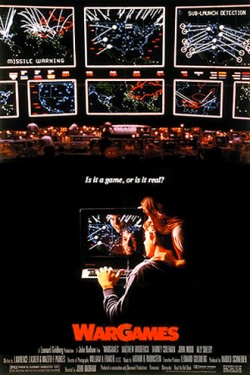
Film Review: Wargames (dir by John Badham)


If you thought Tom Cruise nearly started a war in Top Gun, you should see what Matthew Broderick did three years earlier in Wargames!

In Wargames, Broderick plays David Lighter, a dorky but likable teenager who loves to play video games and who spends his spare time hacking into other computer systems.  (Of course, since this movie was made in 1983, all the computers are these gigantic, boxy monstrosities.)  Sometimes, he puts his skills to good use.  For instance, when both he and Jennifer (Ally Sheedy) are running the risk of failing their biology class, he hacks into the school and changes their grades.  (At first, Jennifer demands that he change her grade back but then, a day later, she asks him to change it again.  It’s kind of a sweet moment and it’s also probably the way I would have reacted if someone had done that for me in high school.)  Sometime, David’s skills get him into trouble.  For instance, he nearly destroys the world.

Now, keep in mind, David really didn’t know what he was doing.  He was just looking for games to play online.  He didn’t realize that he had hacked into NORAD and that Global Thermonuclear War was actually a program set up to allow a gigantic computer named WOPR to figure out how to properly wage a thermonuclear war.  David also doesn’t know that, because humans have proven themselves to be too hesitant to launch nuclear missiles, WOPR has, more or less, been given complete control over America’s nuclear arsenal.

(Wargames actually starts out with a chilling little mini-movie, in which John Spencer and Michael Madsen play two missile technicians who go from joking around to pulling guns on each other during a drill.  Of course, Madsen’s the one ready to destroy the world.)

Of course, the military folks at NORAD freak out when it suddenly appears as if the Russians have launched a nuclear strike against Las Vegas and Seattle.  (Not Vegas!  Though really, who could blame anyone for wanting to nuke Seattle?)  In fact, the only thing that prevents them from launching a retaliatory strike is David’s father demanding that David turn off his computer and take out the trash.  However, WOPR is determined to play through its simulation, which pushes the world closer and closer to war.  (One of the more clever — and disturbing — aspects of the film is that, even after the military learns that the Russians aren’t planning the attack them, they still can’t go off alert because the Russians themselves are now on alert.   Once the war starts, it can’t be stopped even if everyone knows that the whole thing was the result of a mistake.)

With the FBI looking for him, David tries to track down the man who created WOPR, Dr. Stephen Falken (John Wood).  However, Falken is not easy to find and not as enthusiastic about saving the world as one might hope….

Watching Wargames was an interesting experience.  On the one hand, it’s definitely a dated film.  (Again, just look at the computers.)  At the same time, its story still feels relevant.  In Wargames, the problem really isn’t that WOPR wants to play a game.  It’s that men like Dr. John McKittrick (well-played by Dabney Coleman) have attempted to remove the human element and have instead put all of their faith in machines.  The appeal of a machine like WOPR is that it has no self-doubt and does whatever needs to be done without worrying about the cost.  But that’s also the reason why human beings are necessary because the world cannot be run on just algorithms and cold logic.  That’s a theme that’s probably even more relevant today than it was in 1983.

Wargames is also an exceptionally likable film.  In fact, it’s probably about as likable as any film about nuclear war could be.  On the one hand, you’ve got everyone at NORAD panicking about incoming missiles and then, on the other hand, you’ve got David and Jennifer having fun on his computer and trading flirty and silly quips.  Matthew Broderick and Ally Sheedy are both likable in the two main roles.  Broderick brings a lot of vulnerability to the role of David.  (David Lightner is a far more believable teenager than Ferris Bueller.)  He handles the comedic scenes well but he’s even better as David grows increasingly desperate in his attempts to get the stubborn adults around him to actually listen to what he has to say.  When it appears the only way to save the world is to swim across a bay, David is forced to admit that he’s never learned how to swim because he always figured there would be time in the future.  Yes, it’s a funny scene but the way Broderick delivers the line, you understand that David has finally figured out that there’s probably not going to be a future.  It’s not that he doesn’t know how to swim.  It’s that he’ll never get the chance to learn or do anything else for that matter.

Wargames is definitely a film of its time but its themes are universal enough that it’s a film of our time as well.

Film Review: The Last Days of Pompeii (dir by Ernest B. Schoedsack and Merian C. Cooper)


The summer after I graduated high school, I took a trip to Italy.

I absolutely loved it.  There’s nothing more wonderful than being 18 and irresponsible in one of the most beautiful and romantic countries in Europe.  I also loved it because everywhere I looked in Italy, I saw the remains of history.  When I was in Rome, I visited the Colosseum.  When I was in Southern Italy, I visited Comune di Melissa, the village where some of my ancestors once lived.  When I visited Florence, I became so overwhelmed by the beauty of it all that I nearly fainted.

And then there was Pompeii.  I spent a day visiting the ruins of Pompeii and it was an amazing experience.  The eruption of Mt. Vesuvius in 79 AD may have been horrific for the Romans but it’s also gave history nerds like me a chance to step right into the past.  Beyond just the thrill of seeing how the world once was, I have two main memories of Pompeii:

First, there was the visit to Pompeii’s brothel.  An Australian tourist lay down on one of the stone slabs so that his family could take pictures of him.

Secondly, there was the fact that I wore a really pretty red dress for my visit but I failed to take into account that 1) the area around Pompeii is very hilly and 2) it was a very windy day.  So, I can say that I’ve not only visited but I’ve flashed Pompeii as well.

The destruction of Pompeii has inspired several books and more than a few films, as well.  One of the earliest was the 1935 film, The Last Days of Pompeii.

The Last Days of Pompeii opens with Marcus (Preston Foster), an extremely bitter blacksmith who lives in the bustling city of Pompeii.  Marcus is bitter because he’s not rich and his family has been just been run down by some jackass in a chariot.  Marcus does find brief fame as a gladiator but he’s stricken with guilt after he kills a man and then discovers that he’s made an orphan out of the man’s son.  Marcus adopts young Flavius, just to then discover that the boy is seriously ill.  A fortune teller informs Marcus that Flavius will be healed by “the greatest man in Judea.”  Marcus naturally assumes that this is a reference to the Roman governor, Pontius Pilate (Basil Rathbone).  However, upon traveling to Judea, Marcus meets a different great man and then watches as his adopted son is healed.

Jump forward about two decades.  Marcus is now a rich man and is in charge of Pompeii’s gladiatorial games.  Flavius (now played by John Wood) has grown up to be an idealistic young man who barely remembers the day that he was healed. What Marcus doesn’t know is that Flavius has been helping slaves escape from Pompeii.  When Flavius is arrested, it appears that Marcus is doomed to watch his own son be killed in the arena.

But wait a minute — what’s that coming down the mountain?  It’s kinda smoky and red and it looks like it might be really hot and …. oh damn.

Now, there’s two problems here.  First off, from a historical point of view, the film’s timeline doesn’t work out.  Jesus was crucified in 33 AD.  Pompeii was destroyed 46 yeas later, in 79 AD.  Therefore, there’s no way that Flavius should only be in his early 20s.  Secondly, just the fact that the film takes place in Pompeii pretty much gives away the ending before the story even begins.  Since you know that the volcano is eventually going to kill everyone, it’s hard to get too caught up in any of the drama.  You just find yourself sitting there and going, “When isssssssssss the volcano going to eeeeeeeeeeeeerupt!?”

On the plus side, Preston Foster is one of the more underrated of the Golden Age stars and he does a pretty good job here.  Plus, you have to love any film that features Basil Rathbone as a semi-decadent Roman.  Rathbone plays Pilate as both a bored libertine and a guilt-stricken convert and, both times, he’s impressive.

Despite being directed by the team behind the original King Kong, The Last Days of Pompeii is a bit slow but, if you’re specifically a fan of old sword-and-sandal epics, it’s entertaining enough.  See it for Foster, Rathbone, and the ghosts of old Pompeii.

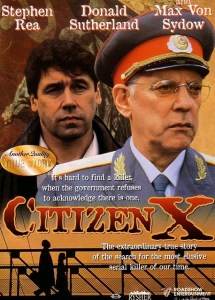
A Movie A Day #226: Citizen X (1995, directed by Chris Gerolmo)


How do you solve a crime in a society that refuses to admit that crime exists?

That is the dilemma faced by Viktor Burakov (Stephen Rea) in the fact-based film, Citizen X.  Burakov is a forensic expert in the Soviet Union.  In 1982, when a dead body is found on a collective farm, Burakov is assigned to investigate.  When seven more bodies are discovered, Burakov is convinced that he is dealing with a serial killer.  The problem is that the official Soviet position is that crime and, especially, serial murder are a product of western decadence.  With his superiors refusing to accept that a serial killer could be active in the USSR, Burakov is driven to the point of insanity as he both tries to stop the murders and keep his job.  Fortunately, he has the Machiavellian Col. Fetisov (Donald Sutherland) on his side but, even with Fetisov’s protection, Burakov is no closer to tracking down the murderer.

Citizen X is based on the crimes of Andrei Chikatilo.  From 1978 to 1990, Chikatilo committed at least 57 murders, with several of his victims being young children.  Though many were suspicious of him, Chikatilo was protected by both his membership in the Communist party and the government’s refusal to allow most of his crimes to be publicly reported.  It was only during the reforms of Perestroika that authorities were allowed to thoroughly investigate Chikatilo’s crimes.  Chikatilo was arrested in 1992 and executed, via a gunshot to the back of his head, in 1994.  In Citizen X, Chikatilo is played by Jeffrey DeMunn, who gives a very good and disturbingly plausible performance as the monstrous killer.

Made for HBO, Citizen X is a low-key but thought-provoking recreations of not just Chikatilo’s crimes but the atmosphere that allowed him to go undetected,  Along with DeMunn, both Rea and Sutherland give great performances.  (Sutherland won an Emmy.)  Max Von Sydow also appears, playing a psychologist who is given the unenviable task of trying to enter Chikatilo’s mind.

Lisa Reviews The Oscar Nominees: Nicholas and Alexandra (dir by Franklin J. Schaffner)


Nicholas_and_Alexandra-831476012-large

(Depending on how much you know about world history, the review below may contain spoilers.)

It was nearly four years ago that I decided that my goal in life was to watch and review every single film — no matter how obscure or potentially disappointing — that had ever been nominated for best picture.  Of course, that’s not my only goal.  If anything, I may have too many, often contradictory goals in my life.  But seeing all of the best picture nominees was definitely one of them and, all these years later, it’s a goal that I’m still trying to achieve.  With the help of TCM and their nonstop schedule of movies made long before I was born, it’s also a goal on which I am slowly but surely making progress.

Last night, as I scrolled through the guide, I noticed that TCM would be showing Nicholas and Alexandra, a three and a half hour film from 1971.  Now normally, I would be hesitant about watching a film that long, if just because I have ADHD and I doubt I’d be able to concentrate on it.  In a theater, watching the action unfold on a big screen, it wouldn’t be a big deal.  However, it’s totally different when you’re talking watching a movie on TV in a house that is full of potential distractions.  Add to that, Wednesday night is when I usually watch shows like Survivor, Hell’s Kitchen, and South Park.

But, here’s the thing.  The title Nicholas and Alexandra sounded familiar to me and not just because I’m an obsessive history nerd.  I did some checking and I discovered that, regardless of how obscure the film may be today, Nicholas and Alexandra was nominated for best picture.  It lost to The French Connection but it was nominated.

So, of course, I had to watch it.

And you know what?
NA

It’s not a terrible movie.  It’s certainly not great.  It has multiple flaws and it’s hard to imagine this film being nominated alongside films like The French Connection, Last Picture Show, and A Clockwork Orange.  Watching the movie, I got the feeling it was probably nominated because it was a big, expensive epic and not because it was one of the best of the year.  But, if you stick with the film (which, if we’re going to be honest here, is much easier said than done), it’s not quite as disappointing as you might expect it to be.

Nicholas and Alexandra tells the story of the last monarch of Russia, Tsar Nicholas II (Michael Jayston).  Struggling to escape the shadow of his father and incapable of understanding what life is like for those not born into royalty, Nicholas is portrayed as being well-meaning but autocratic and blind to the fact that the days of royalty are rapidly coming to an end.  His wife, Alexandra (Janet Susman) is also unpopular with both the Russian citizenry and the royal court on account of being German.

Alexandra spends most her time doting on her youngest son, Alexei, who suffers from hemophilia.  When a flamboyant Serbian monk named Rasputin (Tom Baker) claims that he has the power to heal Alexei, Alexandra immediately brings him into the court.  Soon, rumors are flying across Russia about Rasputin’s relationship with Alexandra.

Meanwhile, men with names like Lenin (Michael Bryant), Trotsky (Brian Cox), and Stalin (James Hazeldine) are plotting to lead a “worker’s revolution…”

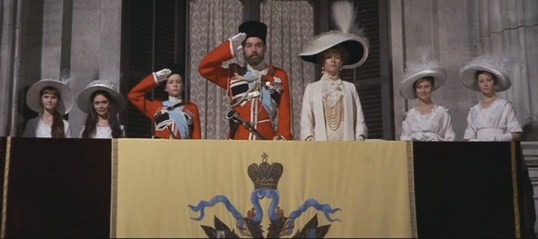
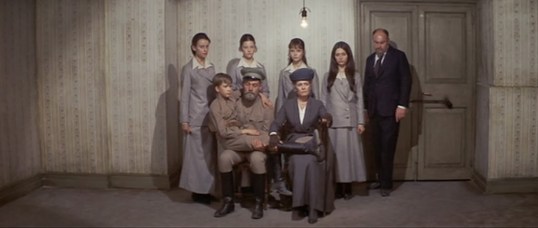
If you know anything about history, it’s not really a spoiler to reveal what happens in the second half of Nicholas and Alexandra.  (And if you’re not into history, you probably would not have any interest in watching the movie in the first place.)   Archduke Franz Ferdinand is assassinated, plunging the entire world into war.  Russia declares war on Germany and the German-born Alexandra becomes even more unpopular than before.  The rest of the royal court, jealous over the mad monk’s influence, plots against Rasputin.  The Tsar is forced from the throne and Nicholas and his family spend their last days as captives of the people they once ruled.  Now a powerless prisoner, Nicholas finally starts to understand the world beyond his palace walls.  However, in the end, Nicholas, Alexandra, their children, and their loyal servants are taken into a small room and violently executed.  End of movie.
NA2

So, there are a lot of things wrong with Nicholas and Alexandra.  Not the least of the film’s problem is an unwieldy length and generally slow pace.  (The film was directed by Franklin J. Schaffner, who also directed the still-fun original Planet of the Apes.  Little of the flair he brought to Planet of the Apes is present here.)  This is one of those films that is full of incident with various characters popping up and discussing the intricacies of international politics with little concern as to whether or not any of this is the least bit cinematic or even compelling on a narrative level.  The film has a huge cast but very few memorable characters.

Even worse is that neither Nicholas nor Alexandra never come across as being all that interesting.  The film makes the case that Nicholas’s downfall was largely a result of him being unlucky enough to rule at a time when people across Europe and Asia were rejecting the old ways for the new ways of revolution and industrialization.  Nicholas is continually portrayed as being well-meaning but isolated and that has the potential to be interesting but, at times, the film feels almost as emotionally detached as its characters.

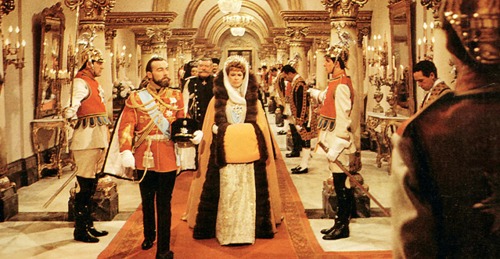
That said, Nicholas and Alexandra does work as a spectacle, as a showcase for beautiful clothing and ornate scenery.  As a character study, Nicholas and Alexandra largely fails but, as a fashion show, it’s actually a lot of fun.    Early on in the film, there’s a lengthy sequence in which Nicholas and Alexandra walk down the red-carpeted hallways of their palace.  It’s shot through Nicholas’s eyes and we see a collection of guards and noblemen and women standing to the side and bowing their heads as the Tsar and his wife walk past.  It’s a good scene and one that perfectly shows not only the life that Nicholas is used to but also why Nicholas doesn’t want to change that life.

baktna03

Perhaps not surprisingly, the first two hours of Nicholas and Alexandra work best when they focus on the flamboyant character of Rasputin.  Baker does a really go job as Rasputin, delivering all of his lines with a ferocious intensity while staring with obviously unhinged eyes.  When he’s with Alexandra, Rasputin is calculating and coldly conniving, providing just enough comfort to keep her under his control.  When he’s with Nicholas or any of the other male members of the court, he reveals himself to be an arrogant libertine, making profane jokes and bragging about his conquests.  It’s a really good performance but, as with so many other good performances in this film, it occasionally gets lost in the film’s dense production.

The best moments of Nicholas and Alexandra come towards the end, with the humbled Nicholas finally revealing his humanity and the Tsar’s family struggling to maintain their dignity even as their inevitable fate approaches.  At this point, the performers came to life.  The film suddenly had an emotional resonance.  It finally became about something!  For those final 20 or so minutes, Nicholas and Alexandra suddenly seemed worthy of being awarded.

In fact, based on those final 20 minutes, I would even be willing to see a sequel called Nicholas and Alexandra and Rasputin Makes Three.  

(Though I’m not sure how that sequel could ever be made.  As @Kev1Media pointed out when I suggested it on twitter, Adam Sandler would have to be somehow involved.)

As for Nicholas and Alexandra, it’s not a great film but if you’re into history or you’re an Oscar completist like me, the film has its occasional charms.  You just have to be willing to look for them.
Nicholas and Alexandra