Horror Film Review: The Tomb of Ligeia (dir by Roger Corman)


Did Roger Corman have an issue with cats?

That’s the question I asked myself as I watched 1964’s The Tomb of Ligeia.  Loosely based on a short story by Edgar Allan Poe, The Tomb of Ligeia tells the story of Verden Fell (Vincent Price).  Fell’s wife, Ligeia, has recently died but Fell worries that her spirit is still haunting and watching him.  One gets the feeling that Fell hated his late wife but, at the same time, was obsessed with her.  Fell has an eye condition which causes him to wear dark glasses on the rare occassions that he leaves his manor.  He’s definitely a creepy guy but that doesn’t stop Rowena (Elizabeth Shepherd) from falling in love with him and leaving her fiancé, Christopher Gough (John Westbrook), to marry him.  Unfortunately, Rowena is soon feeling the spirt of Ligeia as well, in the form of a black cat who keeps attacking Rowena.

Now, in all honesty, I doubt that Roger Corman specifically had an issue with cats.  It’s possible the Edgar Allan Poe had an issue with cats, as he lived at a time when cats were rarely kept as pets and were instead just used to catch and kill mice and rats.  (And, in fairness to the 19th century, that was a very important job in those days of bad hygiene and outhouses.)  There’s no cats to be found in Poe’s short story about Ligeia but there was one very prominently featured in The Black Cat.  As Ligeia was not exactly one of Poe’s most detailed stories, it’s probable that Corman and screenwriter Robert Towne just included the evil black cat because that story was one of Poe’s best-known.

That said, for me, it was difficult to watch an entire movie about people hating and attempting to destroy a cat.  It’s certainly not the cat’s fault that it’s been possessed by the spirit of Ligeia.  As I watched the film, it occurred to me that cats may not have been as popular in the 1960s as they are today.  I mean, there was no internet when this film was made and, as a result, people weren’t constantly being bombarded by cute cat pictures.  Instead, people probably just knew cats for their habit of hissing at people and scratching their owners.  Today, we find that behavior to be cute.  Perhaps back in 1964, people felt differently.

If I seem to be rambling on about the cat, that’s because there’s not really a lot to be said about The Tomb of Ligeia.  It was the last of Corman’s Poe films and neither Corman nor Price seem to be particularly invested in the material.  Price is actually rather miscast as Verden Fell.  Fell is meant to be a mysterious aristocrat, in the spirit of Maxim de Winter from Rebecca.  But Vincent Price is …. well, he’s Vincent Price.  Vincent Price was a wonderful actor and personality but he wasn’t particularly enigmatic.  From the first minute we see Price, we know that he’s being haunted by his dead wife because he’s Vincent Price and the same thing happened to him in several other films.

The Tomb of Ligeia is full of the ornate sets and beautiful costumes that were featured in all of Corman’s Poe films.  And even a miscast Vincent Price is still fun to watch.  But, when compared to the other films in the Poe Cycle, this one falls flat.

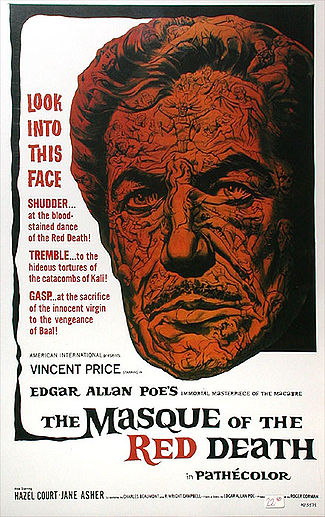
Horror Film Review: The Masque of the Red Death (dir by Roger Corman)


In 1964’s The Masque of the Red Death, Vincent Price stars as Prospero.

Prospero is a nobleman in medieval Italy, a decadent tyrant who rules his villages with an iron hand and who proudly and openly worships Satan.  When an old woman in one of the villages dies of the plague, Prospero orders the village to be burned to the ground.  He returns to his castle where, with his mistress (Hazel Court), he plans to throw a masquerade for the local nobility.  His plan is for everyone to hide out in the castle until Death has passed.  The problem, of course, is keeping Death from sneaking into the castle and claiming everyone within.

Prospero also abducts three villagers, Ludovico (Nigel Green), his daughter Francesca (Jane Asher), and Francesca’s boyfriend, Gino (David Weston).  The three villagers find themselves in a decadent world, where Prospero and his attendants are motivated by their own greed and petty jealousies.  Keeping Death from entering the castle would probably be a lot easier if the people in the castle would stop trying to kill each other.  It’s an odd atmosphere within the castle.  Everyone fears Death and yet, everyone seems to be doing all that they can do invite it in with them.  Can anyone, even a worshipper of the Damned liked Prospero, truly escape Death?

The Masque of the Red Death is not only the best of Roger Corman’s Edgar Allan Poe adaptations but it’s also the best film that Corman ever directed.  Working with cinematographer Nicolas Roeg (who was himself destined to have quite a career as a director of enigmatic films), Corman fills the screen with vivid colors and scenes of medieval decadence.  Price gives one of his best performances, playing Prospero as someone who is in love with his own amoral nature but whose arrogance quickly gives way to fear when he starts to suspect the Death has somehow managed to enter the castle.  The inhabitants of the castle are all memorably eccentric and, in many cases, evil.  A man in an ape costume is burned to death and hardly anyone seems to notice or care.  Prospero and his nobles think that they’re above death because of their wealth and their place in society but, of course, no one can escape Death.

David Weston and Jane Asher are both well-cast as the two lovers, though Asher is clearly more a product of the swinging sixties than medieval Italy.  Patrick Magee and Skip Martin are both memorable as members of Prospero’s court, with Skip Martin giving an especially diabolical performance as a murderous court jester.  In the end, though, this film truly belongs to Price, Corman, and Roeg.  Roeg’s cinematography is dazzling, with the use of red foreshadowing his later film, Don’t Look Now.  Corman’s direction puts the viewer right in the center of Prospero’s court.  And Vincent Price gives one of his best performances as the self-amused but unashamedly evil Prospero.  The Masque of the Red Death remains a classic of 60s pop art and the best of Corman’s many films.

A Movie A Day #5: ffolkes (1979, directed by Andrew V. McLaglen)


A group of terrorists, led by Lou Kramer (Anthony Perkins, at his bitchiest) and Harold Schulman (Michael Parks), have hijacked Esther, a supply ship that services two North Sea oil rigs, Ruth and Jennifer.  Kramer demands that the British government pay him 25 millions pounds.  If he’s not paid, he’ll blow up the two oil rigs, destroying the British economy and causing a catastrophic environmental disaster.  Kramer has also rigged the Esther with explosives.  If anyone tries to board the boat, he will blow both the ship and himself up, taking the crew with him.

The British Prime Minister (Faith Brook, playing Margaret Thatcher) could pay the ransom or she could call in counter terrorism expert, Rufus Excalibur ffolkes (Roger Moore).

(Though the name undoubtedly looked odd to American audiences, ffolkes is a common Welsh surname and is often spelled with both fs lowercase.)

Made in between The Spy Who Loved Me and Moonraker, ffolkes was Roger Moore’s attempt to defy the typecasting that had defined his career.  Other than his loyalty to Queen and country, ffolkes has very little in common with James Bond.  James Bond was a suave smoker who bedded several women per film, lived in a hip London flat, drank Martinis, and was always ready with a quip.  ffolkes is humorless, drinks Scotch, hates cigarette smoke, and lives in an isolated castle.  The biggest difference between Bond and ffolkes?  Embittered by one bad marriage, ffolkes has no interest in women and refuses to work with them.  Instead, ffolkes loves cats.

ffolkes had always been overshadowed by Moore’s work as James Bond but it holds up well as a good, old-fashioned adventure film.  In many ways, Anthony Perkins’s Kramer feels like a predecessor to Die Hard‘s Hans Gruber and, if ffolkes had been released ten years later, it probably would have been referred to as being “Die Hard at sea.”  If you can get used to him playing someone other than James Bond, Roger Moore does a good job as the eccentric ffolkes and James Mason provides welcome support as ffolkes’s only friend.

Though ffolkes was a box office disappointment, it retains a cult following and it used to show up regularly on British television.  (I saw it at least once every summer that I went to the UK.)  When it was originally released in the U.K., it was called North Sea Hijack.   When it was released in the U.S., presumably under the assumption that American audiences wouldn’t be able to find the North Sea on a map, the title was changed to ffolkes, which probably left audiences more confused than the North Sea ever would have.  When the movie was first broadcast on American television, the title was changed yet again, this time to Assault Force.

To quote Roger Moore: “The film has so many title changes that I’ve lost count.  But everyone seems to like the character I played.”

For tomorrow’s movie a day, it’s another film where Roger Moore did not play James Bond, The Cannonball Run.

roger-moore-is-ffolkes

Horror on The Lens: The Masque of the Red Death (dir by Roger Corman)


MasqueOfTheRedDeath(1964film)

So here we are, 24 days into October, and I have yet to share an old Vincent Price film!  It’s not October without at least a little contribution from Vincent.  Well, allow me to correct that with today’s horror on the lens, the 1964 Roger Corman film The Masque of the Red Death.

Based on the classic story by Edgar Allan Poe, this film features Vincent Price giving one of his best performances as the doomed and decadent Satanist Prince Prospero.  The film’s cinematographer was future director Nicolas Roeg and The Masque of the Red Death is probably one of the most visually impressive of all of Corman’s films.

Enjoy!

http://www.youtube.com/watch?v=uCazBlhBs_Q