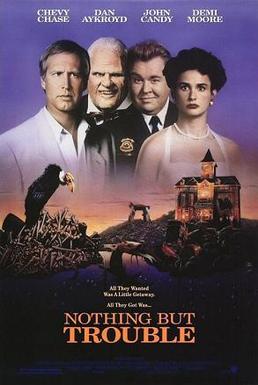
 Publisher Chris Thorne (Chevy Chase) is eager to get to know lawyer Diane Lightson (Demi Moore) so he agrees to drive her and two Brazilian hangers-on from Manhattan to New Jersey. The Brazilians encourage Chris to take a detour, which leads to him running a stop sign, getting into a high-speed chase with chief of police Dennis Valkenheiser (John Candy), and being detained in the dilapidated village of Valkhenheiser. Dennis decides to leave town with the Brazilians, leaving Chris and Diane to face the wrath of 106 year-old Judge Alvin “J.P” Valkenheiser (Dan Aykroyd). Judge Valkenheiser has spent decades killing anyone who breaks the law in his village, though he also kills anyone who he just dislikes. The Judge assumes Chris is a banker (and he hates bankers) and is prepared to kill him unless he marries the Judge’s granddaughter, Eldona (John Candy, in drag). This town is nothing but trouble and Chris and Diane have to escape.
Nothing But Trouble was both the directorial debut and swan song for Dan Aykroyd. (Aykroyd also wrote the script, from a story that was written by his brother, Peter.) The film was an notorious box office bomb and watching, it’s easy to see why. The story is all over the place, awkwardly mixing humor and horror. Anyone who has seen the early seasons of Saturday Night Live knows that young Dan Aykroyd was one of the funniest people around but, when it comes to the movies, he’s always worked better with a collaborator than on his own. As a director, Aykroyd throws a little bit of everything into Nothing But Trouble and the movie feels overstuffed.
As an actor, though, Aykroyd is funny. Whatever laughs are to be found in Nothing But Trouble are largely the result of his performance as the Judge. Chevy Chase seems bored. Demi Moore actually gives a decent performance but she plays her role straight. John Candy is likable as Dennis but too cartoonish as Eldona. Aykroyd, however, so commits himself to playing the 106 year-old judge that he wrings laughs from even the weakest of lines. Criticize Aykroyd the director all you want, Aykroyd the actor delivers.
One final note: The rap group Digital Underground makes a cameo appearance as themselves, performing in the Judge’s courtroom after getting arrested for speeding. When I was watching Chevy Chase mugging for the camera and Dan Aykroyd walking around hunched over, I hardly expected to see a young Tupac Shakur suddenly show up but he did. Digital Underground’s cameo is one of the film’s better moments, even if they don’t perform The Humpty Dance.

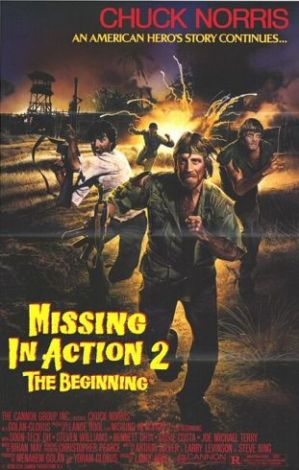 Goddamn, dude. Chuck Fucking Norris. Even when the movie is terrible, Chuck is cool.
 Through the Shattered Lens