(For those following at home, Lisa is attempting to clean out her DVR by watching and reviewing 38 films by this Friday. Will she make it? Keep following the site to find out!)
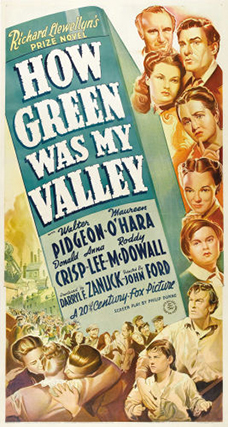
Before I really get into this review, I should admit that I watched How Green Was My Valley with a bias.
Before the movie started, I was expecting to be disappointed with it. I think that a lot of film lovers would have felt the same way. How Green Was My Valley won the 1941 Oscar for best picture. In doing so, it defeated three beloved films that have only grown in popularity and renown since they were first released: Citizen Kane, The Maltese Falcon, and The Little Foxes. (As well, just consider some of the 1941 films that weren’t even nominated for best picture: Ball of Fire, The Devil and Daniel Webster, Dr. Jekyll and Mr. Hyde, High Sierra, The Lady Eve, Never Give A Sucker An Even Break, The Sea Wolf, The Wolf Man, and Sullivan’s Travels.) Because it defeated so many great films and since we’re all used to the narrative that the Academy always screws up, there’s a tendency to assume How Green Was My Valley was really bad.
Well, after years of assumptions, I finally actually watched How Green Was My Valley? Was it bad? No, not really. Was it great? No, not all. If anything, it felt rather typical of the type of films that often win best picture. It was well-made, it was manipulative enough to be a crowd-pleaser while serious enough to appeal to highbrow critics, and, perhaps most importantly, it never really challenged the viewer. Unlike Citizen Kane and The Maltese Falcon, How Green Was My Valley is a film that doesn’t require that you give it too much thought and, as such, it really shouldn’t be surprising that it was named the best picture of the year.
How Green Was My Valley was directed by John Ford and, as you might expect from Ford, it deals with a changing way of life and features good performances and a few impressive shots of the countryside. Taking place in the late 1800s, How Green Was My Valley tells the episodic story of the Morgans, a large family of Welsh miners. The film is narrated by Huw (Roddy McDowall), a youngest member of the family. Though Huw’s eyes, we watch as his once idyllic and green village is transformed by the growing mining industry and blackened with soot, poverty, and death.
The film starts out as a fairly even mix of sentiment and drama. Huw has a crush on his brother’s fiancee. His sister, Angharad (Maureen O’Hara), has a flirtation with the new preacher, Mr. Gruffydd (Walter Pidgeon). Much emphasis is put on communal gatherings. There is a wildly joyful wedding celebration. We often see the villagers in church and hear them singing both hymns and folk songs. In their isolate village, they are are united against a changing world.
Or, at least, they think they are. As the mining industry grows, that united front and sense of community starts to vanish. A strike sets family members against each other, as each miner is forced to decide whether to side with management or with his fellow workers. Each year, the wages become lower. When management realizes that its cheaper to just continually hire new miners, several of the veteran workers are fired and end up leaving the village to seek a living elsewhere. As new people come to the village, even Mr. Gruffydd finds himself the subject of gossip.
As for Huw, he grows up. He goes to school, deals with a sadistic teacher, and learns how to defend himself against bullies. And eventually, like everyone in his family, he is sent down into the mines and soon, his once innocent face is covered in soot.
And, of course, there’s a big tragedy but you probably already guessed that. How Green Was My Valley is not a film that takes the viewer by surprise.
For the most part, it’s all pretty well done. The big cast all inhabit their roles perfectly and Roddy McDowall is extremely likable as Huw. Maureen O’Hara shows why she eventually became a star and even Walter Pidgeon gives a surprisingly fiery performance. How Green Way My Valley is a good film but it’s too conventional and predictable to be a great film, which is why its victory over Citizen Kane and The Maltese Falcon will always be remembered as a huge Oscar injustice.
But, taken on its own terms and divorced from the Oscar controversy, How Green Was My Valley may be a conventional but it’s not a bad film. It’s just no Citizen Kane.


 Through the Shattered Lens