Film Review: King Kong (dir by John Guillermin)


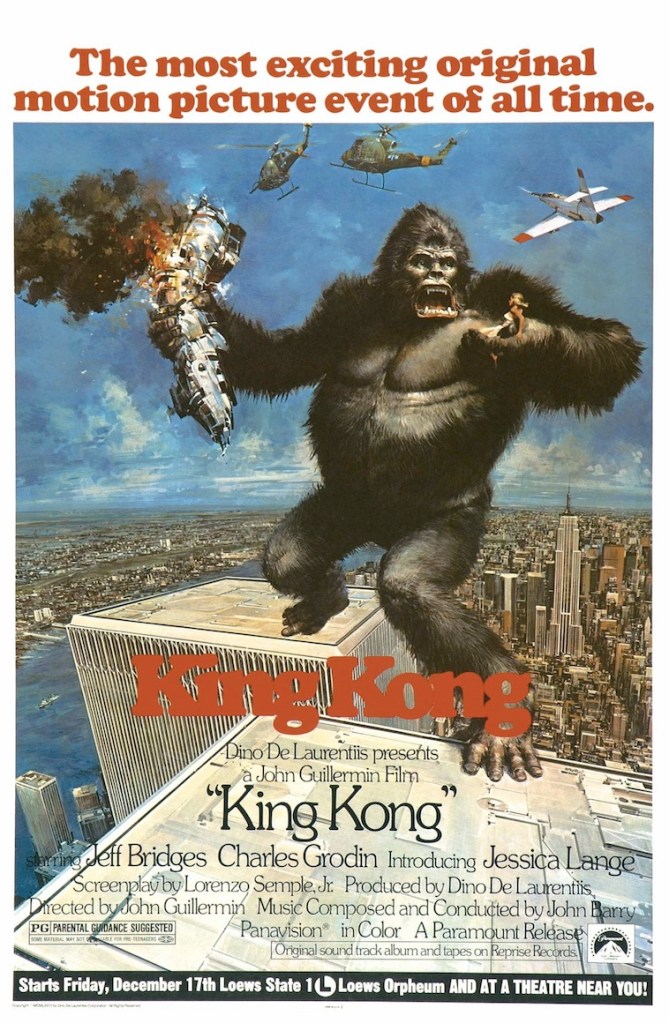
The 1976 remake of King Kong is the version of the great ape’s story that no one ever seems to want to talk about.

Everyone, of course, continues to appreciate the original King Kong from 1933, with its charmingly dated but still somewhat effective special effects. The Japanese King Kong films have their fans, even if it still annoys me that two endings were made for the original King Kong vs. Godzilla. The Peter Jackson-directed remake from 2005 had many admirers, including me. The monsterverse Kong certainly has many fans, as is indicated by the fact that Godzilla vs Kong is the first box office hit of the post-pandemic era. King Kong is a beloved character and yet the 1976 version of his story never seem to get as much attention as all the others.

Some of that, of course, is because the 1976 version of King Kong is often described as not being very good. It tells the same basic story as the first King Kong but there’s a few key differences. The expedition to the hidden island is no longer made up of a film crew. Instead, everyone has a separate backstory that doesn’t really make much sense. Fred Wilson (Charles Grodin) is an energy company executive who is looking for a new source of oil. Jack Prescott (Jeff Bridges) is a long-haired hippie environmentalist type who stows away on Wilson’s ship. Prescott apparently thinks that there’s some sort of ancient primate living on the island. Meanwhile, Dwan (future great actress Jessica Lange, making her film debut) is an aspiring actress who is discovered in a life raft, floating out in the middle of the ocean. It turns out that Dwan (that’s not a typo, that’s her name) has escaped from the yacht of a sleazy film producer. Nobody on the ship seems to be surprised when Dwan suddenly shows up in her life raft and Dwan doesn’t seem to have any hesitation about accompanying a bunch of strangers to previously unexplored island. That’s the type of film this is.

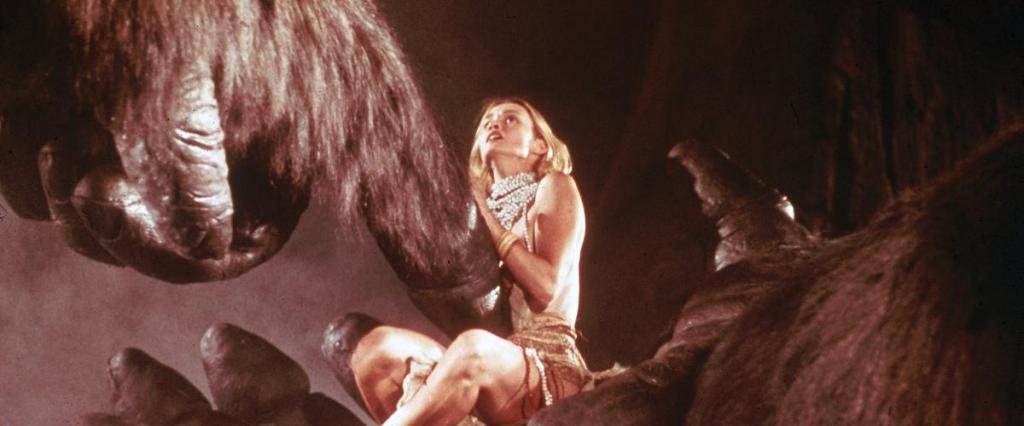
After a considerable amount of time, during which Dwan falls in love with Jack and Fred spends a lot of time looking generally annoyed, the island is discovered. As you can already guess, Dwan is kidnapped by the island’s natives, and she’s rescued by a giant ape who falls in love with her after she punches him in the nose and says, “Put me down, you male chauvinist pig ape!” In some shots, Kong is obviously a man in a rubber suit. In others, he’s just as obviously an animatronic model. Unfortunately, the animatronic version of Kong sometimes appears to kind of be leering whenever he looks down at Dwan in the palm of his hand, which bring a definite element of ickiness to a few of the scenes in which Kong carries Dwan across the island.

I would have started praying too.

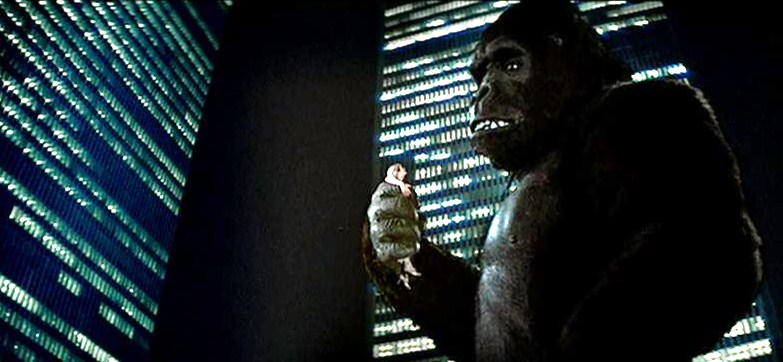
Eventually, just as in the original film, Kong ends up a prisoner in New York. This time, when he escapes, grabs Dwan, and goes on a rampage, he ends up climbing the Two Towers. This leads to scenes of helicopters and fighter planes all firing at the Two Towers, which is a bit difficult to watch today. I remember a few years ago, one of our local stations actually broadcast this version of King Kong on September 11th and it definitely did not feel right.

The 1976 version of King Kong was a hit at the box office and was nominated for three Academy Awards. It won the the award for Best Visual Effects, sharing the Oscar with Logan’s Run. That said, King Kong wasn’t exactly popular with critics, either at the time of its release or today. To a certain extent, it’s understandable why this version of King Kong is so frequently criticized. The script takes a deliberately campy approach to material that, in order to have any real emotional impact, needs to be played straight regardless of how silly the story might seem. Charles Grodin never seems to be sure whether the film is a drama or a comedy. Jeff Bridges is likable but a bit too naturally mellow for his role. Jessica Lange made her film debut in King Kong, famously beating out Meryl Streep for the role. Despite the fact that the film was a box office hit, the reviews of Lange’s performance were so negative that she didn’t work for three years after appearing in the film. (She spent that time studying acting. She went on to win a Tony, two Oscars, and three Emmys so take that, critics.)

And yet, I kind of like this version of King Kong. When taken on its own very silly terms (and not as a remake of a legitimate classic), it’s definitely entertaining. Even the fact that Grodin, Bridges, and Lange are all miscast kind of works to the film’s advantage. You can’t help but appreciate that all three of them are trying so hard to be convincing in roles that they shouldn’t have been playing. For all the criticism of Jessica Lange’s performance, she actually does as well as anyone could with some of the dialogue that she gets stuck with. It’s not easy to pull off a scene where you explain to a giant ape that the relationship is never going to work because you’re a city girl and he’s a …. well, he’s a giant ape. But Lange manages to deliver the lines without laughing and that couldn’t have been easy. Lange’s then-inexperience is obvious whenever she’s having to react to or interact with the other actors but she does fine when she’s having to talk to a guy in a rubber suit or a big animatronic head. (Let’s see Meryl Streep pull that off.) Though it seems to take forever for Kong to actually get captured, the film picks up once he’s transported to New York. If you can look past the awkwardness of how the film uses the Twin Towers, the scenes of Kong rampaging through the city have an over-the-top grandeur that’s both ludicrous and compelling. By the time he reaches the top of the World Trade Center, you will totally be on his side. That’s the way it should be.

This remake of King Kong is deeply, deeply silly but, sometimes, that’s exactly what you’re looking for.

Love on the Shattered Lens: Rapture (dir by John Guillermin)


The 1965 film, Rapture, is an odd one.

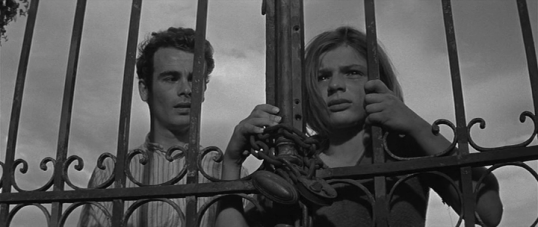
It takes place in France, largely at an isolated home sitting on a cliff above the Brittany coast.  Frederick Larbaud (Melvyn Douglas) is a former judge who has largely retreated from society.  He lives in his house with his teenager daughter, Agnes (Patricia Gozzi) and his promiscuous housekeeper, Karen (Gunnel Lindbloom).  He’s a stern man, one who is obviously struggling to overcome a vaguely defined personal tragedy.  He is very overprotective of his daughter, Agnes.

As for Agnes, she alternates between moments of childish immaturity and moments of surprising clarity.  She’s the type who still plays with dolls but who also casually tosses them over the cliff so that they can shatter on the rocks below.  She seems to be naive and innocent but, at the same time, she’s also capable of blackmailing Karen and threatening to tell her father that Karen’s boyfriend sneaks into the house at night.  When the sheltered Agnes gets her father’s permission to make a scarecrow for the garden, she throws herself into the work, even going so far as to flirt with the scarecrow after it’s been built.

Meanwhile, a sailor named Joseph (Dean Stockwell) has been arrested for getting into a fight during a drunken night on the town.  While he’s being transported to jail, the prison bus runs off the road.  Joseph escapes from the bus and runs up a hill, passing by Frederick, Agnes, and Karen.  Though the police manage to seriously wound Joseph, he still escapes.

Later that night, during a violent storm, Agnes is shocked to see that her scarecrow has vanished.  While she’s out searching for it, she comes across a delirious Joseph.  Because Joseph has stolen the scarecrow’s clothes, Agnes decides that her scarecrow has come to life and, as a result, Joseph belongs to her.  Surprisingly, Frederick expresses no reservations about allowing Joseph to stay at the house while he recovers from his gunshot wound.

Once Joseph recovers, he explains to Frederick what happened and says that he should probably turn himself in and hope for the best.  Frederick, however, disagrees.  It turns out that Frederick has an agenda of his own and part of that agenda is revealing that brutality of the police.  He continues to allow Joseph to hide out at his house but little does Frederick know that Joseph is falling in love with Agnes (and, of course, Agnes still thinks that Joseph is her scarecrow come to life).

Rapture took me by surprise.  When the film started, I honestly thought it was going to be unbearably pretentious and I wasn’t exactly filled with confidence when I discovered that the film was directed by John Guillermin, a prolific British director whose career spanned from the 50s and the 80s but whose overall output is not particularly highly regarded among film historians.  With its obvious debt to Ingmar Bergman, Rapture did not seem like the type of movie that one would expect to be successfully directed by the 1960s equivalent of Taylor Hackford.  And, it should be said, that the first fourth of the film is rather pretentious and a bit silly.  The black-and-white cinematography is frequently gorgeous and atmospheric but Agnes’s eccentricity often feels overwritten and it seems to take forever for Joseph to actually show up at the house.

However, things get better.  The film, itself, doesn’t become any less pretentious but eventually Joseph starts to fall for Agnes and the chemistry between Dean Stockwell and Patricia Gozzi is strong enough that it carries the viewer over the film’s rough spots.  The film becomes less about how strange Agnes is and more about a sheltered girl falling in love for the first time and, freed from the inconsistency that marred her characterization during the first part of Rapture, Patricia Gozzi’s performance starts to click as Agnes becomes relatable and even sympathetic.

The film hits a high point when Joseph and Agnes try to start a life for themselves away from Agnes’s father and we watch a lengthy montage of their steadily deteriorating relationship.  In a manner of minutes, we witness how quickly the intrusion of the real world threatens to cause their too perfect romance to go awry.  Most of the montage is made up of overhead shots and it captures the feeling of two naive lovers being overwhelmed by the difficulties of living in the real world.  With each movement of the camera, we feel Agnes and Joseph’s world getting a little bit more claustrophobic and a little more threatening.

The film ends on a sad note, which shouldn’t come as a surprise to anyone watching.  From the minute that Agnes leads a wounded Joseph into the house, we know that their love is doomed.  That said, it’s still a rather odd ending and one that raises more questions than it answers.  It’s a strange ending for a strange film and it’s one that will stick with you long after you watch it.

Embracing the Melodrama #28: The Towering Inferno (dir by John Guillermin)


The_Towering_Inferno_1974-500x300

I have a weakness for the old, all-star disaster movies of the 1970s.  It could be because those movies remind me of how fragile life really is and encourage me to make the most of every minute.  Or maybe it’s because I have my phobias and, by watching those movies, I can confront my fears without having to deal with a real-life tornado, hurricane, tidal wave, avalanche, or fire.

Or maybe I just have a weakness of glitz, glamour, and melodrama — especially when it involves a huge cast of stars and character actors.  Yes that’s probably the reason right there.

Case in point: the 1974 best picture nominee, The Towering Inferno. 

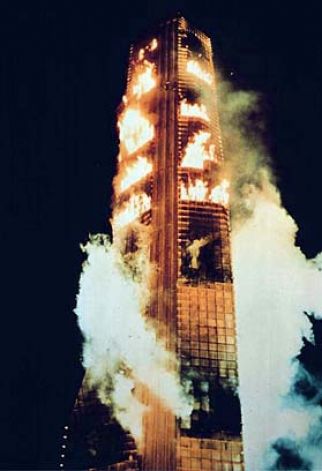
As is the case with most of the classic disaster films, The Towering Inferno is a long and big movie but it has a very simple plot.  The world’s tallest building — known as the Glass Tower — has been built in San Francisco.  On the night of the grand opening, a fire breaks out, trapping all the rich and famous guests on the 135th floor.  Now, it’s up to the fire department to put out the fire while the trapped guests simply try to survive long enough to be rescued.  Some will live, some will die but one thing is certain — every member of the all-star cast will get at least 15 minutes of screen time and at least one chance to scream in the face of the film’s still effective special effects.
628x471

As for the people trapped by the towering inferno, we don’t really get to know them or their motivations.  (Add to that, once the fire breaks out, everyone pretty much only has one motivation and that’s to not die.)  As a result, we don’t so much react to them as characters as we do to personas of the actors who are playing them.
Steve-McQueen-in-The-Towe-001

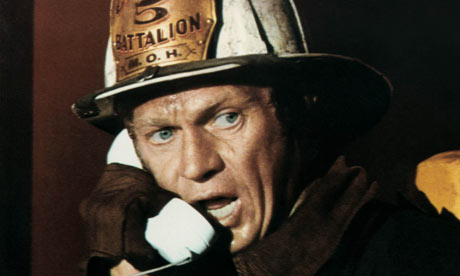
For instance, we know that Fire Chief O’Halloran is a fearless badass and a natural leader because he’s played by Steve McQueen.  McQueen brings a certain blue collar arrogance to this role and it’s a lot of fun to watch as he gets progressively more and more annoyed with the rich people that he’s been tasked with rescuing.

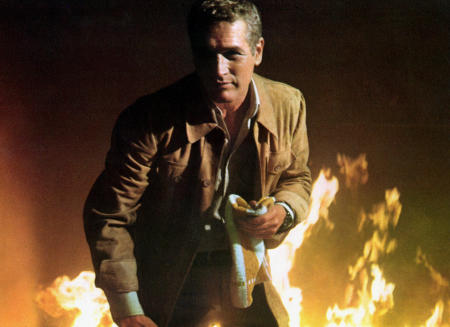
We know that architect Doug Roberts is a good guy because he’s played by Paul Newman.  Reportedly, Newman and McQueen were very competitive and, in this movie, we literally get to see them go-head-to-head.  And, as charismatic as Newman is, McQueen pretty much wins the movie.  That’s because there’s never a moment that O’Halloran isn’t in charge.  Doug, meanwhile, spends most of the movie begging everyone else in the tower to exercise the common sense necessary to not die.  (Unfortunately, despite the fact that he looks and sounds just like Paul Newman, nobody in the tower feels like listening to Doug.  If Towering Inferno proves anything, it’s that most people are too stupid to survive a disaster.)
paul-newman-inferno1

The tower’s owner, James Duncan, is played by William Holden so we know that Duncan may be a ruthless businessman but that ultimately he’s one of the good guys.  Holden gets one of the best scenes in the film when, after being told that people in the building are catching on fire, he replies, “I think you’re overreacting.”

Roger Simmons is Duncan’s son-in-law and we know that he’s ultimately to blame for the fire because he’s played by Richard Chamberlain.  Roger might as well have a sign on his back that reads “Doomed.”  The same can be said of publicity executive Dan (Robert Wagner) and his girlfriend, Lorrie (Susan Flannery).

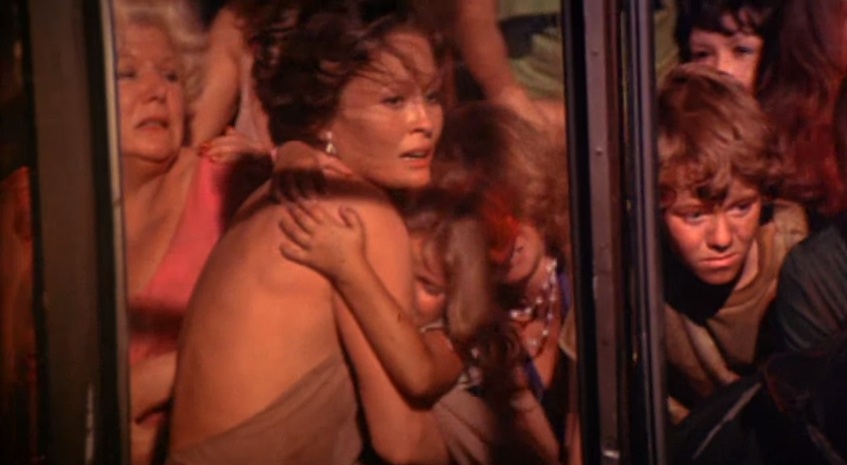
The_Towering_Inferno_1974_Faye_Dunaway_Mike_Lookinland

Faye Dunway is Susan.  She is Doug’s fiancée and she really doesn’t do much but she does get to wear a really pretty dress.  The same can be said of Susan Blakely, who plays Roger’s dissatisfied wife, and Jennifer Jones, who plays a recluse.  And good for them because if you’re going to be stuck in an inferno without much to do, you can at least take some comfort in looking good.

Then there’s Fred Astaire, who does not dance in this film.  Instead, he plays a kind-hearted con artist who ends up falling in love with Jennifer Jones.  Fred Astaire received his only Oscar nomination for his brief but likable performance in The Towering Inferno.

And finally, there’s the building’s head of security, Jernigan.  We know that he’s a murderer because he’s played by O.J. Simpson and … oh wait.  Jernigan is actually probably the second nicest guy in the whole film.  The only person nicer than Jernigan is Carlos, the bartender played by Gregory Sierra.

OJ

The real star of the film, of course, is the fire.  In the 40 years since The Towering Inferno was produced, there’s been a lot of advances in CGI and I imagine that if the film was made today, we’d be watching the fire in 3D and it would be so realistic that we’d probably feel the heat in the theater.  That said, the fire effects in The Towering Inferno are still pretty effective.  Now, I have to admit that I have a phobia (and frequent nightmares) about being trapped in a fire so, obviously, this is a film that’s specifically designed to work itself into my subconscious.  But that said, the scenes with various extras thrashing about in the flames are still difficult to watch.  There’s a scene where Robert Wagner and Susan Flannery find themselves trapped in a blazing reception area and it is pure nightmare fuel.

The Towering Inferno 9

The Towering Inferno is an undeniably effective disaster film.  At the same time, when one looks at the 1974 Oscar nominees, it’s odd to see The Towering Inferno nominated for best picture along with The Godfather Part II, Chinatown, and The Conversation.  Unlike those three, The Towering Inferno is hardly a great film.

But it is definitely an entertaining one.

toweringinferno2