Welcome to Late Night Retro Television Reviews, a feature where we review some of our favorite and least favorite shows of the past! On Fridays, I will be reviewing Freddy’s Nightmares, a horror anthology show which ran in syndication from 1988 to 1990. The entire series can be found on Plex!
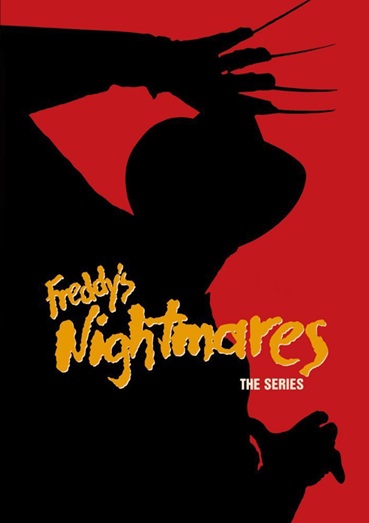
Let’s see what’s happening in Springwood!
Episode 1.2 “It’s A Miserable Life”
(Dir by Tom McLoughlin, originally aired on October 16th, 1988)
Bryan Ross (a young John Cameron Mitchell, giving a performance that really can’t be described as being anything less than lousy) is the son of the owner of the Beefy Boy hamburger joint in Springwood, Ohio. Bryan wants to go to college. His dad (Peter Iacangelo) and his mom (Annie O’Donnell) want him to take over the family business and join them in singing “Chew me, eat me, you can’t beat me.”
Bryan is working the overnight shift alone when a scruffy man (Michael Melvin) pulls up to the drive-through on his motorcycle and threatens to kill him. Bryan passes out but, when he wakes up, he’s got a throbbing headache and he keeps seeing blood dripping on the floor. Bryan’s girlfriend, Karyn (Lar Park Lincoln, giving a good performance), takes Bryan home. At his house, Bryan discovers his mom and dad are acting weird. Bryan tries to convince his parents to let him leave home. Dad tries to stick his head in the oven. Mom tries to seduce her son and then climbs into the refrigerator. On the radio, there’s a news story about “another” drive-by shooting. What could it all mean!?
Oh, you know what it all means. Even if you haven’t watched the episode, you know that the motorcycle man obviously shot Bryan in the head and everything that happens after Bryan leaves Beefy Boy is just his dying vision. It’s not a bad idea but it’s ineffectively executed. We don’t really know enough about Bryan or his parents for Bryan’s hallucination to carry any impact and, from what we do see, they all appear to be broadly-drawn caricatures. This episode also commits the sin of introducing a memorable character — the man on the motorcycle — and then not exploring just who or what he was meant to be.
Bryan’s story was wrapped up in 20 minutes. The second half of the episode dealt with Karyn. Shot in the same drive-by attack that killed Bryan, Karyn ended up at the hospital and …. well, I guess her story was another collection of hallucinations that really didn’t add up to much. The story was effective because hospitals are scary and Lar Park Lincoln gave a better performance than John Cameron Mitchell did in his story. That said, the entire story was basically Karyn getting upset because everyone kept saying that her parents were on their way. Finally, Karyn finally revealed that — you guessed it! — her parents were dead and that they died at the same hospital where she was taken after getting shot. As the episode ended, Karyn saw her parents standing in the doorway and screamed and thrashed around in bed while the doctor and nurse tried to calm her. And …. that was it. I mean, is Karyn dead? Is that why her parents showed up? Is Karyn hallucinating again? Much like a drunk frat boy, this story didn’t reach a climax as much as it just stopped.
As for Freddy, he showed up to introduce each story. There was a cool moment where he emerged from the restaurant’s fry cooker. For the hospital scene, he put on scrubs. He didn’t actually interact with either Bryan or Karyn but he still took credit for their suffering. I think Freddy was just bragging on himself.
This episode was pretty uneven. For the most part, I’m just glad I don’t live in Springwood.
 Through the Shattered Lens