October True Crime: My Father’s Shadow: The Sam Sheppard Story (dir by Peter Levin)


On July 3rd, 1954, Marilyn Sheppard was murdered in her bedroom.

The wife of a prominent neurosurgeon, Marilyn Sheppard was bludgeoned to death in her own bedroom.  Her husband, Sam Sheppard, claimed that he had fallen asleep on a downstairs couch and was woken up by the sound of his wife screaming.  Sheppard said that, when he ran upstairs to the bedroom, he saw a bushy-haired man in the shadows.  The man hit Sheppard, knocking him out.  When Sheppard came to, he saw the man fleeing the house and chased after him.  The two fought outside and again, Sheppard was knocked out.

The police did not believe Sam Sheppard’s story and, after days of headlines that flat out accused him of being the murderer, he was arrested and charged with murdering his pregnant wife.  The press had a field day with the story and the trial was frequently described as being a circus.  Sheppard’s case was damaged by the revelation that he had cheated on his wife multiple times.  Contemporary accounts of the trial portrayed Sheppard as being cocky and arrogant.  As the jury was not sequestered, they saw every tabloid headline about Sheppard.  After deliberating for four days, the jury found Dr. Sam Sheppard guilty of murdering his wife.  He was sentenced to prison.

Sheppard would stay in prison until 1966.  During that time, his mother committed suicide, his father died of an ulcer, and his former father-in-law also chose to end his own life.  Sheppard’s original attorney died in 1961 and his appeals were taken over by a young lawyer named F. Lee Bailey.  In 1966, Bailey argued before the U.S. Supreme Court that Sheppard was denied due process due to the jury not being sequestered.  The Supreme Court agreed and granted Sheppard a new trial.  This time, with the flamboyant Bailey defending him, Sheppard did not testify and the defense focused on the lack of any real evidence that would suggest Sheppard had lied about the Bushy-haired Man.  Sheppard was acquitted.

Today, if Sam Sheppard is remembered, it’s for inspiring The Fugitive, a show about a doctor wrongly accused of murder.  (The show aired while Sheppard was still in prison.)  The majority of online posts and articles that I’ve read about Sam Sheppard have always focused on the retrial and usually end with Sheppard leaving prison.  It’s rare that Sheppard’s life after prison is discussed,  That’s probably because it’s a very sad story.

Sheppard may have been acquitted but he had also just spent 12 years in prison and he came out a changed man.  Sheppard tried to return to practicing medicine but his surgical skills had deteriorated to the extent that two of his patient died after he nicked an artery.  Facing multiple wrong death suits, he resigned from the only hospital that had been willing to give him a job.  He became a professional wrestler and was known as “Killer” Sam Sheppard at some of his matches.  He was also an alcoholic.  Less than four years after getting out of prison, he was dead at the age of 46.

1998’s My Father’s Shadow: The Sam Sheppard Story features Peter Strauss as Dr. Sheppard and Henry Czerny as his namesake son.  The film alternates between flashbacks to Dr. Sheppard’s life and scenes set in the 90s that focus on his son’s attempts to definitively clear his father’s name.  The film suggests that the murder was actually committed by Richard Eberling (John Colicos), who worked as a handyman and a window washer at the Sheppard home and who, when he was arrested for burglary several years after the murder, was discovered to have some of Marilyn Sheppard’s jewelry in his possession.  In the 80s, Eberling was convicted of murdering another one of his clients.  Eberling himself died in prison, the same year that this movie aired.

It’s a big story and My Father’s Shadow tries to do a lot in just 90 minutes.  Sometimes, it tries to do too much.  The flashbacks are occasionally a bit difficult to keep track of.  Sam Sheppard’s son goes from being a military school brat to a long-haired hippy so suddenly that, from a narrative point of view, it’s a bit distracting.  Overall, though, this is an effective look at an interesting story and it features two excellent performances from Strauss and Czerny.  It may not be the definitive telling of Sam Sheppard’s story but it’s a good place to start.

Late Night Retro Television Review: Friday the 13th: The Series 3.6 “Bad Penny”


Welcome to Late Night Retro Television Reviews, a feature where we review some of our favorite and least favorite shows of the past! On Fridays, I will be reviewing Friday the 13th: The Series, a show which ran in syndication from 1987 to 1990. The entire series can be found on YouTube!

This week …. hey, it’s a good episode!

Episode 3.6 “Bad Penny”

(Dir by William Fruet, originally aired October 30th, 1989)

The Coin of Ziocles returns!  Last seen being used by a cult to raise the dead, the Coin is recovered from a construction site at the start of this episode.  This turned out to be the best episode of the third season so far.  Here’s a few reasons why:

  1. First off, with this episode, Friday the 13th finally showed that it still remembered its own history.  The last time Jack, Micki, and Ryan sought the coin, Micki was actually killed and remained dead until Ryan and Jack figured out how to use the coin to bring her back to life.  With this episode, we discover that Micki has some serious PTSD as a result of the experience which actually makes a lot of sense.  In the past, I’ve always felt this show tended to gloss over just how traumatizing it would be to deal with cursed antiques on a daily basis.  With this episode, we see that Micki can’t even look at the site where she was killed without starting to shake.  It was realistic and Robey did a great job portraying Micki’s emotions.
  2. In yet another nod to continuity, Johnny stole the coin and used it to bring back his dead father.  In the past, I’ve felt like Johnny was a bit too quick to accept the idea of the antiques being cursed.  With this episode, we saw that the inexperienced Johnny doesn’t quite understand that danger of the cured antiques.  Ryan, Micki, and Jack would never have made the mistake of using the antique or trusting anything that had once been owned by Uncle Lewis but Johnny is still learning.
  3. Steve Monarque and Sean McCann both did excellent work as Johnny and his father.  Needless to say, Johnny’s father is confused when he’s brought back from the dead.  His struggle to understand what was happening brought tears to my eyes.  It’s been less than a year since I lost my Dad.  I’d probably do the same thing Johnny did.  In the end, Johnny sent his father back into the afterlife.  It was so sad!
  4. Micki writes a letter to Ryan.  It’s probably one that she won’t ever send but it’s good to see that the show at least acknowledged how difficult it would have been for her to say goodbye to Ryan.
  5. By mentioning Ryan so much, this show actually made it easier for me to accept Johnny as his replacement.  Over the past few episodes, I kind of resented how quickly Johnny seemed to be stepping into replace him.  This episode showed me that Ryan is still loved.
  6. The villains — a corrupt cop and his zombified partner — were a bit over-the-top  but still entertaining.  For once, this episode focused on our heroes and I was glad it did.

This was an excellent episode of Friday the 13th!  I hope it’s a sign of things to come for the rest of the third season.

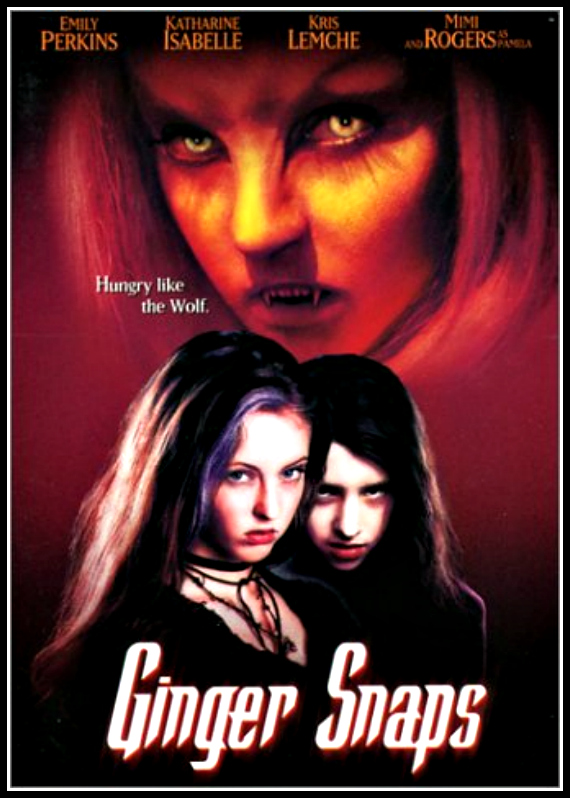
Quickie Horror Review: Ginger Snaps (dir. by John Fawcett)


Werewolf horror films have not enjoyed the same prolific output as zombie or vampire cinema in recent decades. While the undead and bloodsuckers dominate both mainstream and indie horror, lycanthropes remain relatively underrepresented. In the last ten to fifteen years, the number of truly memorable werewolf films is small enough to count on one hand, suggesting that the subgenre is persistently niche despite the creature’s long-standing place in horror folklore. This scarcity makes standout entries even more notable, and among those, two titles remain touchstones for modern audiences: Neil Marshall’s gritty low-budget Dog Soldiers (2002) and the Canadian cult classic Ginger Snaps (2000), which preceded Marshall’s work by two years.

Ginger Snaps is as much a coming-of-age drama as it is a horror film, weaving werewolf mythology into a biting exploration of adolescence, sisterhood, and female identity. Set in a seemingly quiet Canadian suburb, the story follows sisters Ginger and Brigitte Fitzgerald, misfits bound by their shared cynicism, morbid sense of humor, and disdain for high school conformity. Isolated from their peers, they find comfort in their own dark, goth-influenced world, preferring late-night cemetery photography to pep rallies or social gatherings. Their bond is strong, but it faces a severe test one fateful night.

While walking home together, the sisters encounter something in the darkness—an unseen, feral creature that lunges, attacking Ginger with brutal force. The animal’s bite leaves a wound that begins to heal at an unnatural speed, and soon, strange transformations begin to manifest. At first, these changes seem physical—accelerated hair growth, heightened senses, and an insatiable appetite—but as time passes, her personality shifts as well. Ginger grows more assertive, sexually confident, and rebellious, traits that make her magnetic to others yet alienate her from her once inseparable sister.

Director John Fawcett and screenwriter Karen Walton craft the lycanthropy metaphor with unusual clarity: the werewolf curse mirrors puberty’s upheaval. Much like films inspired by the “body horror” sensibilities of David Cronenberg, Ginger Snaps draws unsettling power from portraying transformation as both horrifying and intoxicating. This duality captures adolescence’s contradictions—its liberating confidence and its destabilizing volatility—while reframing the traditional werewolf narrative to center on female experience. For Ginger, the physical metamorphosis coincides with new social dominance, a rejection of her former outsider identity, and an embrace of raw, animalistic freedom. For Brigitte, these same changes signify danger, loss, and the unraveling of the relationship she once relied upon.

The narrative excels in balancing its supernatural premise with human emotional stakes. While a less thoughtful script could have leaned entirely on gore and special effects, Ginger Snaps roots its horror in character dynamics. Walton’s writing, although sometimes heavy-handed in its metaphors, is remarkably strong for a film produced on a modest budget. Themes of loyalty, femininity, sexuality, and transformation run parallel to the literal werewolf plot, creating layers of meaning. This thematic richness ensures that the story resonates beyond its horror trappings, inviting audience discussion in a way that pure creature features often do not.

Central to this success are the performances. Katharine Isabelle embodies Ginger with feral charm, adeptly shifting from sardonic teenager to predatory seductress. Her portrayal never loses sight of the character’s humanity, even as the animal side takes over. Emily Perkins delivers an equally strong performance as Brigitte; her quiet, introverted resolve becomes the emotional anchor of the film, providing a moral counterbalance to Ginger’s volatility. Together, they create a convincing sisterly dynamic where love is tested by fear, jealousy, and survival.

Even the supporting cast contributes meaningfully, with Mimi Rogers standing out as Pamela Fitzgerald, the sisters’ well-intentioned but oblivious mother. Rogers resists the temptation to overplay the role for comic relief, giving Pamela a genuine warmth that contrasts the darkness overtaking her daughters’ lives. This restraint keeps the film grounded, preventing it from becoming camp and ensuring its humor arises naturally from character interactions rather than exaggerated antics.

Visually, Ginger Snaps sidesteps the glossy look of higher-budget Hollywood horror, opting instead for the muted realism of suburban streets and dimly lit interiors. This aesthetic choice enhances the film’s authenticity, making the supernatural intrusion feel more jarring. The creature effects, while limited by budget, are used sparingly and effectively; rather than relying on endless transformation sequences, the filmmakers allow viewers’ imaginations to fill in the most disturbing details. This restraint mirrors the approach of Dog Soldiers, demonstrating that practical effects and atmospheric tension often outshine CGI spectacle.

The film’s release trajectory reflects its cult status. Premiering at the 2000 Toronto International Film Festival, Ginger Snaps did not achieve immediate mainstream attention. Instead, it found its audience gradually, through word of mouth and home video rentals. Horror fans discovered it over time, drawn to its unconventional blend of teenage angst and supernatural dread. In the years since, it has earned a devoted following and spawned two sequels—Ginger Snaps 2: Unleashed (2004) and Ginger Snaps Back: The Beginning (2004)—that expanded the lore while retaining the core themes of the original.

Part of the film’s enduring appeal is that it approaches werewolf mythology with fresh eyes. Traditionally, cinematic werewolves are framed around male protagonists, their curse tied to aggression, uncontrollable rage, or forbidden lust in a way that reflects masculine fears and desires. By centering two teenage girls and equating lycanthropy with female sexuality and transformation, Ginger Snaps subverts these tropes, adding complexity to a genre often dominated by male perspectives. The werewolf becomes a vehicle for exploring how society reacts to—and attempts to control—the emergence of female autonomy.

Dark humor plays an important role as well. The Fitzgerald sisters’ sardonic wit is woven throughout, providing moments of levity even as events grow increasingly grim. These comedic beats arise out of their personalities, underscoring their outsider status and emotional coping mechanisms. The humor and horror work in tandem, preventing the film from collapsing into bleakness while maintaining its bite.

Thematically, Ginger Snaps joins a short list of werewolf films that transcend their genre trappings, akin to An American Werewolf in London (1981) or The Company of Wolves (1984). It invites analysis not just for its scares but for what those scares signify: the fear of change, the allure of liberation, and the strain placed on human bonds by transformation—be it supernatural or psychological. In this respect, it aligns with Cronenberg’s The Fly, where bodily change becomes the central metaphor for loss and evolution.

Two decades later, the film remains a touchstone for horror fans advocating for more diverse and conceptually rich werewolf stories. Its success highlights that the subgenre’s scarcity is not due to audience disinterest but perhaps to a lack of filmmakers willing to innovate beyond conventional “monster hunt” templates. As the horror landscape continues to evolve, Ginger Snaps offers a blueprint for blending creature mythology with compelling character drama, ensuring that lycanthropes can be as emotionally resonant as their undead or vampiric cousins.

For viewers wondering why werewolf cinema lags behind zombie apocalypses and vampire sagas, Ginger Snaps provides an answer: when the subgenre is approached with thematic depth, sharp performances, and genuine character stakes, it can be every bit as compelling—and perhaps even more relatable—than its supernatural peers. In weaving together dark humor, horror, and adolescence’s raw turbulence, the film stands as a rare entry that deserves both its cult following and its place in the broader horror canon.