Film Review: The Eagle Has Landed (dir by John Sturges)


The 1976 film, The Eagle Has Landed, takes place during World War II.

The year is 1943 and, with the war turning against Germany, Heinrich Himmler (Donald Pleasence, in a chilling turn) orders Colonel Max Radl (Robert Duvall) to come up with a plan to kidnap Winston Churchill.  When Radl learns that Churchill is scheduled to visit a small, coastal British village, he recruits a cynical member of the IRA, Liam Devlin (Donald Sutherland), to travel to the village and make contact with a Nazi sleeper agent, Joanna Grey (Jean Marsh).  While Devlin sets up the operation in Britain and falls in love with Molly Prior (Jenny Agutter), Radl recruits disillusioned Colonel Kurt Steiner (Michael Caine) to lead the mission to kidnap Churchill.

At first the village is welcoming to Steiner and his men, who are disguised as being Polish paratroopers.  However, it doesn’t take long for the plan to fall apart.  Soon, Steiner and his men are holding the villagers hostage in a church while battling a group of American soldiers led by the incompetent Colonel Clarence Pitts (Larry Hagman) and Captain Harry Clark (Treat Williams).  Meanwhile, in Germany, Radl learns that Hitler did not actually authorize the mission to kidnap Churchill and that he has been set up as the scapegoat in case the mission fails.

The Eagle Has Landed can seem like a bit of an odd film.  For a film that was released in the same year as Network, All The President’s Men, and Taxi Driver, The Eagle Has Landed feels rather old-fashioned and almost quaint in its storytelling.  This was the final film to be directed by John Sturges, a director who started his career in the 1940s and whose best-known films included The Magnificent Seven and The Great Escape.  Sturges’s direction is efficient but not at all flashy.  (It’s a film that feel like its very much a product of the mid-60s as opposed to the mid-70s.)  The story plays out at a deliberate pace, one that leaves no doubt that the film was based on a novel.  In fact, it sometimes feels as if the film itself should have chapter headings.  The film holds your interest but it’s hard not to feel that a film that should have been an epic action film has instead been turned into something far less ambitious.

Sturges works with an ensemble cast, with no one member of the cast really dominating over the other.  (I guess if the film has a main character, it would be Donald Sutherland’s Liam Devlin but, for all the time that’s devoted to him, he actually doesn’t do that much once the action starts.)  The cast is full of good actors, though a few of them are miscast.  Neither Michael Caine nor Robert Duvall make much of attempt to sound German.  As a member of the IRA, Donald Sutherland sounds as Canadian as ever.  Fortunately, Caine, Duvall, and Sutherland are all strong-enough actors that they can make an impression even with somewhat distracting accents.  Treat Williams is a bit bland as the heroic American but Larry Hagman generates a few chuckles as Williams’s amazingly dumb commanding officer.  The important thing is that ensemble is strong enough to hold the viewer’s attention.

The Eagle Has Landed is an old-fashioned but still entertaining film.  The actors are fun to watch, the action scenes are fairly exciting, and it ends with a clever twist, one that was apparently historically accurate.  It’s a well-done historical melodrama, even if it’s never quite as epic as it aspires to be.
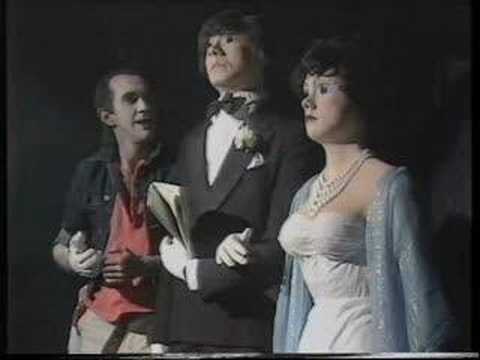
Comedians (1979, directed by Richard Eyre)


“Laugh, you buggers, laugh!”

Set in Manchester, Comedians is about a group of working class men who are enrolled in an evening class for aspiring comedians.  Sammy Samuels (Linal Haft) and Mick Connor (David Burke) both tell jokes about being a member of a minority in England.  (Sammy is Jewish while Mick is Irish.)  George McBrain (Derrick O’Connor) works on a loading dock and tells stereotypically racist and sexist jokes.  Phil and Ged Murray (James Warrior and Edward Peel) are brothers and a tense comedy team.  Phil is desperate to become a star and escape Manchester while Ged is more laid back.  Finally, Gethin Price (Jonathan Pryce) is an aggressive comedian who is willing to take risks on stage.  Teaching the class is Eddie Water (Bill Fraser), a veteran comic who was a star during World War II but who has since faded into obscurity.  Gethin says that he’s lost his edge.

Bert Challenor (Ralph Nossek), a retired stand-up and an old colleague of Eddie’s, is in town.  Challenor is now the President of the Comedy Federation and he is scouting new talent.  Eddie’s class will be performing, between games, at a bingo hall.  Before the performance, Eddie admonishes all of them to stay true to themselves and to not pander to the audience with cheap, racist, or sexist jokes.  However, when Challenor drops by the class, he gives the comedians the opposite advice.  He tells them that getting laughs is the most important thing and the only way to do that is to make the audience like you.  Stick to the acceptable targets, move quickly from one joke to the next, and don’t make any of your humor too personal.

The bingo hall performance is the highpoint of Comedians.  Each student performs and each one has to make their own decision whether to follow Challenor’s advice or to stay true to what Eddie told them.  Some sell out and some don’t.  One act implodes on stage.  The bravest performance of the night is greeted by stony silence from the audience.  Each performance allows a look into the mind of the man telling the jokes, even the ones who are trying to hide behind Challenor’s advice.  After the performance, the students return to the classroom and consider what they’ve done and they’ve become.  Challenor comes to the class to offer some of the comedians a contract while dismissing the others as not being ready or worthy of his time.

Comedians started life as a play by Trevor Griffiths.  It opened in London in 1975, where it was directed by Richard Eyre.  Just as he would in the eventual film, Jonathan Pryce played the role of Gethin Price.  When the play moved to Broadway in 1976, Mike Nichols took over as director and Pryce was the only actor to make the transition from New York to London.  Pryce would go on to win his first Tony for his performance in Comedians.  In 1979, when Comedians was filmed for the BBC’s Play For Today, Richard Eyre returned to direct and Pryce, again, played the role of Gethin Price.

As a debate about what makes comedy “good,” Comedians feels especially relevant today.  The debate about how comedians should view their audience and the role that comedy should play in an unstable world is still going on today.  As opposed to the current argument that comedy should always “punch up,” Challenor encourages all of the students to punch down and to get laughs by appealing to the prejudices of the audience.  As Challenor suggests when giving his notes to the students, it’s more important to get laughs than to actually be funny.  As unsympathetic a character as Challenor is, Comedians does acknowledge that the students who got those easy laughs are also the same ones who going to escape the drudgery of working dead end jobs in Manchester.  Comedians like Gethin Price may stay true to themselves but they’ll also probably never become a star.

Very much a filmed version of a theatrical production, Comedians is undeniably stagey.  But the dialogue and the themes remains sharp and Pryce’s performance is still electrifying.  Unfortunately, several of the BBC’s Play For Today productions have been lost or destroyed but Comedians survived and can be viewed on YouTube.