Deputy Marshal (1948, directed by William Berke)


Deputy Marshal Ed Garry (Jon Hall) is pursuing two bank robbers in Wyoming when he comes across a wounded man.  Harley Masters (Wheaton Chambers) has been shot in the gut but his main concern is holding onto his hat.  Ed takes Harley into town.  They go into the local saloon, where Harley reveals a map hidden in his hat.  He slips the map to Ed before an unseen gunman shoots him a second time.  This time, Harley does not survive.

With the current sheriff “laid up,” Ed decides to stay in town and not only catch the bank robbers but also solve Harley’s murder.  Ed soon finds himself in the middle of a conflict between two rival women (Frances Langford and Julie Bishop) who own ranches and stand to make a lot of money when the railroad comes through.

Deputy Marshal is one of the B-westerns that was produced by Robert Lippert and directed by William Berke in the 40s and 50s.  This one is a step above the usual Lippert production because it combines a murder mystery with the standard western action and there are enough suspects to keep the story interesting.  Jon Hall was best-known for appearing in exotic adventure films, often playing islanders.  His career was in decline when he starred in Deputy Marshal but he makes for a surprisingly believable western hero.  It helps that Hall was older than the typical B-western hero.  His weathered looks make him convincing as an experienced lawman who understood the ways of the west.

Frances Langford, who plays the nicer of the two ranchers, was married to Jon Hall when she appeared in this film.  She gets to sing two songs because this is a Lippert production and Robert Lippert believed that every western should open with a horse chase and should feature at least one song.

While it obviously never won any awards for originality, Deputy Marshal is a better-than-average B-western with an interesting mystery story and a convincing hero.
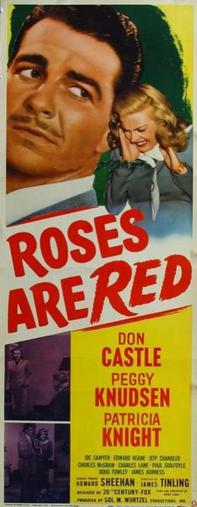
30 Days of Noir #10: Roses are Red (dir by James Tinling)


As the 1947 film, Roses Are Red, begins, Robert A. Thorne (Don Castle) has just been elected to the office of district attorney.

Now, being the horror fan that I am, the thing that I immediately noticed was that the new district attorney had the exact same name as the character played by Gregory Peck in The Omen.  However, Roses Are Red has nothing to do with the son of Satan or the end of the world.  Instead, it’s just a briskly paced tale of swapped identity.

Robert A. Thorne is not just a brilliant lawyer.  He’s also an example of that rare breed, an honest politician.  He ran on a platform of reform and that’s what he’s intending to pursue now that he’s been elected.  As he tells his girlfriend, journalist Martha McCormick (Peggy Knudsen), cleaning up this country isn’t going to be easy but he’s determined to do it.  And the first step is going to be taking down the local mob boss, Jim Locke (Edward Keane).

The wheelchair-bound Jim Locke is a man who prefers to stay in the safety of his penthouse, where he can feed his fish and give orders to his subordinates, all of whom have names like Duke (Charles McGraw), Knuckle (Jeff Chandler), Buster (Paul Guilfoyle), and Ace (Douglas Fowley).  However, his man on the police force, Lt. Rocky Wall (Joe Sawyer), has warned him that this new district attorney might not respond to usual combination of bribes and intimidation.  That’s not good news because there are men who might be willing to testify against Locke in return for a shorter prison sentence.

However, things start to look up when none other than Robert A. Thorne shows up at Locke’s penthouse and says that the honesty bit was all a sham and that he wants to be on Locke’s payroll.  However, Locke soon figures out that he’s not talking to Thorne.  Instead, he’s talking to Don Carney (also played by Don Castle), a career criminal who has recently been released from prison and who just happens to look exactly like Robert Thorne!

Locke and Don come up with a plan that seems foolproof.  What if Knuckle kidnaps Thorne and holds him hostage for a few days?  During that time, Don can study Thorne and learn how to perfectly imitate all of his movements and expressions.  Once the two men are absolutely indistinguishable, Knuckle will murder Thorne and then Don will take his place.

Knuckle manages to kidnap Thorne with absolutely no trouble.  The police, under the prodding of Lt. Wall, announce that Thorne has obviously run off to avoid dealing with the local gangsters.  Don starts the process of studying Thorne but it turns out that the district attorney has a few tricks of his own….

With a running time of only 67 minutes, Roses are Red doesn’t waste any time jumping into its somewhat implausible plot.  Fortunately, the film is so short and quickly paced that most viewers won’t really have time to worry about whether or not the film’s plot actually makes any sense.  This is an entertaining, low-budget film noir, featuring a host of memorable performances and all of the hard-boiled dialogue that you could hope for.  Don Castle does a good job playing both the sleazy Don Carney and the upright Robert A. Thorne.  History nerds like me will immediately notice that, with his mustache and his slicked back hair, Castle bears a distinct resemblance to former Manhattan D.A. and two-time presidential candidate, Thomas E. Dewey.

All in all, Roses are Red is an enjoyable film for fans of old school gangster noir.  Check it out below:


Horror Film Review: The Walking Dead (dir by Michael Curtiz)


In this 1936 film (which has absolutely no relation to the AMC zombie show), Boris Karloff plays John Ellman.  John Ellman is perhaps one of the unluckiest guys ever.  Seriously check this out:

John Ellman was once an acclaimed concert pianist.  However, he was wrongly convicted of killing his wife and spent ten years in prison.  Now that he’s finally been paroled, he can’t get anyone to hire him.  Meanwhile, the judge who originally sent him to prison is in the news for having defied the mob and sentenced a well-known gangster to prison.  The mob is out for revenge but, rather than take the fall themselves, they’d rather frame a patsy.  And who could be a better patsy than a man who everyone already knows has a grudge against the judge?

Nolan (Ricardo Cortez), a crooked lawyer, arranges for Ellman to be given a job.  Ellman is told that he simply has to spy on the judge for a few nights to determine whether the judge is having an extramarital affair.  Ellman agrees and soon finds himself being set up.  The gangsters kill the judge and plant the body in Ellman’s car.  Ellman is arrested and sentenced to die.  It doesn’t matter that there are witnesses who know that Ellman’s innocent.  No one is willing to cross the mafia.

Ellman is convicted and promptly executed but his story isn’t over.  A scientist named Dr. Beaumont (Edmund Gwenn, who later played the man who might be Santa Claus in Miracle on 34th Street) knows that Ellman is innocent.  He takes Ellman’s body and, through an artificial heart and a bunch of other science-y things, he manages to revive Ellman.  John Ellman lives again!  Of course, he’s a bit of a zombie now and he doesn’t have any memory of his former life.  And yet, he instinctively knows who set him up to be executed and he sets out for revenge.

What’s interesting is that Ellman doesn’t kill anyone.  Even after he’s revived and presumably has no concept of right and wrong, John Ellman remains a rather passive zombie.  For the most part, the racketeers die because of how they react to the sight of the previously dead Ellman coming towards them.  For that matter, Beaumont isn’t the typical mad scientist that you might expect to turn up in a film like this.  He’s a benevolent man who was simply doing what he thought was the right thing.  Though the film ends with a warning about playing God, one can’t hep but get the feeling that, unlike Frankenstein, the film is overall very supportive of the idea of reviving the dead.

Directed by Michael Curtiz (who also did Casablanca, Mildred Pierce, The Adventures of Robin Hood, and countless other classic films), The Walking Dead is a combination horror/gangster film.  The film’s plot is a bit too convoluted for its own good but, overall, The Walking Dead works because of Boris Karloff’s performance.  He’s poignantly pathetic as the living John Ellman and then rather chilling as the vengeance-driven, recently revived Ellman.  The film’s most effective scenes are the ones where he just stares at his enemies, fixing them with a gaze that takes no prisoners and offers no hope.  It’s a great performance that elevates an otherwise uneven film.

Crime Does Not Pay: Stanley Kubrick’s THE KILLING (United Artists 1956)


gary loggins's avatarcracked rear viewer

Before Stanley Kubrick became Stanley Kubrick, he made a pair of low-budget crime dramas in the mid-50’s that are standouts in the film noir canon. The second of these, THE KILLING, is a perfect movie in every way imaginable, showing flashes of the director’s genius behind the camera, featuring just about the toughest cast you’re likely to find in a film noir, and the toughest dialog as well, courtesy of hard-boiled author Jim Thompson.

THE KILLING is done semi-documentary style (with narration by Art Gilmore), and follows the planning, execution, and aftermath of a two million dollar racetrack heist. Sterling Hayden plays the mastermind behind the bold robbery, a career criminal looking for one last score. He’s aided and abetted by a moneyman (Jay C. Flippen ), a track bartender (Joe Sawyer ), a teller (Elisha Cook Jr. ), and a crooked cop (Ted de Corsia ). He…

View original post 412 more words

Lisa Reviews An Oscar Nominee: Sergeant York (dir by Howard Hawks)


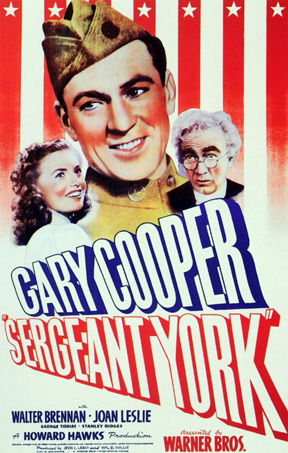
Sergeant_York_1941_Poster

The 1941 film Sergeant York was the American Sniper of its day.  A biopic of Alvin York, one of the most decorated American soldiers of World War I, Sergeant York was not only a huge box office hit but it was a film that celebrated American patriotism in the type of unabashed fashion that you would never see in a film made today.  Though Sergeant York went into production at a time when the United States was officially pursuing a policy of international neutrality, it was released shortly before the Japanese attacked Pearl Harbor and, whether intentionally or not, Sergeant York served as a strong recruiting tool.  According to Wikipedia (and we all know that Wikipedia is never wrong), there were reports of young men going straight from the movie to the nearest military recruitment office.

Clocking in at nearly two and a half hours (and running at least 40 minutes too long), Sergeant York is two films in one.  The second half of the film deals with the military career of Alvin York (Gary Cooper), a plain-spoken and honest Tennessee farmer who, because of his strong religious beliefs, unsuccessfully attempts to register as a conscientious objector.  Forced into the Army, York is, at first, dismissed as a simple-minded hillbilly.  (His fellow soldiers are amused to discover that York doesn’t know what a subway is.)  However, to the shock of his commanding officers, he proves himself to be an expert marksman.  As he explains it, being from the country means that he’s been shooting a rifle his entire life.

On the basis of his skills as a marksman, York is given a promotion but he still says that he refuses to kill.  It’s not until his superior officer reminds him of the sacrifices that past Americans have made that York starts to reconsider his position.  Then, a gust of wind opens York’s bible to a verse about giving unto Caesar what is Caesar’s and York realizes that he can go to war and, if need be, he can kill.

And it’s a good thing that he can!  Because World War I is heating up and York may be the only guy around with the strength and confidence to single-handedly defeat and capture over 170 German soldiers.

The army section of Sergeant York is predictable but well-done.  As you’d expect from a film directed by Howard Hawks, a lot of emphasis is put on how the soldiers work together.  York is portrayed not as being super human but instead as just an honest man who is exceptionally good at his job.  There’s nothing surprising about the second half of Sergeant York but Hawks keeps the action moving and Cooper gives a good performance.

To be honest, I preferred the first half of the film, which examined York’s life before he joined the Army.  When we first meet Alvin York, he drinks too much, he fights too much, and he’s totally irresponsible.  It’s not until he falls in love with Gracie Williams (Joan Leslie) that York starts to change his ways.  The scenes of York in the backwoods of Tennessee had a lively feel to them and it was enjoyable to see Cooper play a somewhat disreputable character.  Cooper seemed to be having fun playing a ne’er-do-well and, in the scenes before York finds God, his bad behavior was a lot of fun to watch.

Considering its success at the box office, it’s not surprising that Sergeant York was nominated for best picture of the year.  While Gary Cooper won the Oscar for best actor, the award for Best Picture went to How Green Was My Valley.