14 Days of Paranoia #3: The Lincoln Conspiracy (dir by James L. Conway)


When it comes to conspiracy theories involving presidential assassinations, the theories surrounding JFK may get all the attention but it’s the theories surrounding the death of Abraham Lincoln are usually far more plausible.

Unless, of course, it’s the theories that are pushed in the 1977 docudrama, The Lincoln Conspiracy.

A mix of documentary-style narration and really cheap-looking historical reenactments, The Lincoln Conspiracy essentially indicts almost everyone who was alive in 1865 as being a part of either the conspiracy or the subsequent cover-up.  Really, it’s remarkable how many historical figures are implicated in this film.

With the Civil War coming to a close, President Lincoln (John Anderson) hopes to pursue a generous reconstruction policy for the former Confederate States.  Secretary of War Edwin Stanton (Robert Middleton), Senator Ben Wade (Dick Callinan), and a host of other are all opposed to this plan, both because they want vengeance and they also want to make as much money as possible off of the Southern cotton fields.  They come up with a plan to impeach Lincoln but, in order to draw up the articles, they have to make sure that Lincoln is not seen for a few days.  When Col. Lafayette Baker (John Dehner) discovers that an actor named John Wilkes Booth (Bradford Dillman) is planning on kidnapping Lincoln, Stanton and his conspirators decide to give Booth their unofficial support.  However, when the plan changes at the last minute and Stanton decides that it would actually be a bad idea to kidnap Lincoln, an angry Booth decides to just kill Lincoln, Andrew Johnson, and William Seward.

Booth succeeds in shooting Lincoln and making his escape.  The other members of Booth’s group all fail in their assignments.  Andrew Johnson becomes president.  Though grievously wounded, William Seward survives.  Booth flees to Canada and …. oh, you thought Booth died?  No, that was just a look alike who was shot by a bizarre soldier named Boston Corbett.  By allowing everyone to believe that Booth was killed, Stanton is able to cover up any role he and his allies played in inspiring the assassination.  Unfortunately, Col. Baker keeps a diary and it seems like he might be planning on revealing the truth but he dies mysteriously before he can.

(And, to give the film some credit, Col. Baker’s sudden death at 41 was an odd one.  And, though it’s not really explored in the film, Boston Corbett, the man who shoot Booth, really was a weirdo who was described by contemporaries as being a religious fanatic who castrated himself and claimed to hear the voice of God.)

It’s a big conspiracy theory that is presented in The Lincoln Conspiracy.  In fact, it’s a bit too big to really be taken seriously.  The film pretty much accuses everyone in Washington of having a part in the assassination.  The film itself has the cheap look of a community theater production and the use of Dr. Samuel Mudd as a narrator only adds to the film’s silliness.  If you’re a fan of gigantic and thoroughly implausible conspiracy theories, as I am, the film is entertaining in its way.  If nothing else, Bradford Dillman certainly looks like how most people probably imagine John Wilkes Booth to have looked.  Otherwise, The Lincoln Conspiracy is far-fetched and not at all realistic, which is why I assume that a lot of people in 1977 probably believed every word of it.

Previous entries in 2025’s 14 Days Of Paranoia:

  1. The Fourth Wall (1969)
  2. Extreme Justice (1993)

Late Night Retro Television Review: Highway to Heaven 3.10 “Man to Man”


Welcome to Late Night Retro Television Reviews, a feature where we review some of our favorite and least favorite shows of the past!  On Thursdays, I will be reviewing Highway to Heaven, which aired on NBC from 1984 to 1989.  The entire show is currently streaming on Tubi and several other services!

This week’s episode made me cry.

Episode 3.10 “Man to Man”

(Dir by Michael Landon, originally aired on November 26th, 1986)

As so often happens on this show, the episode begins with Mark visiting an old friend.  Luke Morgan (Joe Dorsey) grew up with Mark but, while Mark became a blue collar policeman, Luke went on to become a fabulously wealthy tycoon.  That actually seems a bit odd to me.  I mean, why has Mark never mentioned having a millionaire friend before?  All of the times that Jonathan and Mark have had to deal with other millionaires, Mark has always acted like he’s had no experience being around wealthy people.  Now, suddenly, we discover that Mark just happens to have a millionaire friend?

Anyway, Luke invites Jonathan and Mark to stay at his mansion and that’s a good thing because Luke is their mission for the week.  Luke devoted so much time to building up his business that he often wasn’t around when his son, Gary (Lee Montgomery, the kid who got crushed by the chimney in Burnt Offerings), was growing up.  Now Gary is in his twenties and his relationship with his father is strained.  Gary spends all of time lifting weights and working with his computers.  Luke wants to take a road trip with Gary but Gary refuses.  Mark makes a bet with Gary.  If Mark can lift more weight than Gary, Gary will go on the trip.  Jonathan temporarily gives Mark “the stuff.”  Mark wins the bet.  Gary goes on the trip!

Luke, it turns out, is dying.  He has Leukemia and he doesn’t have much time left.  He wants to patch things up with his son before he dies but he doesn’t want Gary to know that he’s dying.  Mark, realizing that Gary needs to know, tells Gary anyway.  Gary accuses Mark of lying but then he realizes that his father actually is dying.  Gary stops being a brat and he and his father enjoy their last road trip together.  Eventually, Gary reveals that he knows the truth.  He knows that Luke is dying.  Gary finally says that he loves his father and Luke says the loves his child.

And that’s pretty much the episode!  This was a pretty simple episode but it still made me cry.  It makes me think about all the people in my life who have passed on.  Every moment that you have with someone is precious and I think that people tend to take those moments for granted.  You never know when someone could get into a wreck while trying to drive home from the store.  I know when my Dad was in his car accident last May, I never expected him to die in August.  I’d give anything to have those final moments back.

This episode is sentimental and earnest and heavy-handed but it is also an example of what Highway to Heaven does so well.


COWARD OF THE COUNTY – the boundary pushing country song turned into a TV movie


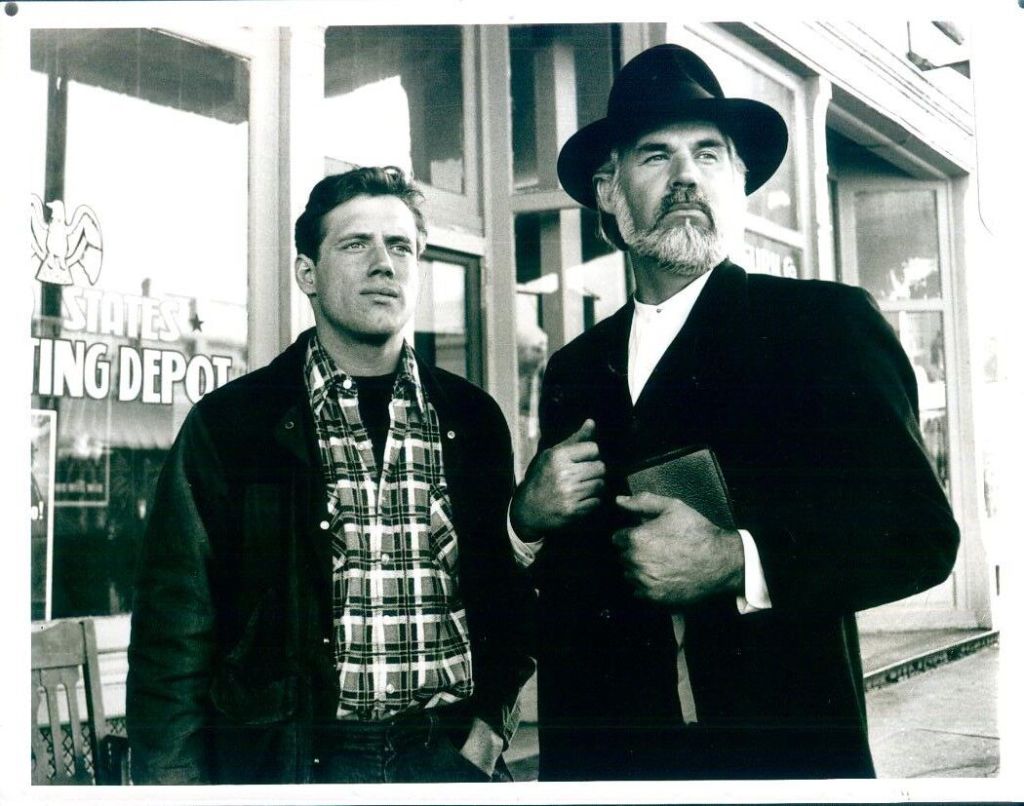
When I was a kid our family loved Kenny Rogers.  I remember listening to songs like “Lucille,” “The Gambler,” “Daytime Friends,” “She Believes in Me,” and “Lady” on my dad’s vinyl records. I would have been no older than second or third grade, and me and my siblings would really belt out “You picked a fine time to leave me, Lucille.” But the one Kenny Rogers song that affected me more than any of the others was the “Coward of the County.” If you know the lyrics of the song, then you know what I’m talking about.  As a kid of around 8 years old, the story about Tommy, Becky and the Gatlin Boys was a little more mature than what I was used to. I remember not even being sure what exactly happened to Becky, but I knew it was bad.  I also remember a TV movie based on the song starring Kenny Rogers, so you know our family watched it.

The TV movie premiered in 1981 and stars Kenny Rogers as Matt, a preacher who likes to drink, gamble, and cavort with the ladies. His nephew Tommy (Fredric Lehne) is a nice young man who already seems to have a bit of a reputation as someone you can push around. We learn this about Tommy at the town Christmas carnival when Jimmy Joe Gatlin wins a cake at a cake-walk (do y’all remember those things?) and proceeds to shove it in Tommy’s face. Tommy grabs Jimmy Joe by the arm to make him stop, but then he walks away without fighting back. It’s right after this confrontation between Tommy and Jimmy Joe that Matt makes an announcement to the crowd that the Japanese have just bombed Pearl Harbor, placing our story in 1941. Immediately the young men of the town, including Jimmy Joe Gatlin, start making their plans to join the military and head out for boot camp. And I tell you, this Jimmy Joe is a real jerk. Before he leaves, he tells the local beauty Becky that she’s “his” girl whether she likes it or not even though she’s telling him she’s not his girl. Jimmy Joe also stops to call Tommy a coward and ask him why he’s standing there with the men when he hasn’t even joined the military. We soon learn that Tommy has a very specific reason for not fighting. You see, his dad died in prison. He had to go to prison for killing another man in a fight, and before he passed he away, he asked his son to promise him that he would never fight. With the bully Jimmy Joe out of town, Tommy and Becky begin seeing each other and fall in love. That part of his life is happy, but everywhere Tommy goes he’s reminded that young men are fighting and dying for their country while he’s still at home. He really wants to keep his promise to his dad not to fight, but he feels he should fight for his country. After eight weeks, Jimmy Joe returns and tries to reclaim Becky as his girl. Becky tells him that she loves Tommy and they are getting married. Jimmy Joe doesn’t take the news well so he heads out and starts drinking. Full of drunken courage, he and his brothers head back to Becky’s house and he forces himself on her. When Tommy finds out what happened to Becky, he’s finally had enough and he confronts Jimmy Joe Gatlin and his brothers. He breaks his promise to his dad and beats the crap out of the Gatlin brothers. As the words of the song would say, “sometimes you have to fight to be a man.” Soon after, Tommy enlists in the service because with Becky he truly has something at home worth fighting for.

I’ll just start out by addressing the elephant in the room that Becky was raped by Jimmy Joe, and that’s what it took for Tommy to finally fight. I sure wish the cake to the face or the many times the Gatlin boys called him yellow would have been enough, but unfortunately it took something that horrible. I didn’t really understand all of this in 1981, and it’s pretty crazy that a mainstream country song told this story to be honest. Also, you might be surprised that Kenny Rogers is more of a peripheral character as the wandering preacher of the story. The main character, Tommy, is played by Fredric Lehne. He’s a likable actor who’s still very busy to this day on TV. I enjoyed seeing Lehne because he was very good in a movie that was filmed here in Arkansas called GREATER back in 2016. The movie tells the tragic, but inspirational story of Brandon Burlsworth, a former walk-on who became an All-American offensive lineman for the Razorbacks. Sadly, he died in a car accident in 1999 after being drafted to play professional football for the Indianapolis Colts. Lehne played an important role as a coach who helped get the very best out of Burlsworth. As a frequent attendee of Razorbacks home football games, I watched Burlsworth play many times in person and the whole state loved him. The news was devastating to our state, and the movie about his short, but very meaningful life is very special to me.

There were a couple of other things that I found interesting about COWARD OF THE COUNTY. First, I wondered if it was just a coincidence that the bad guys were the Gatlin Boys, especially considering that Larry Gatlin and his brothers were contemporary country music stars along with Kenny Rogers. According to the songwriters, they thought the Gatlin boys had a great ring to it and worked great for the song, better than anything else they could come up with. According to Larry Gatlin, he thinks they should have chosen a different name, but he was also a good friend with Kenny Rogers. Finally, the movie was partially filmed in Covington, GA, which has a very unique Courthouse with a large clock tower. Covington, which is about 35 miles east of Atlanta, is affectionately known as the “Hollywood of the South” due to the large number of movies and TV shows filmed there. To name just a few, THE CANNONBALL RUN, MY COUSIN VINNY, and the TV show THE VAMPIRE DIARIES were all filmed in Covington. My wife and I stayed the night in Covington on our way to Myrtle Beach in 2020 and visited the downtown area before we headed on. As soon as I saw that clock tower in COWARD OF THE COUNTY, I knew that it was filmed in Covington.

Late Night Retro Television Reviews: Highway to Heaven 1.2 “Pilot: Part Two”


Welcome to Late Night Retro Television Reviews, a feature where we review some of our favorite and least favorite shows of the past!  On Thursdays, I will be reviewing Highway to Heaven, which aired on NBC from 1984 to 1989.  The entire show is currently streaming on Tubi and several other services!


This week, we finish up the pilot for Highway to Heaven, with Jonathan revealing the true nature of his job to Mark and the old people heading to the horse races!

Episode 1.1 “Highway to Heaven: Part Two”

(Dir by Michael Landon, originally aired on September 19th, 1984)

The second half of the pilot for Highway to Heaven opens with things looking up at the retirement community.  Everyone is enjoying the new garden.  There’s a new sense of community amongst the residents.  Even Estelle (Helen Hayes) has finally come out of her room and is now taking care of the dog that Jonathan previously gave her.  Sidney Gould (John Bleifer) is especially happy to see Estelle out and about, especially after Estelle agrees to have dinner with him.

The only person who is not happy with the changes that Jonathan has brought to everyone’s lives is Mark Gordon.  Mark is still suspicious of Jonathan’s motives and he’s not happy that his sister, Leslie (Mary McCusker), is falling for a man who she really knows nothing about.  When Jonathan is having dinner at Leslie’s apartment, Mark breaks into Jonathan’s apartment and discovers that Jonathan owns nothing.  There’s not even a toothbrush in the bathroom.

Jonathan catches Mark in his apartment and, after Mark demands to know just who exactly Jonathan is, Jonathan explains that he works for “the Boss.”  He travels from location to location, helping people who need help.  When Mark demands to know who the Boss is, Jonathan can only look heaven-ward.

Needless to say, Mark is not at all convinced that Jonathan is an angel.  But there’s an even bigger problem to deal with!  Mr. Sinclair (Joe Dorsey), the owner of retirement home, has sold the land to a developer!  Everyone who worked there is now out of a job and everyone who lived there has been given just a few days to move out and find somewhere else to live.

When Jonathan pays Mr. Sinclair a visit, he discovers that Sinclair has spent his life making money in order to get over the shame of being rejected by his high school love.  Unfortunately, she’s now dead and Sinclair no longer cares about anyone.  Still, Jonathan is able to convince Mr. Sinclair to give him a chance to raise enough money to buy the retirement home.

Mark’s suggestion is that they take the money that they already have and bet it at the tracks.  Jonathan is not sure if the Boss would like him gambling but, in the end, he agrees to Mark’s plan.  At the tracks, it first appears that the horse that the old people put their money on has lost.  But then then Sidney discovers that the person at the betting window accidentally gave him the wrong ticket and — it’s a miracle!  They win the money!

The old people are able to buy their retirement home and Mark is now convinced that Jonathan is angel.  In fact, Mark is so convinced that he insists on driving Jonathan around the country and helping him out.

(Don’t worry about Leslie.  Though she’s upset when Jonathan leaves, a handsome and single man immediately moves in next door to her.)

This episode ends with Jonathan getting into Mark’s car and the two of them driving off, down the highway.

Wow, this was an earnest show.  Seriously, there’s not a hint of sarcasm or snarkiness to be found in this episode, which I imagine explains why this show is still airing on the retro stations and streaming on a hundred different sites.  To an extent, it’s easy to be dismissive of a show where a bunch of quirky old people got to the race track to win enough money to be able to stay together in their retirement home.  There’s nothing subtle not particularly surprising about any of it.  I mean, we know there’s no way Helen Hayes and that adorable dog are going to lose their home!  But this episode was so achingly sincere in its approach that it worked.

We’ll see if it continues to work next week!

Late Night Retro Television Reviews: Highway to Heaven 1.1 “Pilot: Part One”


Welcome to Late Night Retro Television Reviews, a feature where we review some of our favorite and least favorite shows of the past!  On Thursdays, I will be reviewing Highway to Heaven, which aired on NBC from 1984 to 1989.  The entire show is currently streaming on Tubi and several other services!

Highway to Heaven is one of those old shows that, decades after its final episode, still always seems to either be airing or streaming somewhere.  The show’s premise was a simple one.  Jonathan Smith (Michael Landon) was an angel who had been sent to Earth to help people.  Working with him was a retired cop named Mark Gordon (Victor French).  Together, they drove across the country and met a different guest star every week.

Though the show aired its final episode over 30 years ago and both of the stars have since passed on, Highway to Heaven remains popular in both syndication and streaming.  From the few episodes that I’ve seen, it appears that the show’s main appeal was just how unabashedly sentimental it was.  For people living in a cynical age, the show is a throwback to a simpler time.  Of course, I imagine that some people also find it to be a fairly campy show.  There’s nothing subtle about the messaging of Highway to Heaven. 

Anyway, it seems like a good show to review for Retro Television Reviews, so here we are.  Let’s head down that highway!

Episode 1.1 “Highway to Heaven: Part One”

(Dir by Michael Landon, originally aired on September 19th, 1984)

In a small town in Arizona, there’s a retirement community that is full of people who are in need.

For instance, Estelle Wicks (Helen Hayes) hasn’t left her room in years.  She’s convinced that her daughter is going to come to get her at any minute, even though everyone else at the community tries to get her to understand that her daughter hasn’t been by to see her in years.  That said, at least Estelle still has some hope.  Everyone else in the community appears to be resigned to spending all of their time indoors, watching television and waiting for the end.

Mr. Haskins (John O’Leary), the owner of the community, is struggling to pay the bills and is thinking of selling the retirement home to a group of land developers.  Mr. Haskins rarely smiles and hardly ever interacts with the people living at the community.  He doesn’t want them going outside or doing any special activities because he’s worried about potential lawsuits.  He’s not willing to spend the money necessary to even make the community look like an inviting place to live.

Mr. Haskins’s assistant, Leslie Gordon (Mary McCusker), is a lonely woman who lives in an apartment with her brother, Mark (Victor French).  Mark is a former cop who refuses to trust anyone and who can’t hold down a job.  He’s developing quite a drinking problem and spends most of his time either watching television and having a beer or going down to the local bar and having even more beer.

No one, and I mean no one, in this town appears to be happy.  But then a mysterious drifter named Jonathan Smith (Michael Landon) hitchhikes into town and applies for a job as a maintenance worker at the retirement community.  As he explains to Mr. Haskins, he doesn’t have any references but he’s willing to work without a salary for a month in order to prove that he can handle the job.  Mr. Haskins hires Jonathan, who immediately plants a flower garden and gets to know the residents at the retirement community.  He even gets Estelle to agree to take care of a puppy.

With Jonathan’s gentle encouragement, even Leslie starts to enjoy life a little bit more.  When Jonathan shows up one morning with a bicycle, Leslie rides it to work.  When Leslie asks Jonathan how he could afford the bike, he says that a friend gave it to him.  When she asks how Jonathan could afford to plant all of the flowers for the retirement home, he says that a friend helped out.  For a drifter who just came to town, Jonathan certainly seems to have a lot of friends!

This raises the concern of Mark, who thinks that Jonathan must be a conman of some sort.  He sets out to investigate just exactly who Jonathan is.  He first stop is the local bicycle shop, where the owner says that he’s never met a Jonathan Smith.  And then — the episode ends!  “TO BE CONTINUED” reads the title card.

It’s a rather abrupt ending, undoubtedly the result of the pilot originally being aired as a two-hour movie.  As often happens, the pilot was split into two parts for syndication.  Of course, the viewer already knows that Jonathan is an angel who has been sent to Earth to help people but the first episode of the series ends with Mark still convinced that Jonathan is just a con man.  I assume he’ll find out the truth next week.

As far as first episodes go, this one is hard to judge because it’s obviously incomplete.  That said, the pilot’s unapologetic earnestness is definitely its strongest trait.  Early on, Jonathan says, “Kindness doesn’t cost a thing,” and Michael Landon delivers the line with such sincerity that he makes it work despite the fact that it’s also a cliché.

Anyway, next week, we’ll finish up the pilot and see if Mr. Haskins will ever learn how to run a retirement community.  Hopefully, Estelle will finally come out of her room as well.  And, most importantly, we’ll see how Mark went from thinking Jonathan was a con artist to traveling around the country with him.

Until then, be kind.