Film Review: Detective Knight: Independence (dir by Edward Drake)


The Detective Knight trilogy comes to a close with Detective Knight: Independence.

If you haven’t been keeping up with the wonderfully pulpy adventures of Detective James Knight, here’s a quick refresher of what happened last year.  First off, in Detective Knight: Rogue, Detective Knight (Bruce Willis) sought vengeance after his partner, Fitz (Lochlyn Munro), was seriously wounded during a robbery.  Fitz recovered but not before Knight has dispensed some vigilante justice of his own.  The surviving bad guys went to prison but sadly, so did Detective Knight.

Fortunately, Detective Knight was released from prison in Detective Knight: Redemption.  He was released because a cult of people who dressed up like Santa Claus and who chanted, “Ho!  Ho!  Ho!” while committing their crimes were terrifying the city.  With the help of Detective Knight, the police were able to stop the Santa Cult.

In Detective Knight: Independence, Knight is once again on the police force.  He and Fitz are still quick to shoot first and ask questions later.  That said, Knight is trying to make amends with his estranged wife and spend more time with his daughter.  That’s not going to be easy, though, because there’s a new threat in town …. just in time for the 4th of July!

Dezi (Jack Kilmer) is an EMT who has always dreamt of being a cop.  Unfortunately, he’s never been able to qualify for the force.  Even when he shows up at a cop bar and just tries to have a beer in peace, the bartender approaches him with a baseball bat and two detective toss him out of the place.  When Dezi is subsequently fired for refusing to give aid to a wounded man (the man in question was a bank robber and Detective Fitz actually told Dezi to go help a bleeding civilian in the bank and leave the robber to die), Dezi snaps.  First, Dezi steals a uniform, a badge, and a gun.  After dispensing some vigilante justice on some muggers, Dezi decides that he would like to rob a bank.  Yes, you read that correctly.  In just a matter of hours, Dezi goes from pretending to be a cop to pretending to be a criminal.  As the film progresses, it starts to become pretty clear why the police force didn’t want to hire this guy in the first place.

Unfortunately, for Dezi, his fellow EMT and occasional lover, Ally (Willow Shields), had a connection to Detective Knight and soon, Knight is on Dezi’s trail.  It all leads to a 4th of July confrontation on a baseball field.

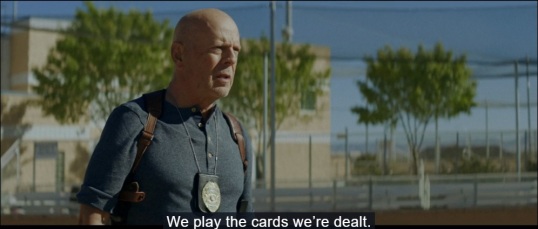
Even though Bruce Willis is playing the title character, he’s not present for much of Detective Knight: Independence.  As with the other two Detective Knight films, it’s obvious that Willis was only on set for a day or two.  While Willis is still a physically imposing actor, there’s none of the wise guy swagger that made Willis a star.  Instead, Detective Knight is a fairly grim character.  As always, it’s a bit difficult to watch Willis in films like this, especially with the knowledge of his recent health struggles.  That said, the Detective Knight films are definitely the best of Willis’s final films and, despite the limitations imposed by his health, Willis comes across well in them.  Considering that this is Willi’s final film, certain lines hit in a way that they otherwise might not.
As with the previous Detective Knight films, the majority of the screen time is given over to the man that the Detective is pursuing.  Jack Kilmer gives a strong performance as the unbalanced Dezi.  When he first appears, he’s almost a sympathetic character.  The cops were being bullies when they kicked him out of their bar.  His boss was being unreasonable when she announced that, rather than suspend him, she was just going to fire him because she didn’t like his attitude.  When Dezi first puts on his stolen badge and uniform, it’s hard not to sympathize with his happiness because he finally has what he wants.  But almost immediately, the power goes to his head and he loses control.  He becomes a frightening character but still, it’s hard not to feel sorry for him as he yells, “I’m not the bad guy!”  Of course, Dezi is the bad guy and the tragedy of his character is that he’ll never be able to understand why that is.

He’s right, you know.

For those of us who remember him in films like Die Hard, Pulp Fiction, and The Sixth Sense, late-era Bruce Willis films can be difficult to watch and I understand and respect why some people simply can’t bring themselves do it.  And, obviously, several of Willis’s later films do leave one feeling as if the actor has been exploited by filmmakers who cared less about his legacy and more about making money off of his name.  That said, the Detective Knight films do not feel exploitive, certainly not in the way that many of his 2022 films did.  Instead, the trilogy serves as a tribute to Willis and his status as one of the world’s most popular movie stars.  As pulpy as it may be, Detective Knight: Independence allows Bruce to go out on a good note.

Film Review: Detective Knight: Redemption (dir by Edward Drake)


2022’s Detective Knight: Redemption picks up where Detective Knight: Rogue ended.

After having been arrested in front of his wife and daughter, football player-turned-criminal Casey Rhodes (Beau Mirchoff) has been sent to prison.  In the same prison is Rhodes’s nemesis, former Detective James Knight (Bruce Willis).  Knight has been imprisoned for murdering the two villains from Detective Knight: Rogue, finally answering the age-old question of what happens to an action hero after the end credits roll.  In prison, both men meet Ricky Conlan (Paul Johansson), a former convict who is now a chaplain.  Conlan is big on encouraging everyone in prison to set aside their differences and come together as one big community of sinners seeking redemption.

Meanwhile, as Christmas approaches, New York City finds itself under siege.  Terrorists are dressing up like Santa Claus and robbing banks, chanting “Ho!  Ho!  Ho!” as they do so.  Their leader alternates between handing out candy canes and tossing live grenades at people.  He becomes known as The Christmas Bomber and he announces that he’s only robbing the banks to get back at the 1%.  He’s a revolutionary, you see.

He’s also a prison chaplain.  That’s right, Ricky Conlan is the Christmas Bomber and he’s decided that Casey is going to be newest member of his operation!  He even stages a jailbreak, releasing the entire population of Riker’s onto the streets of New York.  The only prisoner who voluntarily chooses not to escape is Detective Knight.  Impressed by his refusal to escape when he had the chance, NYPD Capt. Anna Shea (Miranda Edwards) arranges for Detective Knight to be released from prison so that he can head up the search for Conlan and the commie Santas.

Meanwhile, Knight’s partner, Eric Fitzgerald (Lochlyn Munro), has traveled to New York to help out with the investigation.  In the previous movie, when we last saw Detective Fitzgerald, he was in the hospital after having been shot by Casey Rhodes.  Fitzgerald may be in a wheelchair now but he’s still good with a gun and he also mentions that the doctors think that he should be able to walk again by Memorial Day.  Fitzgerald doesn’t let being in a wheelchair prevent him from investigating and confronting New York’s power brokers, including the oily mayor (John Cassini).

Detective Knight: Redemption was one of the films that Bruce Willis filmed shortly before the announcement that he would be retiring from acting.  Though he’s definitely the main attraction here and he still looks convincing firing a gun during the film’s finale, Willis’s screen time is limited and it’s also obvious that a stand-in was used for a few of the scenes that involved his character.  There are a handful of fleeting moments where we get to see some hints of the wiseguy charisma that was Willis’s trademark but, for the most part, Detective Knight is written to be a man of few words.  When he made this film, Willis still had his screen presence but it’s still difficult to watch with the knowledge that he was struggling with his health during filming.

With Willis largely sidelined, it falls to Munro, Johansson, and Mirchoff to keep the action moving and all three of them prove themselves to be up to the challenge.  Johansson, in particular, is so wonderfully over-the-top in his villainy that it’s impossible not to be entertained whenever he’s onscreen.  The film’s plot does have a few interesting twists.  Conlan presents himself as being a revolutionary who is dedicated to bringing down the 1% but Casey eventually realizes that, much like Die Hard‘s Hans Gruber, he’s ultimately just a greedy thief.  Conlan’s gang is a mix of hardened escaped prisoners who are looking for revenge on the system and confused kids who quickly discover that the revolution is a lot scarier than they thought it would be.  The story may sometimes be too quick to ask the viewer to suspend their disbelief but the plot moves quickly and, just as he did with Gasoline Alley, director Edward Drake doesn’t allow the film’s low budget to prevent him from choreographing a few impressive action scenes.

Ultimately, of course, the main reason to see Detective Knight: Redemption is that it features a bunch of Santa Clauses chanting “Ho!  Ho!  Ho!” while robbing banks.  Who can resist that?

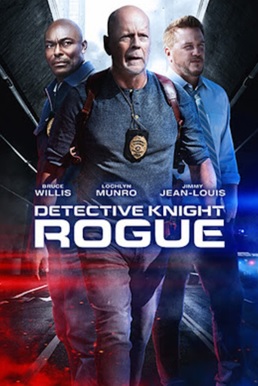
Film Review: Detective Knight: Rogue (dir by Edward Drake)


Once upon a time, Casey Rhodes (Beau Mirchoff) was a football star.  He was a quarterback.  Everyone expected great things from him.  He was going to be the next Tom Brady.  But then a knee injury took him out of the game and a subsequent drug addiction took him out of mainstream society.  Now, Casey makes his living pulling off robberies.  He may be a criminal but he’s not a bad-hearted one.  He may carry a gun but he tries not to shoot anyone who doesn’t shoot at him first.  Working with him are a former baseball player named Mike (Trevor Getzky) and Nikki (Keeya King), who is the smartest member of the crew.

Despite Casey’s attempts to do his job with as little violence as possible, a gunfight does break out during one robbery in Los Angeles.  When Detectives James Knight (Bruce Willis) and his partner, Eric Fitzgerald (Lochlyn Munro), interrupt the robbery, Fitzgerald ends up getting shot multiple times as Casey and his crew make their escape.  With Fitzgerald in the hospital, Knight decides to follow the crew to New York and take out both them and their boss, a former Internal Affairs officer named Winna (Michael Eklund).  It turns out that there’s a history between Knight and Winna.  Knight wants his revenge on Winna but, at the same time, Winna knows some dark secrets from Knight’s past.

Though it works as a stand-alone film, 2022’s Detective Knight: Rogue is actually the first part of a trilogy that follows the adventures of Detective Knight.  (Detective Knight: Redemption was released at the end of 2022 while Detective Knight: Independence came out last month.)  The Detective Knight films were among the last of the movies in which Bruce Willis appeared before announcing his retirement.  It can be strange to watch Willis’s final films, knowing what we know about what he was going through at the time that he made them.  Though he’s definitely the star of the film, Willis is used sparingly in Detective Knight: Rogue and there’s little of the cocky attitude that we tend to associate with Willis’s best roles.  Instead, he’s a grim avenger, determined to get justice for both his partner and himself.  Willis is convincing in the role, even if the film is edited in such a way that the viewer gets the feeling that a stand-in may have been used for some of the long-shots involving Detective Knight.  That said, Willis still looks convincing carrying a badge and a gun and it’s nice to see a Willis film where he’s again playing a hero instead of a villain.

As the football player-turned-thief, Beau Mirchoff gets more screentime than Willis but, fortunately, Casey is an interesting character and Mirchoff gives a strong performance as a criminal who would rather be a family man and who is desperately looking for a way to make up for the mistakes of his past.  Towards the end of the film, he does a flawless job delivering a surprisingly well-written monologue about how he went from being a football star to being a common thief.  Mirchoff’s strong performance adds a good deal of ambiguity to the film.  The criminals aren’t necessarily that bad at heart and, as we learn, the good guys haven’t always been angels in the past.  Detective Knight: Rogue becomes more than just another low-budget thriller.  It becomes a meditation of regret and redemption.

Detective Knight: Rogue took me by surprise.  As directed by Edward Drake (who was also responsible for another effective late Bruce Willis starrer, Gasoline Alley), it’s an intelligent thriller and it’s one that pays tribute to Bruce Willis as an action icon.  It’s proof that a good story can sometimes be found where you least expect it.

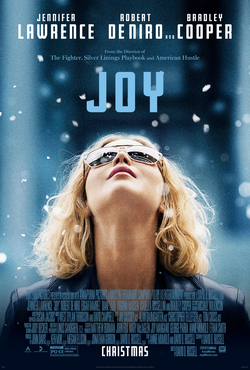
Film Review: Joy (dir by David O. Russell)


Joyfilmposter

Hi there and welcome to 2016!

Today was the first day of a new year so, of course, I had to go down to the Alamo Drafthouse and see a movie.  What was the title of the first movie that I saw in a theater in 2016?

Joy.

Despite the fact that Joy has gotten some seriously mixed reviews, I had high hopes when I sat down in the Alamo.  After all, Joy represents the third collaboration between director David O. Russell and one of my favorite actresses, Jennifer Lawrence.  (Their previous collaborations — Silver Linings Playbook and American Hustle — happen to be two of my favorite films of the past 5 years.)  Add to that, Joy has been advertised as being a tribute to a real-life, strong-willed woman and I figured that, at the very least, it would provide a nice alternative to the testosterone-crazed movies that I’ve recently sat through.  And finally, Joy had a great trailer!

Sure, there were a few less than positive signs about Joy.  As I mentioned before, the majority of the reviews had been mixed and the word of mouth was even worse.  (My friend, the sportswriter Jason Tarwater, used one word to describe the film to me: “Meh.”)  But what truly worried me was that Sasha Stone of AwardsDaily absolutely raved about the film on her site and that’s usually a bad sign.  Let’s not forget that this is the same Sasha Stone who claimed that Maps To The Stars was one of the best films ever made about Hollywood.

And, to be honest, I had much the same reaction to Joy that I had to Map To The Stars.  I really wanted to love Joy and, occasionally, there would be a clever bit of dialogue or an unexpected directorial choice and I would briefly perk up in my seat and think to myself, “Okay, this is the film that I wanted to see!”  But, for the most part, Joy is a disappointment.  It’s not so much that it’s bad as it’s just not particularly great.  For the most part, it’s just meh.

But let’s talk about what worked.  Overall, this may be one of Jennifer Lawrence’s lesser films but she gives a great performance, one that reminds us that she truly is one of the best actresses working today.  I’ve read some complaints that Lawrence was too young for the title role and, to be absolutely honest, she probably is.  She looks like she could easily go undercover at a high school and help Jonah Hill and Channing Tatum bust drug dealers.  But, at the same time, she projects the inner weariness of a survivor.  For lack of a better term, she has an old soul and it comes across in her films.

In Joy, she plays Joy Mangano, a divorced mother of two who lives in upstate New York.  Her mother (Virginia Madsen) lives with Joy and spends all of her time watching soap operas.  Joy ex-husband, a lounge singer named Tony (Edgar Ramirez), lives in the basement.  Meanwhile, her grandmother (Diane Ladd, who narrates the film) is always hovering in the background, offering Joy encouragement and optimism.  At the start of the film, Joy’s cantankerous father (Robert De Niro) has also moved into the house.  Joy, who was the valedictorian of her high school, has got a demeaning job working as a flight booker at the airport.

(“What’s your name?” one rude customer asks, “Joy?  You don’t seem very joyful to me…”)

How stressful is Joy’s life?  It’s so stressful that she has a reoccurring nightmare in which she’s trapped in her mother’s favorite soap opera and Susan Lucci (cleverly playing herself) tells her that she should just give up.

However, as difficult as life may get, Joy refuses to take Susan Lucci’s advise.  She invents a miraculous mop known as the miracle mop and eventually becomes a highly successful businesswoman.  Along the way, she makes her television debut on QVC and becomes a minor celebrity herself…

The film’s best scenes are the ones that deal with Joy and QVC.  These scenes, in which the inexperienced Joy proves herself to be a natural saleswoman, are the best in the film.  These scenes are filled with the spark that I was hoping would be present throughout the entire film.  Of course, it helps that these scenes also feature Bradley Cooper as a sympathetic television executive.  This is the third time that Bradley Cooper and Jennifer Lawrence have acted opposite each other and there’s an immediate chemistry between them.  In this case, it’s not a romantic chemistry (and one of the things that I did appreciate about Joy was that it didn’t try to force a predictable romance on the title character).  Instead, it’s the type of mutual respect that you rarely see between male and female characters in the movies.  It’s a lot of fun to watch, precisely because it is so real and unexpected.

But sadly, the QVC scenes only make up a relatively small part of Joy.  The rest of the film is something of a mess, with David O. Russell never settling on a consistent tone.  At times, Joy feels like a disorganized collection of themes from his previous films.  Just as in The Fighter and Silver Linings Playbook, we get the quirky and dysfunctional family.  Just as in American Hustle, we get the period detail, the Scorsese-lite soundtrack, and the moments of cynical humor.  There’s a lot going on in Joy and, at time, it doesn’t seem that Russell really knows what to do with all the theme and characters that he’s mixed into the movie.  I found myself wondering if he truly understood the story that he was trying to tell.

Finally, at the end of the film, Joy visits a business rival in Dallas, Texas.  Let’s just say that the film’s version of Dallas looks nothing like the city that I know.  (The minute that the scene cut from her ex-husband discovering that Joy had left to a close-up of a Bar-B-Q sign, I let out an exasperated, “Oh, come on!”)  I suppose I should be happy that Russell didn’t have huge mountains in the background of the Dallas scenes but seriously, would it have killed anyone to do a little research or maybe hop on a plane and spend a day or two filming on location?

(After all, if Richard Linklater or Wes Anderson decided to set a movie in David O. Russell’s home state of Massachusetts, I doubt that they would film the Boston scenes in El Paso….)

Joy features great work from Jennifer Lawrence and Bradley Cooper and it tells a story that has the potential to be very empowering.  But, when it comes to the overall film … meh.

Sorry Jen