
1945’s The Vampire’s Ghost takes place in the African port of Bakunda. It’s the colonial period and the port is full of not just adventurers and local plantation owners but also all sorts of disreputable people who are looking to disappear from civilization for a while. A series of murders have recently rocked the port. Victims, almost all of them women, have been discovered drained of blood. The natives claim that it is the work of vampire but the colonialists dismiss that as superstition. Plantation owner Thomas Vance (Emmett Vogan) says that there is no such things are vampires. Thomas’s daughter, Julie (Peggy Stewart), says that there is no such things as vampires. Julie’s boyfriend, Roy (Charles Gordon), says that there is no such thing as vampires. Mysterious casino owner Webb Fallon (John Abbott) says that …. well, actually, Webb’s thoughts on the subject are a bit less certain.
Webb Fallon is known to be an expert on the occult and voodoo. The natives consider him to be a vampire and it turns out that they’re right! After he is wounded in an assassination attempt, Fallon is forced to reveal the truth of his existence to Roy. He also puts Roy under his psychic command, forcing him to serve as Fallon’s servant while Fallon proceeds to kill several people. Can Father Gilchrest (Grant Withers) save Roy from Fallon’s control and also prevent Fallon from turning Julie into his eternal vampire bride? And why exactly did Thomas think it was a good idea to buy a plantation next to the infamous Temple of Death in the first place?
It may not sound like it from the plot description but The Vampire’s Ghost is actually a fairly interesting take on the traditional vampire story. The film was made by Republic Studios and, as was so often the case with Republic, the budget was noticeably low and the film’s African locations were obviously just sets on a Hollywood soundstage. The film was apparently shot in ten days, which was considered to be a long shoot by Republic standards. And yet, despite the low budget, director Lesley Selander does a good job of creating a properly eerie atmosphere, opening with a POV shot of the vampire stalking a native woman and filling the soundtrack with the sound of beating drums in the distance. The beautiful Adela Mara appears as a dancer in Abbott’s casino and her dance scene is definitely one of the film’s highlights, a sudden burst of energy that fills the screen with life. With his somewhat wan appearance, John Abbott may not immediately strike most viewers as the most intimidating of vampires but, as the film progresses, Abbott’s performance win us over. He plays Webb Fallon as being a calculating villain who suffers from just a touch of ennui. He’s grown weary of his existence but he’s still driven by his vampiric urges.
This film was an early credit for screenwriter Leigh Brackett. Apparently, Howard Hawks hired her to adapt The Big Sleep after seeing this film. Brackett would go on to work on the scripts for Rio Lobo, El Dorado, The Long Goodbye, and The Empire Strikes Back. And it all started with a vampire named Webb.
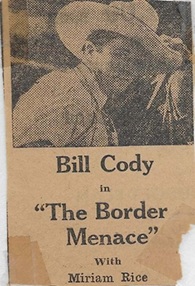 Ranger Bill Williams (Bill Cody) is working undercover. First, he meets up with and goes to prison with rustler Dragon Morris (Ben Corbett). After Bill finds out that Dragon’s boss is Chuck Adams (George Chesebro), Bill gets out of prison, tracks down Chuck, and then has a fake posse pursue him in order to prove his bona fides as an outlaw. Chuck invites Bill to be a member of his gang. However, Dragon has figured out that Bill’s a lawman and, when he escapes from prison, he tries blow Bill’s cover.
 Through the Shattered Lens