(Lisa recently discovered that she only has about 8 hours of space left on her DVR! It turns out that she’s been recording movies from July and she just hasn’t gotten around to watching and reviewing them yet. So, once again, Lisa is cleaning out her DVR! She is going to try to watch and review 52 movies by the end of 2017! Will she make it? Keep checking the site to find out!)

Before I talk about the 1960 film Where The Boys Are, I’m going to admit something. Nearly a month ago, I started this mission to clean out my DVR. I had 52 films to review and I said that I’d have it all done by Thanksgiving. Of course, I failed to take into account that Thanksgiving is a holiday and, when you’re celebrating a holiday, that doesn’t always leave time to write 52 reviews. So, I gave myself until the end of the first week of December. And that’s when I realized that 52 reviews is not a small amount of work. Especially if you want to make them decent reviews, as opposed to just posting a few sentences. So, I’m abandoning all of my arbitrary deadlines. I’ve got 14 more movies to review and I really hope that I’ll be done by the end of the year. Maybe I will be, maybe I won’t…
But, seriously, I really hope that I am!
Anyway, now that I’ve cleared that up, let’s go to Where The Boys Are!
Released in 1960, Where The Boys Are was one of the first spring break films and it set the template for many films that would follow. Because it is a piece of history, it’s one of those films that seems to regularly pop up on TCM. It last aired on TCM on November 13th. That’s when I recorded it.
Where The Boys Are tells the story of four girls who go to college in Maryland. When we first see them, they are trudging across a snowed-in campus and there’s a distinct lack of handsome men around. We listen as Merritt Andrews (Delores Hart) debates her far older professor about whether or not a girl should be “experienced” before getting married. The professor thinks that all girls should wait for marriage. Merritt disagrees. What makes this scene interesting is that it’s almost totally done in euphemism. Merritt never says sex. Instead, she says making out and the professor has to ask her to explain what that means.
I mean …. 1960, amirite?
Anyway, it’s spring break so Merritt and her friends go down to Ft. Lauderdale. After all … that’s where the boys are! All of the girls have their own defining characteristic. Merritt is the leader of the group, an intellectual with an I.Q. of 138. Tuggle (Paula Prentiss) is smart and no-nonsense. She’s a self-described “good girl” and her hope is to be a “baby-making machine.” She intimidates some men because she stands 5’10. Angie (Connie Francis) is athletic and naive. And then there’s Melanie (Yvette Mimieux), who overcomes her insecurity and loses her virginity as soon as they arrive in Florida (though, of course, this is all handled via euphemism).
Over the course of spring break, all four of the girls meet a man or two. Merritt meets Ryder (George Hamilton), who is not only an Ivy League student but has a tan to die for. Ryder it turns out is very experienced (the film doesn’t seem to have the same issue with men being experienced as it does with women) and Merritt is forced to consider whether she’s really as ready for sex as she claims. Melanie also hooks up with an Ivy Leaguer but it quickly becomes obvious that, despite going to Yale, Franklin (Rory Harrity) is a total heel. (Oh, how you will hate Franklin.) Tuggle finds herself competing for the attention of TV (Jim Hutton). And Angie falls for a myopic jazz musician, Basil (Frank Gorshin).
Watching Where The Boys Are was an odd experience. It’s an extremely dated film and it’s hard to believe that its euphemistic sex talk and extremely modest swimsuits were ever considered to be controversial. There’s a hilarious scene where the girls are getting ready for their dates by changing into dresses that look more appropriate for cotillion than a night in Ft Lauderdale. Needless to say, nobody is seen smoking weed or skinny dipping or doing any of the other stuff that we’ve come to take for granted as far as spring break films are concerned. (That said, I get the feeling that both TV and Basil may have been stoned. But definitely not Ryder. From the minute Ryder shows up, you know he’s going to end up running a successful business and probably serving as an advisor in the Trump White House.)
There are a lot of jokes about people getting drunk, however. It’s nice to see that, even in 1960, college students on Spring Break couldn’t hold their liquor. I also found it interesting that not only did almost everyone in Where The Boys Are smoked but most of them looked really cool doing it. In fact, I’d say that this film was probably the best advertising for cigarettes that I’ve ever seen.
For the most part, Where The Boys Are is a hit-or-miss comedy that’s distinguished by perfect casting. Even though the film itself was dated, I felt that I could relate, in one way or another, to all of the girls. Hart, Prentiss, Mimeux, and even Francis captured universal emotions and feelings in their performances and their friendship felt very true.
About 70 minutes into the film, Where The Boys Are takes a very serious turn and the film actually ends on a rather melancholy note, a reminder that not even a somewhat light weight comedy could escape the harshly judgmental morality of the time. The sudden shift in tone took me by surprise but the film actually handled it well. I just wish that it didn’t feel as if the filmmakers were punishing our characters for questioning the dictates of society.
On a final note, it’s interesting to note that Delores Hart, who played the sexually free thinking Merritt, later gave up her film career and became a nun.
So much for where the boys are.
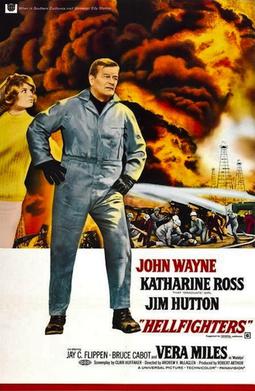 Chance Buckman (John Wayne) is the best there is when it comes to fighting oil fires. Along with Greg Parker (Jim Hutton), Joe Horn (Bruce Cabot), and George Harris (Edward Faulkner), Chance travels the world and puts out fires that the regular authorities can’t handle. Chance loves his job but he also loves his ex-wife, Madelyn (Vera Miles). When Madelyn indicates that she wants to remarry Chance but only if he pursues a less dangerous line of work, Chance retires from firefighting and becomes an oil executive. He leaves his firefighting company to his new son-in-law, Greg. When Greg and Chance’s daughter (Katharine Ross) head down to Venezuela to battle a fire and find themselves not only having to deal with the flames but also with a band of revolutionaries, Chance is the only one who can help them.
 Through the Shattered Lens