The Daily Grindhouse (Horror Edition): Female Vampire (dir. by Jess Franco)


My wonderful and loyal readers, I fear that I have failed you.  How is it, with my love of both grindhouse and Eurosleaze cinema, that I have yet to review a Jess Franco film on the site?  Halloween seems to be the perfect time to correct that oversight by taking a look at Franco’s infamous 1973 horror film, Female Vampire.

To truly “appreciate” a film like Female Vampire, it helps to know a little something about Jess Franco.  Working under a variety of pseudonyms, Spanish-born Jesus Franco Manera has been making films for over 60 years.   Among critics, Franco is usually either dismissed as a total hack (and/or pervert) or embraced as the living embodiment of the auteur theory.  Though no one’s quite sure how many films Franco has directed, Franco himself has estimated that he’s directed more than 200 films and, for the most part, he has financed and distributed them all on his own.  Franco has worked in every genre from thriller to comedy to hardcore pornography, but he is probably best known for directing low-budget, occasionally atmospheric erotic horror films like Female Vampire.

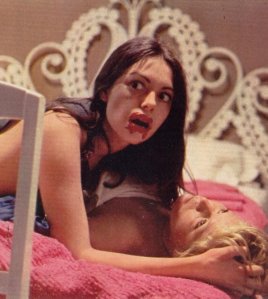
The opening of Female Vampire pretty much epitomizes everything that people love and hate about Jess Franco as a director.  The film begins with a series of ominous shots of a misty forrest.  The forest feels both beautiful and desolate at the same time and Franco’s camera lingers over the fog, building up an atmosphere of both mystery and melancholy.  Suddenly, we see one lone figure walking through the forest.  Irina (played by frequent Franco star Lina Romay) emerges from the fog, naked except for a cape and a belt.  The camera follows Irina as she walks through the mist.  When Irina stops and faces the audience, the camera zooms in to a close-up of her face and her body.  While Franco’s aim here is obviously to cater t0 the sexual fantasies of his predominately male audience, it’s still a remarkably strong scene because Romay faces the camera with such confidence that her nudity feels less like exploitation and more like empowerment.  (Romay was, like me, a self-described exhibitionist.)  Once Franco’s camera zooms away from Irina, she then starts to confidently approach the camera (and the audience as well).  She gets closer and closer to the camera until finally … she accidentally bumps her head on the lens.

That, for lack of a better example, totally sums the aesthetic of Jess Franco.  When you watch a Franco film, you’re left with the impression that Franco simply turned on the camera and recorded whatever happened to happen in front of it.  Occasionally, he managed to capture something unique and dramatic and just as often, he filmed someone bumping into the equipment or staring straight at the camera.  Whether he liked the spontaneity that came from an unexpected mistake or he just didn’t have enough money in his budget to do a second take, Franco would more often than not include these mistakes in his final film.

As for the rest of Female Vampire, it’s eventually established that. along with being a vampire, Irina is a countess and also a mute.  (At one point, we do hear her inner thoughts, a monologue in which she tells us, “I earnestly wish an end would come to this bloody race I am forced to run.”)  Several different cuts of Female Vampire have been released over the years and depending on which version you see, Irina either has to either regularly drink blood or drink semen in order to survive.  (“It was as if his potency was sucked out of him,” as the coroner puts it.)

While Irina spends all of her time wandering around a depressing resort town and seducing various victims, a poet (Jack Taylor) searches for her.  This poet — who spends a lot of time staring off into the distance and delivering inner monologues about walking down this road we call life — is determined that he and Irina are meant to be together.

There are many different version of Female Vampire currently in circulation.  For instance, a heavily-edited version was released in the U.S. as The Bare-Breasted Countess.   While Franco’s director’s cut lasts close to two hours, there are other versions that barely clock in at 70 minutes.  There’s a hard-core version, a soft-core version, and even a version that features close to no sex at all.  The version I saw was the DVD released by Image Entertainment.  That version is reportedly close to Franco’s original.

As is typical for a Franco film, not much happens in Female Vampire and what does happen doesn’t make much sense.  But, oddly enough, that actually worked in the film’s favor.  By ignoring things like plot and logic and by focusing on the film’s visuals, Franco made a film that literally feels like a dream.  Every scene is filled with an atmosphere of pure ennui and, when coupled with charisma of Lina Romay and Jack Taylor,  the end result is a film that’s strangely compelling.

Oh my God! 6 More Chilling Classics: The Cold, Dr. Tarr’s Torture Dungeon, The Legend of Big Foot, Oasis of the Zombies, Slashed Dreams, and Track of the Moon Beast


It’s a lonely Saturday here at the TSL Bunker.  Leonard Wilson is at a theater in the city, watching Chernobyl Diaries.  My sister, the Dazzling Erin, has abandoned me to go shopping for ingredients so she can make something later tonight for our family’s annual memorial day get together tomorrow and our cat, Doc, is too busy sleeping at the foot of my bed to pay much attention to me   Probably even as I sit here typing this, Leon the Duke is watching season 3 of Lost and how I envy him!  The Trash Film Guru has escaped to the grindhouse. Necromoonyeti is discovering new music, Pantsukudasai is undoubtedly meeting with his enigmatic anime connection, Semtex Skittle is playing Diablo Something-Or-Another, and SenorGeekus is off spreading the gospel of Jack Kirby.  Even Arleigh is off somewhere else, watching a war movie no doubt.

Yes, I’ve been left here alone in my section of the Bunker, which I’ve decorated by utilizing a combination of Catholic iconography, Hello Kitty, and pink wallpaper.  I should be working on getting caught up because I am running behind on meeting my quota for the month.  However, instead of writing about what’s currently playing in a theater near you, I find myself once again distracted by my continuing mission to watch and review every single film included in Mill Creek’s 50 Chilling Classics Boxset.  Fortunately, I’m happiest when I have a mission.  Here are reviews of 6 more of the Chilling Classics that I’ve sat through.

The Cold (dir by Bill Rebane)

First released in 1984, The Cold is yet another odd little morality tale from Wisconsin-based filmmaker Bill Rebane.  Three mysterious millionaires invite nine people (and just try to keep them all straight) to a secluded mansion that looks suspiciously like an EconoLodge.  The nine guests are informed that if  they spend a few nights at the “mansion” and face their greatest fears, they’ll win a million dollars.  Of course, everyone agrees to do that but how could they have imagined that their fears would include a giant spider that shows up in soup bowl, a shark that shows up in a swimming pool (Agck!  That would be my fear right there), rats, and people who wander around hallways while wearing white sheets.  Of course, it all ends with a twist that you’ve already guessed and then the film introduces another twist that you’ve already guessed.

This is the third Rebane film that I’ve come across in the Chilling Classic Boxset (the previous two being The Alpha Incident and The Demons of Ludlow).  Rebane is one of those odd directors whose uneven films are genuinely inept and yet occasionally show a flash of equally genuine imagination.  The Cold is a complete and total mess that features bad acting (after 5 minutes, I’d had enough of the slow-witted girl with the bad Southern accent), bad dialogue (“You can’t come in here.  I’m nude.” “Don’t worry, I’ve had a vasectomy”), and a truly incoherent style of editing.  Rebane punctuates the action by including random snatches of old timey music and boy did that get irritating fast.  And yet, once you start watching, it’s impossible to look away.  You simply have to watch to convince yourself that what you’re seeing isn’t just a dream.  Plus, the film includes not only an endless disco sequence but a narrator who admits that he can’t really follow the story either.

Dr. Tarr’s Torture Dungeon (dir by Juan Lopez Moctezuma)

This Mexican film from 1972 is based on an Edgar Allan Poe short story and, despite the poor picture quality that we’ve come to expect from anything put out by Mill Creek, it is one of the most visually interesting films to be found in the Chilling Classics boxset.  A newspaper reporter visits a sanitarium in order to investigate the revolutionary form of therapy practiced by Dr. Maillard (Claudio Brook).  As Maillard explains (and sh0ws), the inmates are essentially allowed to roam freely through the asylum and live under whatever delusions make them happiest.  However, it quickly becomes obvious that Dr. Maillard is insane himself and his asylum is part of a bigger plot to rule the world.  The plot makes little sense and it quickly becomes pretty clear that it’s not meant too.  Director Juan Louis Moctezuma was a collaborator of the famed surrealist Alejandro Jadorowsky and it quickly becomes obvious that he’s more interested in putting as many odd and surreal images on-screen as possible and, on that level, he succeeds.  For whatever the film’s narrative failings, it’s fascinating to just sit and look at some of the images that appear on-screen.  Claudio Brook gives a wonderfully over-the-top performance that perfectly compliments the film’s visuals.
The Legend of Big Foot (dir by Harry Winer)

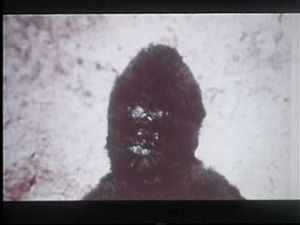
In this documentary from 1976, a wildlife expert named Ivan Marx rambles on and on about Big Foot while unrelated stock footage plays out on-screen.  It’s just as exciting as it sounds.  Seriously, I try to make it a point to stick with any film I start watching, no matter how boring it may turn out to be, but the Legend of Big Foot severely tested my patience.  Some of the animals in the stock footage are cute, though.  Regardless of what he may be discussing at any particular moment during the film, Marx delivers his narration in the most dramatic way possible and that provides a few laughs as well.
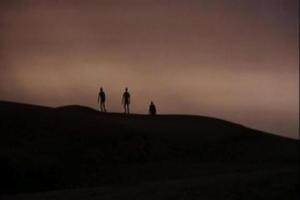
Oasis of the Zombies (dir. by Jess Franco)

In this 1981 Eurocine film, a group of unlikable people come across a lost Nazi treasure in the middle of the African desert.  Unfortunately for them, the Nazis are still there, standing guard.  Of course, the Nazis have now all been transformed into zombies!  As far as Nazi zombie films are concerned, Oasis of the Zombies isn’t as scary as Shock Waves and it’s not as much fun as Zombie Lake.  What it is, however, is a Jess Franco film which means that the film features actors in tacky outfits, poorly dubbed dialogue, a zoom lens that just won’t quit, and a few oddly surreal (and occasionally nightmarish) visuals.  This is really a pretty shoddy film but it’s enjoyable if you’re a fan of Franco’s “unique” style of filmmaking.

Slashed Dreams (dir. by James Polaskof)

This film was originally released in 1974, under the title Sunburst.  It was obviously not meant to be a horror film (though it was clearly meant to appeal to the exploitation market) but instead, it was a painfully sincere, annoyingly naive, and, ultimately, rather offensive attempt to make an important statement about the need to drop out of society and “do your own thing.”  However, Robert Englund shows up for the film’s final 10 minutes so, at some point in the 80s, Sunburst was re-released, retitled, and resold as a horror film.

Anyway, this 74 minute film is about two perky and attractive college students (Peter Hooten and Katharine Baumann, both of whom give good performances) who decided to go visit their first Michael who has dropped out of society and is currently living in a cabin out in the middle of the woods.  The majority of the film is an endless montage of scenes of Hooten and Baumann hiking through the wilderness while a singer named Roberta Van Dere warbles away on the soundtrack, singing some of the most annoyingly 70s folk songs ever written.  I’m sad to say that I got one of them, Animals Are Clumsy Too, stuck in my head.  Once they finally reach the cabin, they discover that Michael is off wandering about.  They decide to wait around for Michael to show up which leads to them being spotted by two inbred hicks who proceed to rape Baumann before running off.  The next morning, Michael shows up and hey, he’s Robert Englund!  Michael hears what has happened and, instead of going to the police or, at the very least, getting Baumann to a hospital,  he tells her that she just needs to “push the demons out” and get on with living.  Which, by the way, is complete bullshit.  It’s one thing to discover strength you previously didn’t realize you had as the result of something terrible, it’s another thing to seriously expect a woman to shrug it off after a day or two or to consider rape to be a character-building exercise as this film seems to.  Say what you will about I Spit On Your Grave, at least that film understood that rape is an unforgivable violation and more than just a bad thing that might happen in the woods.  I swear, just when I think that I can’t hate the late 60s and early 70s anymore than I already do, I see a film like this.

Track of the Moon Beast (dir. by Dick Ashe)

When it comes to bad movies from the 70s, I prefer the likes of 1976’s Track of the Moonbeast to Sunburst/Slashed Dreams.  This films takes place in New Mexico and tells the story of Paul (Chase Cordel), a slow-talking mineralogist who gets a chunk of moon rock lodged into his brain.  As a result, he turns into a gigantic lizard and goes around killing people.  His only hope appears to be his old friend, the stoic Profession Johnny Longbow (Gregorio Sala) who knows all sorts of indian lore.  He also knows how to make stew and early on in the film, he gives a world-weary monologue about what ingredients he puts in his stew.  (Onions, mostly).  Anyway, this is an awful, awful film that’s full of bad acting, bad special effects, and dumb dialogue.  It’s also a lot of fun and it features the guy pictured below singing a song called California Lady that got stuck in my head almost as quickly as Animals Are Clumsy Too.  I loved Track of the Moon Beast.

So, out of these six, I would definitely recommend Track of the Moon Beast and Dr. Tarr’s Torture DungeonThe Cold and Oasis of the Zombies should be watched only by people who are already familiar with the work of Bill Rebane and Jess Franco.  Legend of Big Foot might be amusing if you’re intoxicated and Slashed Dreams is the one to definitely avoid.

6 Trailers for Cinco De Mayo


Hola and happy Cinco De Mayo!  I’m not sure if Cinco De Mayo is as big a deal up north as it is down here in the Southwest but today is going to be one of the few Saturdays that I don’t go to the movies.  Instead, I will be observing this day with friends, family (I am a fourth Spanish), and cerveza.  But first, here’s the latest edition of Lisa Marie’s Favorite Grindhouse and Exploitation Trailers…

(Be warned: Some of these trailers are a tad bit more explicit than some of the other trailers that I’ve featured as a part of this series.  Watch with caution.)

1) Tombs of the Blind Dead (1971)

This is one of the first of the great Spanish horror films. 

2) Return of the Evil Dead (1973)

The Blind Dead returned in this gory and violent sequel.  One of my prize possessions is my Blind Dead box set, which was released (in the shape of a coffin, no less) by Blue Underground.

3) Vampyros Lesbos (1971)

This is the German trailer for Vampyros Lesbos, directed by the infamous Jess Franco.  Just try to guess what this film is about…

4) Oasis of the Living Dead (1981)

In a career that has spanned over 500 films, Jess Franco has dealt with not only lesbian vampires but zombies as well…

5) Night of the Bloody Apes (1969)

From Rene Cardona comes this surprisingly bloody films about what happens when an ape’s heart is transplanted into a normal human being.  Fortunately, there’s a wrestler around to save the day…

6) The Werewolf Vs. The Vampire Woman (1970)

Finally, let’s end things with a Paul Naschy film, shall we?

Six Trailers of the Supermoon


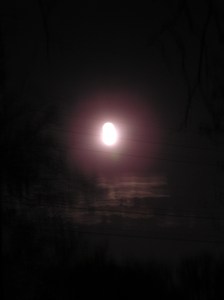
Picture of supermoon taken by Erin Nicole Bowman

Apparently, as I sit here in my underwear and glasses, the Earth is about as close to the moon as it will ever get.  Because of that, the moon is huge out in the night sky.  Or at least that’s what I’m hearing.  It looks pretty normal to me but anyway, this is being referred to as being “Supermoon.”  I’m not sure why.  If I stood less than an inch from your face, would that suddenly make me Super Lisa? 

But anyway, this weekend’s slightly intoxicated edition of Lisa Marie’s Favorite Grindhouse and Exploitation Trailers is dedicated to Supermoon.

1) Werewolves on Wheels (1971)

Of course, a gigantic full moon would bring a werewolf film with it.  This is one of the thousand or so biker films to come out in the late 60s and early 70s.  These films were interesting mostly from the point of view of how they mixed other genres with the biker conventions.  Werewolves on Wheels did it with lycanthrophy.

2) Werewolf of Washington (1973)

Actually, since it’s a supermoon, we better include two werewolf-themed trailers.  This is for the Werewolf of Washington, starring Dean Stockwell.  For some reason, I’ve actually got several copies of this on DVD (I think this is one of those films that somehow found its way into the public domain) but I’ve yet to actually sit down and watch it.  I think my hesitation has to do with the fact that it appears to be a political satire and it was made in the 70s.  That sounds like a combination for boredom, to be honest.

3) Psych-Out (1968)

Before Dean Stockwell could become a werewolf, he had to serve as Jack Nicholson’s hippie guru in Richard Rush’s Psych-Out.

4) The Shooting (1967)

But before Jack Nicholson could become a hippie, he was a sinister gunman in Monte Hellman’s existential grindhouse western, The Shooting.  The Shooting, which co-stars Warren Oates and Millie Perkins, is an unacknowledged classic and a movie that I’m going to have to review one of these days.  Perkins, by the way, was married to none other than Dean Stockwell.

5) Cockfighter (1974)

And then, 7 years later, Hellman, Oates, and Perkins reunited to make an odd little film called Cockfighter.  This is another film I have to review though I also have to say that, as a former country girl who has actually seen a few cockfights, cockfighting is right up there with dogfighting as far as sickening sadism is concerned.*

6) Macon County Line (1974)

And, of course, while some people in the south were going to cockfights, others were apparently getting killed by redneck lawmen in films like the ’74 classic, Macon County Line.

In honor of Supermoon, I’m going to include two extra trailers.  Seriously, don’t ever doubt that Lisa loves you.

7) The Education of Sonny Carson (1974)

While rural audiences (probably made up of people I’m distantly related to) spent 1974 cheering police brutality and animal cruelty, urban grindhouse audiences were enjoying films like this one.

8 ) Bloody Moon (1981/2)

Finally, since we’re under a supermoon, here’s the trailer for Jesus Franco’s infamous (and frequently banned) slasher Bloody Moon.  I haven’t seen Bloody Moon (copies aren’t that easy to find) but seriously, the involvement of Jesus Franco tells me all I probably need to know.**

—–

*If you’ve got a cock, use it to spread love, not hate.

** Well, we’ll see about that.  I just ordered a copy off of Amazon.

Lisa Marie Does 6 Trailers In The Snow


I was so happy today and it didn’t  even have anything to do with the movies, either!  Early this afternoon, I was watching my cat twitch in his sleep (he has very violent dreams, apparently) when I happened to look out my bedroom window and you know what I saw?  Snow!  “Yay!” I yelled, waking up the cat. 

Now, I know that everyone else in the country gets a blizzard every other month but I live in Texas so snow is kind of a big deal to me.  I jumped off my bed, threw my Hello Kitty robe on, and went running down stairs.  I threw open the door, ran out to the front porch, and then slipped and fell right on my backside. 

My neighbor stared at me from his yard.  “Are you okay?” he asked. 

“Yay!”  I replied, “it’s snowing!”

He nodded and then went, “Better hope those power lines don’t ice over or we might be without electricity.”

At that point, I resolved to never speak to my neighbor again.

So, I was very, very happy but now, the snow’s gone.  It’s moved along to Arkansas and Mississippi.  Now, the only thing falling rom the sky is freezing rain and the roads will probably be really icy and scary when I’m going to work tomorrow.  So, as I sit here all kinds of pantsless with a big purple bruise on my ass, I’m cheering myself up by putting together the latest installment of Lisa Marie’s Favorite Grindhouse and Exploitation Trailers.

1) The Dunwich Horror

From 1970: Dean Stockwell kidnaps and brainwashes Sandra Dee and he’s doing it all in the name of all mighty Cthulhu.  This is actually kind of a fun film as long as you can get the image of H.P. Lovecraft spinning in his grave out of your mind.

2) Curtains

I’ve never seen this 80s slasher film but I’ve read about its troubled production on various web sites.  I’m kinda embarrassed to admit it but I actually get scared when I see this trailer.  First off, that mask is disturbing.  And secondly, that doll…

3) Black Belt Jones

Fortunately, even if this world does occasionally give us a demon doll, it can also give us a Black Belt Jones.  I loved the trailer as soon as I saw Gloria Hendry shooting the dishes…

4) Frightmare

From Peter Walker, comes one of the greatest British horror films ever made.  It’s all about cannibalism, psychology, and fire place pokers.

5) Faceless

Jess Franco has directed close to a thousand films and approximately 12 of them are worth watching.  This is one of the lucky dozen, a remake of Eyes Without A Face.  The film gave Brigitte LaHaie her best role outside of the films of Jean Rollin and it also co-stars the great Caroline Munro.  And since it’s a Franco film, Howard Vernon plays a character named Dr. Orloff.  Plus, its got that cute little panther animation at the start of the trailer.

6) Electra Glide In Blue

Finally, it’s up to Robert Blake to restore some order.  This is actually a fairly interesting little movie as long as you realize that it’s such a 70s film, it might as well be wearing a suit with lapels stretching all the way to the end of the shoulders.

Book Review: The Eurospy Guide by Matt Blake and David Deal


Sometimes, believe it or not, I feel very insecure when I come on here to talk about movies because, unlike most of my fellow writers and the site’s readers, I’m actually pretty new to the world of pop culture and cult films.  Up until 8 years ago, ballet was my only obsession.  It was only after I lost that dream that I came to realize that I could feel that same passion for other subjects like history and writing and movies.  In those 8 years, I think I’ve done a fairly good job educating myself but there’s still quite a bit that I don’t know and, at times, I’m almost overwhelmed by all the movies that I’ve read so much about but have yet to actually see.  And don’t even get me started on anime because, honestly, my ignorance would simply astound you.  What I know about anime — beyond Hello Kitty — is pretty much limited to what I’ve read and seen on this site.  (I do know what a yandere is, however.  Mostly because Arleigh explained it to me on twitter.  I still don’t quite understand why my friend Mori kept using that as her own personal nickname for me back during my sophomore year of college but that’s a whole other story…)

The reason I started soul searching here is because I’m about to review a book — The Eurospy Guide by Matt Blake and David Deal — that came out in 2004 and I’m about to review it as if it came out yesterday.  For all I know, everyone reading this already has a copy of The Eurospy Guide in their personal collection.  You’ve probably already spent 6 years thumbing through this book and reading informative, lively reviews of obscure movies.  You may already know what I’ve just discovered.  Well, so be it.  My education is a work in progress and The Eurospy Guide has become one of my favorite textbooks.

The Eurospy Guide is an overview of a unique genre of films that started in the mid-60s and ended with the decade.  These were low-budget rip-offs — the majority of which were made in Italy, Germany, and France — of the Sean Connery-era James Bond films.  These were films with titles like Code Name: Jaguar, Secret Agent Super Dragon, More Deadly Than The Male, and Death In a Red Jaguar.  For the most part, they starred actors like George Nader, Richard Harrison, and Eddie Constantine who had found the stardom in exploitation cinema that the mainstream had never been willing to give to them.  They featured beautiful and underappreciated actresses like Marilu Tolo and Erika Blac and exotic, over-the-top villainy from the likes of Klaus Kinski and Adolfo Celi.  Many of these films — especially the Italian ones — were directed by the same men who would later make a name for themselves during the cannibal and zombie boom of the early 80s.  Jess Franco did a few (but what genre hasn’t Jess Franco experimented with) and even Lucio Fulci dabbled in the genre.  Their stories were frequently incoherent and, just as frequently, that brought them an undeniably surreal charm. 

And then again, some of them were just films like Operation Kid Brother, starring Sean Connery’s younger brother, Neil.  (Operation Kid Brother was an Italian film, naturally.)

Well, all of the films — from the good to the bad (and no, I’m not going to add the ugly) — are covered and thoroughly reviewed in The Eurospy Guide.  Blake and Deal obviously not only love these films but they prove themselves to be grindhouse aficionados after my own heart.  Regardless of whether they’re reviewing the sublime or the ludicrous, they approach each film with the same enthusiasm for the potential of pure cinema run amuck.  It’s rare to find reviewers who are willing to pay the same respect to a film like The Devil’s Man that they would give to a sanctioned classic like The Deadly Affair.

Along with reviewing a countless number of films, Deal and Blake also include two great appendices in which they detail the review some of the film franchises that came out of the genre and provide biographies of some of the more prominent stars of the eurospy films.

The highest compliment I can pay to The Eurospy Guide is that, even with all the various films guides I own (and I own a lot), I found films reviewed and considered in this book that I haven’t found anywhere else.  Everytime I open this book, I learn something that, at least to me, is new.  The book was an obvious labor of love for Blake and Deal and I love the results of their labor.

So, if you already own a copy, you rock. 

And if you don’t, order it.

10 Films I Must See Before I Die


I love movies.  I love watching movies, reading about movies, and talking about movies.  Perhaps most of all, I love the hunt.  I love discovering movies or finding movies that had previously, for me, only existed in reviews or as a collection of screen captures.  To me, there is no greater experience the watching a movie for the first time.  (Even if, as often happens, that first time turns out to be the only time.)  Listed below are ten movies that I have yet to see but desperately hope to at some point in my life. 

1)  Giallo a Venzia (1979) — This is supposedly one of the most graphically depraved Italian horror films ever made.  If that’s not a recommendation, I don’t know what is.  Actually, I haven’t heard a single good thing about this movie but it has still become something of a Holy Grail in my quest to see as much Italian horror as possible.  This is largely because the movie is nearly impossible to find.  When it was first released, it was banned in the UK as part of the so-called “video nasties” scare.  (Trust the English to not only ban a movie but to come up with an annoying name for doing so in the process.)   This led to it never really getting much of a release in the English-speaking world and, now years later, it’s only available on bootleg DVDs.  As such, I imagine that if I ever do see it, it’ll be because I made a deal in a back alley with some bald guy who speaks with a Russian accent.  Much as with drug prohibition, the fact that its “forbidden” has made this movie rather attractive.

The few people who have seen this always mention that towards the end of the movie, Mariangela Giordano’s legs are graphically sawed off.  This makes sense as Giordano was always meeting grotesque ends in Italian horror movies.  In Patrick Lives Again, she is impaled (through her vagina no less) by a fireplace poker while in Burial Ground, she makes the mistake of breast feeding her zombie son.  In many ways, Giordano was like a female Giovanni Lombardo Radice.  However, its odd to consider that while the sight of Giordano’s legs getting sawed off was enough to get the film banned, the sight of poker being graphically driven into her crotch was apparently totally acceptable.  Censorship is a strange thing, no?

One last reason I want to see this movie — its filmed in Venice.  When I was in Italy, I fell in love with Venice.  (I also fell in love with a tour guide named Luigi but that’s another story.)

2) An uncut version of Nightmares in a Damaged Brain (1981) — This is another banned Italian movie.  When Nightmares was originally released, Tom Savini was credited as being behind the special effects.  Savini, however, has long claimed to have had little to nothing to do with the movie.  As Savini, to his credit, has never been embarrassed to claim ownership for his effects (regardless of the movie they appear in), I’m inclined to believe him.

In many ways, Nightmares reminds me of a film that Savini actually did work on, Maniac.  Not so much as far as the plot is concerned but just in the same bleak worldview and almost palpable sleaze that seems to ooze from every scene.  The version that is most widely available on DVD (and the one that I own) appears to be the cut version that was eventually okayed for release in the UK and even cut, this is a film that remains oddly compelling in just how much its willing to immerse itself in sleaze.  The uncut version remains elusive but someday, I will find it.

3) The Day The Clown Cried (1972) — You knew this one was coming, didn’t you?  I think everyone wants to see Jerry Lewis’s never released Holocaust comedy.  Supposedly, Lewis keeps the movie in a locked vault which I just find to be oddly hilarious.  My hope is that, if nothing else, some enterprising filmmaker will make a movie about a crack team of thieves who break into Jerry Lewis’s estate just to steal the only copy of The Day The Clown Cried and sell it to the people at Anchor Bay.  Jerry could play himself.  I also think this film will see the light of day sooner or later.  At some point, either Jerry Lewis or his estate is going to need the money.

4) The Other Side of the Wind — Orson Welles apparently spent the last few decades of his life making this movie.  At the time of his death, the movie was reportedly 95% film but only 40% edited.  Apparently, because of a whole lot of complicated legal things, the movie has spent the last 30 years under lock and key in Iran.  Even if somebody could rescue it, the remaining footage still needs a strong hand to put it together.  While I’m sure that many directors would be happy to volunteer to provide that hand, the two names most frequently mentioned — Peter Bogdonavich and Henry Jaglom — do not fill me with confidence.  I’d rather see the final film put together by Jess Franco, who was assistant director on Chimes at Midnight.

5) The Fantastic Four (1994) — This is not the dull movie that came out in 2005.  This apparently an even duller version of the same film that was made 11 years earlier for legal reasons.  Apparently, Roger Corman would have lost the movie rights to the comic book if he didn’t start production on a film by a certain date.  So, this film was made on the cheap and then promptly shelved.  My main desire to see it comes from the same morbid desire that makes me look at crime scene photos.  How bad can it be?

6) Le Cinque Giornate (1973) — This Italian film is apparently many things.  It’s a comedy.  It’s a historical epic.  It’s a satire of then contemporary Italian politics.  And most of all, it’s also apparently the only non-horror film directed by Dario Argento.  This was Argento’s fourth  film, coming after his celebrated animal trilogy and it was apparently an attempt, on Argento’s part, to break away from the giallo genre that he has since come to symbolize.  Though the film apparently did well enough in Italy, it failed to establish Argento as a director of comedy and that’s probably for the best as Argento’s fifth film would be the classic Deep Red.  Still, it’s hard not to play the “What If?” game, especially when it involves an iconic a figure as Dario Argento.  It’s also interesting to compare Argento’s attempts to go from horror to comedy with the career of Lucio Fulci, who went from comedy to horror.

7) Cocksucker Blues (1972) — Robert Frank’s documentary of the Rolling Stone touring America was officially unreleased because of its title.  While that title certainly played a role, it also appears that the film was unreleased because of just how much hedonism Frank managed to capture backstage.  The Stones apparently went to the court to block the film’s release.  Somehow, this resulted in a ruling that the movie can only be shown if Robert Frank is physically present.  Mr. Frank, if you’re alive and reading this, you have an open invitation to come down to Texas and stay with me anytime you want.  Seriously.

8 ) The Profit (2001) — The Profit is a satiric film about a cult.  The film’s cult is known as The Church of Scientific Spiritualism and is led by a recluse named L. Conrad Powers.  Sound familiar?  The film’s release was (and continues to be) prevented by a lawsuit brought by the Church of Scientology.  Say what you will about the Vatican, at least you can attack them in a movie without having to worry about getting sued or blown up.

9) Superstar: The Karen Carpenter Story (1987) — Probably one of the most famous film that most of us will never see, Superstar tells the story of Karen Carpenter through the use of Barbie dolls.  Director Todd Haynes supposedly failed to get the rights to the music he used in the film and, obviously enough, nobody in the Carpenter camp was all the eager to give him permission. 

9) Can Hieronymous Merkin Ever Forget Mercy Humppe And Find True Happiness (1969) — God, don’t you hate that title?  And, honestly, are you surprised that a film with that title is apparently history’s 1st X-rated musical?  Anyway, this is a movie I’ve come across in various film reference books where it’s either described as a masterpiece or (more often) one of the worst movies ever made.  Myself, I love musicals and if the musical numbers are mixed in with explicit sex — well, why not?  But that title — that title just gives me a bad feeling.  Another thing that gives me a bad feeling is that the movie was apparently the brainchild of Anthony Newley.  I don’t know much about Mr. Newley but what I do know seems to indicate that he personified everything that most people hate about musicals.  The film is apparently autobiographical and its about a really talented composer who treats the women in his life terribly but has a lot of reasons (or excuses) that we learn about in elaborate flashbacks and — wait, I’ve seen this movie.  Oh wait, that was Nine.  Anyway, Merkin was a huge flop and it has never been released on any type of video format.  Yet, it has not been forgotten which can only mean that it must have really traumatized the critics who saw it.  In other words, this is another one of my “how-bad-can-it-be” crime scene movies.

10) The uncut, original, 9-hour version of Erich Von Stroheim’s Greed (1924) — A girl can dream, can’t she?