Film Review: Heroes (dir by Jeremy Kagan)


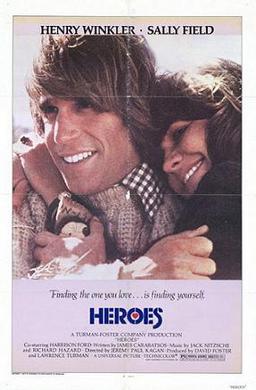
The 1977 film, Heroes, tells the story of Jack Dunne (a young Henry Winkler).

Jack spent four years fighting in Vietnam.  Since returning to America, he has struggled to adjust to civilian life.  Though he’s mentally blocked out much of what happened in Vietnam, he’s haunted by nightmares,  When we first meet him, he’s a patient at a mental health facility in New York City.  He has big plans, though.  He wants to open up a worm farm in Eureka, California.  He’s convinced that he can make a ton of money selling worms to fisherman and he wants all of the old members of his unit to join him in the venture.  After Jack escapes from the hospital, he boards a bus heading for California.

He also meets Carol (Sally Field), who is supposed to be getting married in four days but who has decided to board a bus and take an impromptu vacation instead.  When Carol is told that the bus is already full and she’ll have to wait for the next one, Jack bribes the ticket agent to get Carol on the bus.  Once on the bus, Jack makes himself into a nuisance, continually bothering the driver (Val Avery) and embarrassing Carol.  (In the film’s defense, it’s later established that Jack isn’t just being a jerk for fun.  The driver’s uniform makes Jack nervous.  That said, it’s hard not to feel bad for the driver, who is just doing his stressful job to the best of his ability.)  Carol and Jack do eventually strike a tentative friendship.  They’re linked by the fact that they’re both trying to escape from something.

At a diner, Jack tells her that he served in Vietnam.

“I protested the war,” Carol says.

“I fought it,” he replies.

Carol eventually joins with Jack in his quest to track down the three people who he expects to go into business with.  One of them is missing.  One of them never returned home from the war.  And the third, Ken (Harrison Ford), is living in a trailer and raising rabbits for a living.  Ken is also a stock car racer, though he eventually admits that he rarely wins.  In fact, he seems to spend most of his time drinking and shooting off the M16 that he keeps in his car’s trunk.  Meeting Ken sends Jack spiraling into depression but, with Carol’s help, Jack is finally starts to come to terms with the reality of what happened to him and his friends in Vietnam.

Heroes was one of the first films to sympathetically portray the plight of Vietnam veterans struggling to adjust to life back in the United States and it certainly deserves a lot of credit for its good intentions.  (Indeed, it’s implied that a part of Carol’s concern from Jack comes from her own guilt over how the anti-war movement treated the returning soldiers.)  That said, the film itself is an awkward mix of drama and comedy.  The first half of the film, in which Henry Winkler comes across like he’s doing a manic Al Pacino impersonation, is especially uneven.  Winkler and Field are both naturally likable enough that the film remains watchable but, during the first half of the film, most viewers will never buy their relationship for a second.  It’s hard to believe that the driver wouldn’t have kicked Jack off the bus as soon as he started to cause trouble and the other passengers often seem to be unrealistically charmed by Jack’s behavior.  If I’m on a crowded bus and some dude insists on walking up and down the aisle and taunting the driver, I’m probably going to get off at the first stop and refuse to get back on.  Traveling with a bunch of strangers is already nerve-wracking enough without having to deal with all of that.

Not surprisingly, things improve once Harrison Ford shows up.  This was one of Ford’s last character parts before he was cast as Han Solo in Star Wars.  (Heroes, however, was released after Star Wars, which explains why Ford is mentioned prominently in the trailer despite having a relatively small role.)  Ford gives a strong performance as the amiable but ultimately self-destructive Ken.  Ford plays Ken as someone whose quick smile is a cover for the fact that his entire life is a mess.  Whereas Jack wears his emotions on his sleeve (and Winkler never stops projecting those emotions), Ken is someone who has repressed his anger and his sadness and Ford gives an internalized and controlled performance.  Perhaps not coincidentally, Winkler calms down a bit when he’s acting opposite Ford and, as a result, his own performance starts to improve.

After the meeting with Ken, Jack starts to realize that it’s not going to be as easy to start his business as he thought.  Jack starts to come down from his manic high and, even more importantly, Henry Winkler stops overacting and instead, starts to dig into the sadness at the heart of Jack’s life.  During its second half, the film finally settles on being a drama and Heroes becomes a much stronger story as a result.  Even Jack and Carol’s relationship seems to make more sense during the second half of the film.  Things end on a note of cautious optimism, which also acknowledging that life can never go back to what it was before the war.

Today, if anyone watches Heroes, it’s probably going to be for Harrison Ford.  (I imagine the presence of Harrison Ford is the reason why it’s currently available on Netflix.)  It’s a bit of an uneven film, one that feels as if it should have been stronger than it actually was.  Still, it’s a worthwhile time capsule of 1977 and America’s struggle to come to terms with the Vietnam War.  Today, we’re still struggling to come to terms with what happened in Iraq and with the botched withdrawal from Afghanistan and, again, it seems like the country is too busy trying to move on to take the time to take care of its veterans.  It’s sad that so many people only seem to care about the soldiers who fight in popular wars.  Heroes was a plea to America not to forget its veterans.  It’s a plea that still needs to be heard.
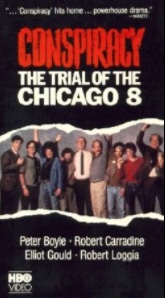
Conspiracy: The Trial of the Chicago 8 (1987, directed by Jeremy Kagan)


The year is 1969 and, in an Illinois courtroom, 8 political radicals stand accused of conspiring to disrupt the 1968 Democratic Convention.  The prosecution is putting the entire anti-war movement on trial while the defendants are determined to disrupt the system, even if it means being convicted.  The eight defendants come from all different sides of the anti-war movement.  Jerry Rubin (Barry Miller) and Abbie Hoffman (Michael Lembeck) represent the intentionally absurd Yippies.  Tom Hayden (Brian Benben) and Rennie Davis (Robert Carradine) are associated with the Students for a Democratic Society.  Bobby Seale (Carl Lumbly) is one of the founders of the Black Panthers while David Dellinger (Peter Boyle) is a longtime peace activist.  John Friones (David Kagan) and Lee Weiner (Robert Fieldsteel) represent the common activists, the people who traveled to Chicago to protest despite not being a leader of any of the various organizations.  Prosecuting  the Chicago 8 are Richard Schulz (David Clennon) and Tom Foran (Harris Yulin).  Defending the 8 are two radical lawyers, Leonard Wienglass (Elliott Gould) and William Kunstler (Robert Loggia).  Presiding over the trial is the fearsome and clearly biased Judge Julius Hoffman (David Opatoshu).

Conspiracy: The Trial of the Chicago 8 is a dramatization of the same story that inspired Aaron Sorkin’s The Trial of the Chicago 7 but, of the two films, it’s Jeremy Kagan’s The Trial of the Chicago 8 that provides a more valuable history lesson.  By setting all of the action in the courtroom and recreating only what was said during the trial, director Jeremy Kagan and his cast avoid the contrived drama that marred so much of Sorkin’s film.  Kagan trusts that the true story is interesting enough to stand on its own.  Kagan includes documentary footage from the convention protest itself and also interviews with the people who were actually there.  While Kagan may not have had the budget that Sorkin did, his film has the authenticity that Sorkin’s lacked.  Kagan also has the better cast, with Michael Lembeck and Barry Miller both making Abbie Hoffman and Jerry Rubin into something more than the mere caricatures that they are often portrayed as being.

The Trial of the Chicago 8 was a film that Jeremy Kagan spent a decade trying to make.  When he first tried to sell the idea behind the film to CBS in 1976, Kagan had Marlon Brando, Walter Matthau, George C. Scott, and Dustin Hoffman all willing to work for scale and take part in the production.  CBS still passed on the project, saying that no one was interested in reliving the 60s.  It wasn’t until 1987 that Jeremy Kagan was finally able to revive the film, this time with HBO.  It actually worked out for the best because, with HBO, there was no need to try to come up with a “clean” version for the language that was used in the courtroom or in the interviews with the actual participants.  The defendants could be themselves.

Though it has been overshadowed by Sorkin’s subsequent film, The Trial of the Chicago 8 is the definitive film about what happened in the aftermath of the the 1968 Democratic Convention.

4 Shots From 4 Films: Deadly Blessing, The Journey of Natty Gann, The New World, Cristiada


James Horner

4 Shots From 4 Films is just what it says it is, 4 shots from 4 of our favorite films.  As opposed to the reviews and recaps that we usually post, 4 Shots From 4 Films is all about letting the visuals do the talking.

Tonight, the film community is in shock following the news of the passing of award-winning composer James Horner.  Our latest installment of 4 Shots From 4 Films is dedicated to to the memory of this talented artist.

The four shots below all come from films that feature a score composed by the great James Horner.

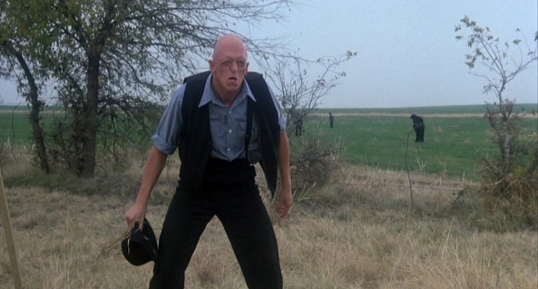
Deadly Blessing (1981, dir by Wes Craven)

Deadly Blessing (1981, dir by Wes Craven)

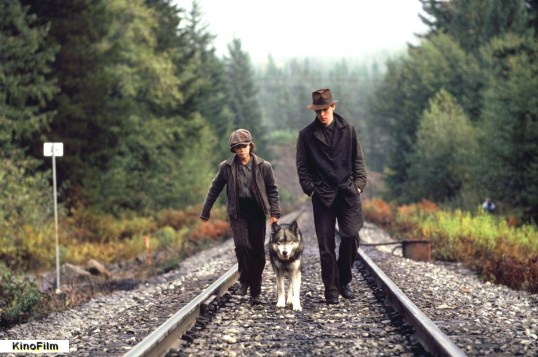
The Journey of Natty Gann (1985, dir by Jeremy Kagan)

The Journey of Natty Gann (1985, dir by Jeremy Kagan)

The New World (2005, dir by Terrence Malick)

The New World (2005, dir by Terrence Malick)

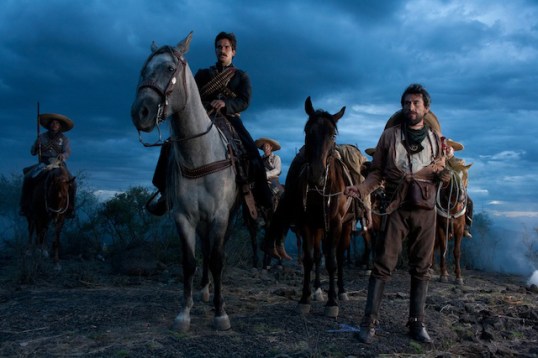
Cristiada, also known as For Greater Glory (2012, dir by Dean Wright)

Cristiada, also known as For Greater Glory (2012, dir by Dean Wright)


An Obscure Film Review: Katherine (dir by Jeremy Kagan)


One of the great things about being an online film critic is that you occasionally come across a good but obscure film that you can then let the rest of the world know about as well.  Katherine is one such film.

I came across Katherine as part of a 3-film compilation DVD called Classic Films Of The 70s.  The other two films on the DVD were The Harrad Experiment and Born To Win and both of those films were so bad that I nearly tossed the DVD to the side without watching Katherine.  I’m glad I changed my mind because, while it may not have truly lived up to the promise of being a classic film of the 70s, Katherine was still a thousand times better than The Harrad Experiment.

Beginning with the idealism and hope of the early 60s and ending with a literal bang in the 70s, Katherine tells the story of how one woman is transformed from being a sheltered, upper class liberal to being a political revolutionary who is proud to embrace violence in order to bring about change.  Katherine ( Sissy Spacek, before she was Carrie) starts out as a teacher before falling in love with a civil rights activist (played, in a nicely smarmy performance, by Henry Winkler).  Against the backdrop of the Viet Nam War and the violence of the late 60s, Spacek and Winkler gradually become more and more radicalized until they eventually go underground and turn violent.  The film is made up of interviews with people who knew Katherine and Katherine herself even pops up and tells us her own version of her story.  Despite being forced to wear a horrid wig in the latter half of the film, Sissy Spacek gives a wonderfully empathetic and multi-layered performance as Katherine.  Even if you don’t always like the self-righteous stridency of the character, you never doubt her sincerity.

After I watched Katherine, I did a little research on the IMDb and I discovered that Katherine was a made-for-TV movie that was originally broadcast in 1975.  This did not surprise me because,  even as I was watching it, it was very easy to imagine a remake of Katherine (starring, I decided after much debate, Leighton Meester) being broadcast on the Lifetime Movie Network.  However, if Katherine felt like a Lifetime movie  with a political subtext, that’s only because I happen to love Lifetime movies.  Katherine is both an intelligent and interesting look at a very specific period of American history and a portrait of youthful idealism, disillusionment, and wanderlust.  We have all had to deal with that moment when our beliefs run into the wall of reality and Katherine captures that experience perfectly.

I found myself thinking about Katherine earlier today as I watched the presidential inauguration in Washington D.C.  Though the film might be close to 40 years old, its portrait of naive idealism, political stridency, and destructive activism still feels relevant.  Katherine is a film that most people have never heard of but it’s also one that is worth tracking down.