
I hate to admit it but it actually took me a day or two to really warm up to Boyhood.
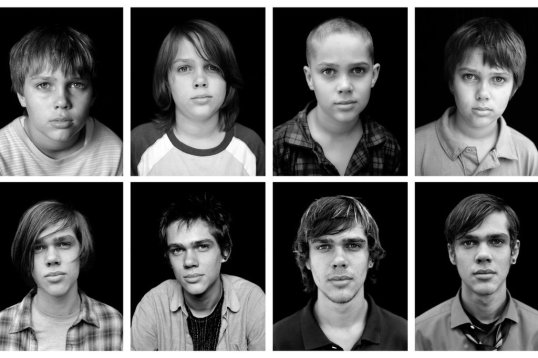
When I first saw it, I knew that I was watching a great film and it was a movie that I had a good deal of respect for. By now, we’ve all heard the story of how the film was made and how director Richard Linklater first started the film in 2002 when star Ellar Coltrane was only 6 years old. Over the next 12 years, Linklater would spend a few weeks out of each year filming. The script was written on a year-by-year basis, allowing the story to develop organically and often taking into account whatever was happening in Coltrane’s life at the time. The end result is that Coltrane grows up on screen in much the same way that Mason, the character he’s playing, does. As I watched Boyhood, I knew that Linklater had somehow managed to turn what could have been a mess into an undeniably effective movie.
But yet, in the hours immediately following the showing, I had a nagging feeling. I realized that, as much I respected the film and as much as I wanted to love the film, there was a part of me that was slightly disappointed. In some ways, it made sense. Richard Linklater is a director whom I absolutely revere and, as a result, I am always going to watch his movies with extremely high (and occasionally unrealistic) expectations. As for the film itself, Boyhood is the most acclaimed film of the year so far. For the longest time, it had a perfect 100% rating over at Rotten Tomatoes.
And, when you’re continually told that a film is the greatest movie ever made, it’s going to be a challenge to then judge the film on its actual merits.
And so, I was content to think of Boyhood as being one of those undeniably important films that I respected more than I enjoyed.
But then something happened.
Boyhood stuck with me. Boyhood is a film that has stuck with me more than almost any other film this year. (Interestingly enough, perhaps the only 2014 film that I’ve seen so far that has stuck with me more was Guardians of Galaxy, which in many ways is the exact opposite of Boyhood.) There are scenes in Boyhood that are still as fresh in my mind as they were when I first saw them. Interestingly enough, they’re not big, dramatic scenes. (Indeed, Boyhood is memorable for just how determined it is to avoid the big, dramatic scenes that usually appear in coming-of-age films.) Instead, what stuck with me were the little details.
I remembered how, when Mason was 6 and his family was moving down to Houston, his best friend rode by on a bicycle and waved goodbye, never to be seen again in the film but definitely destined to be remembered by both Mason and the audience.
I remembered how, from the minute that Mason’s mom (Patricia Arquette), met and married the seemingly friendly Bill (Marco Perella), I knew that the marriage wasn’t going to work. I remembered the scenes of Mason and his sister (Lorelei Linklater) trying not upset Bill and failing every time. Years later, when Arquette marries yet again, I knew that it wasn’t going to work out any better. By that point, Mason knew it too but what can you do when you’re only 16?
I remembered how Mason, after having been moved to San Marcos, had an awkward conversation with a girl from his school. The girl obviously liked Mason and Mason obviously liked the girl but neither one had a clue how to say it.
I remembered feeling stunned when, over the course of just one scene break, Mason went from being an innocent-looking 14 year-old to a skinny and angrily sullen 15 year-old. It’s hard for me not to feel that, in that regard, Boyhood serves as a warning of what’s probably in store for me once I actually have kids.
I also remember being surprised when Mason’s Dad (Ethan Hawke) went from being the guy who ranted about George W. Bush in 2004 to a 2011 newlywed who asks his children to come to church with him. But then again, in retrospect, was it that much of a shock or, like Mason, did I unfairly expect his Dad to remain a rebel for the rest of his life?
(One of the most interesting things about the film is that, since it was literally filmed while the story was occurring, Boyhood serves as a time capsule of life and culture throughout the beginning on this century. While the scenes set in 2004 and 2008 are dominated by Mason’s father enthusiastically talking about politics, he never mentions anything about the presidential election in 2012. And it actually makes sense because was anyone enthusiastic about 2012?)
That’s the thing that sets Boyhood apart from other coming-of-age films. Many of the events that would be major scenes in other teen films — like losing one’s virginity or learning to drive — happen off-screen in Boyhood. Instead, Boyhood is just about watching life unfold. Many questions are not answered. Characters come and go, playing their part in Mason’s life and then disappearing as Mason moves on.
Some of them, like Mason’s stepbrother and step sister who are both left behind when his mother leaves Bill, we wonder about, just as surely as Mason wonders about them too. But life is rarely neat enough to provide all the answers and Boyhood, if nothing else, is about life.
And that, ultimately, it why Boyhood sticks with you. Looking back on the film, you can see how Mason the 6 year-old who had to be forced to leave behind his best friend eventually grew up to be Mason the 18 year-old who is almost insensitive in his eagerness to leave behind his mother and drive himself to college. But, and this is the key, you have to be willing to look back on the film to truly understand at. Trying to figure out how the pieces of puzzle fit together while watching the film will only leave you frustrated, as life often does while you’re living it. It’s only after the film that you can truly understand what it all means. It’s only when you look back that you realize just how much Richard Linklater has accomplished with Boyhood.
As such, Boyhood is not an easy film.
But it is a great one.

 Through the Shattered Lens