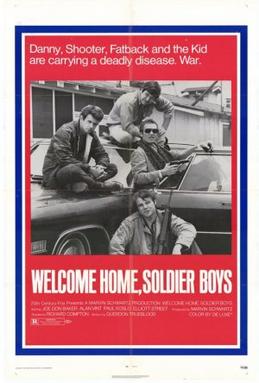
Welcome Home, Soldier Boys (1971, directed by Richard Compton)


Talk about embarrassing!  When Lisa told me that today was Joe Don Baker’s birthday, I decided that I would review Speedtrap, as 1977 car theft movie that Lisa and I watched last week.  But, when I took a look at the imdb to double check the name of the character that Baker played in Speedtrap, I discovered that I had already reviewed it!

Instead of talking about Speedtrap a second time, I’m going to recommend one of Joe Don Baker’s early films.  In Welcome Home, Soldier Boys, Baker stars as Danny, the leader of a group of Green Berets who have just returned from Vietnam and can no longer find a place in society.  Danny, Kid (Alan Vint), Shooter (Paul Koslo), and Fatback (Elliott Street) go on a cross-country road trip.  After they kill a prostitute (Jennifer Billingsley) who demanded more money than they were willing to pay, they visit many sites from their youth.  They go to a high school basketball team.  They spend some time in a sleazy motel.  (Geoffrey Lewis plays the desk clerk.)  They get into a fight with a mechanic (Timothy Scott) over the price of some auto repairs.  After being cheated by one too many people and realizing that no one cares about the sacrifices that they made for their country, they put on their uniforms and violently take over a small town, leading the National Guard to show up to take them all out.

Welcome Home, Soldier Boys is a pretty ham-fisted anti-war allegory and the plot sometimes meanders too much for its own good.  With its road trip violence, its a dry run for director Richard Compton’s far more cohesive Macon County Line.  The movie still packs a punch, due to the efforts of the cast and the violent ending.  The movie is full of familiar characters actors, who are all convincing in their roles but it really is dominated by Joe Don Baker’s hulking intensity.  Danny is the dark side of the amiable country boys that Joe Don Baker would play in so many other movies.  Danny is angry but, as a stranger in a strange land, he’s sometimes sympathetic.  Ultimately, Danny wants the respect that was given to the returning soldiers of the previous generation.  Instead, he comes back to country that doesn’t want much to do with him or his friends.  Returning from serving overseas and still trying to deal with the things that he saw in overseas, Danny feels lost in and rejected by his home country.  It’s one of Baker’s best performances.
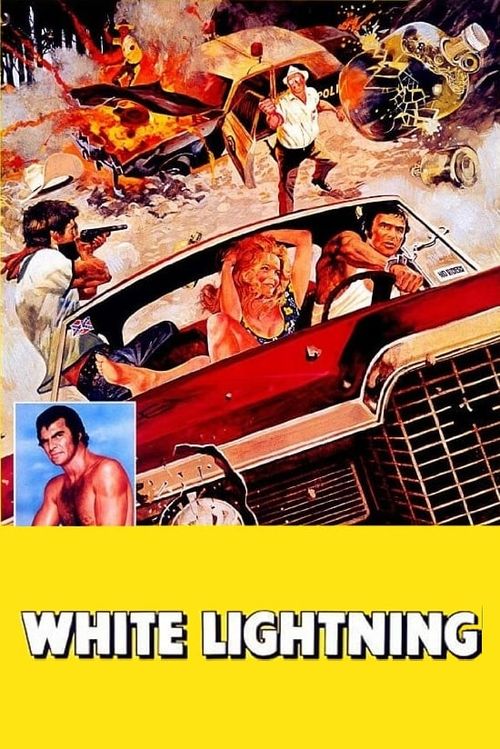
WHITE LIGHTNING – #ArkansasMovies, my celebration of movies filmed in the Natural State!


I love watching movies that are filmed in my home state of Arkansas. There’s something cool about seeing places I’ve been before showing up on the big screen, and if I haven’t been there before, I can go visit. We’ve had our share of big stars show up in the Natural State. Burt Reynolds, Billy Bob Thornton, Bill Paxton, Robert De Niro, Dennis Quaid, Matthew McConaughey, Tom Cruise, and Andy Griffith have all filmed really good movies here. Heck, Martin Scorsese directed one of his very first movies in southern Arkansas. It’s going to be fun revisiting some of my favorites and sharing them with you!

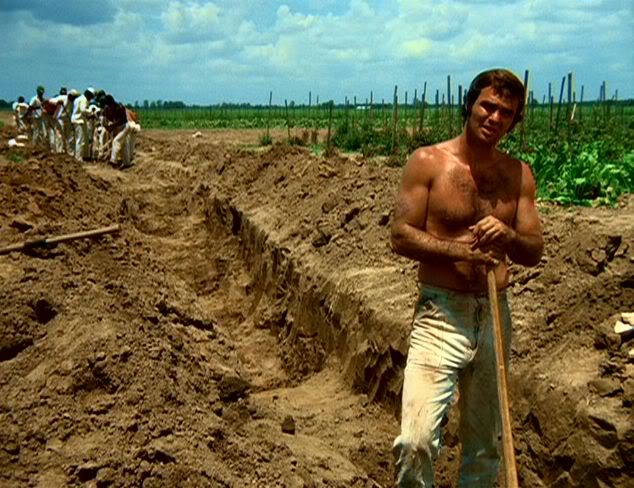
I’m kicking off #ArkansasMovies with WHITE LIGHTNING, the 1973 film from director Joseph Sargent that was filmed almost entirely within 30 minutes of my house in central Arkansas. Burt Reynolds is Gator McKlusky, a good ol’ boy who happens to find himself serving a stint in prison for “stealin’ cars, runnin’ cars, and runnin’ moonshine whiskey.” One day a cousin comes to visit him in prison and tells him that his younger brother Donny has been killed in Bogan County. Suspecting foul play, Gator first tries to escape. When that doesn’t work, he agrees to go stool pigeon and work with the federal authorities to infiltrate the world of illegal moonshining in Bogan County and provide them the names of the big money people in the area. This includes the crooked county Sheriff J.C. Connors (Ned Beatty), who Gator immediately zeroes in on as the key person responsible for his brother’s death.

In my opinion, WHITE LIGHTNING is one of the best of the good ‘ol boy, southern redneck films that were so popular in the 1970’s. One of the main reasons I like WHITE LIGHTNING so much is that while it does has some of the clowning that’s expected in these types of films, the tone gets deadly serious as McKlusky zeroes in on what happended to his brother. Reynolds is especially badass when he stops his signature laughing and goes into vengeance mode. And Ned Beatty is perfect casting as the small-town sheriff who is completely and irredeemably evil. The opening scene shows Beatty boating a couple of bound and gagged young men out into the middle of the lake, shooting a hole in the their boat, and then casually paddling away as the boat sinks. If you came up on him a little later, you’d think he was just heading in from a day of crappie fishing. For a guy that doesn’t look menacing at all on first glance, we know just how dangerous Sheriff J.C. Connors is. And so does Gator. We have a rooting interest in seeing Gator get his revenge.

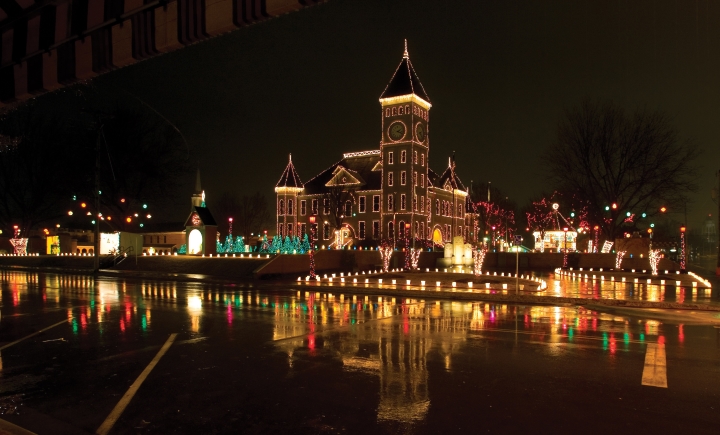
The primary filming locations in WHITE LIGHTNING are practically in my backyard. My wife and I got married at the Saline County Courthouse in downtown Benton, which is featured very prominently in the film. It’s a beautiful courthouse, with a distinctive clock tower. They decorate it so beautifully for the Christmas season (see picture below). Burt also spends time at the “Benton Speedway” in the film.  This is actually the old I-30 Speedway that was in operation in Little Rock for 66 years. Sadly, the Speedway held its final race on October 1, 2022, which is almost 50 years after filming completed. The rest of the locations used were also in central Arkansas in the towns of North Little Rock, Keo, Scott, Wrightsville, and Tucker. FYI, I don’t recommend poking around Tucker if you’re into film tourism. Tucker is the primary prison unit for the Arkansas Department of Corrections. If you do head that way, just don’t pick up any hitchhikers!

All in all, WHITE LIGHTNING is a movie I whole-heartedly recommend, and it’s especially meaningful to me since it’s so close to home. Billy Bob Thornton would be back in this same area in 1996 to film SLING BLADE.

The TSL’s Grindhouse: C.C. and Company (dir by Seymour Robbie)


As our long-time readers know, I’ve seen my share of bad movies but it’s been a while since I’ve seen one as bad as 1970’s C.C. and Company.

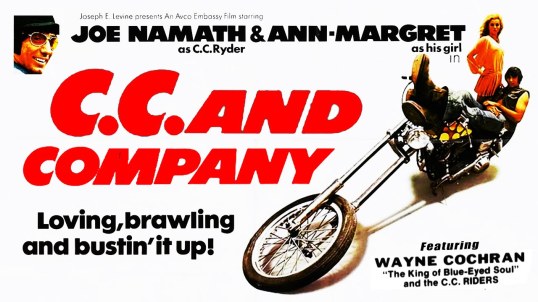
C.C. and Company is about a drifter named C.C. Ryder (played by Joe Namath, who was a pro football quarterback at the time).  Ryder rides through the desert on his dorky motorcycle.  He doesn’t have a job.  He doesn’t have much money.  He does have a lot of hair and he also has a lot of teeth.  We know that because it’s rare that there’s ever moment when C.C. isn’t smiling.  C.C. is perhaps the most cheerful amateur criminal that I’ve ever seen.  Even when C.C. really shouldn’t be smiling, he’s smiling.  There are moments when people try to kill C.C. and he responds with a smile.  This could be a sign of C.C.’s devil-may-care-attitude but I think it has more to do with Joe Namath being a really bad actor.

C.C. is apparently a member of a motorcycle gang.  I say apparently because no one in the gang seems to like him and they’re constantly beating up on him.  The leader of the gang is Moon (William Smith) and among the members of the gang is an intimidating figure named Crow (Sid Haig).  Smith and Haig were both professional actors and genuine tough guys.  They not only knew how to act on camera but they also knew how to throw a punch without faking it.  Having them act opposite Namath doesn’t really accomplish much beyond emphasizing just how terrible an actor Namath was.  Even though Moon is a Mansonesque creep, you still find yourself rooting for him whenever he and C.C. get into a fight because Smith creates an actual character whereas Namath…. well, he doesn’t.  I sat through this entire film and never once did I find myself wondering what C.C.’s initials stood for.  That’s how uninterested I was in C.C.’s life.

Anyway, C.C. meets the wealthy and chic Ann McCalley (Ann-Margaret) after Ann’s limo breaks down in the middle of the desert.  C.C. not only fixes the limo but he also saves Ann from Crow and Lizard (Greg Mullaney).  It’s love at first sight but, unfortunately, Ann has places to go so she drives off and C.C. returns to the biker camp and watches as Moon sends his girlfriend, Pom Pom (Jennifer Billingsley), out to make money on the highway.  As I watched all of this, I found myself wondering how everyone else in the gang got stuck with names like Moon, Lizard, Crow, Rabbit, Pom Pom, and Zit-Zit (my favorite) but somehow C.C. was able to keep his innocent initials.  The movie never explained the ritual behind receiving motorcycle gang names and I think that was a missed opportunity.

Eventually, C.C. trades in his dorky motorcycle for a Kawasaki, largely because Kawasaki apparently paid the film’s producers a lot of money.  C.C. enters a race and wins.  Ann sees him win and falls even more in love with him.  C.C. gets into a fight with the gang and then he and Ann head to …. well, it looked a lot like Reno but honestly, who knows for sure?  Eventually, Moon and the gang track C.C. and Ann down and it all leads to one last fight.  We never do find out if the “company” of the title referred to Ann and her rich friends or Moon and the gang.  Not even C.C. seems to know for sure.

So, there’s a lot of reasons why C.C. and Company doesn’t really work but mostly it all comes down to the lead non-performance of Joe Namath as C.C.  There’s nothing tough or intimidating or rebellious about Namath.  C.C. is the biker you can bring home to meet your parents.  William Smith and Sid Haig are a lot more fun but they’re playing totally disreputable characters.  Namath and Ann-Margaret have zero romantic chemistry and the entire film has the look of a cheap made-for-TV movie.  Between C.C. and Company and Altamont, 1970 was not a good year to be a biker groupie.

That said, there is one good scene in C.C. and Company, where C.C. and Ann go out dancing.  While Joe Namath awkwardly shakes his shoulders while flashing that ever-present grin, Ann-Margaret dances as if the fate of the world depended upon her.  One year after the release of this movie, she would prove herself as dramatic actress and receive her first Oscar nomination for Carnal Knowledge.

Spring Beakdown: The Thirsty Dead (dir by Terry Becker)


So, imagine this.

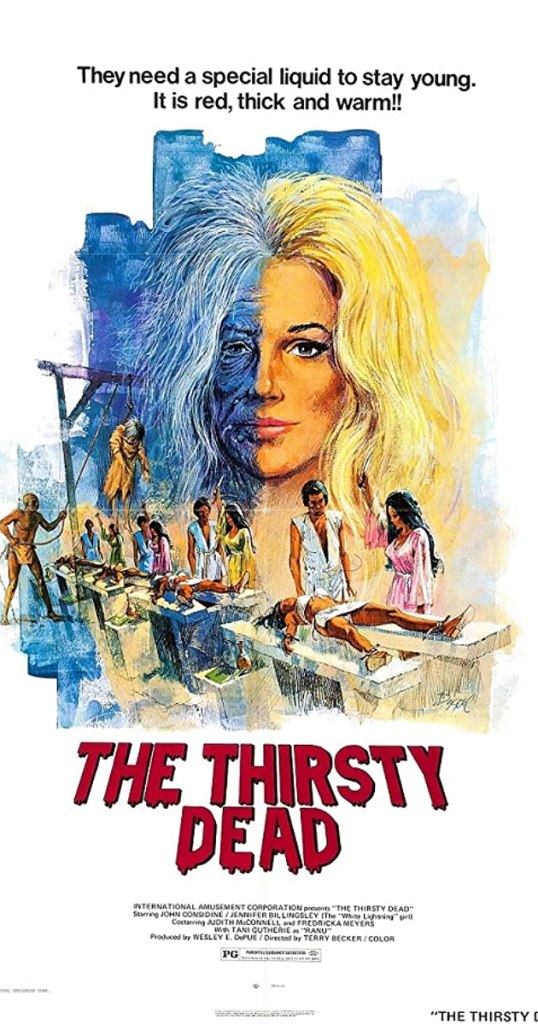
You’re on vacation in a tropical paradise.  (Maybe you’re even there on Spring Break, just so we can justify including this review in my series of Spring Break film reviews.)  One night, while wandering around the city, you get grabbed by a bunch of robe-wearing monks.  The monks proceed to tie you up and then force you to take a canoe ride from the sewer to the middle of the jungle.  Once you reach the jungle, you’re informed that you’ve been kidnapped by a cult that worships a shrunken head in a box.  The members of the cult have been around for centuries but they’ve managed to retain their youth by drinking the blood of the women who they kidnap off the streets of the city.  Like you, for example.

That would probably freak most people out.  That would certainly freak me out.  Not only do I not particularly care for the jungle but I’m also pretty attached to my blood.  However, when this exact same thing happens in the 1974 film The Thirsty Dead, no one seems to be particularly shocked to hear about it.  Instead, the kidnapped women all kind of shrug and accept their fate as if it all makes total sense.

In fact, Claire (Judith McConnell) appears to develop Stockholm Syndrome within record time.  She’s a dancer in Manila who, within hours of being kidnapped, is soon joking with her abductors.  She makes it clear that she’s apparently fine with being kidnapped and donating her blood to a good cause.  It’s never really clear why she’s okay with that but Claire is so determined to do what she wants to do (even if that means being subservient to a bunch of 100 year-old cultists) that it’s hard not admire her stubbornness.

On the other hand, Laura (Jennifer Billingsley) is determined to escape.  Even though the members of the cult believe that she’s the reincarnation of one of their goddesses, Laura wants to get back to civilization.  She thinks that one of the cultists, Baru (John Considine), might be willing to help her.  However, as Baru explains, if he goes too far into the jungle, he’ll lose his youth and basically just waste away.

(Just in case there’s any doubt on the part of anyone reading this review, the cult is right about the whole eternal youth thing.  One cultist makes the mistake of venturing too far out into the jungle and transforms from 49 to 50 right in front of our eyes!)

The Thirsty Dead is an odd film.  On the one hand, the first few minutes of the film is undeniably sordid.  Claire dances in a cage.  Laura gets knocked over the head by a cultist and ends up with her hands tied behind her back.  The camera lingers on a doll of a baby floating in a sewer.  When the women first find themselves in the jungle, Claire jokes about being sold into prostitution and the whole film, up until that point, has had a rather icky feel to it.  However, once the cult shows up, The Thirsty Dead suddenly becomes a rather tame film, one that’s almost totally free of graphic gore and sexual innuendo.  The Thirsty Dead ultimately feels less like a film and more like an extended episode of some 70s sci-fi show.  For a film about a blood-sucking cult, there’s surprisingly little blood.  It feels a bit off and, to be honest, it’s a little boring.  This is the type of film that calls out for a sleazier approach.

Despite being rather forgettable, The Thirsty Dead has achieved the dubious immortality of being included in several Mill Creek box sets, the ones with names like 100 Horror Classics or 50 Chilling Thrillers.  So, in all probability, you’ve got The Thirsty Dead on DVD or Blu-ray without even realizing it.  If you somehow don’t already have The Thirsty Dead in your film collection, you can always watch it on YouTube or Prime or probably a hundred other streaming sites.  The Thirsty Dead will never die.

Star Vehicle: Burt Reynolds in WHITE LIGHTNING (United Artists 1973)


gary loggins's avatarcracked rear viewer

wl1

Burt Reynolds labored for years in the Hollywood mines, starring in some ill-fated TV series (his biggest success on the small screen was a three-year run in a supporting role on GUNSMOKE) and movies (nonsense like SHARK! and SKULLDUGGERY) before hitting it big in John Boorman’s DELIVERANCE. Suddenly, the journeyman actor was a hot property (posing butt-naked as a centerfold for COSMOPOLITAN didn’t hurt, either!), and studios were scurrying to sign him on to their projects. WHITE LIGHTNING was geared to the Southern drive-in crowd, but Reynolds’ new-found popularity, along with the film’s anti-authority stance, made it a success across the nation.

wl22

WHITE LIGHTNING takes place in rural Arkansas, and Gator McKluskey (Burt) is doing a stretch in Federal prison for running moonshine. His cousin visits and tells Gator his younger brother Donnie was murdered by Sheriff J.C. Connors, the crooked boss of Bogan County. A raging Gator tries to escape, but is immediately caught, so he…

View original post 690 more words

A Movie A Day #8: White Lightning (1973, directed by Joseph Sargent)


white-lightning-02

A year after co-starring in Deliverance, Burt Reynolds and Ned Beatty reunited for another movie about life in the backwoods, White Lightning.

White Lightning starts with two hippies, bound and gagged and floating in a canoe.  While a banjo plays in the background, two rednecks use a shotgun to blow the canoe into pieces.  They watch as the hippies drown in the swamp.  It turns out that one of those hippies was the brother of legendary moonshiner and expert driver, Gator McCluskey (Reynolds).  Gator is doing time but when he hears that his brother has been murdered, he immediately realizes that he was probably killed on the orders of corrupt Sheriff J. C. Connors (Ned Beatty).  The Feds arrange for Gator to be released from prison, on the condition that he work undercover and bring them enough evidence that they can take Connors down.

Back home, Gator works with a fellow informant, Dude Watson (Matt Clark), teams up with local moonshiner, Roy Boone (Bo Hopkins), and has an affair with Roy’s girl, Lou (Jennifer Billingsley).   Connors and his main henchman, Big Bear (R.G. Armstrong) both suspect that Gator and Dude are working for the government.  Since this is a Burt Reynolds movie, it all ends with a car chase.

A classic of its kind and a huge box office success, White Lightning set the template for almost every other film that Burt Reynolds made in the 1970s and 80s.  There is not much to the movie beyond Burt’s good old boy charm and Ned Beatty’s blustering villainy but if you’re in the mood for car chases and Southern scenery, White Lightning might be the movie for you.   Joseph Sargent also directed the New York crime classic, The Taking of Pelham One Two Three, and he gives White Lightning an edginess that would be lacking from many of Burt Reynolds’s later movies.

For tomorrow’s movie a day, it’s the sequel to White Lightning (and Burt Reynolds’s directorial debut), Gator.

white-lightning-05