Welcome to Late Night Retro Television Reviews, a feature where we review some of our favorite and least favorite shows of the past! On Wednesdays, I will be reviewing Monsters, which aired in syndication from 1988 to 1991. The entire series is streaming on YouTube.
This week, we begin the third season of Monsters!
Episode 3.1 “Stressed Environment”
(Dir by Jeffrey Wolf, originally aired on September 30th, 1990)
The third season of Monsters starts off with the story of an experiment gone wrong.
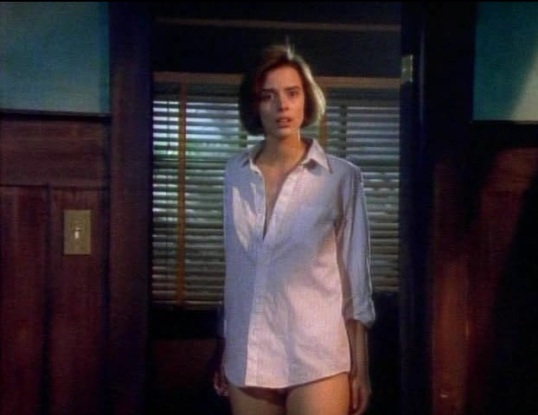
For twelve years, Dr. Elizabeth Porter (Carol Lynley) has been experimenting with lab rats, trying to help them evolve into a higher form of intelligence. Her work is supervised by Dr. Robert Winston (Victor Raider-Wexler) and her assistants are the cowardly Keith (Scott Weir) and Gina (Kathleen McCall). The episode opens with a lengthy (by Monsters standards) scene of Gina undressing and then putting on her special rat feeding uniform while Keith tries to discreetly watch. It’s a scene that really has little to do with the rest of the episode but I guess the producers of Monsters decided that the best way to survive to a fourth season would be to appeal to teenage boys.
Anyway, Keith’s crush on Gina comes to naught because Gina is killed while trying to feed the rats. It turns out that the rats have gotten smart. They’ve gotten smart enough to build crude spears and crossbows and use them as weapons. Dr. Winston wants to shut the experiment down. Keith wants to go home. Elizabeth, however, wants to protect her rats and see if she can convince them to give up their weapons and live in peace. Dr. Winston points out that if humans can’t convince their own species to do that, how is Elizabeth going to convince a bunch of rats?
And Dr. Winston has a point. Elizabeth may think that she has a special bond with the rats but the rats disagree. Soon, Gina is not the only person to have lost their life to an army of spear-carrying rats. The episode ends with Keith as the sole survivor and his ultimate fate is still up in the air. The rats are angry, ruthless, and armed.
And cute!
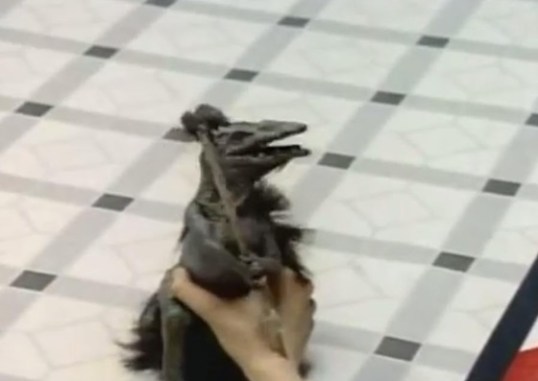
Seriously, this episode probably might have been more effective if the rats themselves have been a bit more frightening but it wouldn’t have been as much fun. As it is, the use of crude puppets actually made the rats look kind of adorable, especially when they were holding their little spears and setting up their little crossbows. Of course, one reason why I found the rats to be cute is because I’m used to CGI. I take CGI for granted. This episode was made when special effects people still had to use puppets for their monsters and, as a result, the rats don’t really look like rats. They’re so fake-looking that it’s hard not to like them. They’re a throw-back to a simpler and more innocent time.
This was actually a pretty entertaining episode and a great way to start season 3! I appreciated that this episode of Monsters featured actual monsters. After the uneven batch of episodes that finished up the second season of this show, it’s nice to season 3 starting off on the right foot.
Welcome to Late Night Retro Television Reviews, a feature where we review some of our favorite and least favorite shows of the past! On Wednesdays, I will be reviewing Monsters, which aired in syndication from 1988 to 1991. The entire series is streaming on YouTube.
This week, Abe Vigoda and Brad Greenquist star as two criminals who discover that they have an unexpected visitor in the basement of their cabin.
Episode 2.22 “The Gift”
(Dir by Jeffrey Wolf, originally aired on May 20th, 1990)
Two low-life criminals, Sid (Abe Vigoda) and his protege, Kirby (Brad Greenquist), show up at a cabin in the mountains. They have a rich kid named Jeffrey (Zach Overton) with them. They’ve kidnapped Jeffrey from his exclusive private school and they are planning to hold him until they get paid several million dollars.
Wanting to keep the kid comfortable, Sid tells Kirby to look in the basement for blankets. Kirby doesn’t find any blankets but he does a find a mysterious wolfman. Kirby shoots the wolfman twice but the wolfman survives. Kirby then chains up both Jeffrey and the Wolfman in the basement. Kirby thinks that it might be a good idea to forget about the whole kidnapping scheme but Sid is determined to get the money.
In the basement, Jeffrey discovers that the Wolfman can communicate with him through telepathy. The Wolfman introduces himself as being William (physically played by Carlos Lauchu, with a voice provided by John Michael Bolger). William explains that he’s not a monster. Instead, he’s just a man who, centuries ago, was granted magical abilities by an old traveler. Now, William is over 200 years old. He’s nearly immortal but he’s also lonely. Jeffrey is the first person who has been willing to listen to William in a long time.
Jeffrey and William bonding in the basement is undeniably sweet but Sid and Kirby are still holding Jeffrey hostage and, as time passes, it becomes obvious that they’re planning on killing both Jeffrey and his new friend. William explains that there is a way that he can ensure that Jeffrey will survive and that he’ll be able to defeat both Sid and Kirby. But it will involve Jeffrey making a huge sacrifice of his own….
This episode was fairly dull. When it started, I was hoping that the show would at least do a Ransom of Red Chief sort of thing and have Jeffrey turn out to be such a brat that absolutely no one would be willing to pay a cent to get him back. I think that would have been more interesting than what we ended up with, an episode in which Jeffrey awkwardly bonded with a werewolf who could only communicate through telepathy because moving his mouth probably would have made the actor’s mask look even cheaper than it already did. Abe Vigoda and Brad Greenquist were well-cast as the two criminals. Vigoda, in particular, did a good job of portraying Sid’s outwardly calm but still ruthless demeanor. Otherwise, this was a fairly dull episode that didn’t really do much with its potentially intriguing premise.
Welcome to Late Night Retro Television Reviews, a feature where we review some of our favorite and least favorite shows of the past! On Wednesdays, I will be reviewing Monsters, which aired in syndication from 1988 to 1991. The entire show is streaming on Tubi.
Tonight’s episode of Monsters is …. surprisingly good!
Episode 1.7 “The Legacy”
(Directed by Jeffrey Wolf, originally aired on December 3rd, 1988)
Dale (David Brisbin) is a film teacher and a writer who is hoping to make his name and reputation by writing the authoritative biography of actor Fulton Pierce. Pierce was silent film horror actor who, much like Lon Chaney Sr, was noted for his ability to physically transform himself into the monsters that he was playing. Dale not only wants to write about the events of Pierce’s life but he also wants to explain how Pierce was able to play so many different monsters.
In order to get into Pierce’s mind, Dale moves into Pierce’s former home. When Dale comes across Pierce’s old makeup box, he is convinced that he’s finally found the secret of Pierce’s success. When he opens the makeup box and looks at the mirror within, he seems not his face but instead the face of some of Pierce’s most fearsome characters, including a disfigured monster and a cackling mad scientist.
For the record, the mirror apparitions are inspired by The Cabinet of Dr. Caligari, Thomas Edison’s Frankenstein, Phantom of the Opera, and maybe London after Midnight.
Dale’s girlfriend, a model named Debbie (Lara Harris), fears that Dale is wasting his time on a book that no one is going to care about. When she drops by the house and discovers that Dale hasn’t even been able to come up with an opening line for his masterpiece, she gives him an ultimatum. He can either spend the rest of his life trying to write his book or he can marry her but she’s not going to wait forever. She tells him to “Make up your mind!” Dale latches onto the phrase “Make up your mind!,” shouting that he now knows how Fulton Pierce pulled off his amazing transformations.
I was pretty much wearing the same outfit when I watched this episode.
At first Debbie thinks that she has made a real break-through with Dale but later, that night, she wakes up to find Dale standing in front of a mirror and staggering around like one of Fulton Pierce’s monsters. She also discovers that the first chapter of the book is just the phrase Make Up Your Mind written over and over again. Has Dale’s obsession led him to madness or has he truly been possessed by the spirit of Fulton Pierce?
Someone’s losing it.
This episode of Monsters was based on a short story by Robert Bloch and certainly, the plot is more intriguing than any of the stories that preceded it. How exactly does an actor become a character and, more importantly, can you play a monster without becoming one yourself? Can one enter the mind of a madman without becoming mad themselves? (One wonders if Bloch, who was reportedly very much a no-nonsense personality, was satirizing the excesses of method acting.) Though the episode is only 21 minutes long, the story doesn’t feel rushed and the deliberate pace helps to create a properly ominous atmosphere. Add in two strong performances from David Brisbin and Lara Harris and you have the best episode of Monsters so far.
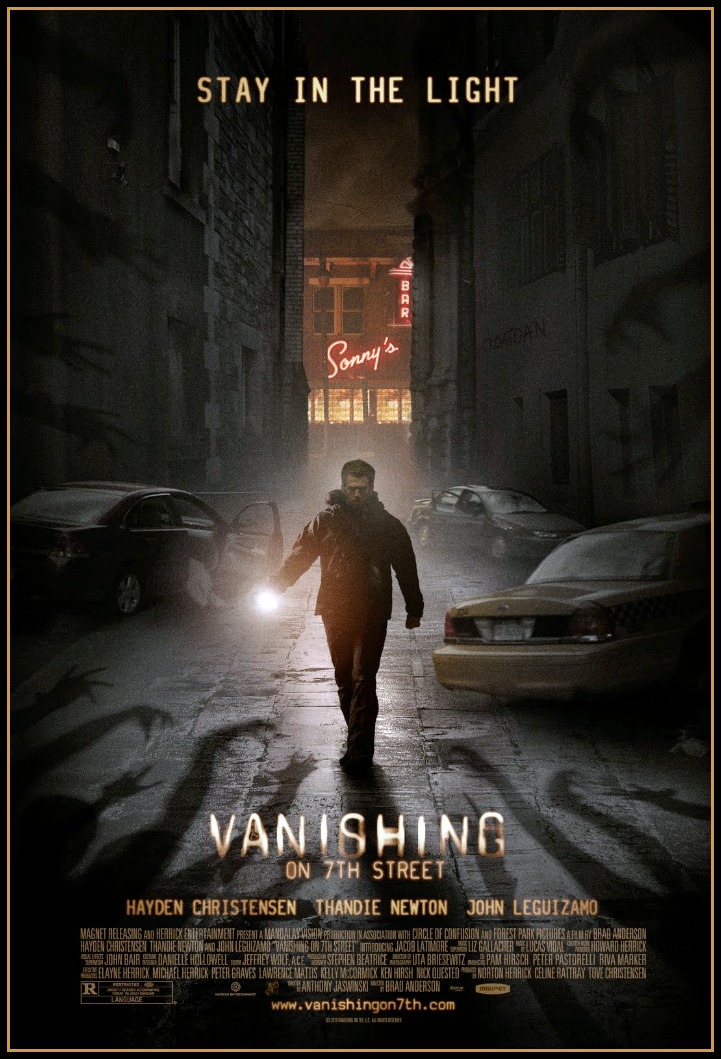
In the genre world of horror and thrillers there’s been one name who always seem to be on the verge of breaking out. He has done some exceptionally well-crafted horror and thrillers which never could get a mainstream audience to commit to but always gathering a cult-following upon their release. He has done some wonderful work as a TV director for such acclaimed shows as Fringe, Treme, Boardwalk Empire and The Wire. His best known work was a thriller collaboration with Christian Bale in The Machinist. While it’s a film more well-known for the extremes an actor was willing to go for to make their performance as authentic as possible it was also a film which showed style and talent in it’s filmmaker. The person I speak of is Canadian filmmaker Brad Anderson whose latest film was another low-budget horror-thriller which looks to be gaining a cult-following once again despite not being well-received by the mainstream critics. Vanishing On 7th Street was a film using the screenplay of Anthony Jaswinski which puts an interesting, claustrophobic and, at times, entertaining twist on the oft-used and well-ridden post-apocalyptic genre.
The film begins with film projectionist Paul in his projection booth reading up on the lost colony of Roanoke and the mysterious word left behind: CROATOAN. It’s through his point of view that we first see the beginning of what could be the end of the world as lights begin to flicker then go out throughout the theater and the mall it’s located in. Paul investigates this event only to discover sets of clothing and accessories where theater patrons and employees used to be in. With each passing moment the darkness — punctuated by just the flashlights of Paul and a lone mall security guard — becomes to take on an ominous tone before the film sudden moves ahead three days into what would become the major setting for the film: a lit bar on a deserted and darkened stretch of 7th Street in Detroit, Michigan.
We meet the rest of the main cast in this bar. There’s Luke who used to be a TV anchorman who discovers to his horror just what might have been the cause of the disappearance of most everyone in the world as he tries to find his girlfriend at the TV station they both worked at. It’s in these flashbacks to Luke’s early experience with the dark apocalypse that we see some of the most perfectly shot scenes of a major city devoid of life. An urban setting where the sudden disappearance of people during the power outage the night before has caused an eerie detritus of crashed vehicles, empty clothing and, in a sudden and violent sequence, a lone airline crashing in the background. It’s through Luke and the lone survivor in the bar, a 12-year old boy named James (Jacob Latimore), that we begin to try and piece together just what might have caused the event which continues to plague those left behind for the last three days.
The film posits the basic concept that darkness itself was the culprit for the disappearance of everyone and what continues to stalk those still left behind, alive and desperate for answers. While the film never really give definite answers as to the cause the two other characters in the back outside of Luke and James bring their own theories. There’s Rosemary (Thandie Newton), the distraught mother searching for her infant son, who thinks what’s going on around them is the the prophecized Rapture and those left behind were those who have sinned and were now being tormented for whatever sins they might have committed. On the other side is Paul from the beginning of the film who Luke rescues from an illuminated bus stop shelter who believes the very thing which caused the disappearance of the Roanoke colony during the 16th-century has now returned on a global-scale. His reasonings run the gamut of scientific causes from wormholes, black holes, gamma ray burst, nanotech gone amok and even an accident from a particle collider.
The audience are left to decide amongst themselves which explanation holds merit since neither one has enough backing to be the true answer. Vanishing On 7th Street leaves much of the questions raised by the dark apocalypse around these surviving characters to be left ambiguous and unanswered which at times becomes a detriment to the narrative as a whole. It’s a testament to Brad Anderson’s direction that the film was able to move past the apparent weaknesses in Anthony Jaswinski’s script and deliver a taut thriller (the film never truly gets to the level of horror) that just builds and builds with tension from beginning to an end that seemed almost too rushed.
With a low-budget and minimal cast the film tries to create some of the tension in the film be a construction of the differences between the four main characters. The actors were pretty game to try and make their characters more complex than what the script have provided, but in the end they still seem too basic for anyone of them to become sympathetic for the audience to truly care for their well-being. The film has to finally rely on just them as the last people on the planet as the main crux for the audience to latch onto. All the actors involved never become too cartoonish or stereotypical in their performance, but some of their decision-making in the middle and latter section of the film were too horror-typical, but they do add to the film’s many scenes of mounting terror as characters drop flashlights, lose light sources and other such problems with the living shadows in the darkness creeping up to try and take those still left. These scenes do look to be too stereotypical of other horror films but under Anderson’s direction there’s a palpable sense of claustrophobia and menace in these shadows.
What truly sells the film despite these flaws outside of Anderson’s direction would be the minimalist score by first-time film composer Lucas Vidal. His composition for the film were at once ominous and haunting. At times his score shows off hints of influences from the more doom-laden scores of Philip Glass. The other component of the film which definitely added to the atmosphere of inevitable doom to the film was Uta Briesewitz cinematography which made great use of darkness and solitary light sources to create islands of safety in a sea of encroaching terror we never truly comprehend. It’s the trifecta of Anderson’s directing, Vidal’s minimalist doom orchestration of a score and Briesewitz’s cinematography which gives Vanishing On 7th Street enough reasons to be a film which stands out as a fine piece of genre filmmaking despite weaknesses in the script.
Brad Anderson truly seem to be a filmmaker destined to remain in the fringes of mainstream cinema. His Vanishing On 7th Street continues to be another example of his great work in the horror-thriller genre. Despite same flaws which could turn off some of those who see this film it doesn’t diminish the fact that even at it’s worst this film was still an entertaining piece of post-apocalyptic work which brings some new ideas into the genre. Maybe a stronger treatment of the script would’ve made for a near-perfect thriller and one which could’ve had more horror to it, but Anderson was able to make a good enough film with an average script that I think deserves for this film to be seen by more people. For every horror remakes we get from Michael Bay’s Platinum Dunes to the latest in the Saw-like torture porn horror it’s good to see that such films as Vanishing On 7th Street exist to be the solitary beacon of light in a sea of cookie-cutter, by-the-numbers horror films that seem to dominate each film year after the other.



 Through the Shattered Lens