Holidays On The Lens: Beyond Tomorrow (dir by A. Edward Sutherland)


After three eccentric businessman arrange for a young couple to get together right before the holidays, a plane crash kills the three men.  However, their ghosts remain on Earth to watch over the couple and to take care of some unexpected holiday business.  The film is a holiday film and a comedy and a romance and a musical and a ghost story and a melodrama and finally an oddly sincere meditation on life and death.

From 1940, here’s Beyond Tomorrow!

Holiday Spirit: Beyond Tomorrow (dir by A. Edward Sutherland)


After three eccentric businessman arrange for a young couple to get together right before the holidays, a plane crash kills the three men.  However, their ghosts remain on Earth to watch over the couple and to take care of some unexpected holiday business.  The film is a holiday film and a comedy and a romance and a musical and a ghost story and a melodrama and finally an oddly sincere meditation on life and death.

From 1940, here’s Beyond Tomorrow!

Holiday Film Review: Beyond Tomorrow (dir by A. Edward Sutherland)


I’m standing at the edge of tomorrow
And its all up to me how far I go
I’m standing at the edge of tomorrow

I’ve never seen such a view before
A new world before my eyes
So much for me to explore
It’s where my future lies

Today I’m standing at the edge of tomorrow
From here the future looks bright for me
And it’s all up to me how far I go
It’s my time to break away
I’m standing at the edge of tomorrow
Today

Beyond Tomorrow is a strange film from 1940.  Technically, it is a holiday film.  It takes place during the Christmas season and there’s a lot of very peppy scenes featuring people celebrating the holidays.  I watched the movie with my friends in the Late Night Movie Gang.  We’re a pretty sentimental group but even we felt that some of the characters went a bit overboard with the holiday cheer.  The film is also comedy and a romance and a musical and a ghost story and a melodrama and finally an oddly sincere meditation on life and death.  That’s a lot of weight for one film to carry and there were more than a few times that Beyond Tomorrow seemed like it might collapse in a heap of Christmas ambition.  Fortunately, the film always righted itself and, in the end, it actually managed to be …. well, definitely more interesting than what any of us were expecting!

The film opens with three businessmen (Harry Carey, C. Aubrey Smith, and Charles Winninger) living in a mansion with their Russian housekeeper (played by Maria Ouspenskaya, who was also the old gypsy lady in The Wolf Man).  As almost something of a lark, the three men arrange for James (Richard Carlson) to meet Jean (Jean Parker).  Jean is a teacher.  James is a singing cowboy from Texas.  Together, with the encouragement of the three businessmen, Jean and James get together.  Awwwww!

Unfortunately, the three businessmen are then all killed in a plane crash.  However, their ghosts remain on Earth and watch over the growing love between James and Jean.  Unfortunately, James become a singing sensation on the radio and soon, he’s being tempted to cheat.  Meanwhile, Jean’s ex-husband is running around with murder in his heart and a gun in his hand!  This romantic comedy has suddenly taken a very dark turn!

While the three ghosts look after James and Jean, they consider why they’re still on Earth and not in the afterlife.  One ghost is eventually greeted by his son, who died during the Great War.  Another one of the businessmen is haunted by vaguely defined sins and, even in death, he refuses to repent because he feels that he doesn’t deserve to go to Heaven.  Instead, he continually walks off into the darkness.  The last businessman continually tries to push James and Jean on the right path but it turns out that it’s not easy for the dead to talk sense to the living.

You can probably give yourself whiplash trying to keep up with the film’s tonal changes.  It starts out with romance and comedy and then suddenly, it’s turns into an existential rumination of love, forgiveness, and guilt.  Once the three businessmen die, it becomes a totally different story.  Suddenly, soldiers are returning from the dead and the gates of Hell are beckoning.  And, on top of that, James keeps breaking out into song every few minutes!

It’s a very strange film.  Unfortunately, from the start, the pacing feels off.  By today’s standards, Beyond Tomorrow gets bogged down in all of the songs and the scenes of holiday mirth-making.  That may not have been as much of a problem for audiences in 1940 but I have to say that, speaking as someone trying to watch this film in 2020, Beyond Tomorrow made my ADD go crazy.  If not for my friends and their patient willingness to inform me what was going on in the film, I probably wouldn’t have been able to follow the film’s storyline.

That said, the film was fairly well-acted and the final scenes, with the heavenly gates in the sky, are undeniably effective.  Speaking as a history nerd, I found it interesting to see how the shadow of World War I still hung over a film that was made 21 years after that war ended.  As the scenes in which one of the ghosts is a reunited with son showed, America was still dealing with trauma and horror of the first modern war.  (One year after the release of Beyond Tomorrow, Japan would bomb Pearl Harbor and America entered World War II, a conflict that many hoped to avoid precisely because they remembered the all of the men who didn’t make it home during the previous war in Europe.)  Messy though the film may be, Beyond Tomorrow functions well as both a historical document and a bit of sentimental wish fulfillment.

Compared to holiday classics like the original Miracle on 34th Street and It’s A Wonderful Life, Beyond Tomorrow is relatively unknown.  Certainly, it’s no classic.  But, for fans of both Christmas and old movies, it’s still an interesting trip into the past.
Lisa Reviews An Oscar Nominee: Lady for A Day (dir by Frank Capra)


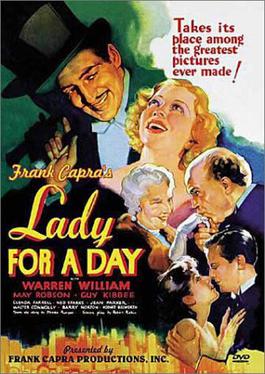
The 1933 film, Lady For A Day, tells the story of Apple Annie (May Robson) and Dave the Dude (Warren William), who is perhaps the nicest gangster that you could ever hope to meet.

Of course, when I refer to Dave the Dude as being a gangster, I should make clear that he’s not the type of gangster who guns down his rivals or sells drugs in back alleys.  I mean, I guess he might do that but we certainly don’t see much of evidence of it in the film.  Instead, Dave is just a dapper gambler who travels with a bodyguard named Happy McGuire (Ned Sparks) and whose girlfriend, Missouri Martin (Glenda Farrell), owns a nightclub where, since this is a pre-code film, the acts are slightly racy but not excessively salacious.  The country may be mired in a depression but Dave appears to be doing okay for himself.  Yes, Dave may be a criminal but at least he’s honest about it.

Surviving the Depression has proven to be far more difficult for Apple Annie.  She’s known as Apple Annie because she makes a meager living by selling fruit on the streets of New York City.  Dave is one of her regular customers, as he believes that her apples bring him good luck.  Annie has a daughter named Louise (Jean Parker).  Louise has never met her mother, having spent the majority of her life in a Spanish convict.  Annie regularly steals stationary from a high class hotel so that she can sends letters to Louise.  Not wanting her daughter to be ashamed of her, Annie has always presented herself as being a rich woman named Mrs. E. Worthington Manville.

However, it now appears that Annie’s charade is about to be exposed.  Louise is coming to New York with her fiance, Carlos (Barry Norton) and her prospective father-in-law, Count Romero (Walter Connolly).  Annie knows that when the Louise arrives, she’s going to discover that her mother is not wealthy and that the marriage will probably be called off.  So, led by Dave, Annie’s customers conspire to fool Louise into believing that her mother really is a member of high society.  And if that means that Dave is going to have to not only kidnap (but, let’s be clear, not harm) three nosy reporters and then make a deal with not just the mayor but also the governor to pull of the deception, that’s exactly what he’s going to do.

Though it may be disguised as a sweet and rather simple comedy, Lady For A Day is actually a rather melancholy little film.  Even when Annie and her friends are pretending to be wealthy members of high society, the film is aware that their escape from reality is only temporary.  Eventually, they’ll have to return to the reality of being poor in 1930s America.  At heart, it’s a sad story but May Robson, Warren William, Glenda Farrell, and Guy Kibbee (who plays the pool hustler who is recruited to pretend to be Annie’s husband) all bring such sincerity to their roles that you can’t help but smile while watching it.  Rejected by “polite” society, Annie and her friends have formed a community of outsiders and, throughout the film, the audience is happy that, no matter what, they have each other.

Lady for a Day was the first Frank Capra film to ever be nominated for Best Picture.  Capra was also nominated, for the first time, for best director but he had the misfortune to be competing with Frank Lloyd, who directed Cavalcade.  At the awards ceremony, when host Will Rogers, announced the winner for best director, he said, “Come on up here, Frank!”  An excited Capra ran down to the podium, just to discover that Rogers had actually been talking to Frank Lloyd.  Rogers, seeing what had happened, quickly invited the other nominated director, Little Women‘s George Cukor, to come join Lloyd and Capra at the podium.  Fortunately, one year later, Capra would win the directing Oscar for It Happened One Night.

Cavalcade would go on to win Best Picture but Capra retained so much affection for Lady For A Day that it was the only one of his films that he would subsequently remake.  A Pocketful Of Miracles came out in 1961 and featured Bette Davis in the lead role.  It would be Capra’s final theatrical film.

30 Days of Noir #4: Lady in the Death House (dir by Steve Sekely)


The 1944 film, Lady in the Death House, tells the tragic and faintly ridiculous story of Mary Kirk Logan (Jean Parker).

The daughter of a small-time criminal, Mary has spent most of her life trying to escape from her family’s legacy of crime.  She’s even got a job, working at the same bank that her father once tried to rip off.  Of course, at work, everyone knows her as Mary Kirk and they have no idea that her father was the infamous Tom Logan.  If that information got out, Mary would lose her job and no longer be able to take care of herself or her younger sister, Suzy (Marcia Mae Jones).

One night, Mary is out on a date with a clumsy man who takes her out to a nightclub and manages to accidentally set Mary’s dress on fire.  Luckily, Dr. Brad Braford (Douglas Fowley) is there, having a drink with his friend, the famous criminologist, Charles Finch (Lionel Atwill).  Brad jumps into action, extinguishing the fire and saving Mary’s dress.  It’s love at first sight.

There’s just one problem.  Dr. Bradford is studying ways to bring the dead back to life and, in order to raise money for his research, he’s been working as the state’s executioner.  When someone goes to the electric chair, Brad is the one who pulls the lever.  Mary says that she can only marry Brad if he gives up his electrifying night job.

However, before Brad can turn in his letter of resignation, Mary is arrested for the murder of Willis Millen (Dick Curtis), a crook who once knew her father.  Mary swears that she’s innocent but there are two eye witnesses who testify that they not only heard Mary and Willis fighting but that they also saw the shadow of someone hitting Willis over the head with a lamp.  It doesn’t take long for the jury to reach a verdict:

I have to admit that, when this newspaper appeared on-screen, I was actually more curious about the “youth” who was arrested for stealing glitter off of campaign signs.  However, for whatever reason, the film declines to follow up on that story.  Instead, we watch as Mary goes to death row, with the knowledge that she is to die “at the hand of the man I love.”

However, there may still be hope!  Charles thinks that Mary is innocent.  Though there’s only 24 hours left before Brad is scheduled to execute Mary, Charles launches an investigation of his own.  But even if Charles is able to find the evidence that exonerates Mary, will he be able to contact the governor in time?  Or will Mary go to the chair?

Well, regardless of what happens, rest assured that this World War II-era film will end with an appeal for all movie goers to do the right thing and buy war bonds.

Lady in the Death House is an entertaining but fairly ludicrous little movie.  I mean, realistically, having the executioner execute his own fiancée is a huge conflict of interest.  It seems like they could have gotten a substitute executioner, if just for one night.  But, if they did that, we wouldn’t get the melodramatic highlight of Mary announcing that she’s scheduled to be killed “by the hand of the man I love.”

Lady in the Death House provides a rare chance to see Lionel Atwill in a heroic role.  The British actor played a countless number of mad scientists, killers, and Nazis before his premature death in 1946.  (Atwill’s promising career was derailed in 1943, when he accused of hosting orgies at home and was subsequently convicted of perjury.  That’s one reason why Atwill turned up in a “poverty row” feature like this one.)  Atwill is convincing as Charles Finch.  The same superior attitude that made him a good villain also makes him believable as the only person capable of figuring out who murdered Willis Millen.

Taking on its own terms, Lady in the Death House is a fun movie.  If nothing else, it provides a lesson on how to get a message to the governor, even if no one’s quite sure where he is for the evening.  That’s an important lesson to learn!

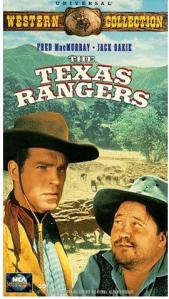
A Movie A Day #223: The Texas Rangers (1936, directed by King Vidor)


Sam (Lloyd Nolan), Jim (Fred MacMurray), and Wahoo (Jack Oakie) are three outlaws in the old west.  Wahoo works as a stagecoach driver and always lets Sam and Jim know which coaches will be worth holding up.  It’s a pretty good scam until the authorities get wise to their scheme and set out after the three of them.  Sam abandons his two partners while Jim and Wahoo eventually end up in Texas.  At first, Jim and Wahoo are planning to keep on robbing stagecoaches but then they realize that they can make even more money as Texas Rangers.

At first, Jim and Wahoo are just planning on sticking around long enough to make some cash and then split.  However, both of them discover that they prefer to be on the right side of the law.  After they save a boy named David from Indians, Jim and Wahoo decide to stay in Texas and protect its settlers.

The only problem is that their old friend Sam has returned and his still on the wrong side of the law.

Made to commemorate the Texas centenary (though it was filmed in New Mexico), The Texas Rangers is a good example of what’s known as an oater, a low-budget but entertaining portrayal of life on the frontier.   King Vidor does a good job with the action scenes and Fred MacMuarry and Jack Oakie are a likable onscreen team.  The best performance comes from Lloyd Nolan, as the ruthless and calculating Sam.  Sam can be funny and even likable but when he’s bad, he’s really bad.

Jack Oakie was better known as a comedian and The Texas Rangers provides him with a rare dramatic role.  Four years after appearing in The Texas Rangers, Oakie would appear in his most famous role, playing a parody of Benito Mussolini in Charlie Chaplin’s The Great Dictator.

Cleaning Out The DVR #26: Little Women (dir by George Cukor)


(For those following at home, Lisa is attempting to clean out her DVR by watching and reviewing 38 films by this Friday.  Will she make it?  Keep following the site to find out!)

Little_Women_1933_poster

Based on the beloved classic by Louisa May Alcott, the 1933 film Little Women tells the story of the March sisters.  Growing up in Concord, Massachusetts during the Civil War, they wait — with their mother, Marmee (Spring Byington) — for their father to return from serving as a chaplain in the Union Army.  There are four sisters.  The oldest, Meg (Frances Dee) is a responsible and practical (which is a nice way of saying that someone is boring) seamstress.  The youngest, Beth (Joan Bennett) is beautiful but selfish.  Meanwhile, saintly Beth (Jean Parker) spends her time playing a severely out-of-tune piano.

And then there’s Jo (Katharine Hepburn).  Jo is just a year younger than Meg and … well, basically, she’s Katharine Hepburn.  She’s an independent-minded intellectual who dreams of being a writer and who isn’t interested in conforming to society’s expectations.  She’s head-strong and occasionally, she’s too stubborn for her own good.  But she’s also kind-hearted and loves her sisters, even if she does sometimes disagree with them.  We follow Jo as she rejects one potential suitor, poor earnest Laurie (Douglass Montgomery) and discovers another when she meets the older Prof. Behar (Paul Lukas).  We also watch as a family tragedy brings her and her sisters back together.

In fact, Katharine Hepburn is so perfect as Jo that it throws the rest of this adaptation out of balance.  So totally does Hepburn dominate this film that it’s hard not to feel that the other March sisters end up getting a short shrift.  To a certain extent, it does make sense.  Jo is the lead character and the story is largely told through her point of view.  But, for someone who enjoyed reading Alcott’s novel, it’s hard not to be disappointed.  I mean, Jo is great but some of us may have related more to one of the other March sisters.  Like Beth, for instance.

Another problem with this version of Little Women is that the March sisters are all supposed to be teenagers and yet, they’re played by actresses who were in their 20s.  For instance, 23 year-old Joan Bennett played Amy, who is supposed to be only 12 years old when we first see her.  By casting actresses who were already clearly adults, it makes t difficult for the film to work as a coming-of-age story.

(Personally, my favorite version of Little Women — and the first one that I ever saw — was the 1994 version that starred Winona Ryder as Jo.  Even though Ryder was clearly the film’s star, the other three March sisters were all given time to make an impression as well and, as a result, they felt like a real family.  Speaking as the youngest of four sisters, there was a lot about that movie to which I could relate.  Add to that, Christian Bale made for a far more interesting Laurie than Douglass Montgomery.)

With all that said, it bears repeating that Katharine Hepburn is absolutely perfect as Jo and, if you’re a Hepburn fan (and who isn’t), this is one of her essential films.  It helps that she was directed by George Cukor, the director who was responsible for some of Hepburn’s best performances.  The rest of the movie doesn’t quite live up to Hepburn’s performance but she was such a great talent that it almost doesn’t matter.

Little Women was nominated for best picture.  However, it lost to Cavalcade.