Hillbilly Deluxe: MURDER, HE SAYS (Paramount 1945)


gary loggins's avatarcracked rear viewer

murderhe1

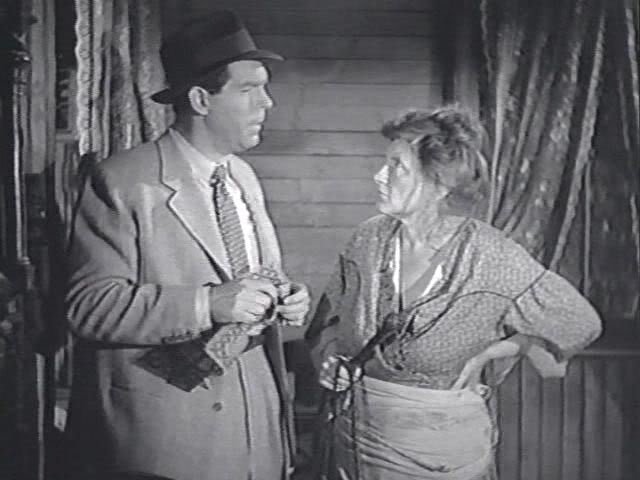
George Marshall has long been a favorite director of mine. Though he excelled in all genres (particularly Westerns), it’s his comedies that first caught my attention. Marshall guided W.C. Fields through his first for Universal, YOU CAN’T CHEAT AN HONEST MAN (with radio foils Edgar Bergen and Charlie McCarthy), did some of Bob Hope’s best films (THE GHOST BREAKERS, MONSIER BEAUCAIRE, FANCY PANTS), and directed MY FRIEND IRMA, the debut of Dean Martin & Jerry Lewis, later teaming with the pair for SCARED STIFF. He’s also responsible for the classic comic Western DESTRY RIDES AGAIN with James Stewart and Marlene Dietrich, and the remake with Audie Murphy. But his wackiest comedy is undoubtably the off-the-wall MURDER, HE SAYS.

murderhe4

This black comedy gem stars the underrated Fred MacMurray as Pete Marshall, pollster for the Trotter company (“Like the Gallup Poll, but not as fast”), sent to tiny rural Potowanamie to find missing coworker Hector P…

View original post 472 more words

Cleaning Out The DVR #11: Going My Way (dir by Leo McCarey)


GoingmywayBing

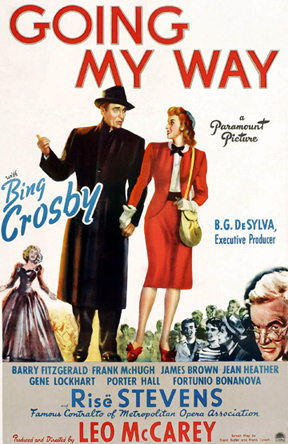
Last night, continuing my effort to watch 38 movies in 10 days (and, for the record, I have 7 days left as of today), I watched the 1944 musical-comedy-drama Going My Way.

Going My Way tells the episodic story of Father Chuck O’Malley (Bing Crosby), a priest from St. Louis who is assigned to take charge of a struggling parish in New York City.  O’Malley is meant to replace Father Fitzgibbon (Barry Fitzgerald), a stubbornly old-fashioned priest who is struggling to keep up with a changing world.  Though O’Malley is to take charge of the parish’s affairs, Fitzgibbon is to remain the pastor.  However, the compassionate O’Malley doesn’t tell Fitzgibbon about the arrangement and allows Fitzgibbon to believe that O’Malley is only meant to be his assistant.

It’s obvious from the start that Fitzgibbon and O’Malley have differing approaches.  Fitzgibbon is a traditionalist.  O’Malley, on the other hand, is a priest who sings.  He’s a priest who understands that the best way to prevent the local teens from forming a street gang is to convince them to start a choir instead.  When it appears that 18 year-old Carol (Jean Heather) is “living in sin,” it is the nonjudgmental O’Malley who convinces her to marry her boyfriend.

And, slowly but surely, Fitzgibbon and O’Malley start to appreciate each other.  O’Malley is even able to convince Fitzgibbon to play a round of golf with him, while Fitzgibbon tells O’Malley about his love for his mother in Ireland.

What’s interesting is that we learn very little about O’Malley’s past.  In many ways, he’s like a 1940s super hero or maybe a less violent and far more ethical version of one of Clint Eastwood’s western heroes.   He shows up suddenly, he fixes things, and then he moves on.  Instead of a cape or a poncho, he wears a collar.

(And, of course, he doesn’t kill anyone.  Actually, that’s probably a lousy analogy but I decided I’d give it a try anyway…)

At one point, O’Malley does run into an opera singer named  Genevieve Linden (Rise Stevens).  He and Genevieve (whose real name is Jenny) talk briefly about their past and it becomes obvious that they once had a romantic relationship.  We don’t learn the exact details but it does bring some unexpected melancholy to an otherwise cheerful film.  It reminds us of what O’Malley gave up to become a priest.

Fortunately, Genevieve is more than happy to help out with O’Malley’s choir, even arranging for them to meet with a record executive (William Frawley).  The executive doesn’t have much interest in religious music but then he hears Bing O’Malley sing Swinging On A Star.

It’s a bit strange to watch Going My Way today because it is a film that has not a hint of cynicism.  There’s no way that a contemporary, mainstream film would ever portray a priest as positively as Father O’Malley is portrayed in this film.  Indeed, it says something about the world that we live in that I instinctively cringed a little whenever O’Malley was working with the choir, largely because films like Doubt and Spotlight have encouraged me to view any film scene featuring a priest and an pre-teen boy with suspicion.  O’Malley is the ideal priest, the type of priest that those of us who were raised Catholic wish that we could have known when we were young and impressionable.  Bing Crosby does a pretty good job of playing him, too.  Watching Going My Way felt like stepping into a time machine and going to a simpler and more innocent time.

In the end, Going My Way is a slight but watchable film.  It doesn’t add up too much but, at the same time, it’s always likable.  Though the film may be about a priest, the emphasis is less on religion and more on kindness, charity, and community.  Going My Way was a huge success at the box office and even won the Oscar for best picture.

Personally, I would have given the Oscar to Double Indemnity but Going My Way is still a likable movie.

Speaking of likable, the Academy was so impressed with Barry Fitzgerald’s performance that they actually nominated it twice!  He got so many votes in both categories that Fitzgerald ended up nominated for both Best Actor and Best Supporting Actor.  Subsequently, the Academy changed the rules and decreed that a performance could only be nominated in one category.  As for Fitzgerald, he won the Oscar for best supporting actor.  He later broke the Oscar while practicing his golf swing.
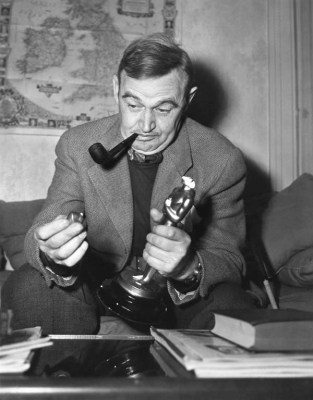
Barry and Oscar

Barry and Oscar

(Don’t worry.  The Academy sent him a replacement.)

Embracing the Melodrama Part II #16: Double Indemnity (dir by Billy Wilder)


Double_indemnity

The 1944 best picture nominee Double Indemnity is probably one of the most imitated films ever made.  While it may not be the first film noir, it is one of the most influential and its plot has been duplicated in countless films.  In fact, it’s such an influential film that all one has to do is say, “Indemnity” and you automatically know that they’re talking about murder.

Most people assume that the film is the story of Walter Neff (Fred MacMurray), an insurance agent who thinks that he’s smarter and smoother than he actually is.  When Phyllis Deitrich (Barbara Stanwyck) approaches him with questions about how much her husband’s life insurance would pay off if his death was accidental, Walter immediately figures out that she’s talking about murder.  At first, Walter tells her that he’s not interested but actually he’s very interested.  Soon, he and Phyllis are lovers (though Walter, from the start, seems to know that Phyllis is just using him) and he’s plotting out her husband’s murder.  After he does kill Phyllis’s husband, Walter makes it look as if he fell from a train.  At first, the death is ruled a suicide but, just as Walter hoped, his best friend and fellow insurance agent, Barton Keyes (Edward G. Robinson), announces that it wouldn’t make any sense for a suicidal man to jump from a slow-moving train.  Instead, Keyes successfully argues that the death should be ruled an accident and, as a result, the life insurance pays out for double of its value.

However, the money makes Walter paranoid.  He starts to worry that Phyllis will betray him.  Even worse, he’s approached by the dead man’s daughter, Lola (Jean Heather).  Lola tells Walter that she believes that Phyllis not only killed her father but her mother as well.  Soon, Walter is involved with both Lola and Phyllis.  Walter claims that he feels guilty and protective of Lola but MacMurray’s wonderfully ambiguous performance leaves us wondering just how much we should trust anything that he has to say.

Now, as I said before, the film may be narrated by Walter Neff and it may be set into motion by his affair with Phyllis but ultimately, the film is not about his relationship with Phyllis.  Instead, it’s about Walter’s friendship with Barton Keyes.  When we first see Walter, he’s recording a confession specifically for Keyes to hear and the film ends not with Walter and Phyllis but instead with Walter and Keyes.

In many ways, Keyes is the opposite of Walter.  Whereas Walter is slick and amoral, Keyes is rather nerdy and ethical to a fault.  Walter respects Keyes for his brilliant mind and, to a large extent, he does what he does because he wants to prove that he’s just as smart as Keyes.  Keyes is the type of man that Walter aspires to be while Walter is the dark side of Keyes’s own obsession with mystery.  It’s only appropriate that the film ends with Walter and Keyes because, ultimately, their friendship is the heart of the film.

Double Indemnity is a classic.  Barbara Stanwyck and Fred MacMurray set the standard by which all future illicit couples would be judged.  But really, the film is stolen by Edward G. Robinson.  Over the course of his long and remarkable career, Robinson was never once nominated for an Oscar.  Watching Double Indemnity, you can’t help but wonder how such an injustice could have happened.