Of the vaporwave I’ve heard so far, no individual song has struck me more than “Airglider”, the opening track on フライトを楽しむ (Enjoy Your Flight!) by 日本航空株式会社 ✈ Japan Airlines. Expanding on the sort of feathery easy listening you might hear while boarding an airplane, the song lifts you up into the sunlit skies above an Asian metropolis in a way that the original sampled tunes could never realistically accomplish. The guitar is totally contrived–the sort of thing that a washed-up rock star might produce under contract from a commercial director–but 日本航空株式会社 ✈ Japan Airlines manages to twist it into this dreamy ride. The hyper-generic solo becomes stimulating–a vision of soaring through the clouds aboard a wonder of no-longer-so-modern technology. You feel like you are experiencing a commercial flight in the 70s or 80s, when it was not such a common affair. The very brief, unintelligible vocal line carries a sense of style. You are in the very least a first class customer. You might be taking off on your own private jet after a long day of insider trading on the Tokyo Stock Exchange.
Well, no, that’s just what the airline wants you to believe. You’re sitting in coach. Everything about this presentation is over the top in a clumsy, reckless sort of way. The song cuts in a moment too late, missing a split second of the opening note. The artist’s name is outrageous, going so far as to visually remind you that you are on a plane. (It has since been reduced to simply AIR Japan.) The song is bombastic, slamming its product down your throat. The video shows an attendant passionately spoon-feeding you information dumbed down to a child’s level in that uniquely artificial, condescending Japanese way. It’s pseudo-class for the middling mass consumer. It is everything vaporwave was initially intended to reflect, made all the more poignant through a careful, precise effort to capture the aesthetic. A lot of vaporwave has its go at cheap marketing by being intentionally careless. This one crafts the carelessness with a keen awareness, and the result is a lot more revealing. It feels more authentic than the real deal. It creates in the listener the sort of sales-minded artificial experience that real commercial music is usually too shallow to achieve. You will fly Japan Airlines again.
I am not sure whether my recent discovery of vaporwave was a coincidence or not. When people check out my Last.fm profile, I always return the serve, and I happened to be listening to a lot of other music that will be featured in this series when I got a new visitor. This person’s profile was filled with really odd artist names, mostly consisting of katakana followed by a seemingly random English word in all caps. Click click.
This was vaporwave, as it turned out, and vaporwave was pretty odd. I guess the genre emerged beginning in 2011 as electronic and dance artists, partly in jest and partly as a sort of social commentary, began to resurrect trash audio from the 70s, 80s, and 90s. The background sounds of shopping malls and elevator shafts twisted in conformity to dance beats and reemerged packaged with bad 90s digital imagery. The artist titles are a nod to those used in Asian markets to sell western hits without having to pay royalties. The genre title, too, was a hoax, referring to vaporware–products which are heavily marketed but never actually released or cancelled. (Remember when Duke Nukem Forever gained so much fame after 14 years “in development” that Gearbox slapped together a garbage FPS under the title?) Some of the early artists in the scene suggested that their music was not intended to be enjoyed for any intrinsically pleasing qualities. Rather, they were taking music that was trashy in spirit and making it trashy in sound, degrading it to a state where its shallow capitalist origins could shine while, as a possibly unintended consequence, infusing it with actual conceptual value.
The earlier artists I sampled were, as you might expect from the description, entertaining but not particularly pleasant to listen to. In 2014, a label called Dream Catalogue launched and helped to really redirect the genre. Taking the same technical approach of restructuring muzak, smooth jazz, funk, lounge, new age, and R&B into electronic and dance tracks, Dream Catalogue artists showed a generally keener eye towards making the music aesthetically pleasing in its own right. The result was a sound that’s simultaneously modern and nostalgic, and a collection of albums that show a lot more individual character and vision.
Hong Kong Express, the Dream Catalogue founder’s personal project, presents a consistent vision of dreamy nighttime travels in a modern city. In describing his first release, 浪漫的夢想, the label’s website concludes that “This dream, ultimately, is a mysterious and romantic trip through the neon haze of a night in Hong Kong – a journey of subway carriages and fast cars, a love both lost and found, and a connection between souls.” I can definitely hear that. The pitched, echoing pop and jazz samples generate the sense that you aren’t fully taking in your surroundings. You drift through a landscape of glowing billboards and signs, recognizing the products subliminally while reflecting on the light itself, becoming lost in a vibrant capitalist world. What could be more appropriate for the theme of this series?
If you ever wonder what it’s like to roam the midnight streets of a cynical, depraved city full of alcoholics and deadbeats, you will never find a more poetic account than Small Change, the 1976 masterpiece by Tom Waits. It flows as a shambling, drunken journey through neon squalor. On each track, he takes us to some bar, nightclub, diner, or strip joint, and tells the stories of the people he finds there. Hawkers on “Step Right Up” offer him an incoherent slur of sales pitches. (“We’ve got a white sale on smoke-damaged furniture. You can drive it away today!”) A young punk on “Jitterbug Boy” nonchalantly brags about accomplishing all sorts of improbable feats and then tells Tom to get lost. (“If it’s heads I go to Tennessee, tails I buy a drink. If it lands on the edge I’ll keep talking to you.”) A shameless deviant on “Pasties and a G-String” rambles about his lust. (“Crawling on her belly, shaking like jelly, and I’m getting harder than Chinese algebra.”)
The album is brilliant from start to finish. Lyrically, I think I can safely call it my all-time favorite. And while the title track, “Small Change”, is not my first pick on the album generally, it’s the one that most robustly captures the dystopian theme in this music series. It tells of a small-time gangster who gets murdered, and how the community passes by in apathy or else dives like vultures to try and make a buck off the tragedy.
Small Change got rained on with his own .38,
And nobody flinched down by the arcade,
And the marquees weren’t weeping; they went stark-raving mad,
And the cabbies were the only ones that really had it made,
And his cold trousers were twisted, and the sirens high and shrill,
And crumpled in his fist was a five-dollar bill,
And the naked mannequins with their cheshire grins,
And the raconteurs and roustabouts said “Buddy, come on in,
Cause the dreams ain’t broken down here now; they’re walking with a limp,
Now that Small Change got rained on with his own .38”,
And nobody flinched down by the arcade,
And the burglar alarm’s been disconnected,
And the newsmen start to rattle,
And the cops are telling jokes about some whorehouse in Seattle,
And the fire hydrants plead the Fifth Amendment,
And the furniture is bargains galore,
But the blood is by the jukebox on an old linoleum floor,
And what a hot rain on forty-second street,
Now the umbrellas ain’t got a chance,
And the newsboy’s a lunatic with stains on his pants,
Cause Small Change got rained on with his own .38,
And no one’s gone over to close his eyes,
And there’s a racing form in his pocket circled “Blue Boots” in the 3rd,
And the cashier at the clothing store didn’t say a word,
As the sirens tear the night in half, and someone lost his wallet,
It’s surveillance of assailance, if that’s what you want to call it,
And the whores hike up their skirts and fish for drug-store prophylactics,
And their mouths cut just like razor blades, and their eyes are like stilettos,
And her radiator’s steaming, and her teeth are in a wreck,
She won’t let you kiss her, but what the hell did you expect?
And the gypsies are tragic, and if you want to buy perfume,
They’ll bark you down like carnies, sell you Christmas cards in June,
But Small Change got rained on with his own .38,
And his headstone’s a gumball machine,
No more chewing gum or baseball cards or overcoats or dreams,
Someone’s hosing down the sidewalk and he’s only in his teens,
Cause Small Change got rained on with his own .38,
And a fistful of dollars can’t change that,
And someone copped his watch fob, and someone got his ring,
And the newsboy got his porkpie Stetson hat,
And the tuberculosis old men at The Nelson wheeze and cough,
And someone will head south until this whole thing cools off.
I just got back from watching an early screening of Captain America: The Winter Soldier.
Now, what does this have to do with the latest “Song of the Day” featuring musical legend Marvin Gaye. Well, I’m glad you asked. The song gets mentioned by a major character in the film and gets some airplay towards the end. The lyrics of the song itself could almost be synonymous with the storyline for this follow-up to Captain America: The First Avenger.
The song is also the theme song to the 1972 Soul Cinema Classic film production Trouble Man.
While the song remains a classic R&B song that does consistent radioplay I’m sure it won;’t hurt for new listeners coming to listen to it even more after experiencing it for the very first time watching Captain America: The Winter Soldier.
Trouble Man
I come up hard, baby, and that ain’t cool! I didn’t make it sugah, playin’ by the rules! I come up hard, babe, but now I’m fine. I’m shakin’ trouble sugah, & movin’ down the line. I come up hard, but that’s OK. ‘Cause
Trouble Man don’t get in my way!!
I come up hard, baby!
I mean fo’ real, baby, cuz I’m a Troubled Man! Gonna keep movin’, gonna go to town. I come up hard, and now I’m gettin’ down! There’s only 3 things that’s fa sho*: Taxes, death and trouble
This I know, baby. this I know. Yeah, you never let it sweat you baby,
Whooooo
Got me singin’, yeah, yeah, hooo
I come up hard, baby, I had to fight! To keep my dignity with all my might! I come up hard, I had to win! Then start all over. And WIN AGAIN!! I come up hard, but that’s OK! ‘Cause Trouble Man don’t get in my way
Hey,Hey!
Now I been some places and I seen some faces I got my connections they take my directions Don’t care what they say. that’s OK, they don’t bother me I’m ready to make it, don’t care ’bout the weather Don’t care ’bout no trouble, got myself together No laughin’, no cryin’, my protection’s all around me
I come up hard, baby I mean for real, baby With the Trouble Man Movin’, goin’ tight I come up hard, come on, get down There’s only 3 things for sure: Taxes, death and trouble
This I know, baby, baby This I know, baby, baby Hey now, let it sweat, baby
I’ve come up hard, but now I’m cool I didn’t make it, baby, playin’ by the rules I’ve come up hard, baby, but now I’m fine I’m shakin’ trouble, sure movin’ down the line
I think it’s time to slow things down a bit after several choices of rock and metal for Song of the Day. Thus, my pick for the latest Song of the Day is the song “We Are One” by Kelly Sweet.
Yes, I have a soft spot for adult contemporary singers like Kelly Sweet whose sound of modern jazz and classical leanings make for fine easy listening. Life can’t be all rock and metal. Got to have something relaxing and soothing once in awhile. Ms. Sweet is one of the hidden gems of the last couple years whose career is still doing a sow burn, but her debut album, also titled We Are One, has gained her quite a loyal following. The ballad chosen for the song of the day is one of her original songs in the album full of covers. While she does a great job doing both original and cover work, this paticular song is my favorite out of the bunch.
Her classical and jazz training gives her voice an almost ethereal quality during this song. It’s not too catchy and pop like her more successful contemporaries. Her songs are something both the younger and older generations can get into. This song will definitely not be something to inspire the casual booty call, but it is one that is definitely one to light up that slow burn romance that’s harder to create and even harder to keep.
We Are One
Didn’t need to ask
Don’t know the reason
Everything that I believe
Is right here
Not thinkin’ bout tomorrow
Couldn’t catch it if I tried
World is spinning too fast
So I’ll wait ’til it comes to me
I am you
You are me
We are one
Take me in your arms
And flow through me
I’ll flow through you
Steal my breath away
Cause I’m so moved by you
Deeper than I ever thought
Was possible, was possible, it’s everything, oh
Difference between me and you
It’s all in where your heart lies
And every day’s another chance
So let’s get it right
I am you
You are me
We are one
Take me in your arms
And flow through me
I’ll flow through you
Did you lose yourself out there
Did you lose faith and give up
Don’t turn away and hide yourself
Cause there’s a friend to make along the way
We are the heartbeat and our souls speak
And all the beauty I have ever dreamed
Is right here in front of me, oh
Is right here in front of me, oh
I am you
And you are me
We are one
Take me in your arms
And flow through me
I’ll flow through you…
First off, a confession of my own. When I’m not reviewing movies or chattering away on twitter, I work in a law office. Before anyone panics, I’m not a lawyer, I just hang out with a couple of them. For the most part, I answer the phone, I schedule appointments, and I keep all the files in alphabetical order. On a few very rare occasions, I’ve accompanied my boss to court and the thing that has always struck me about real-life courtroom drama is how boring it all really is. There are no surprise witnesses, no impassioned closing statements, and those all trail rarely, if ever, jump to their feet and start yelling that they’re innocent. For the most part, real life lawyers are usually just as poorly groomed and bored with their work as the rest of us. Don’t even get me started on the judges, the majority of whom seem to have judgeships because they weren’t really making the grade as an attorney.
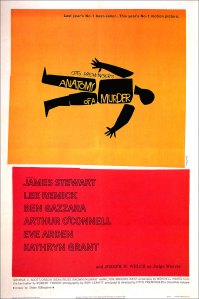
As a result, it’s rare that I get much out of seeing lawyer-centric movies or tv shows any more. After seeing the reality of it, I find fictionalized courtroom theatrics to be ludicrous and, for the most part, evidence of a lazy writer. However, I’m happy to say that last night, I discovered that — no matter how jaded I may now be about the legal process — Anatomy of a Murder is still one of my favorite movies.
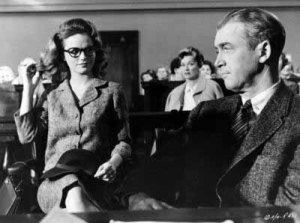
Based on a best-selling novel and directed by the notorious Otto Preminger, Anatomy of a Murder tells the story of Paul Beigler (James Stewart), a former district attorney who is now in private practice after having been voted out of office. Having apparently fallen into a state of ennui, Beigler spends his time drinking with another alcoholic attorney (Arthur O’Connell) and trying to avoid his secretary’s (Eve Arden) attempts to get paid.
However, things change for Beigler when he is hired to defend an army officer named Frederick Manion (Ben Gazzara). Manion has been arrested for murdering a bar own named Barney Quill. Manion says that he was justified in committing the murder because Quill raped his wife, Laura (Lee Remick). Others claim that Manion is himself just a notoriously violent bully and that the openly flirtatious Laura was having an affair with Quill. Despite strongly disliking Manion and disturbed by Laura’s own obvious instability, Beigler takes on the case.
Beigler decides to argue that Manion was temporarily insane when he shot Quill and that he was acting on “irresistible impulse.” As shaky as that line of defense might seem, it’s not helped by the fact that Manion himself is a bit of a brute. Meanwhile, Beigler finds himself facing not the innefectual D.A. in court but instead a young, ambitious prosecutor from the State Attorney General’s Office, Claude Dancer (played by a young and obviously ambitious George C. Scott). As the trial begins, small hints start to appear that seem to indicate that there’s a lot more to the murder of Barney Quill than anyone realizes…
Director Otto Preminger is an odd figure in film history. Up until the early 60s, he was a consistently interesting director who made intelligent, well-acted films that often challenged then-contemporary moral attitudes. However, once the 60s hit, he became something of a parody of the egotistical, old school, autocratic filmmaker and his films seemed to suffer as a result. Like many of the film industry’s top directors, he found himself adrift once the 60s and 70s hit. His decline was so dramatic that, as a result, there’s a tendency to forget that he made some truly great and important films, like Laura, Carmen Jones, The Man With The Golden Arm, and, of course, Anatomy of a Murder.
Anatomy of a Murder represents Preminger at his best. His own natural tendency towards embracing melodrama and shock are perfectly balanced with an intelligent script and memorable performances. Whereas later Preminger films would often come across as little more than big screen soap operas, here he makes the sordid believable and compelling. Preminger has never gotten much attention as a visual filmmaker but here, he uses black-and-white to perfectly capture the grayness of the both the film’s location and the moral issues that the film raises. He keeps the camera moving without ever calling attention to it. As a result, the movie has an almost documentary feel to it.
As previously stated, Preminger gets a lot of help from a truly amazing cast. At first, it’s somewhat strange to imagine a Golden Age icon like Jimmy Stewart appearing in the same film as a dedicated method actor like Ben Gazzara. These are two men who represent not only different philosophies of acting but seemingly from two different worlds as well. However, Preminger uses their differing acting styles to electrifying effect. One of the joys of the movie is watching and contrasting the old style, “move star” turns of James Stewart, Arthur O’Connell, and Eve Arden with the more “naturalistic” approaches taken by their younger co-stars, Gazzara, Lee Remick, and especially George C. Scott. The contrast in style becomes a perfect reflection of the film’s contrast between what is legal and what is correct. All the actors, as both individuals and as an ensemble, give memorable performances. When you look at the cast, you realize that any one of their characters could have been the center of the story without the film becoming any less compelling.
Lee Remick (a notoriously fragile actress who, for years, I knew solely as the poor woman who kept getting attacked by her adopted son in the original Omen) brings out the best in everyone she shares a scene with. Whether she’s making Stewart blush or breaking down on the witness stand, she dominates every scene as an insecure young woman who forces herself to be happy because otherwise, she’d have to confront the fact that she’s miserable. (I should admit that I related more than a bit to Remick’s character. To me, the movie was about her and therefore, about me.)
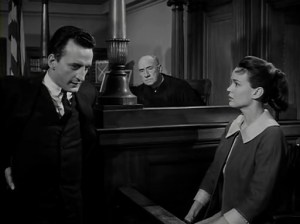
She is perhaps at her best towards the end of the film when she is on the witness stand and is cross-examined by George C. Scott. Starting out as flirtatious and seemingly confident, Remick slowly and believably falls apart as Scott methodically strips away every layer of defense that, until now, she’s spent the entire movie hiding behind. By the end of the scene, Remick has shown as every layer of pain that has built up in Laura Manion over the years. For his part, Scott is simply amazing in this scene. Determined and focused, Scott doesn’t so much cross-examine Remick but seduces her and the audience along with her. As a result, when he suddenly turns off the charm and lunges in for his final attack, it’s devastating for everyone watching. (And, as was correctly pointed out to me by a friend while I was watching the film last night, George C. Scott was quite the sexy beast when he was young.)
Lastly, the film’s judge is played by an actual lawyer by the name of Joseph Welch. Welch wasn’t a great actor but he did make for a great judge.
Of course, it wouldn’t be a Preminger film is a few contemporary morals weren’t challenged and, at the time it was released, Anatomy of a Murder was considered to be very daring because of its frank discussion of topics like rape and spousal abuse. It doesn’t seem quite so daring now but it does seem to be remarkably mature in a way that even most modern movies can’t match. That being said, the film does occasionally embrace the “she must have been asking for it” male viewpoint but still, it’s a remarkably advanced movie for the 1950s.
One of the wonderful things about watching a 51 year-old film is that it provides a chance to see what was considered to be shocking in the years before you or I was born. From watching this movie, I’ve discovered that, in the year 1959, “panties” was apparently a taboo phrase. A good deal of the film’s plot revolves around the panties Lee Remick’s character was wearing the night she was raped and their subsequent disappearance. At one point, there’s even a scene where Welch, Stewart, and Scott struggle to come up with a less offensive term to use when referring to them in the court. (Scott suggests employing a term he heard in France.) Seen 51 years later (in a time when we can not only say “thong” in polite conversation but specifically go out of our way to show off the fact that we’re wearing one), this scene, and the actors’ obvious discomfort whenever they have to say the word “panties”, never fails to amuse me.
Preminger’s other grand challenge to the 50s mainstream was in getting Duke Ellington to compose the film’s jazz soundtrack. At the risk of being called a heretic by some of my closest friends, I’ve never been a big fan of jazz but it works perfectly here. Ellington, himself, makes a cameo appearance and wow, is he ever stoned.
In conclusion, allow me to thank the readers of the site for “ordering” me to watch, once again, a truly classic film. Now, seeing as how close the vote was and that I know, for a fact, that some people voted more than once, I think it would be only fair for me to also rewatch and review the other 9 movies (Lost in Translation, Primer, Hatchet For the Honeymoon, Emanuelle in America, Starcrash, Darling, Sole Survivor, The Sweet House of Horrors, and The Sidewalks of Bangkok) in my poll over the next couple of weeks. I’m looking forward to each and every one of them (well, almost all of them) and, again, thank you for allowing me to start things off with a great film like Anatomy of a Murder.
I just realized that I haven’t picked a song from the jazz corner. I think I have just the song to fix that problem.
Song of the day comes courtesy of the one and only Nina Simone and her jazz cover of the Anthony Newley and Leslie Bricusse song, “Feeling Good”. This song is just smooth cool from start to finish and why jazz singers will always have a special place in my music collection. Nina Simone croons and sings the devil out of this song. When the song segues smoothly from Simone’s acapella section in the beginning to the smoky and sultry way the horns starts off the song proper one cannot help but nod their head to the beat.
The song is pretty brief, but for a little under 3 minutes one can and will fall in love not just with Nina Simone’s singing but jazz music as well.
Feeling Good
Birds flying high you know how I feel
Sun in the sky you know how I feel
Reeds driftin on by you know how I feel
(refrain:)
Its a new dawn
Its a new day
Its a new life
For me
And Im feeling good
Fish in the sea you know how I feel
River running free you know how I feel
Blossom in the tree you know how I feel
(refrain)
Dragonfly out in the sun you know what I mean, dont you know
Butterflies all havin fun you know what I mean
Sleep in peace when day is done
Thats what I mean
And this old world is a new world
And a bold world
For me
Stars when you shine you know how I feel
Scent of the pine you know how I feel
Oh freedom is mine
And I know how I feel

 Through the Shattered Lens