Sundance Film Review: The Tale (dir by Jennifer Fox)


With this year’s Sundance Film Festival getting underway in Colorado, I’m going to be spending the next two weeks looking at some films that caused a stir at previous Sundances.  Today, I’m taking a look at 2018’s The Tale.

The Tale is all about memory.

Jennifer Fox (Laura Dern) is, as her mother (Ellen Burstyn) often reminds her, nearly fifty years old and childless.  She’s been engaged to the sensitive Martin (Common) for three years but she’s in no hurry to get married.  As for children — well, she decided a long time ago that she didn’t want to have children.  Jennifer is a documentarian and a teacher.  She not only records real life but she also teaches others how to do the same thing.  She makes films that, in the decades to come, will be used by future students of history who want to know what it was like to live in the late 20th and early 21st Century.  And yet, it’s her own history that Jennifer has never come to terms with.

When her mother comes across a school essay that a 13 year-old Jennifer once wrote about her relationship with her riding instructor, Mrs. G (Elizabeth Debicki), and her running coach, Bill (Jason Ritter), Jennifer dismisses her concerns.  As Jennifer explains it to Martin, her mother is just upset because Jennifer once had a boyfriend who was “older.”  Of course, that older boyfriend was in his 40s.  What’s obvious to everyone but Jennifer is that her coach took advantage of and raped her.  Jennifer, however, refuses to accept that.  She refers to the coach as being her “lover” and, more than a few times, she attempts to dismiss the whole topic by shrugging and saying, “It was the 70s.”

It’s not that Jennifer doesn’t realize the truth about what actually happened.  Laura Dern gives a fiercely intelligent performance as Jennifer, one that slowly and deliberately peels away at the layers of defensive protection that Jennifer has spent the past 35 years developing.  Jennifer knows what happened but she’s allowed her memory to cloud the reality of it, largely because that’s the only way that she could deal with the aftereffects of Bill’s sexual abuse.  When Jennifer thinks back to the summer that she spent with Mrs. G and Bill, she first sees herself as she was when she was 15 years old, curious and headstrong.  It’s only when Jennifer looks at a photograph that was taken that summer that she sees starts to see herself as she really was, an introverted and vulnerable 13 year-old (played by Isabelle Nelisse) who was groomed and abused by two predators.

As Jennifer investigates her past and finally begins to understand what really happened over the course of that summer, her memories begin to change.  Hazily-remembered conversations take on new meaning and she begins to understand that terrible truth between the looks that were often exchanged between Bill and Mrs. G.  At times, the older Jennifer finds herself interrogating her memories of Bill, Mrs. G, and even her younger self.  She demands to know how they could have done what they did and their answers leave you wondering whether you’re hearing what they would really say or if your just hearing what Jennifer would hope they would say.  When Jennifer talks to others who were around that summer, she’s shocked to learn that she wasn’t the only one who Bill abused and her insistence that she was Bill’s lover (as opposed to his victim) sounds more and more hollow.  When Jennifer finally does track down some of her abusers, you wonder if their somewhat confused reactions are due to guilt or if it’s possible that there were so many victims that they don’t even remember what they did to Jenny Fox.  And if they do remember, they seem to be either horrifically ignorant or curelly unconcerned about the consequences of their actions.

It’s a brave and powerful film, one that is made all the more disturbing by the fact that director and screenwriter Jennifer Fox is telling her own story.   At least year’s Sundance Film Festival, it premiered to acclaim and controversy.  There was also some surprise when, instead of securing a theatrical release, the film was instead sold to HBO.  At the time, there was a lot of concern that the film’s power would somehow be diluted as a result of playing on television as opposed to a big screen.  However, in hindsight, the small screen — with its unavoidable vulnerability — was the perfect place for this uncompromising and emotionally raw film.

The Tale is not an easy film to watch but it is an important one.  It’s a film for anyone who has ever struggled to come to terms with the past.  It’s both a reminder that you’re not alone and a warning to not ignore or laugh off your suspicions.  It’s also a good example of the type of film that probably would never have been discovered if not for Sundance.  There’s a lot of legitimate criticism that one can direct towards the Sundance Film Festival but occasionally, it does do what it’s supposed to do.
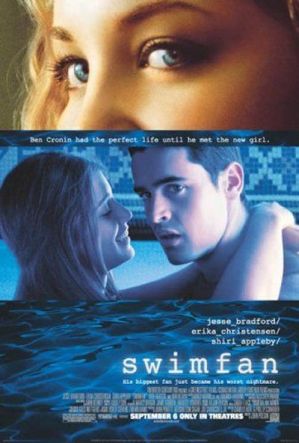
Guilty Pleasure No. 28: Swimfan (dir by John Polson)


Oh my God, y’all — Swimfan was on last night!

Do you remember Swimfan?  It originally came out in 2002 and it starred Jesse Bradford, the hot guy from Bring It On, and Erika Christensen, the drug addicted runaway from Traffic.  The movie is like a high school version of Fatal Attraction.  Jesse swims for the high school swim team.  Erika is a psycho stalker who is obsessed with swimmers.  Chaos follows.

I was on a high school date when I first saw Swimfan.  Fortunately, the movie offered up some very important life lessons.

Probably the film’s most important lesson was that you should always put out because, if you don’t, your dumbass boyfriend is going to end up cheating on you with some psycho bitch who is going to go all obsessive on his ass and end up framing him for murder.  When Swimfan starts, Ben (Jesse Bradford!) is dating Amy (Shiri Appleby) and they’re a cute couple but Amy is more into studying and planning for the future than in having sex with Ben.

So, of course, Ben ends up cheating on her with the new girl at school, Madison Bell (Erika Christensen).  He does this despite the fact that Madison is obviously unbalanced from the minute that he meets her, has a major case of the crazy eyes, and tends to come across as being a little bit robotic.  It’s only one night and Ben says that he feels terrible about it but Madison still decides that Ben is her man now.

It all leads to this scene:

(I have to admit that the artful placement of the camera in this scene makes me laugh every time.  The filmmakers were obviously really determined to get that PG-13 rating.  Also, just a little tip — if you’re taking nudes for your man, try smiling.)

When Ben keeps rejecting her, Madison conspires to get him kicked off the swim team.  She also kills the swimmer who takes Ben’s place on the team and frames Ben for the crime.  (The exact same thing happened to Michael Phelps but you never hear about it because all the media wants to talk about is that time he got his picture taken at that party.)  And then she tries to kill Amy and, the movie tells us, this all could have been avoided if only Amy hadn’t spent so much time worrying about which college to go to.  Keep your man happy, girls, the movie tells us, or be prepared to deal with the consequences. Boys will be boys!

The other life lesson is that you should really learn how to swim.  Since this movie is called Swimfan and it features a gigantic subplot about swimming, you can already guess that it’s all going to end with a big fight in a pool.  Ben can swim.  Madison and Amy can’t.  Can you guess what happens?  Watching Swimfan last night reminded me that I still need to learn how to swim.  Thank you, Swimfan!

Anyway, Swimfan is definitely a guilty pleasure.  I mean, if you want to get technical about it, this is a really, really bad movie.  The plot is derivative of every single stalker thriller that you’ve ever seen.  Jesse Bradford is pretty good but Erika Christensen appears to be in a daze.  And yet, whenever I see that it’s on, I can’t help but watch it.  Some of it, of course, is because Swimfan appeals to the same nostalgia that still causes me to sing …Baby One More Time, at the top of my lungs, whenever I’m driving home despite the fact that Britney’s later songs are so much better.  But beyond the nostalgia appeal, Swimfan is just so ludicrous and silly and over the top.  How can you not be a fan of Swimfan?

Swimfanposter

Previous Guilty Pleasures

  1. Half-Baked
  2. Save The Last Dance
  3. Every Rose Has Its Thorns
  4. The Jeremy Kyle Show
  5. Invasion USA
  6. The Golden Child
  7. Final Destination 2
  8. Paparazzi
  9. The Principal
  10. The Substitute
  11. Terror In The Family
  12. Pandorum
  13. Lambada
  14. Fear
  15. Cocktail
  16. Keep Off The Grass
  17. Girls, Girls, Girls
  18. Class
  19. Tart
  20. King Kong vs. Godzilla
  21. Hawk the Slayer
  22. Battle Beyond the Stars
  23. Meridian
  24. Walk of Shame
  25. From Justin To Kelly
  26. Project Greenlight
  27. Sex Decoy: Love Stings

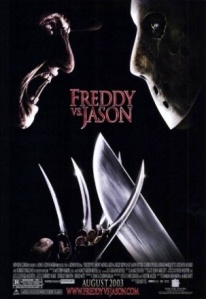
Film Review: Freddy Vs. Jason (dir. by Ronny Yu)


(This review probably contains what some people would consider to be spoilers.)

Today, as part of my continuing series reviewing the films of the Friday the 13th franchise, I take a look at Freddy Vs. Jason.

After spending 15 years in development Hell, the film Freddy Vs. Jason was finally released in 2003.  With this film, New Line Cinema brought together the stars of their two best-known horror franchises, Jason Voorhees (played here not by Kane Hodder but by Ken Kirzinger) and Freddy Krueger (Robert Englund.) 

During the time that Freddy Vs. Jason was languishing in development Hell, a huge number of potential storylines were pursued and a lot of scripts were written.  Some of those scripts are surprisingly good and one of them (the one with the enviromental message) is hilariously self-important.  Most of them are just terrible and can be found online via a google search.  The main problem was how to convincingly bring both Jason and Freddy together when the two of them essentially epitomized two radically different subsets of the slasher genre.  Especially when compared to some of the other ideas that were considered, the concept behind FreddyVs. Jason is actually pretty clever.

As the film starts, Freddy is trapped in Hell because he’s been forgotten by the teenagers of the world.  They’re no longer scared of him and, as such, they’re not having nightmares about him.  Freddy’s solution?  He tracks down Jason (also hanging out in Hell and having dreams that neatly parody his whole image of being a murderous defender of purity) and, by disguising himself as Pamela Voorhees, he convinces Jason to resurrect himself in Freddy’s old hometown.  Jason promptly starts killing teenagers and Freddy is blamed.  Soon, people are having nightmares and Freddy has his gateway back into the real world.  Unfortunately for Freddy, Jason keeps killing everyone before Freddy can get to them.  Freddy sets out to kill Jason and it all leads to one “final” battle between the two of them.

I have to admit that when I first saw Freddy Vs. Jason, I didn’t care much for it.  Of course, at that point in my life, my view of whether or not a film was good or bad was largely based on the type of night I was having when I saw it.  I saw Freddy Vs. Jason with a guy who 1) thought proper date attire was shorts, a t-shirt, and a baseball cap and 2) who apparently thought my right breast was just an armrest there for him to lean on whenever he got bored.  Bleh.  Beyond the company that I saw the film with, I was also upset that the character I most related to, Katharine Isabelle’s Gibb, was rather brutally killed off while boring old Monica Keena was allowed to survive.  My initial response to Freddy Vs. Jason was that it had to be bad film because I had a bad time while I was watching it.

However, I recently rewatched it again with my BFF Evelyn (who always dresses up and is pretty good about not feeling me up every three minutes) and I actually enjoyed Freddy Vs. Jason a bit more the second time around.  I think it also helped that, in between the two viewings, I got a chance to see all the other Friday the 13th and Nightmare on Elm Street films along with a lot of other horror films and was now able to see how scenes that seemed pointless the first time around were actually meant to comment on the history and the conventions of both the Friday the 13th and Nightmare on Elm Street franchises.  The 2nd time around, I could better appreciate the perverse parody at the center of Robert Englund’s performance as Freddy Krueger.  While the human characters are never all that interesting, the “final” battle between Jason and Freddy is genuinely exciting.  When I first saw it, I thought that the film’s final scene (with Freddy’s decapitated head winking at the camera before laughing) was incredibly stupid but now I appreciate it for what it is — a deliberately campy homage to the over the top exploitation films of the 70s and 80s. 

As opposed to the previous few films in the Friday the 13th franchise, Freddy vs. Jason was a huge box office success.  It was the first (and, come to think of it, only Friday the 13th film) that I saw in an actual theater and it actually did give me nightmares (mostly because I foolishly chose to relate to the obviously doomed Katharine Isabelle).  With that type of success, it was inevitable that there would be another film in both the Friday the 13th and Nightmare on Elm Street franchises.  Those two films, however, would not be sequels.  Instead, they would be (bleh) reboots.  We’ll take a look at the reboot of Friday 13th (and finish off this series of reviews) tomorrow.