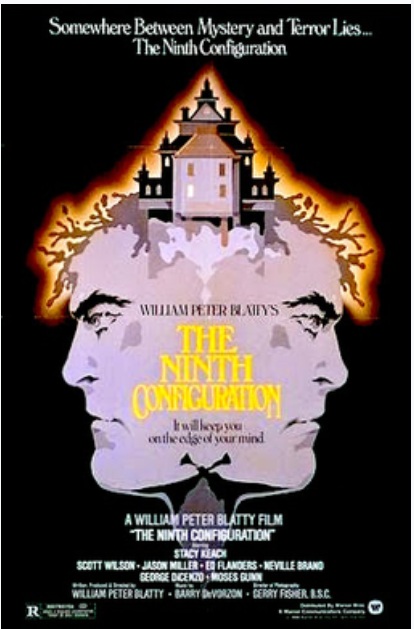
The Unnominated #20: The Ninth Configuration (dir by William Peter Blatty)


Though the Academy of Motion Picture Arts and Sciences claim that the Oscars honor the best of the year, we all know that there are always worthy films and performances that end up getting overlooked.  Sometimes, it’s because the competition too fierce.  Sometimes, it’s because the film itself was too controversial.  Often, it’s just a case of a film’s quality not being fully recognized until years after its initial released.  This series of reviews takes a look at the films and performances that should have been nominated but were, for whatever reason, overlooked.  These are the Unnominated.

Some films defy easy description and that’s certainly the case with 1980’s The Ninth Configuration.

The film opens with a shot of a castle sitting atop of a fog-shrouded mountain.  A voice over tells us that, in the early 70s, the castle was used by the U.S. government to house military personnel who were suffering from mental illness.  Inside the castle, the patients appear to be left to their own devices.  Lt. Reno (Jason Miller) is trying to teach dog how to perform Shakespeare.  Astronaut Billy Cutshaw (Scott Wilson) is haunted by the thought of being alone in space and refuses to reveal why he, at the last minute, refused to go to the moon.  The men are watched over by weary and somewhat sinister-look guards, who are played by actors like Joe Spinell and Neville Brand.

Colonel Kane (Stacy Keach) shows up as the new commandant of the the castle.  From the first minute that we see Kane, we get the feeling that there might be something off about him.  Though he says that his main concern is to help the patients, the man himself seems to be holding back secrets of his own.  With the help of Colonel Fell (Ed Flanders, giving an excellent performance), Kane gets to know the patients and the guards.  (Despite the objections of the guards, Kane says that his office must always be unlocked and open to anyone who want to see him.)  He takes a special interest in Cutsaw and the two frequently debate the existence of God.  The formerly religious Cutshaw believes the universe is empty and that leaving Earth means being alone.  Kane disagrees and promises that, should he die, he will send proof of the afterlife.  At night, though, Kane is haunted by dreams of a soldier who went on a murderous rampage in Vietnam.

The film start out as a broad comedy, with Keach’s smoldering intensity being matched with things like Jason Miller trying to get the dogs to perform Hamlet.  As things progress, the film becomes a seriously and thoughtful meditation on belief and faith, with characters like Kane, Billy, and Colonel Fell revealing themselves to be quite different from who the viewer originally assumed them to be.  By the time Kane and Cutshaw meet a group of villainous bikers (including Richard Lynch), the film becomes a horror film as we learn what one character is truly capable of doing.  The film then ends with a simple and emotional scene, one that is so well-done that it’ll bring tears to the eyes of those who are willing to stick with the entire movie.

Considering all of the tonal shifts, it’s not surprising that the Hollywood studios didn’t know what to make of The Ninth Configuration.  The film was written and directed by William Peter Blatty, the man who wrote the novel and the script for The Exorcist.  (The Ninth Configuration was itself based on a novel that Blatty wrote before The Exorcist.)  By most reports, the studio execs to whom Blatty pitched the project were hoping for another work of shocking horror.  Instead, what they got was an enigmatic meditation on belief and redemption.  The Ninth Configuration had the same themes as The Exorcist but it dealt with them far differently.  (Because he wrote genre fiction, it’s often overlooked that Blatty was one of the best Catholic writers of his time.)  In the end, Blatty ended up funding and producing the film himself.  That allowed him complete creative control and it also allowed him to make a truly unique and thought-provoking film.

The Ninth Configuration was probably too weird for the Academy.  Though it received some Golden Globe nomination, The Ninth Configuration was ignored by the Oscars.  Admittedly, 1980 was a strong year and it’s hard to really look at the films that were nominated for Best Picture and say, “That one should be dropped.”  Still, one can very much argue that both Blatty’s script and the atmospheric cinematography were unfairly snubbed.  As well, it’s a shame that there was no room for either Stacy Keach or Scott Wilson amongst the acting nominee.  Keach, to date, has never received an Oscar nomination.  Scott Wilson died in 2018, beloved from film lovers but never nominated by the Academy.  Both of them give career-best performances in The Ninth Configuration and it’s a shame that there apparently wasn’t any room to honor either one of them.

The Ninth Configuration is not a film for everyone but, if you have the patience, it’s an unforgettable viewing experience.
Previous Entries In The Unnominated:
  1. Auto Focus 
  2. Star 80
  3. Monty Python and The Holy Grail
  4. Johnny Got His Gun
  5. Saint Jack
  6. Office Space
  7. Play Misty For Me
  8. The Long Riders
  9. Mean Streets
  10. The Long Goodbye
  11. The General
  12. Tombstone
  13. Heat
  14. Kansas City Bomber
  15. Touch of Evil
  16. The Mortal Storm
  17. Honky Tonk Man
  18. Two-Lane Blacktop
  19. The Terminator

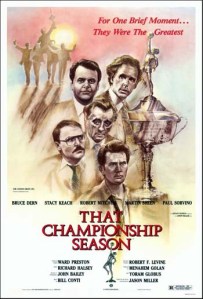
A Movie A Day #315: That Championship Season (1982, directed by Jason Miller)


Four former high school basketball players and their coach gather for a reunion in Pennsylvania.  Twenty-five years ago, they were state champions.  Now, they are all still struggling with the legacy of that championship season.  George (Bruce Dern) is the mayor of Scranton and is in a fierce race for reelection.  Phil (Paul Sorvino) is a wealthy and corrupt businessman who is having an affair with George’s wife.  James (Stacy Keach) is a high school principal who is still struggling to come to terms with his abusive father.  James’s younger brother, Tom (Martin Sheen), is an alcoholic who can not hold down a steady job.  The Coach (Robert Mitchum) remains the Coach.  All four of the men still want his approval, even though they know that he is actually an old bigot who pushed them to cut too many corners on their way to the championship.

Though Cannon film may have been best known for producing action films with actors like Charles Bronson, Chuck Norris, and Michael Dudikoff, they occasionally tried to improve their image with a prestige picture like That Championship Season.  Not only is this film based on Jason Miller’s Pulitzer Prize-winning play but Cannon also hired Miller himself to direct.  (Before Miller was brought in, That Championship Season was nearly directed by William Friedkin, who directed Miller in The Exorcist.)  While no one knew the text better than Miller, this was also his directorial debut and sometimes, his inexperience shows.  The first half of the movie does a good job of opening up the play but the second half takes place almost entirely in the Coach’s house and is very stagey, never escaping its theatrical origins.

One thing That Championship Season has going for it is an excellent cast. Dern, Sorvino, Keach, and even Sheen rarely got roles with as much depth as the ones that they got here and four of them make the best of the opportunity.  As for Robert Mitchum, he was known for being a mercurial actor but here, he gives one of the better performances of the latter half of his career.  Because of the efforts of the ensemble, That Championship Season is one of the better Cannon prestige pictures, though Chuck Norris is still missed.

Lisa Cleans Out Her DVR: Monsignor (dir by Frank Perry)


(Lisa is currently in the process of cleaning out her DVR!  It’s taking her longer than it took Saint Malachy to transcribe The Prophecy of the Popes!  She recorded the 1982 film, Monsignor, off of Retroplex on March 8th!)

Maybe it’s because I’m a fourth Italian and I was raised Catholic but Monsignor amused the Hell out of me.

See, Monsignor is a big, sprawling epic about the Church and the Mafia.  I don’t know much about the production of this film but, having watched it, I’m going to guess that it was made by people who were neither Catholic nor Italian.  This is one of those films that is so full of clichés and inaccuracies and yet so self-important that it becomes oddly fascinating to watch.

It tells the story of Father John Flaherty (Christopher Reeve, an Episcopalian who gives a performance so wooden that one worries about getting splinters just from watching it).  When we first meet Father Flaherty, he’s just taken his orders.  He’s a good Irish kid from Brooklyn.  The neighborhood’s proud of him, because he has volunteered to serve as a chaplain in the army.  (The film opens during World War II.)  The neighborhood is even prouder when he performs a Mafia wedding.  Don Appolini (Jason Miller), who may be a mobster but who still loves the Church, is especially impressed.  He expects big things from Father Flaherty.

(The father of the bride, incidentally, is played by Joe Spinell, who played Willy Chicci in Godfathers One and Two and who achieved a certain infamy when he starred in Maniac.)

Father Flaherty goes to war and discovers that it’s not easy to be a man of God in a war zone.  Everywhere around him, soldiers are either dying or losing their faith.  (Perhaps it would help if Father Flaherty knew how to properly conduct a Requiem Mass but the movie screws that up, with Flaherty saying, “”Requiescat in pace” when he clearly should have said, “Requiescant in pace.”)   After trying, in vain, to comfort a mortally wounded man, Flaherty snaps, picks up a machine gun, and starts blowing away Germans.

Having broken the Thou Shalt Not Kill Commandment and indulged in one of the seven deadly sins, Father Flaherty apparently decides to commit every other sin as well.  Or, at least, it seems like that’s his plan.  The thing is, Christopher Reeve’s performance is bland that it’s difficult to guess what could possibly be going on inside of Flaherty’s head.  Is he disillusioned with the church or does he still have faith?  When he says that he feels guilty over his transgressions, is he being sincere or is he lying?  It’s impossible to tell because, when it comes to Father Flaherty, there’s no there there.  He’s literally an empty vessel.

That, of course, doesn’t stop him from becoming a powerful man in the Church.  Through his Mafia connections, he makes a fortune on the black market and launders money for the church.  He also has sex with a cynical, nymphomaniac postulant nun, who is something of a stock figure in films like this.  In this case, the role is played by Genevieve Bujold.  Despite the stereotypical nature of her character, Bujold comes the closest of anyone in the cast to giving a nuanced performance but her character abruptly vanishes from the film.  One can literally hear the producers in the background saying, “Okay, we’ve indulged in the sexy nun thing.  Send her home now.”

Towards the end of the film, there’s a flash forward that is so abrupt that I didn’t even realize it had happened until I noticed that Christopher Reeve and Jason Miller now had a little gray in their hair.  The flash forward doesn’t really accomplish much.  Father Flaherty has lost a lot of the Mafia’s family and the Mafia’s not happy about it.  It’s kinda like the Vatican subplot in The Godfather Part III, just with less interesting actors.

Anyway, Monsignor obviously thinks that it has something to say about both the Church and the Mafia but it’s actually remarkably empty-headed.  Strangely enough, for an epic film that cost 10 million dollars to make (that’s in 1982 money), the whole film looks remarkably cheap.  If a community theater decided to put on a production of Otto Preminger’s The Cardinal, the end result would probably end up looking a lot like Monsignor.

And yet, I really can’t hate Monsignor.  It’s so bad that, as I said earlier, it’s also oddly fascinating.  You watch and you ask yourself, How many details can one film about Catholicism get wrong?  How many Italian stereotypes can be forced into a movie with a Mafia subplot?  Now, I should point out that, at no point, does Don Appolini say, “Mama mia!” but, if he had, I wouldn’t have been surprised.  It’s just that type of film.

Anyway, Monsignor is so sordid and stupid that it becomes entertaining for all the wrong reasons.  If you’re into that, you’ll enjoy Monsignor.

Horror Film Review: The Exorcist (directed by William Friedkin)


When I first read Arleigh’s idea that we devote October to reviewing horror films, I knew immediately that there was no way I could let the month pass without saying a few words about one of the true classics of the horror genre, the 1973 best picture nominee The Exorcist.

Based on an equally scary novel by William Peter Blatty and directed by William Friedkin, The Exorcist is one of those films that has become so iconic that even people who have never seen it know what the movie is about.  Chris McNeil (Ellen Burstyn) is an agnostic actress who is shooting a film about student protestors on a college campus.  Her 12 year-old daughter, Regan (played by the future Grindhouse queen Linda Blair), spends her time playing with a Ouija Board and talking to her friend “Capt. Howdy.”  Unfortunately, Capt. Howdy is actually a Sumerian demon who proceeds to posses Regan.  Soon, Regan is levitating, cursing, and masturbating with a crucifix.  After trying (and failing with) all the conventional methods of treatment, Chris desperately turns to the God she doesn’t believe in and tries to convince a troubled priest (Jason Miller) to perform an exorcism on Regan.  Unfortunately, this priest has begun to question his faith and he fears that he might not be strong enough to “cure” Regan.  An elderly priest (Max Von Sydow) is called in to help with the exorcism and, faster than you can say, “The power of Christ compels you,” the two priests are locked in mortal combat for Regan’s soul.

The ultimate test of any horror films is whether or not it’s still unsettling even after you already know what’s going to happen and when all the evil is going to come jumping out of the shadows.  In short, the test is whether or not the film holds up to repeat viewings.  This is a test that The Exorcist easily passes.  I’ve seen this film enough times that I now know exactly when Linda Blair’s head is going to do that 360 degree turn and I now know exactly when to divert my eyes so I don’t have to see possessed Regan puking on the priests.  (For all the terrible physical manifestations of Regan’s possessions, it’s always the vomiting that gets to me.)  Most of the film’s “shock” sequences aren’t that scary any more because we’ve all seen far worse.  However, watching this film remains, for me, a truly unsettling experience. This is due largely to director William Friedkin.  Today’s aspiring filmmakers could learn a lot from Friedkin because, for all the attention the film’s grotesque effects received, Friedkin actually devotes more time to setting up the situation and establishing a palpable atmosphere of doom.  This is a film full of grainy, almost gray images, the perfect visual suggestion of a world that has perhaps been abandoned by its God.  It takes more than an hour before Ellen Burstyn meets Jason Miller and Max Von Sydow doesn’t show up until the final 30 minutes of the film.  At first, it seems as if the movie itself is moving slowly but, by the end of it, you realize that what Friedkin has done is that he’s sucked us into the reality of his film.  For all the special effects and metaphysical concerns, The Exorcist almost feels like a documentary.  He’s also helped by a talented cast that makes the situation feel real, regardless of how extreme things may get.  I’ve read that a lot of people decided they needed to be exorcised after seeing this film and I can understand why.

The Exorcist is a film that benefits from debate and it’s also one that is open to multiple interpretations.  Quite a few critics have argued that the Exorcist is actually a very reactionary film in that Regan’s possession can be seen as a metaphor for adolescent rebellion and her exorcism is actually more about the establishment regaining control than any attempt to save her eternal soul.  I actually think this interpretation is pretty much spot on correct though I also don’t think the filmmakers were intentionally trying to deliver that message.  Instead, I think that the Exorcist — like all great films — is simply filled with the subtext of its time.  While the filmmakers may have unintentionally created a document of then-contemporary fears, I think the film is even more interesting as an argument about the origin of sin and evil.

Ultimately, for a horror film to be truly timeless, it has to do more than just scare you.  The supernatural and/or otherworldly forces have to serve as more than just a cinematic threat; they have to stand-in for our own universal fears and concerns.  The Exorcist attempts to answer one of the most basic questions: why is there evil in the world and why do people sometimes behave in such terrible ways?  For all of the film’s notoriety, the answers it provides are surprisingly simple.  Evil is because of the devil and people behave the way they do because they’re not individually strong enough to resist the lure of sin.  The only way to defeat the world’s demons is through sacrifice, suffering, and martyrdom.  You don’t have to come from a Catholic background to “get” the Exorcist but it helps.  (To be honest, it probably helps even more to be a “fallen” Catholic like me because wow, this movie really knows how to exploit all that lingering guilt.)  Thanks to this film, it sometimes seems the only time that priests (and Catholicism in general) are portrayed positively in the movies is when they’re exorcising someone (which, contrary to popular belief, doesn’t really happen all that much).  Fortunately, you don’t have to agree with the answers provided by the Exorcist in order to find both the questions and the film itself to be intriguing.

Review: A Dog Called Vengeance (dir. by Antonio Isasi)


I’ve always felt that a truly good movie should inspire the viewer to seek to confess something about themselves.  So here’s my confession.  When I was a toddler, I was mauled by a stray dog.  I don’t remember it, of course but I still have the small scars on my left arm as proof.  As a result, I’m scared of dogs and I always have been.  I jump when I hear one barking and the sound of one growling can easily set off a panic attack.  Whenever I see one nearby, regardless of whether it’s on a leash or not, my heart starts to race.  

For that reason, I suppose it was inevitable that a movie like the 1976 Spanish production A Dog Called Vengeance would get to me.

The film opens in an unnamed South American country.  Political prisoner Jason Miller escapes from a jungle prison.  As he flees, Miller runs into a tracker and the tracker’s dog, a German Shepard named King.  Miller kills the tracker and then continues to run.  King, after a few rather sad scenes in which he tries to revive his dead master, gives chase.

And that, in short, is pretty much the entire 108-minute film.  Miller runs and King chases.  Whenever Miller thinks that he’s safe (whether he’s taking a bath in a river or making love to a woman who has agreed to hide him), that relentless dog shows up and tries to kill him.   I have to admit that this movie did little to alleviate my fear of dogs because King is truly viscous.  The scenes were attacks both Miller and other assorted humans left me cringing and I don’t think it’s just a coincidence that Miller looks to be truly scared during some of the attack scenes.  King easily dominates the 1st half of this movie.

The 2nd half of the movie feels like a totally different movie from the first.  Jason Miller, having reached the city, is reunited with his comrades in the revolution.  Whereas the first half of the movie was almost wordless, the movie suddenly become a lot more talky as Miller and his associated debate the merits and morality of revolution.  Personally, I prefer the second half if just because a nice element of moral ambiguity is introduced here as it becomes pretty obvious that the “revolutionaries” are just as corrupt as the country’s dictator.  In the city, Miller finds himself still being pursued by his enemies but now his friends want him dead as well.  And, of course, that dog shows up again as well…

Anatonio Isasi’s direction is, for the most part, strong and Jason Miller (best known as Father Karras in the Exorcist) gives a good, low-key performance as the film’s lead.  But, of course, the real star of the movie is that damn dog and, despite not being a doglover, I have to admit that it did a pretty good job.  Not only did I believe that dog wanted to kill Miller but I believed that he easily could as well.  However, at the same time, it hard not to feel a little bit of admiration for King.  He was just so compellingly relentless in his pursuit.  It’s probably one of best unacknowledged canine performances in film history.

A Dog Called Vengeance is the epitome of the type of flawed yet oddly compelling film that could only have been made outside of the Hollywood system.  By refusing to shy away from showing either the full savagery of the dog’s attacks or in man’s response to those attacks, director Isasi manages to craft a political allegory that also works as a simple thriller.  By refusing to paint either Miller or the dog in purely black-and-white terms, he introduces a moral ambiguity that most Hollywood studios would never have the guts to even attempt.  Tellingly, the most shocking and disturbing scene in the film is not one of King’s many attacks on Miller.  Instead, it’s a scene in which our paranoid “hero” guns down an innocent dog while its 10 year-old owner watches in horror.

Unfortunately, A Dog Called Vengeance isn’t an easy film to find.  I saw it as part of the Grindhouse 2 DVD compilation and the transfer — taken straight from a VHS release — was terrible with frequently blurry images and terrible sound.  To a certain extent, this did give an authentic “grindhouse” feel to the experience of watching the movie but it doesn’t change the fact that it took a while to get used to just how bad the movie looked.  Luckily, the transfer seemed to improve as the film went on and, by the end of the movie, was no longer an issue.