Peter Brock (Michael Bryant) is the leader of a team of researchers who work for an electronics company that is trying to come up with a new recording technique to keep up with their Japanese competitors. Peter and his team move into an old Victorian mansion that is said to be haunted. After Jill Greeley (Jane Asher) thinks that she’s seen a ghost, Peter theorizes that the stone walls of the mansion have actually recorded everything that has happened at the location over the years, like a security tape. Some people, like Jill, are sensitive enough to pick up on the images of the past. Other people, like Peter, are so determined to use what he calls The Stone Tape to his own advantage that it leads to tragedy.
The script for The Stone Tape was written by Nigel Kneale, who was also responsible for creating Quatermass. As he did with his Quatermass stories, Kneale took an otherwise standard horror story and added an interesting scientific twist. Peter is a classic villain who makes the mistake of thinking that he can control that which he does not understand. Ghosts and spirits may just be recordings of past events but that doesn’t mean they can’t hurt you. There’s a lot of screaming in The Stone Tape but there’s also some very interesting ideas, good acting, and intelligent directing from Peter Sasdy. First broadcast by the BBC in 1972, The Stone Tape is a classic ghost story, creepy and clever with a killer ending.
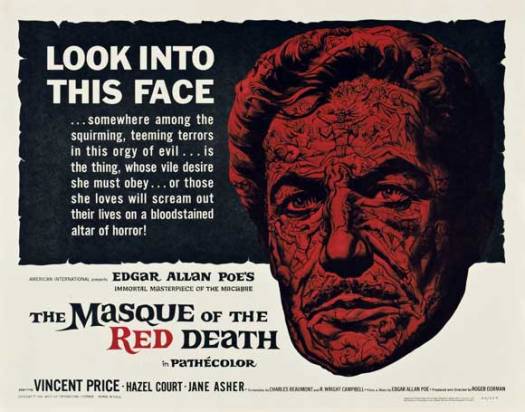
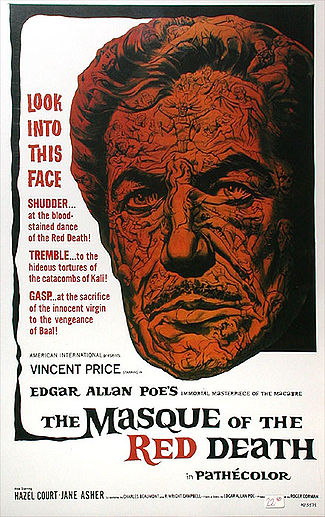
In 1964’s The Masque of the Red Death, Vincent Price stars as Prospero.
Prospero is a nobleman in medieval Italy, a decadent tyrant who rules his villages with an iron hand and who proudly and openly worships Satan. When an old woman in one of the villages dies of the plague, Prospero orders the village to be burned to the ground. He returns to his castle where, with his mistress (Hazel Court), he plans to throw a masquerade for the local nobility. His plan is for everyone to hide out in the castle until Death has passed. The problem, of course, is keeping Death from sneaking into the castle and claiming everyone within.
Prospero also abducts three villagers, Ludovico (Nigel Green), his daughter Francesca (Jane Asher), and Francesca’s boyfriend, Gino (David Weston). The three villagers find themselves in a decadent world, where Prospero and his attendants are motivated by their own greed and petty jealousies. Keeping Death from entering the castle would probably be a lot easier if the people in the castle would stop trying to kill each other. It’s an odd atmosphere within the castle. Everyone fears Death and yet, everyone seems to be doing all that they can do invite it in with them. Can anyone, even a worshipper of the Damned liked Prospero, truly escape Death?
The Masque of the Red Death is not only the best of Roger Corman’s Edgar Allan Poe adaptations but it’s also the best film that Corman ever directed. Working with cinematographer Nicolas Roeg (who was himself destined to have quite a career as a director of enigmatic films), Corman fills the screen with vivid colors and scenes of medieval decadence. Price gives one of his best performances, playing Prospero as someone who is in love with his own amoral nature but whose arrogance quickly gives way to fear when he starts to suspect the Death has somehow managed to enter the castle. The inhabitants of the castle are all memorably eccentric and, in many cases, evil. A man in an ape costume is burned to death and hardly anyone seems to notice or care. Prospero and his nobles think that they’re above death because of their wealth and their place in society but, of course, no one can escape Death.
David Weston and Jane Asher are both well-cast as the two lovers, though Asher is clearly more a product of the swinging sixties than medieval Italy. Patrick Magee and Skip Martin are both memorable as members of Prospero’s court, with Skip Martin giving an especially diabolical performance as a murderous court jester. In the end, though, this film truly belongs to Price, Corman, and Roeg. Roeg’s cinematography is dazzling, with the use of red foreshadowing his later film, Don’t Look Now. Corman’s direction puts the viewer right in the center of Prospero’s court. And Vincent Price gives one of his best performances as the self-amused but unashamedly evil Prospero. The Masque of the Red Death remains a classic of 60s pop art and the best of Corman’s many films.
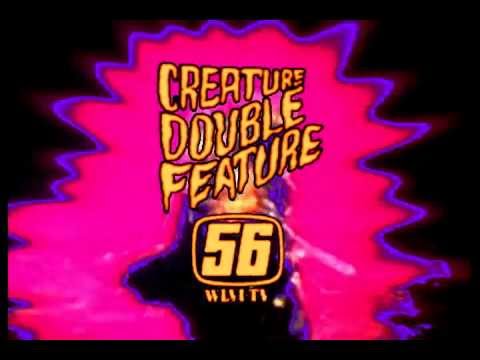
Boston’s WLVI-TV 56 ran it’s ‘Creature Double Feature’ series from 1972 to 1983. Though fans remember it mostly for those fabulous giant monster movies starring Godzilla and friends, CDF occasionally featured some monsters of a different kind…
Roger Corman and Vincent Price had teamed to make five successful Edgar Allan Poe adaptations for American-International Pictures, beginning with 1960’s HOUSE OF USHER (there was a sixth, THE PREMATURE BURIAL, that starred Ray Milland rather than Price). Studio execs James Nicholson and Sam Arkoff, always on the lookout for ways to cut costs, joined forces with Britain’s Anglo-Amalgamated Productions (makers of the CARRY ON comedies) and shipped Corman and company to jolly ol’ England for the final two, THE MASQUE OF THE RED DEATH and THE TOMB OF LIGEIA. Both turned out to be high points in the Corman/Price/Poe series.
1964’s MASQUE OF THE RED DEATH is a sadistic, psychedelic nightmare of…
In a London flat, a phone rings. Up-and-coming actor Terrence Stamp answers. On the other end, the producers of an up-coming film called Alfie ask Stamp if he would be interested in playing the lead role. In many ways, Stamp seems like the obvious choice. After all, he already starred in the stage version of Alfie. He knows the character and everyone knows that he’s going to be a big star…
And that’s why Stamp turns down the role. The character of Alfie is an irresponsible and self-centered womanizer who, over the course of the play, has numerous affairs, arranges for one illegal abortion, treats almost everyone terribly, and, at the end of the movie, ends up alone. Not only will the film’s risqué subject matter provide a challenge, even if it is being made in “swinging London,” but Alfie just isn’t a heroic figure. He has some good lines. He makes a few good jokes and, after arranging an abortion for one of his girlfriends, he realizes just how empty his life really is. But, as written, Alfie is hardly sympathetic.
Stamp says he’s not interested in playing Alfie on screen and then he hangs up.
Two minutes later, the phone rings again. Stamp answers. It’s the producers of Alfie. They ask to speak to his roommate, a cockney actor who was born Maurice Micklewhite but who, at the start of his acting career, changed his name to Michael Caine.
And that’s how Michael Caine came to star in the 1966 film, Alfie.
Alfie not only made Michael Caine a star, it also landed him his first Oscar nomination. It was especially a popular film in the States, where it tapped into a youth culture that was obsessed with all things British and a desire, on the part of many filmgoers, to see films that deal with “adult” topics that American films, at that time, wouldn’t dare touch. Though Alfie may seem rather tame by today’s standards (for a film about a man obsessed with sex, there’s actually not much of it to be found in Alfie), one can still see why it would have taken American audiences by surprise in 1966. At a time when American films still starred Doris Day and Bob Hope, here was a British film about a working class cockney who screws almost every woman he meets, both figuratively and literally.
And really, it’s fortunate that Michael Caine accepted that role. Along with Stamp, Alfie‘s producers also tried to interest Richard Harris and Laurence Harvey in the role. All three of them would have brought a harder edge to the character. However, Michael Caine has just enough charm to make Alfie likable, even when his actions are not. Since a good deal of the film is made up of Alfie breaking the fourth wall and talking straight to the audience (and, often times, not exactly saying that most charitable of words), that charm is essential to the film’s success. Michael Caine’s Alfie is self-centered but, at the same time, you never doubt that there’s a better man lurking underneath the surface. You forgive Alfie a lot because, thanks to Caine’s performance, you can see the man that he’s capable of being.
Alfie is pretty much Michael Caine’s show but he’s ably supported by the rest of the cast, especially Jane Asher as a poignantly insecure hitchhiker and Shelley Winters as a cheerfully promiscous American. And then there’s Denholm Elliott, who plays an abortionist with a seedy intensity that catch you off-guard and drives home the dark reality lurking underneath Alfie‘s charm.
For a film that is often described as being very much a product of its time, Alfie holds up surprisingly well. It was nominated for best picture but it lost to something far more sedate, A Man For All Seasons.
So here we are, 24 days into October, and I have yet to share an old Vincent Price film! It’s not October without at least a little contribution from Vincent. Well, allow me to correct that with today’s horror on the lens, the 1964 Roger Corman film The Masque of the Red Death.
Based on the classic story by Edgar Allan Poe, this film features Vincent Price giving one of his best performances as the doomed and decadent Satanist Prince Prospero. The film’s cinematographer was future director Nicolas Roeg and The Masque of the Red Death is probably one of the most visually impressive of all of Corman’s films.
 Peter Brock (Michael Bryant) is the leader of a team of researchers who work for an electronics company that is trying to come up with a new recording technique to keep up with their Japanese competitors. Peter and his team move into an old Victorian mansion that is said to be haunted. After Jill Greeley (Jane Asher) thinks that she’s seen a ghost, Peter theorizes that the stone walls of the mansion have actually recorded everything that has happened at the location over the years, like a security tape. Some people, like Jill, are sensitive enough to pick up on the images of the past. Other people, like Peter, are so determined to use what he calls The Stone Tape to his own advantage that it leads to tragedy.

 Through the Shattered Lens