Oh my God, did you know that it’s Loyalty Day!?
Well, actually, it’s not Loyalty Day for everyone. In fact, a lot of the world’s citizens are celebrating Communist May Day today. However, here in the United States, it’s Loyalty Day. Even if you are an American, it’s possible that you’ve never heard of Loyalty Day. It was first celebrated in 1921 and it was intended to provide a non-Communist alternative to International Workers Day. It wasn’t until 1955 that Loyalty Day was officially recognized by Congress.
Loyalty Day is defined as follows in 36 U.S.C. § 115:
- (a) Designation.— May 1 is Loyalty Day.
- (b) Purpose.— Loyalty Day is a special day for the reaffirmation of loyalty to the United States and for the recognition of the heritage of American freedom.
- (c) Proclamation.— The President is requested to issue a proclamation—
- (1) calling on United States Government officials to display the flag of the United States on all Government buildings on Loyalty Day; and
- (2) inviting the people of the United States to observe Loyalty Day with appropriate ceremonies in schools and other suitable places.
Though released before it officially became a holiday, the 1952 film, My Son John, is perfect for Loyalty Day.
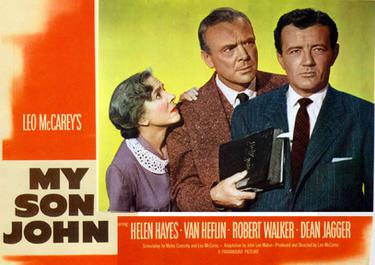
The John of the title is John Jefferson (Robert Walker, in his final role), an employee of the State Department. While his younger brothers (played by Richard Jaeckel and James Young) are two high school football stars who are looking forward to serving their country in Korea, John is an intellectual who considers concepts like patriotism to be simplistic and naive. While his father (Dean Jagger) sings patriotic songs at the American Legion hall, John rolls his eyes at such middle class activities. (“If you don’t like your Uncle Sammy,” move to another country, John’s father sings.) The only person to whom John is especially close is his nervous mother, Lucille (Helen Hayes).
However, John is keeping a secret from even Lucille. He’s a double agent, working for the communists! With FBI agent Stedman (Van Heflin) hot on his trail, will John ever be able to see the light about the communists? And, how will the communists respond to John having doubts about the cause?
My Son John was a dream project for Hollywood director Leo McCarey. (It’s not a coincidence that the devoutly Catholic McCarey made a film about a devoutly Catholic family who discovers that one of their own has become a communist.) McCarey carefully supervised every detail of the film and he was even able to talk stage legend Helen Hayes into starring in the film, her first in 14 years. My Son John is full of scenes of shadowy communists, smug intellectuals, and all-American FBI agents marveling at the strength of Lucille Jefferson’s faith. Everything that is today often cited as a negative aspect to living in the suburbs is presented as being a positive in My Son John. The film’s communists come into a world of happy families, big houses, and well-manicured lawns and they set out to make everyone else as miserable as they are. There’s nothing subtle about either McCarey’s approach or Helen Hayes’s performance but, as is often the case with propaganda, the film is crudely effective.
My Son John was Robert Walker’s final film. In fact, he died before completing work on the film, leading the ending being rewritten. (No longer would John personally deliver a commencement address. Instead, his words come out of a tape player that has been rolled out on stage. A holy light shines down on the player while The Battle Hymn of the Republic plays in the background. It’s bizarre but it’s also probably the most memorable part of the movie.) Scenes from Strangers On A Train were rather awkwardly spliced into final moments of My Son John, never mind the fact that Robert Walker’s gleefully evil performance as Bruno Antony had little in common with his self-tortured performance as John Jefferson.
Surprisingly, considering that My Son John was released at the height of the anti-Communist era, the film was not a success at the box office. (Audiences seemed to better appreciate low-budget and pulpier anti-communist films, like I Was A Communist For The FBI.) Still, thanks to the Internet, My Son John is still available to be viewed on this Loyalty Day.
So, remember — if you don’t like your Uncle Sammy …. well, actually, the cool thing about this country is that you don’t have to like your Uncle Sammy. You have the right to decide for yourself how you feel about old Uncle Sammy. That’s an idea that is worth being loyal to.


 Through the Shattered Lens