Produced by Gene Roddenberry and directed by Clive Donner, 1977’s Spectre was a pilot film for a television series about an occult detective (Robert Culp) who solved supernatural mysteries while dealing with a curse that had been put on him by the demon, Asmodeus.
In this film, Culp’s William Sebastian and his associate, Dr. Ham Hamilton (Gig Young) travel to the UK to investigate a supernatural case involving an old family. Despite the efforts of a succubus and a cursed airplane, Sebastian and Ham are determined to solve the mystery. John Hurt appears as a member of the cursed family.
This pilot was not picked up and developed into a series but it was popular enough that it was released as a theatrical film in Europe.
Produced by Gene Roddenberry and directed by Clive Donner, 1977’s Spectre was a pilot film for a television series about an occult detective (Robert Culp) who solved supernatural mysteries while dealing with a curse that had been put on him by the demon, Asmodeus.
In this film, Culp’s William Sebastian and his associate, Dr. Ham Hamilton (Gig Young) travel to the UK to investigate a supernatural case involving an old family. Despite the efforts of a succubus and a cursed airplane, Sebastian and Ham are determined to solve the mystery. John Hurt appears as a member of the cursed family.
This pilot was not picked up and developed into a series but it was popular enough that it was released as a theatrical film in Europe.
Though the Academy of Motion Picture Arts and Sciences claim that the Oscars honor the best of the year, we all know that there are always worthy films and performances that end up getting overlooked. Sometimes, it’s because the competition too fierce. Sometimes, it’s because the film itself was too controversial. Often, it’s just a case of a film’s quality not being fully recognized until years after its initial released. This series of reviews takes a look at the films and performances that should have been nominated but were, for whatever reason, overlooked. These are the Unnominated.
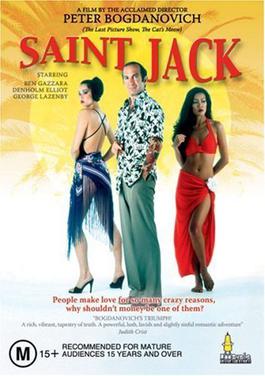
In 1979’s Saint Jack, Ben Gazzara stars as Jack Flowers. Jack was born in Brooklyn in 1931, a first-generation Italian-American. Though Jack himself prefers to keep his past something of a mystery, it’s implied that his family had less-than-savory “connections.” Jack served in the Korean War. After the war, he served in the Merchant Marine and spent a while trying to pursue a career as a writer. Now, in the early 1970s, Jack lives in Singapore.
What does Jack do in Singapore? He seems to know everyone and everyone seems to like him, with the exception of a few members of a Chinese triad who view Jack as being their competition. Jack is friendly and he knows how to talk to people. With the Vietnam War waging, Singapore is full of American soldiers on R&R and Jack is always willing to help set them up with companionship during their stay. He does the same thing for the businessmen who stop off on the island. At the same time, if someone just wants to play a game of squash, Jack can direct them to nearest health club. Whatever someone needs, Jack know how to get it.
This episodic film is largely a character study, following Jack over three eventful years of his life. We learn a lot about Jack just from watching his interactions with his friend William (Denholm Elliott), an alcoholic accountant who visits Singapore once a year and who is one of the few people with whom Jack is comfortable just being himself around. For all of his friendliness and good humor, Jack never quite lets anyone get too close to discovering who he really is. In many ways, Jack feels trapped in Singapore. He’s getting older and the world around him is changing and becoming less safe. Jack’s true goal is to open his own brothel, make a fortune, and eventually return to Brooklyn a rich man. At times, with the help of the CIA and a shady businessman (played by the film’s director, Peter Bogdanovich), it appears that Jack is going to do just that. But when his business associates put pressure on Jack to help them blackmail a gay U.S. Senator (played by George Lazenby, of On Her Majesty’s Secret Service fame), Jack is forced to finally decide how far he’s willing to go to achieve his dream.
The film works best as a showcase for Ben Gazzara, the character actor who may be best remembered for his over-the-top villainous turn in Roadhousebut who also gave excellent performances in films that rarely got the appreciation that they deserved. Starting his career as the accused killer in Anatomy of a Murder, Ben Gazzara brought his trademark intensity to several independent and mainstream films. He was a favorite of John Cassavetes. Over the course of his long career, Gazzara was never nominated for a single Oscar, though he certainly deserved to be nominated for one here. I would rate his work in Saint Jack as being superior to the performance that won that year’s Oscar, Dustin Hoffman’s rather self-satisfied turn in Kramer vs. Kramer. From the minute that Gazzara appears onscreen, he simply is Jack. The film was shot on location in Singapore and Gazzara walks through the streets with the an appealing confidence. As Jack, he’s a likable raconteur but, in the film’s quieter moments, Gazzara allows us to see just how alone Jack actually is. Jack may know every corner of Singapore but he also knows that it will never truly be where he belongs. There’s a particular poignance to Gazzara’s scenes with Denholm Elliott. Jack and Bill are two very different men but they share a desire to return to their homes.
Saint Jack should have been a comeback for Peter Bogdanovich, the film critic-turned-director who got off to a strong start with Targetsand The Last Picture Show but whose career floundered as the 70s moved on. Following the Oscar-nominated Last Picture Show and Paper Moon, Bogdanovich directed three big budget films — Daisy Miller, At Long Last Love, and Nickelodeon — that all failed at the box office. Finding himself a sudden pariah in Hollywood, Bogdanovich returned to his low-budget roots with Saint Jack, getting funding from Roger Corman and directing the film in a gritty, cinéma vérité-style. Roger Ebert loved the film, declaring that it proved that Bogdanovich was still a director worthy of appreciation. Unfortunately, the film was never widely distributed and it proved to be another box office disappointment for Bogdanovich. Sadly, the film was also ignored by the Academy, despite award-worthy performances from both Gazzara and Elliott.
Bogdanovich, who was born 84 years ago on this date, would often be cited as a cautionary tale for other directors who peaked early and spent the rest of their career on a downward slope. That’s not quite fair to Bogdanovich, who did continue to direct good films like Saint Jack, Mask, and The Cat’s Meow. Before he passed away in 2022, Bogdanovich found new popularity as both a character actor and as a frequent guest on TCM. And, fortunately, his films have come to be better appreciated with age. Saint Jack may not have gotten the attention it deserved in 1979 but it has since been rediscovered and rightfully acclaimed.
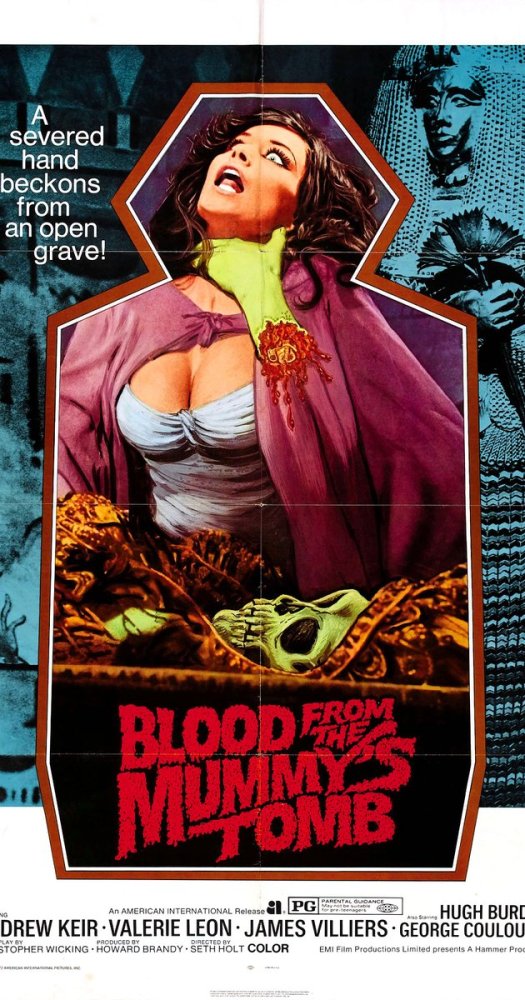
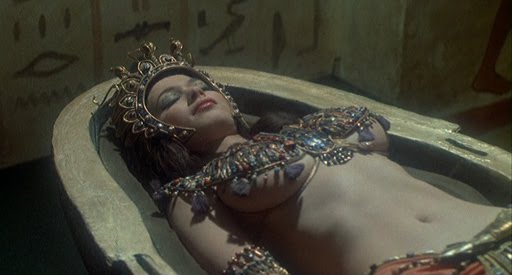
Hammer’s ‘Mummy’ movies never really did it for me, but BLOOD FROM THE MUMMY’S TOMB is a shroud of a different colour. Adapted from Bram Stoker’s novel “The Jewel of the Seven Stars”, the movie suffered some behind the scenes setbacks, which contribute to its choppy nature. The backstage chaos began when original star Peter Cushing’s wife passed away after only a day’s filming. He was replaced by Andrew Keir (QUARTERMASS AND THE PIT). Then before shooting was complete, director Seth Holt (TASTE OF FEAR, THE NANNY) died of a heart attack, and Hammer veteran Michael Carreras had to step in to finish the film. Despite all this, BLOOD FROM THE MUMMY’S TOMB is one of the better latter-day Hammers, picking up steam as it goes along, with a great performance by sexy star Valerie Leon.
Leon plays Margaret Fuchs, who was born the same day her father Professor Julian Fuchs…
The year is 1953. The place is Croydon. Derek Bentley (Christopher Eccleston) is 19 years old but has the mental capability of an 11 year-old. Unable to hold down a job and judged unfit for the national service, Derek drifts into a gang led by 16 year-old Christopher Craig (Paul Reynolds). When Derek and Craig are caught burglarizing a warehouse, it leads to a tense rooftop confrontation between Craig and the police. Derek has already been captured by the time that the police demand that Craig hand over his gun. Bentley shouts, “Let him have it, Chris!” Craig opens fire, killing one officer.
Because he’s a minor, Craig is only facing a prison sentence for killing the police officer. But, as a legal (if not mental) adult, Derek will be hung if he’s found guilty. Under the common purpose doctrine, it doesn’t matter that Derek didn’t actually shoot the gun. The only thing that matters is what Derek meant when he said, “Let him have it, Chris!” Derek says that he was telling Craig to hand over his gun. The Crown says that Derek was ordering Craig to open fire.
Let Him Have It is based on a true story. The case of Derek Bentley was one of the many cases that eventually led to the death penalty being abolished in the UK. Let Him Have It was released at the height of a long campaign to secure a pardon for Derek. That pardon was finally issued in 1998, though it was too late to help Derek Bentley.
Let Him Have It is a powerful and angry docudrama, one that reveals in searing detail how Derek was railroaded by the British legal system. In his film debut, Eccleston gives a powerful performance as Derek and he is ably supported by both Paul Reynolds and, in the role of Derek’s father, Tom Courtenay. Let Him Have It leaves little doubt as to why the case of Derek Bentley remained a cause célèbre for 45 years after his initial trial.
 Produced by Gene Roddenberry and directed by Clive Donner, 1977’s Spectre was a pilot film for a television series about an occult detective (Robert Culp) who solved supernatural mysteries while dealing with a curse that had been put on him by the demon, Asmodeus.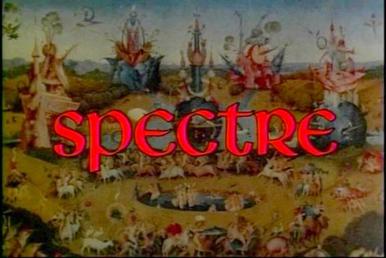


 Through the Shattered Lens