Late Night Retro Television Review: Highway to Heaven 2.23 “Children’s Children”


Welcome to Late Night Retro Television Reviews, a feature where we review some of our favorite and least favorite shows of the past!  On Thursdays, I will be reviewing Highway to Heaven, which aired on NBC from 1984 to 1989.  The entire show is currently streaming on Freevee and several other services!
This week, Jonathan and Mark find themselves in a Douglas Sirk-style melodrama.

Episode 2.23 “Children’s Children”

(Dir by Victor French, originally aired on April 30th, 1986)

When I watched this episode, I saw that the script was credited to David Thoreau and I immediately assumed that it had to be a pseudonym for the actual writer.  Fortunately, for once, I actually did some research and I discovered that the writer’s name actually was David Thoreau.  He wrote a few scripts that were produced in the 80s and 90s and, in fact, this was the first of seven scripts that he wrote for Highway to Heaven.  He’s also credited as writing the screenplay for the classic beach volleyball film, Side Out.

As for this episode, it finds Mark and Jonathan working at a home for unwed mothers.  Just the term “home for unwed mothers” brings to mind the 50s melodramas of Douglas Sirk and I found myself thinking about just how old-fashioned Highway to Heaven must have seemed even in the 80s.  I did a google search and I discovered that homes from unwed mothers do still exist, though they’re now called “maternity homes.”

The manager of the home for unwed mothers is Joyce Blair (Bibi Besch), who finds herself being hounded by a reporter named Dan Rivers (Robert Lipton).  Dan is determined to take Joyce down and, to do so, he brings up a past incident in which Joyce was arrested.  Dan twists the facts to make Joyce look like a criminal and soon, Joyce finds that she might not be able to keep the home open.  Why is Dan doing this?  Like most reporters on Highway to Heaven, he’s just plain evil.  But when one of the girls at the home suggests that Dan might be the father of her child, Dan learns what it’s like to be falsely accused.

Meanwhile, evil businessman Jack Brent (James T. Callahan) hopes for a chance to foreclose on the home so that he can bulldoze it and replace it with condominiums.  (Bad guys in the 80s always wanted to build condos.)  But how will he react when he discovers that his teenage son (Scott Coffey) is going to be a father and that the girl he impregnated in currently living at the home?

This episode is the type of episode that most people think of when they dismiss Highway to Heaven as just being an old-fashioned and slightly preachy melodrama.  There’s not a single subtle moment or particularly nuanced moment to be found in this particular episode.  It’s note quite as heavy-handed as that episode where Mark begged the President to talk to the Russians and reduce amount of nuclear missiles but it’s close.
Cleaning Out The DVR: Outlaw Blues (dir by Richard T. Heffron)


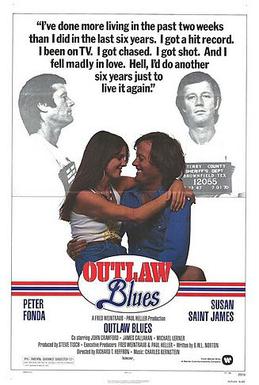
The 1977 film, Outlaw Blues, opens in Huntsville State Prison. An arrogant country music star named Garland Dupree (James T. Callahan) is about to perform for the prisoners. He’s hoping his Huntsville concert will do for him what playing at Folsom did for Johnny Cash. The warden insists that Garland listen to a song written and performed by a soft-spoken prisoner named Bobby Ogden (Peter Fonda). A visibly annoyed Garland agrees but he doesn’t actually listen while Bobby performs. Instead, Garland is too busy arguing with the manager of his record label, Hatch (Michael Lerner). However, the members of Garland’s backup band record Bobby as he sings.

Several months later, Bobby is about to be released from prison when he learns that Garland is performing his song. Not only has Garland made it a hit but he’s also taking credit for writing it! Garland and Hatch even copyrighted the song, something that Bobby was never able to do because he was in prison.

Released from prison, Bobby ends up in Austin. He wants to stay out of prison and get his life straightened out. He wants to pursue a career as a singer. And he wants Garland to admit that he stole Bobby’s song. Unfortunately, when Bobby confronts Garland, things escalate and Garland ends up accidentally getting shot. Garland survives but now Bobby has the police after him. With the help of one of Garland’s former backup singers, Tina Waters (Susan Saint James), Bobby tries to become a star while staying one step ahead of the cops. Like the outlaws of old, Bobby and Tina sneak around Texas, performing where they can. (Knowing that any publicity is good publicity, Tina often calls the cop just as Bobby finishes his show, all the better for her and Bobby to make a dramatic escape.) Hatch is eager to record and release a Bobby Ogden record but both Bobby and Tina know that he can’t be trusted. But with the cops closing in, what choice do they have?

For a film about criminals on the run, Outlaw Blues is a surprisingly loose and laid back movie. It’s definitely a product of the 70s. It celebrates rebellion and doing your own thing, it mixes drama and comedy and, because it was made in the 70s, you know there’s always a good chance that, regardless of how pleasant the majority of the film may be, everyone’s going to die at the end of the movie. That definitely adds some tension to the film’s story that might not otherwise be there. For the most part, though, this is an enjoyable little lark of a drive-in movie. It celebrates individualism while also finding time for a few songs and a car chase or two.

A good deal of the film’s charm is the result of the chemistry between the two stars. Peter Fonda and Susan Saint James just seem as if they belong together and they both play characters who are written with slightly more depth than you might otherwise expect from what was obviously meant to be a cheap, drive-in film. Tina may appear to be a hippie but, as played by Saint James, she eventually turns out to be a clever businesswoman and promoter. As for Peter Fonda, he definitely had his acting limitations but he also had a nice smile and a far more likable screen presence than you might suspect if you only know him from his remote performance in Easy Rider. In Outlaw Blues, Fonda’s inexpressive manner feels right for someone who has spent most of his life in prison and who is still adjusting to being on the outside. Fonda wins you over and, once his character falls in love with Saint James, Fonda starts to relax and you get the feeling that both he and Bobby Ogden are having fun.

Outlaw Blues may be a minor 70s film but it’s likable. It has an amiable spirit which makes it worth watching.

Quickie Review: Return of the Living Dead 3 (dir. by Brian Yuzna)


In 1993 horror fans were greeted with the release of Return of the Living Dead 3. This third film in the Return of the Living Dead series produced by John Russo ends up being a very good zombie movie and actually has genuine horror that the second film lacked. What ROTLDIII, its writers and directors seem to have left behind was the comedy side of the series which made them cult-classics to begin with.

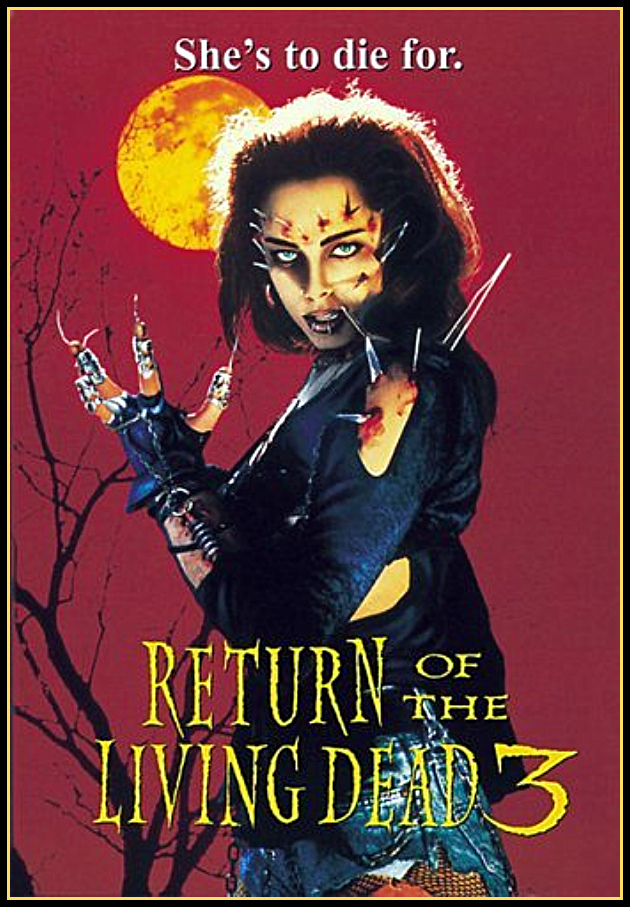
Taking up directing duty this time around was genre-veteran Brian Yuzna (Beyond Re-Animator) who films this third entry purely on a horror standpoint. This film is serious horror from start to finish. This time around the military is still trying to find a way to use 2-4-5 Trioxin as a way to create zombie soldiers, but ones that could be easily controlled by them. To say that this project hasn’t met with success is an understatement. But it’s the story of the son of the military project director and his girlfriend who dominate the film’s plot. As portrayed by J. Trevor Edmond and Melinda Clarke, these two star-crossed lovers find themselves enmeshed with the dark secret of the project being held in secret. Son soon uses the Trioxin gas to try and ressurect his girlfriend who gets killed early on during an accident. What he gets instead is an undead girlfriend whose hunger for live brains (for some reason the zombies in this ROTLD sequel also feed on other bodily parts) can only be controlled when she causes herself bodily pain through extreme forms of piercing. The rest of the film deals with the father trying to save his son not just from himself and his undead girlfriend but from the hordes of escaped zombies in the facility.

The horror in the film was actually pretty good and this was helped a lot by the gore effects work which surpasses anything the first two films in the series had. The acting was decent enough with Melinda Clarke as the zombified girlfriend putting on a sexy, albeit creepy performance. If it wasn’t for the brain and flesh-eating she sure would’ve made for quite a poster girl for teenage boys.

In the end, Return of the Living Dead 3 continues the series admirably. Despite not having much humor and comedy in the film, this third film in the series more than makes up for it with high levels of gore and a definite sense of horror the first two didn’t much have not to mention a bit of romance which seemed to work.