Film Review: Assault on Precinct 13 (dir by John Carpenter)


Legend has it that, when John Carpenter originally offered the role of Dr. Sam Loomis to Donald Pleasence, Pleasence was reluctant to accept it.  To Pleasence, Halloween sounded like it would just be another forgettable horror film.

However, when Donald mentioned to his daughter, actress Angela Pleasence, that he had been offered a role in a film by a young director named John Carpenter, Angela immediately told him to accept.  She assured him that it would turn out to be a great film.  When Donald asked her why she was so sure about this, Angela replied that she had seen Assault on Precinct 13 at the Cannes Film Festival.

1976’s Assault on Precinct 13 was John Carpenter’s second feature film.  (The first was Dark Star, which started out as a student film and, even after being extended to feature length, still ended up feeling very much like a student film.)  The film takes place in Los Angeles, at an isolated police precinct house that is scheduled to be abandonedd.  When the father (Martin Lawson) of a girl (Kim Richards) who was murdered earlier in the day seeks refuge at the precinct, a Che Guevara-influenced street gang launches a relentless late night attack on the building.  (Frank Doubleday, who later played Romero in Escape From New York, appears as a member of the gang.)  Lt. Ethan Bishop (Austin Stoker) is forced to work with criminal Napoleon Wilson (Darwin Joston) to defeat the gang.
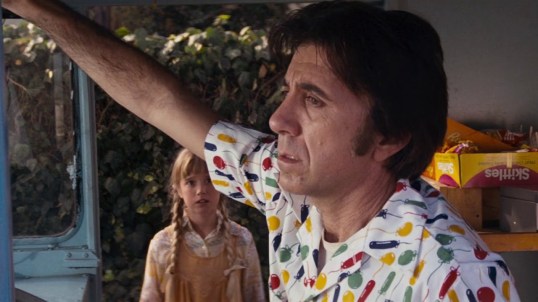
Assault on Precinct 13 (1976, dir by John Carpenter. DP: Douglas Knapp)

John Carpenter later said that Assault of Precinct 13 was his attempt to make a Howard Hawks-style western and, despite taking place in the modern era, it is very much a western.  Ethan Bishop is the strong and moral lawman who refuses to allow the untamed land around him to change who he is and what he believes.  Napoleon Wilson is the outlaw who finds redemption.  In most westerns, the attackers would represent the last gasp of the lawless frontier fighting against encroaching civilization.  In the case of Assault on Precinct 13, the opposite is true.  The attackers represent the collapse of society and the people in the precinct find themselves fighting not only for their lives but also the ideals of modern civilization.  With their relentless drive to attack, the members of the street gang resemble the zombies from George Romero’s Night of the Living Dead.  They’re so nihilistic and destructive that even a hardened criminal like Napoleon Wilson knows that they have to be stopped.  The film’s ultimate message seems to be that, even if Bishop and Wilson and Leigh (Laurie Zimmer) survive the night, the assault on Precinct 13 will never truly end.  In a way, we’re all trapped in that abandoned precinct house.

Wow, that sounds pretty grim!  And really, it is a grim film.  This, after all, is the film in which little Kim Richards is graphically shot in the chest while trying to buy ice cream.  (From the start, Carpenter understood the importance of shocking the audience.)  That said, there are unexpected moments of dark humor to be found in the film.  (Even Kim Richards’s indignation over being given the wrong flavor ice cream is rather humorous, up until she asks for a replacement and gets shot as a result.)  Both Bishop and Wilson make for compelling heroes.  As Angela Pleasence realized when she saw the movie at Cannes, John Carpenter was and is a natural-born storyteller.  Assault on Precinct 13 is a film that wastes no time in getting started and is relentless in both its suspense and its action.

Assault on Precinct 13 has been overshadowed by Carpenter’s subsequent successes but it’s still one of Carpenter’s best films.  Without Assault on Precinct 13, we would never have gotten Donald Pleasence as Dr. Sam Loomis.  That alone is reason enough to celebrate the film.
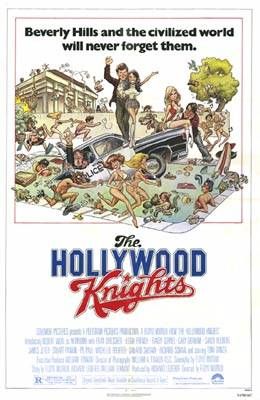
The Hollywood Knights (1980, directed by Floyd Mutrux)


Halloween Night, 1965.  While the high school holds a pep rally and the Beverly Hills Homeowners Association debate the best way to tackle the problem of juvenile delinquency, the Hollywood Knights hang out at Tubby’s Drive-In, their favorite burger joint.  The Hollywood Knights are a car club and a group of fun-loving rebels, determined to have a good time and to always humiliate Officers Clark (Sandy Helberg) and Bimbeau (Gailard Sartain).  In practice, this amounts to a lot of jokes about flatulence and Newcomb Turk (Robert Wuhl) mooning the cops every chance the he gets.  I’m hoping a stunt butt was used for the mooning shots.  If I had known watching Hollywood Knights would mean seeing Robert Wuhl’s bare ass a dozen times over 91 minutes, I wouldn’t have started the movie.

The humor is crude but the movie has a serious side, one that was cribbed from American Graffiti.  Duke (Tony Danza), a senior member of the club, is upset that his girlfriend (Michelle Pfeiffer, in her film debut) is working as a car hop.  He’s also sad that his buddy, Jimmy Shine (Gary Graham), is leaving in the morning for the Army.  Jimmy’s not worried about being sent to Vietnam because Americans are only being sent over there as advisors.  Hollywood Knights doesn’t end with a Graffiti-style epilogue but if it did, Jimmy would be the one who never came home.  The serious scenes work better than the comedy, due to the performances of Gary Graham, Michelle Pfeiffer, and Tony Danza.  I can’t believe I just said that either.  Danza, though he’s way too old to be playing a high school student, is actually really good in this movie.  Pfeiffer doesn’t get to do much but, from her first scene, it’s easy to see why she became a star.  The camera loves her and she brings her character to life, despite not having much screen time.

Unfortunately, the drama takes a back seat to a lot of repetitive humor.  The problem isn’t that the humor is crude.  One thing that has always been true is that, regardless of the year, teenage boy humor is the crudest humor imaginable.  Even back in prehistorical times, teenage boys were probably drawing dirty pictures on the walls of their caves.  The problem is that the humor is boring and Robert Wuhl is even more miscast as a high school student as Tony Danza was.  Fran Drescher plays a high school student with whom Turk tries to hook up.  Drescher, like Pfeiffer, comes across as being a future star in the making.  Robert Wuhl comes across as being the future creator of Arli$$.

The Hollywood Knights has a bittersweet ending, the type that says, “It’ll never be 1965 again.”  This movie made me happy that it will never be 1965 again.  1965 should have sued The Hollywood Knights for slander.  Hollywood Knights tried to mix the nostalgia of American Graffiti with the raunchiness of Animal House but it didn’t have the heart or creativity of either film.  At least some of the member of the cast went onto better things.


Lisa Watches An Oscar Nominee: The Sand Pebbles (dir by Robert Wise)


The_Sand_Pebbles_film_posterAfter watching Witness For The Prosecution, I continued TCM’s 31 Days of Oscar by watching the 1966 Best Picture nominee, The Sand Pebbles.

Considering that The Sand Pebbles is close to four hours long, it’s interesting how little there is to really say about it.  Taking place in 1926, The Sand Pebbles follows the crew of the USS San Pablo, a gunboat that patrols the Yangtze River in China.  The San Pablo is there to protect American business interests, which are in particular danger because China is caught up in a communist revolution.  For the most part, the crew of the San Pablo are portrayed as being lazy and racist.  They have little interest in understanding the culture of the people around them and they use Chinese laborer to do the work on the boat.

When Jake Holman (Steve McQueen) is transferred to the San Pablo, he upsets his fellow crewmen by insisting on working in the ship’s engine room himself, the fear being that if Holman is willing to work then the rest of them will be expected to work as well.  The ship’s commander, Lt. Collins (Richard Crenna), views Holman as being a threat to morale and starts to make plans to get Holman off of his boat.  But, first, the boat is going to have to get out of China…

The Sand Pebbles is an episodic film and some of those episodes are more interesting than others.  Typically, an episode will start out positively and then end with some sudden tragedy.  For instance, Holman trains one laborer (Mako) to be a boxer and then watches as he beats the most racist crewman on the ship.  However, just a few minutes later, the laborer is captured and savagely tortured by the communists and Holman is forced to perform a mercy killing.

In another subplot, Holman’s only friend, Frenchy (Richard Attenborough), marries a local prostitute (Emmanuelle Arsan, who would later write an autobiography that would serve as the basis for a very different type of film).  However, in order to see his wife, Frenchy has to continually swim to shore in the middle of the night.  Frenchy soon develops pneumonia and dies while his wife is dragged off and apparently executed.

And finally, Holman strikes up a romance with Shirley Eckert (Candice Bergen), an innocent missionary.  However, when her arrogant and naive boss, Jameson (Larry Gates), refuses to leave the country despite the revolution, the San Pablo is ordered to rescue them.  This, of course, leads to a final battle with the communists which leaves a good deal of the cast dead.

As I watched The Sand Pebbles, my main impression was that it was an extremely long movie.  The film’s climatic battle was exciting and Steve McQueen (not to be confused with the director of 12 Years A Slave and Shame) gave a good performance but otherwise, the film often seemed to drag.  While the movie’s theme of Americans struggling (and failing) to understand another country’s culture had a definite resonance, The Sand Pebbles did not seem to be quite sure what it truly wanted to say about it.

Let’s face it — over 500 films have been nominated for best picture.  And, while a good deal of them hold up surprisingly well and are still entertaining to watch, there’s also a handful like The Sand Pebbles, ambitious films that never quite reached their potential but were probably nominated because they seemed like the type of epic film that should be nominated.  Many of these films were nominated and a few even won.

However, in the case of The Sand Pebbles, a nomination would have to be enough.  That year, the Oscar for Best Picture was won by A Man For All Seasons.