Cleaning Out The DVR: The Sandpiper (dir by Vincente Minnelli)


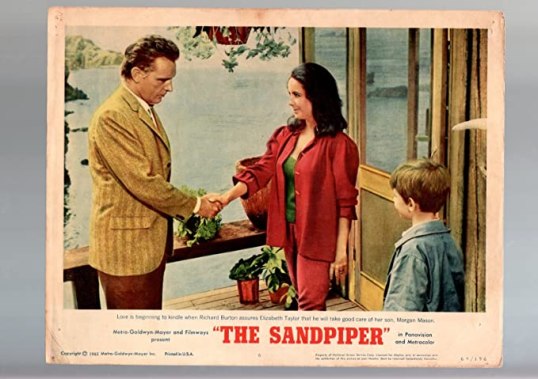
I recorded The Sandpiper that last time that it aired on TCM.  This 1965 film is one of the many films that Elizabeth Taylor and Richard Burton made together after they fell in love during the making of Cleopatra.  And while it’s true that Who’s Afraid of Virginia Woolf? won Taylor an Oscar and probably should have won one for Burton as well, the majority of the Taylor/Burton films were overproduced melodramas that often seemed as if they’d been rushed into production in order to capitalize on the couple’s tabloid popularity.  Unfortunately, Virginia Woolf aside, neither Taylor nor Burton seemed to bring out the best in each other as actors.

The Sandpiper finds Taylor playing Laura Reynolds, an artist who lives in a California beach house with her young son, Danny (Morgan Mason).  Laura is a free spirit who believes that everyone, including her son, should have the freedom to make their own choices.  She is resistant to any and all authority.  She’s a bohemian, a rebel, the type who doesn’t care what society has to say and who flaunts her refusal to follow the dictates of respectability.  Good for her!  However, she’s also Elizabeth Taylor, which means that she’s impossibly glamorous and even her “cluttered” beach house looks like it’s a hundred times more expensive than anything that anyone viewing the film will ever be able to afford.  Though Taylor tries hard, there’s nothing convincingly bohemian about her.

Richard Burton plays Dr. Edward Hewitt, who runs the nearby Episcopal school.  Dr. Hewitt is not a free spirit.  Instead, he and his wife, Claire (Eva Marie Saint), very much believe in structure and playing by the rules.  They believe in a traditional education and, when a judge orders Danny to be enrolled at their school, that’s what Hewitt plans to give him.  This, of course, brings Hewitt into conflict with Laura.  Both of them have differing ways of looking at the world and Laura is not a fan of religion in general.  However, since they’re played by Burton and Taylor, they’re destined to fall in love and have a scandalous affair.

Dr. Hewitt is one of the many religious figures that Burton played throughout his career.  In fact, Burton played so many alcoholic priests that I spent most of the movie assuming that Hewitt was an alcoholic as well.  However, he’s not.  He’s just Episcopalian.  That said, Burton delivers every line of dialogue in his trademark “great actor” voice and every minute that he’s onscreen just seems to be full of self-loathing.  Even before he cheats on his wife, Hewitt seems to hate himself.  Of course, once Burton does start cheating on his wife, it only gets worse.  The film presents Hewitt as being something of a hesitant participant, someone who knows that he’s doing the wrong thing but he simply cannot stop himself.  Laura, meanwhile, is presented as being someone who is fully willing to break up a marriage to get what she wants.  One gets the feeling that 1965 audiences probably just assumed they were watching the true story of how Taylor and Burton fell in love during the making the Cleopatra.  That said, it’s all pretty tame.  Just like Taylor, director Vincente Minnelli was too much of a product of the old Hollywood to truly embrace this story for all of its sordid potential.

If you’ve ever wanted to watch Charles Bronson debate religion with Richard Burton, this is the film for you.  Bronson plays a sculptor and an atheist who upsets Hewitt by calling him “reverend.”  Bronson is actually more convincing in the film than either Burton or Taylor, bringing a rough authenticity to his role.  Whereas Burton and Taylor both seem to be going through the motions, Bronson comes across as if he actually has a personal stake in the film’s story.  It’s not enough to save the movie, of course.  Fortunately, a year later, Liz and Dick would be used to better effect in Who’s Afraid of Virginia Woolf?
 

A Movie A Day #243: The Joe Louis Story (1953, directed by Robert Gordon)


Joe Louis, also known as the Brown Bomber, is generally agreed to have been one of the greatest heavyweight boxers of all time.  Despite the barriers put up by both poverty and racism, Louis held the world heavyweight championship from 1937 to 1949 and successfully defended his title in 26 fights (ranking him second to only Julio Cesar Chavez, who had 27 title defenses).  In 1938, he defeated German Max Schmelling, disproving Nazi claims that a black man could not defeat an Aryan and making Louis, along with Jesse Owens, one of the first African-American athletes to achieve nationwide hero status in America.
The Joe Louis Story, which was made and released shortly after Louis lost his final fight to Rocky Marciano and announced his retirement from boxing, tells an effective but sanitized version of Louis’s life story.  Made on an obviously low budget, The Joe Louis Story hits all the highlights — Joe’s relationship with trainer Jack Blackburn (James Edwards), Joe’s marriage to Marva Trotter (Hilda Simms), Joe’s two fights against Max Schmelling, and Joe’s time in the army — while ignoring most of the lowlights.  No mention is made of Joe’s financial troubles, Joe’s initial struggle to even get a match against the white heavyweights of the day, or the infidelity that led to Joe and Marva’s divorce.  The Joe Louis Story does briefly touch on racism when Joe is told that, as a black man, he already has a strike against him as far as the boxing establishment is concerned.

The best thing about The Joe Louis Story is that it features footage from Louis’s actual fights. Coley Wallace, the boxer who was hired to play the title role, bore a remarkable resemblance to Joe and the footage of the real Joe Louis boxing is easily mixed in with scene of Wallace as Joe.  Wallace was not much of an actor but, as a real-life boxer, he still brought enough authenticity to the role that his casting works.

One final note: In real life, Joe Louis ended his career after a brutal loss to Rocky Marciano.  Before turning pro, Marciano lost four fights as an amueter.  One of those losses came in 1948 when Marciano was defeated in the final round of the New York Golden Gloves tournament.  The fighter who defeated Rocky Marciano?  Coley Wallace.

Cleaning Out the DVR Pt 9: Film Noir Festival Redux


gary loggins's avatarcracked rear viewer

prev

Welcome back to the decadently dark world of film noir, where crime, corruption, lust, and murder await. Let’s step out of the light and deep into the shadows with these five fateful tales:

redux1

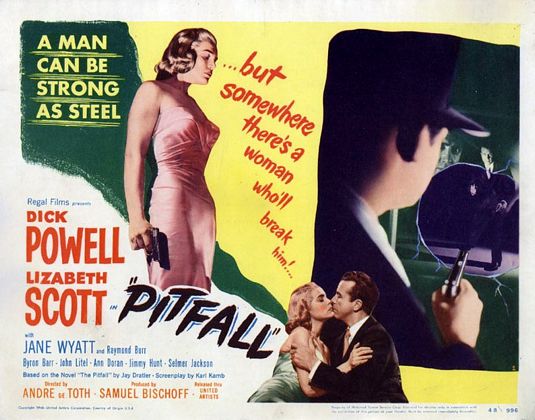
PITFALL (United Artists 1948, D: Andre DeToth) Dick Powell is an insurance man who feels he’s stuck in a rut, living in safe suburbia with his wife and kid (Jane Wyatt, Jimmy Hunt). Then he meets hot model Lizabeth Scott on a case and falls into a web of lies, deceit, and ultimately murder. Raymond Burr  costars as a creepy PI who has designs on Scott himself. A good cast in a good (not great) drama with a disappointing ending. Fun Fact: The part of Scott’s embezzler boyfriend is played by one Byron Barr, who is not the Byron Barr that later changed his name to Gig Young.  

redux2

THE BRIBE (MGM 1949, D:Robert Z. Leonard) Despite an…

View original post 759 more words

Bloody Pulp Fiction: THE SET-UP (RKO 1949)


gary loggins's avatarcracked rear viewer

setup1

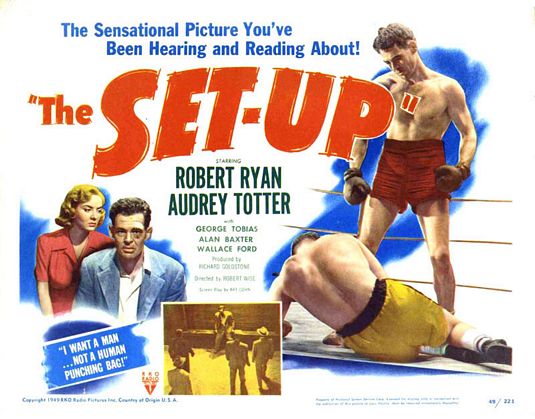
The seedy worlds of professional boxing and film noir were made for each other. Both are filled with corruption, crime, and desperate characters trapped in situations beyond their control.  Movies like CHAMPION, BODY AND SOUL, and THE HARDER THEY FALL expose the dark underbelly of pugilism. One of the best of this sub-genre is THE SET-UP, Robert Wise’s last film for RKO studios. He doesn’t fail to deliver the goods, directing a noir that packs a wallop!

THE SET-UP follows one night in the life of aging, washed up fighter Stoker Thompson ( Robert Ryan ). Stoker’s 35 now, ancient in boxing terms, but still has delusions of making the big time. Wife Julie (Audrey Totter ) is tired of going from one tank town to the next, and fears for Stoker’s safety. She refuses to go to tonight’s fight, a matchup with up and coming young contender Tiger…

View original post 817 more words

Shattered Politics #11: The Phenix City Story (dir by Phil Karlson)


PhenixCityPoster

If A Man Called Peter was the epitome of a stereotypical 1950s film, The Phenix City Story is the exact opposite.  Like A Man Called Peter, The Phenix City Story was released in 1955.  And like A Man Called Peter, The Phenix City Story is based on a true story.  However, beyond that, A Man Called Peter and The Phenix City Story might as well have been taking place on different planets.

And, in many ways, they were.  The Phenix City Story not only takes place in Phenix City, Alabama but it was filmed there as well and featured a few actual citizens in the cast.  Not only was The Phenix City Story telling a true story but the story was being told by some of the same people who actually lived through it.  That makes The Phenix City Story brutally realistic, with brutal being the key word.

And, just in case we have any doubt about the film’s authenticity, it actually opens with a 15 minute documentary in which Clete Roberts (who was an actual news reporter) interviews several citizens of the town.  All of them, speaking in thick Alabama accents and nervously eyeing the camera, assure us that what we are about to see is true.  Quite a few of them also tells us that they still live in fear of losing their lives as a result of everything that happened.

What’s amazing is that, once the actual film does get started, it manages to live up to all of that build up.  The Phenix City Story is a shocking film that remains powerful even 60 years after it was initially released.

As the film opens, we’re informed that Phenix City, Alabama is home to some of the most dangerous and violent criminals in the state.  From his club, crime boss Rhett Tanner (Edward Andrews) runs a shadowy organization that not only controls Phenix City but the entire state of Alabama as well.  The police ignore his crimes.  The majority of the town’s citizens are too scared to stand up to him.  When a returning veteran of the Korean War, John Patterson (Richard Kiley), tries to stand up to Tanner, the result is even more violence.  A young black girl is kidnapped and murdered, her body tossed on John’s front lawn as a warning.  John’s best friend is killed but Tanner uses his influence to have the death ruled accidental.

Finally, John and a group of other reformers convince John’s father — Albert Patterson (John McIntire) — to run for Attorney General.  Albert runs on a reform platform and exposes both the corruption of Phenix City and how Tanner’s power extends through the rest of the state as well.  When Albert wins the Democratic primary, he’s gunned down in the street and it’s up to John to avenge his death…

To say that The Phenix City Story is intense would be an understatement.  As directed by Phil Karlson, there’s not a single frame of The Phenix City Story that’s not full of menace and danger.  The stark black-and-white cinematography is full of shadows and the camera moves almost frantically from scene to scene, occasionally catching glimpses of dark figures committing acts of violence and cars speeding away from who knows what outage.  It’s a dark film but, ultimately, it’s also a hopeful one.  It suggests that evil will triumph when good men do nothing but that sometimes you can depend on good men — like Albert and John Patterson — to actually step up.

The Phenix City Story shows up on TCM occasionally and you should keep an eye out for it.  It’s one of the best B-movies ever made.