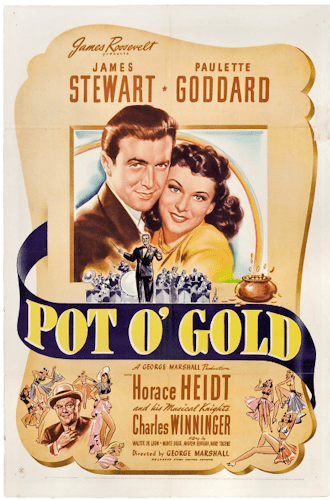
The Fabulous Forties #48: Pot O’ Gold (dir by George Marshall)


Pot_o_Gold-_1941-_Poster

The 48th film in Mill Creek’s Fabulous Forties box set was 1941’s Pot O’ Gold.  At first, I was really excited about watching Pot O’ Gold because it starred James Stewart, one of my favorite of the Golden Age stars.  “Wow,” I thought, “James Stewart never made a bad movie!  This is going to be great!”  However, before watching the film, I looked Pot O’ Gold up on Wikipedia and I discovered that apparently, James Stewart considered Pot O’ Gold to be the worst film that he ever made.

After having watched the film, I think that Jimmy may very well have been correct in his assessment.

Pot O’ Gold is a musical comedy.  Stewart plays Jimmy Haskell, the owner of a music store.  Jimmy loves music but he’s a terrible businessman.  Despite the fact that his store always seems to be full of quirky characters playing musical instruments, it still goes out of business.  Jimmy is forced to go to work for his uncle, C.J. Haskell (Charles Winninger).  C.J. not only owns a health food company but he also produces a radio show.

And, on top of all that, C.J. hates music!

Unfortunately, considering how much C.J. hates music, he lives right next door to the McCorkles, a family of Irish musicians.  The McCorkles are constantly practicing in front of C.J.’s store and, as a result, C.J. is constantly forced to call the cops to make them go away.

When Jimmy first arrives at the store, he befriends the McCorkles.  He even falls in love with Molly McCorkle (Paulette Goddard).  Unfortunately, none of the McCorkles know that he is C.J.’s nephew and C.J. doesn’t know that his nephew secretly continues to love music.  Meanwhile, C.J. is trying to catch the mysterious person who threw a tomato at him.  What he doesn’t realize is that the tomato was thrown by … JIMMY!

And it just keeps going on and on from there.  C.J. conspires to get rid of the McCorkles.  Jimmy tries to bring peace between the two sided without the Molly discovering that he’s related to C.J. and without C.J. realizing that Jimmy threw that tomato.  Jimmy eventually goes on C.J.’s radio show and soon, he’s using the show as a way to give away money to the needy.  Meanwhile, he struggles to forge peace between the McCorkles and C.J. without Molly discovering his true identity and without C.J. finding out he threw that tomato.  Will C.J. ever learn to love music and will it ever occur to anyone that this whole mess could easily be resolved by everyone making an effort not to randomly break out into song every time C.J. happens to be walking down the street?

Pot O’ Gold is an amazingly silly movie and I don’t mean silly in a good way.  This is one of those films where every issue could be resolved if people just showed a little intelligence.  It’s also a movie where everyone breaks into song every few minutes.  The key to a successful musical is that the songs have to feel like the grow organically out of the action.  The songs in Pot O’ Gold feel like they’re just there to be there.

Personally, I think James Stewart is one of those actors who can make any movie worth seeing.  He is his normal, likable self in this film but Pot O’ Gold never seems worthy of his famous persona.

Incidentally, Pot O’ Gold’s credited producer was James Roosevelt, FDR’s wastrel son.  I don’t know how much he had to do with the actual production but I’ve always wanted an excuse to use the word “wastrel” in a review.

Cleaning Out The DVR #25: The Maltese Falcon (dir by John Huston)


(For those following at home, Lisa is attempting to clean out her DVR by watching and reviewing 38 films by this Friday.  Will she make it?  Keep following the site to find out!)

220px-Falconm

I would love to see a remake of The Maltese Falcon with Bill Murray in the role of Sam Spade.  Well, maybe not the Bill Murray of today because he’s getting a little bit too old to play a hard-boiled private detective who is as good with his fists as his brain.  Instead, I’m thinking more of Lost In Translation era Bill Murray, when he was no longer young but could still probably beat up any sniveling punk who came at him with a gun.

Now, that may sound crazy to some but think about it.  Bill Murray is one of the great deadpan snarkers and so is Sam Spade.  Last night, when I watched the famous 1941 version of The Maltese Falcon (the story was filmed twice before, once with Bette Davis as the femme fatale), I was struck by how much of the film really was a comedy.  It may have been a murder mystery that featured death and betrayal and a lot of people getting beaten up but, ultimately, The Maltese Falcon is really about Sam Spade reacting to all of the crazy and strange people around him.  No matter how weird things get, Spade always responds with a smirk and a quip.  It’s a role that, at times, seems to be tailor-made for an actor like Bill Murray.

Bill Murray wasn’t around in 1941 but fortunately, Humphrey Bogart was.  Humphrey Bogart may have grown up wealthy and attended private schools but, on screen, nobody was tougher than Humphrey Bogart and nobody was better at delivering sarcastic, snark-filled dialogue.  After spending years as a villainous supporting actor, Humphrey Bogart got his first starring role when he played Sam Spade in The Maltese Falcon.  His performance, of course, would set the standard by which all future cinematic private eyes would be judged.

And, of course, Spade was tough and he was cynical and he has that wonderful moment at the end of the film where he explains that nobody’s going to make a “sap” out of him.  But for me, Bogart’s best moments come when Spade is alone and thinking.  It’s at those times that Spade suddenly becomes a human being.  A slight smirk comes to his lips, almost as if he’s sharing a private joke with the audience.  You can tell that he’s thinking to himself, “Can you believe how weird my life is?”

And it is indeed a weird life.  The film opens with Spade’s partner, Miles Archer (Jerome Cowan), being murdered.  The police believe that Archer was murdered by a man named Thursby and that Thursby was subsequently murdered by Spade.  Spade, however, suspects that both Archer and Thursby were killed by his latest client, a woman who introduced herself as Ruth Wonderly (Mary Astor).  Except, of course, that’s not her real name.  Her real name is Brigid O’Shaughnessy and, as she admits to Spade, Thursby was her partner.  She claims that Thursby must have murdered Archer but that she doesn’t know who could have possibly killed Thursby.

What’s particularly interesting about all this is that no one really seems to be that upset about Archer’s death.  Spade’s main motivation for investigating the murder is to clear his name and there are several lines of dialogue that reveal how little regard he had for Miles.  In fact, when Archer’s widow (Gladys George) suggests that Spade might be Archer’s killer, you can understand why she might think that.  But then again, that’s the world of The Maltese Falcon.  Only the tough survive.  Getting sentimental or allowing yourself to care is the biggest mistake you can make.

The murders are connected to the hunt for a valuable statue of a bird.  (This is the famous Maltese Falcon of the title.)  As Spade tries to clear his name in the two murders, he also finds himself getting caught up with a strange group of treasure hunters.  There’s the obsequious Joel Cairo (Peter Lorre).  There’s the ruthless “fat man,” Kasper Gutman (Sidney Greenstreet).  And then there’s Wilmer (Elisha Cook, Jr.), Gutman’s young henchman who spends the entire film trying to convince everyone that he’s tougher than he appears.  Wilmer is a born patsy.  Whenever Spade gets annoyed, he beats up Wilmer.  And he usually smiles afterward.

Along with being the directorial debut of John Huston, The Maltese Falcon was also one of the first great film noirs.  It’s one of the most influential films ever made and, even seen today, it’s a lot of fun.  You really can’t go wrong with Bogart, Astor, Greenstreet, Lorre, and Cook all in the same movie.  Bill Murray may never get a chance to play Sam Spade but that’s okay.  Humphrey Bogart’s the only Sam Spade we really need.

The Maltese Falcon was nominated for best picture.  However, it lost to How Green Was My Valley, a film that literally seems to take place in an entirely different universe from The Maltese Falcon.

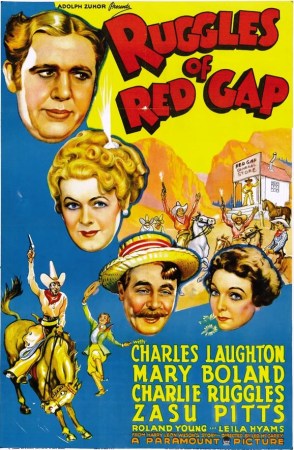
Lisa Watches An Oscar Nominee: Ruggles of Red Gap (dir by Leo McCarey)


Ruggles_of_red_gap

After watching Barry Lyndon, I decided to continue to explore my DVR by watching another film that was shown as a part of TCM’s 31 Days of Oscar.

First released way back in 1935, Ruggles of Red Gap was nominated for best picture but it lost to Mutiny of the Bounty.  Interestingly enough, both Ruggles and Bounty featured the great Charles Laughton.  In Bounty, Laughton played a tyrannical villain, Capt. Bligh.  In Ruggles, however, Laughton is the film’s hero, a gentle and comedic butler named Marmaduke Ruggles who, after having his contract gambled away in a poker game, finds himself living in the frontier town of Red Gap, Washington.

It’s also interesting to note that Ruggles of Red Gap is one of the few best picture nominees to receive absolutely no other nominations.  To a certain extent, it’s understandable.  Ruggles of Red Gap was made at a time when the Academy had less categories but still nominated ten films for best picture.  As a film, Ruggles mostly serves as a showcase for Charles Laughton but, that year, he received his best actor nomination for his work in Mutiny.  (At that time, there were no supporting categories.  Had there been, it’s likely that Laughton could have received a lead actor nomination for Ruggles and a supporting nomination for Bounty.)  The next time that someone complains that Selma only received two nominations, you remind them that’s one more than Ruggles of Red Gap received.

As for the film itself … well, for a modern audience, the film’s deliberate pace takes some getting used to.  The film’s best moments occur at the start.  Ruggles wakes up one morning to discover that his boss (Roland Young) lost him in a poker game.  Ruggles spends the day meeting and attempting to get used to his new employer, a nouveau riche cowboy named Egbert Floud (Charlie Ruggles).  The joke here, of course, is that Ruggles is stereotypically reserved and British while Egbert is loud, brash, and American.  Ruggles lives his life by the rules of the class system.  Egbert comes from a world where there is no class and everyone is equal.  Ruggles refuses to call Egbert by his first name.  Egbert gets Ruggles drunk.  The scenes of Egbert and Ruggles in Europe are a lot of fun, largely because the two actors were obviously having a lot of fun playing off each other and Laughton clearly relished getting to play comedy as opposed to villainy.

The second half of the film features Ruggles settling into life in Red Gap, Washington.  The citizens of Red Gap are, of course, all honest and hard-working folks who don’t have the slightest hint of pretension.  (Red Gap may have been in Washington but it was obviously nowhere close to Seattle.)  They welcome Ruggles into the community but they also mistake him for being a colonel and soon, everyone is under the impression that Ruggles himself is a war hero.  It’s an odd subplot, one that doesn’t seem to really be necessary to make the film’s point.

And that point, by the way, is that America is a land where everyone is equal and where butlers have the same rights as their employers.  Ruggles goes from being somewhat horrified by his new surrounding to being a proud American, an entrepreneur who is now capable of being his own man.  And it may sound corny and I’m sure all of my cynical friends are rolling their eyes but you know what?  Charles Laughton pulled it off.  As uneven as the film may sometimes be, Laughton’s sincere performance holds it all together.  He’s the main reason to watch Ruggles of Red Gap.

How proud of an American does Ruggles become?  He’s enough of an American that he can even recite the Gettysburg address!  Watch below!