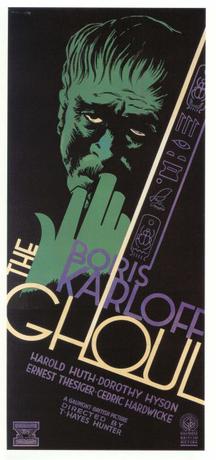
Horror Film Review: The Ghoul (dir by T. Hayes Hunter)


Some actors can make just about anything worth watching.  That’s certainly the case with Boris Karloff and 1933’s The Ghoul.

In The Ghoul, Karloff plays Prof. Henry Moriant.  The professor is an Egyptologist, a world-renowned expert on the dead.  Moriant is now facing death himself, sick in bed and ranting about how he wants to be treated after he passes.  Nigel Hartley (Ralph Richardson) stops by the mansion while pretending to be a vicar and offers to comfort Prof. Moriant in his last moments.  The butler, Laing (Ernest Thesiger), explains that Moriant has never had much use for traditional religion.  Instead, Moriant believes in the Gods of Egypt.

In death, Moriant wants to be buried with an Egyptian jewel in his hands.  He believes that, after he dies, he will exchange the jewel with the Egyptian God Anubis and he will be reborn with amazing powers.  However, when Moriant passes, Laing keeps the jewel for himself and attempts to hide it from the countess number of people who show up at the mansion, all seeking either the jewel or just information about Moriant’s estate.  Moriant may not have been loved in life but everyone clearly loves his money.

Boris Karloff is not actually in that much of The Ghoul.  He dominates the start of the film, ranting from his deathbed.  And then, towards the end of the film, he rises from the dead and attacks those who he thinks have betrayed him and stolen the jewel.  He’s only onscreen for a few minutes but he dominates those minutes.  Karloff’s screen presence is undeniable.  When he’s in a scene, he’s the only person that you watch.  When he’s not in a scene, you find yourself wondering how long it’s going to take for Karloff to return.

That’s not to say that the other actors in The Ghoul aren’t good.  The cast is full of distinguished names.  Along with Richardson and Thesiger, Cedric Hardwicke, Anthony Bushnell, Dorothy Hyson, and Kathleen Harrison all wander through the mansion and try to avoid getting caught up in Karloff’s vengeance.  Harrison provides the film’s comic relief and I actually enjoyed her flighty performance.  The film itself is so darkly lit and full of so many greedy characters that it was nice to have someone on a totally different wavelength thrown into the mix.  That said, the majority of the actors are stuck with paper-thin characters and aren’t really allowed the time to make much of an impression.  This is Karloff’s film, from the beginning to end.  And while the film itself is definitely a bit creaky, Karloff is always enjoyable to watch.

The Ghoul was made at a time when Karloff, having become a star with Frankenstein, was frustrated with the roles that he was being offered in America.  He returned to his native UK and promptly discovered that he was just as typecast over there as he was in the United States.  For a long time, The Ghoul was believed to be a lost film.  However, in 1968, a copy was discovered in Egypt of all places.  It’s unfortunate that the film itself isn’t better but there’s no denying the power of Karloff the performer.
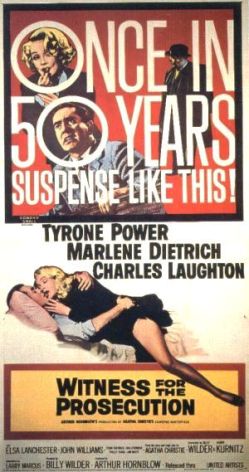
 

Lisa Watches an Oscar Nominee: Witness for the Prosecution (dir by Billy Wilder)


Movie_poster_for_-Witness_for_the_Prosecution-

Earlier today, I DVRed the 1957 best picture nominee, Witness for the Prosecution, off of TCM.  I watched the film as soon as I finished dinner and, having now seen Witness for the Prosecution, I am prepared to give you my professional and erudite review.

Okay, are you ready for it?  Here we go:

🙂 Oh my God, I freaking love this movie!!!!!!!!! 🙂

Witness for the Prosecution is many things.  It’s a courtroom drama.  It’s a domestic comedy.  It’s a twisty murder mystery.  It’s a showcase for three great performers.  It’s crowd pleaser that will make you think and, even if it does involve people killing each other, it will probably make you smile as well.  Don’t let that 1957 date fool you.  Witness For the Prosecution is a lot of fun.

Leonard Vole (Tyrone Power) is a somewhat sleazy man who has two claims to fame.  One is that he claims to be responsible for inventing the egg beater.  The other is that he’s been accused of murdering Mrs. French (Norma Varden), a wealthy widow who had recently named Leonard as the beneficiary of her will.  Everyone assumes that Leonard must have been having an affair with Mrs. French but Leonard claims that he’s innocent.

Suspecting that he is soon going to be arrested, Leonard hires Sir Wilfred Robarts (Charles Laughton) to serve as his attorney.  Though Sir Wilfred is recovering from a heart attack and has been ordered to not take on any more stressful criminal cases, he agrees to defend Leonard.  He proceeds to do just that, under the watchful eye of his nurse, the protective Mrs. Plimsoll (Elsa Lanchester).

(The testy relationship between Sir Wilfred and Mrs. Plimsoll provides the film with its comedic relief.  Laughton and Lanchester were married in real life and, watching the film, you can tell that they had a lot of fun acting opposite each other.)

Sir Wilfred is convinced that he can win acquittal for Leonard, especially since Leonard’s German wife, Christine (Marlene Dietrich), is willing to provide an alibi for him.  (In one of the film’s best moments, Sir Wilfred talks about how distraught Christine will be to discover that Leonard has been arrested just to then have the very calm and self-possessed Christine step into the room.)  However, to everyone’s shock, Christine is called as a witness for the prosecution.  She testifies that Leonard confessed the murder to her and that she only provided an alibi out of fear and love.

Things aren’t looking good for Leonard but then, a mysterious woman with a cockney accent contacts Sir Wilfred and reveals that Christine may have had reasons of her own for not giving Leonard an alibi…

Witness For The Prosecution ends with a voice over that says, “The management of this theater suggests that for the greater entertainment of your friends who have not yet seen the picture, you will not divulge, to anyone, the secret of the ending of Witness for the Prosecution.”  And I have to say that, when I heard that, it just made me love the film even more.  I had enjoyed the film so much and had so much fun following all the twists and the turns of the mystery that I found myself nodding in agreement.

“Sure, 58 year-old voice over,” I said, “I will not divulge the secret ending of Witness For The Prosecution.”

And I’m not going to!  Though, to be honest, you’ll probably guess the secret before it’s revealed.  It’s a plot twist that has been imitated by so many other courtroom dramas that it’s probably not as much of a mind-blower today as it may have been back in 1957.

But no matter!  Witness For The Prosecution is still a lot of fun.  Even if you figure out the mystery early, you can still watch the film and enjoy Laughton’s wonderfully theatrical performance.

Witness for the Prosecution was nominated for best picture and, interestingly enough, another theatrical courtroom drama — 12 Angry Men — was also nominated that year.  It’s interesting to compare the low-key drama of 12 Angry Men to the cheerful flamboyance of Witness For The Prosecution.  They are both great films about the law but each is told from a very different perspective.

Of course, in the end, both of these great films ended up losing to The Bridge On The River Kwai.