Film Review: No Highway In The Sky (dir by Henry Koster)


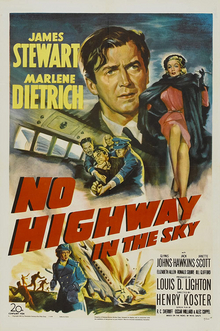
In 1951’s No Highway In The Sky, James Stewart stars as Dr. Theodore Honey.

In many ways, Theodore Honey is similar to the other roles that Stewart played after he returned from serving in World War II.  Dr. Honey is intelligent, plain-spoken, and good-hearted.  He’s eccentric and he sometimes has a difficult time relating to other people.  He’s also deeply troubled.  Dr. Honey is an engineer, one who specializes in determining how many hours an airplane can fly before it starts to fall apart.  Dr. Honey is in England, working for an airline and testing his hypothesis that their newest model’s tail will fall off after the plane accumulates a specific number of hours.  As is usually the case with these things, Dr. Honey’s employers are skeptical about his claims.  There’s a lot of money to be made in air travel and the last thing they need is some eccentric American scaring everyone.

When Honey sets out to investigate a recent crash site, he finds himself on the same type of airplane that he’s been testing.  After the plane takes off, Dr. Honey talks to the pilots and discovers, to his horror, that the plane is closing in on the time limit.  While flight attendant Marjorie Corder (Glynis Johns) tries to keep him calm, Dr. Honey explains his theory to a film star named Monica Teasdale (Marlene Dietrich), who just happens to be a passenger on the flight.  Both Marjorie and Monica find themselves falling in love with Dr. Honey and who can blame them?  He may be an eccentric and it may be hard to follow what he’s talking about but he’s still Jimmy Stewart!

I’ve often thought that Stewart was “Jimmy” before World War II but he was definitely James afterwards.  Stewart, unlike a lot of Hollywood stars who enlisted and were then used solely for PR purposes, actually flew several combat missions and saw firsthand the devastation of the war.  He returned to America deeply disturbed by what he had seen and there’s a definite sense of melancholy to be found in all of Stewart’s post-war performances.  That’s certainly the case here.  Dr. Honey is a widower, his wife having been killed by a rocket attack during the war.  He’s raising his 12 year-old daughter on his own and he deals with his sadness by throwing himself into his work.  He’s someone who has seen and experienced great tragedy firsthand and it’s left him more than a little obsessed. There’s a very authentic sadness at the heart of Stewart’s performance and it elevates this film, making what could have been a by-the-book corporate thriller into a character study of a man standing at the dawning of a new age, the post-war era of commercial air travel, and saying, “Well, hold on one minute.”

Unfortunately, Honey’s obsessive nature makes it easy for some to dismiss him.  When Dr. Honey purposefully sabotages the plane to keep it from flying again, he finds himself forced to defend his actions.  Can he prove that his theory is true?  And who will he end up falling in love with?  You can probably guess the answers but it doesn’t matter if the latter half of the film is a bit predictable.  James Stewart’s performance carries the film and keeps you watching.

Cleaning Out The DVR #2: The Bridge on the River Kwai (dir by David Lean)


The_Bridge_on_the_River_Kwai_poster

Last night, after I watched Captains Courageous, I continued to clean out the DVR by watching the 1957 film, The Bridge On The River Kwai.

The Bridge On The River Kwai is a great film but it’s not necessarily an easy one to review.  It’s always easier to review a film when you can be snarky and dismissive but The Bridge On The River Kwai is one of the few films that can truly be called great.  Everything about it — from the directing to the cinematography to the script to the acting (especially the acting!) — works.  It’s a 3 hour film that never drags.  It’s a rousing and exciting adventure story that also works as an anti-war film.  As directed by David Lean, it’s probably about as perfect as a film can get.

The Bridge On The River Kwai takes place during World War II and really, it’s two films in one.  One film tells the story of Shears (William Holden), a POW at a Japanese prison of war camp in what was then Burma and what is now Myanmar.  Knowing that, under the rules of the Geneva Convention, officers are exempt from manual labor, Shears pretends to be a commander.  However, when the camp’s commandant, the harsh Col. Saito (Sessue Hayakawa), announces the all prisoners — regardless of rank — will have to build a railway bridge over the River Kwai, Shears manages to escape.  With the help of local villagers, Shears makes it to an Allied hospital.

It’s at the hospital that Shears has a two-scene romance with a nurse because the film’s producer, Sam Spiegel, was worried that the film was too male dominated.  It’s also at the hospital that Shears is informed that he will be returning to the POW camp, with a group of British commandos, on a mission to destroy the bridge.  When Shears explains that he’s not even an officer, British Maj. Warden (Jack Hawkins) explains that’s why the Americans have agreed to let the British use Shears for their mission.

The film’s 2nd storyline deals with Col. Nicholson (Alec Guinness), the senior British officer at the POW camp.  When we first meet Nicholson, he’s in a battle of wills with Saito.  When Nicholson insists that no officer will work on the bridge, Saito first forces all of the British officers to spend an entire day standing in the heat.  When that doesn’t work, Saito has Nicholson locked in an iron box.  However, Nicholson refuses to back down and becomes a hero to the other prisoners.  Realizing that the bridge will never be finished on time and that he will be required to commit suicide because of his failure, Saito decides to take a different approach to dealing with Nicholson.

After releasing Nicholson from the iron box, Saito shows him the poor job that the British prisoners have been doing on the bridge.  Saito appeals to Nicholson’s vanity.

And it turns out that Col. Nicholson is a very vain man indeed.

Soon, Nicholson is ordering his men to do a good job on the bridge, announcing that they are going to show the Japanese what the British can accomplish.  Nicholson claims that the project will be a morale booster and that the bridge will be a permanent monument to British ingenuity.

This part of the film is an unexpectedly nuanced character study and Guinness gives a brilliant performance.  For the film’s first hour, Nicholson is our hero but then, just as suddenly, he reveals himself to be a far more complicated character and our feelings towards him become much more mixed.  We’re forced to reconsider everything that we previously felt towards him.  Was Nicholson standing up for his men because it was the right thing to do or was he doing it because he desired the camp’s adulation?  His motives are complicated and difficult to figure out and the implications are, at times, rather frightening.  About the only thing that can definitely be said about Nicholson is that he becomes so obsessed with showing what the British can do that he loses sight of what the Japanese are going to do with that bridge once it is complted. Nicholson’s short-sightedness become a metaphor for blind nationalism and war in general.

When these two storylines finally intersect, it leads to one of the most justifiably climaxes in cinema history, one that leads one of the film’s few surviving characters to exclaim, “The madness, the madness!”

As I mentioned earlier, The Bridge On The River Kwai won the Oscar for best picture and for once, not even I can disagree with the Academy.

Lisa Watches An Oscar Winner: Ben-Hur (dir by William Wyler)


Ben-Hur

I’m actually kind of upset with myself because, at one point, I was planning on spending all of February watching TCM’s 31 Days of Oscars and reviewing all of the best picture nominees that showed up on the channel.  Unfortunately, I ended up getting busy with other things (like Shattered Politics, for instance) and it was only tonight that I finally got a chance to sit down and watch TCM.  Oh well, maybe next year! But for now, I’m just going to watch and review as much as I can before the month ends.

With that in mind, I just spent four hours watching the 1959 best picture winner Ben-Hur.

In many ways, Ben-Hur feels like a prototypical best picture winner.  It’s a big epic film that obviously cost a lot to produce and which features a larger-than-life star surrounded by a bunch of a memorable character actors.  It features two spectacular set pieces and some human drama that’s effective without being particularly challenging.  It’s a film that deals with big themes but does so in a rather safe way.  Perhaps not surprisingly, it’s a film that, today, is often dismissed as being old-fashioned and simplistic and yet it’s still a lot of fun to watch.

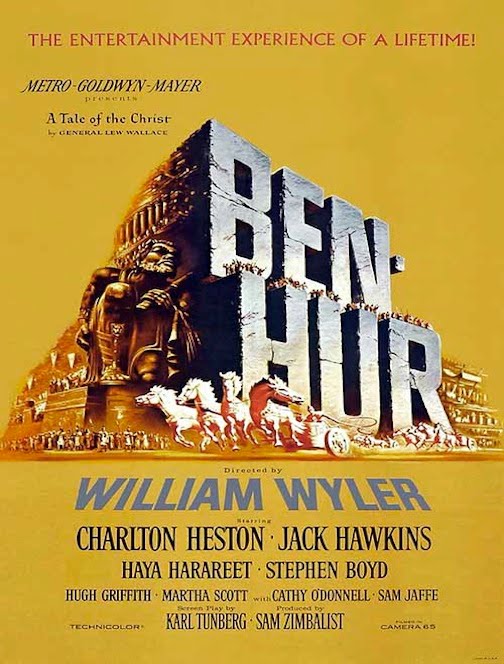
Opening with no less of an event than the birth of Jesus, Ben-Hur tells the story of Judah Ben-Hur (Charlton Heston), a wealthy Jewish aristocrat who, as a young man, was best friends with a Roman named Messala (Stephen Boyd).  When Messala is named as the new commander of the local Roman garrison, he is upset to discover that Ben-Hur is more loyal to his religion than to the Roman Empire.  Feeling personally rejected by his best friend (and perhaps more, as there are a lot of theories about the subtext of their relationship), Massala frames Ben-Hur for the attempted assassination of Judea’s governor.

Over the next 220 minutes, we watch as Ben-Hur goes from being a prisoner to a galley slave to the adopted son of a Roman general (Jack Hawkins) and finally one of the best chariot racers in ancient Rome.  Throughout it all, he remembers a mysterious man who once attempted to give him a sip of water.  Meanwhile, Ben-Hur’s family has been imprisoned and afflicted with leprosy.  Appropriately, for a film that opened with the Nativity, it ends with the Crucifixion, during which Ben-Hur’s struggle to save his family also comes to a climax.

Ben-Hur is undoubtedly flawed film.  (Among the film that were nominated for best picture of 1959, my favorite remains Anatomy of Murder.)  The film runs about an hour too long, some of the supporting actors give performances that are a bit too over-the-top, and the entire film is so reverential that in can be difficult for modern audiences, especially in this age of nonstop irony, to take it seriously.  In the lead role, Charlton Heston is always watchable and has a strong physical presence but you never quite believe that he’s the thinker that the script insists that he is.  There’s nothing subtle about Heston’s performance but, then again, there’s nothing subtle about the film itself.

And yet, if the film struggles to connect on a human level, Ben-Hur still works as a spectacle.  The gigantic sets and the ornate costumes are still impressive to look at.  The film’s two big action sequences — a shipwreck and the chariot race — are still exciting and thrilling to watch.  Ben-Hur may be dated but you can still watch it and understand why it was so popular with audiences in 1959 and, though I may not agree with a lot of the decisions, I can see why the Academy honored Ben-Hur with a record 11 Oscars.  It’s the type of spectacle that, in 1959, could only have been found on the big screen.  By honoring Ben-Hur, the Academy was honoring the relevance of the Hollywood establishment.

In the end, Ben-Hur may not hold up as well as some best picture winners but it’s still worth watching.

http://www.youtube.com/watch?v=enfWkWJZZ5U

Lisa Reviews The Oscar Nominees: Nicholas and Alexandra (dir by Franklin J. Schaffner)


Nicholas_and_Alexandra-831476012-large

(Depending on how much you know about world history, the review below may contain spoilers.)

It was nearly four years ago that I decided that my goal in life was to watch and review every single film — no matter how obscure or potentially disappointing — that had ever been nominated for best picture.  Of course, that’s not my only goal.  If anything, I may have too many, often contradictory goals in my life.  But seeing all of the best picture nominees was definitely one of them and, all these years later, it’s a goal that I’m still trying to achieve.  With the help of TCM and their nonstop schedule of movies made long before I was born, it’s also a goal on which I am slowly but surely making progress.

Last night, as I scrolled through the guide, I noticed that TCM would be showing Nicholas and Alexandra, a three and a half hour film from 1971.  Now normally, I would be hesitant about watching a film that long, if just because I have ADHD and I doubt I’d be able to concentrate on it.  In a theater, watching the action unfold on a big screen, it wouldn’t be a big deal.  However, it’s totally different when you’re talking watching a movie on TV in a house that is full of potential distractions.  Add to that, Wednesday night is when I usually watch shows like Survivor, Hell’s Kitchen, and South Park.

But, here’s the thing.  The title Nicholas and Alexandra sounded familiar to me and not just because I’m an obsessive history nerd.  I did some checking and I discovered that, regardless of how obscure the film may be today, Nicholas and Alexandra was nominated for best picture.  It lost to The French Connection but it was nominated.

So, of course, I had to watch it.

And you know what?
NA

It’s not a terrible movie.  It’s certainly not great.  It has multiple flaws and it’s hard to imagine this film being nominated alongside films like The French Connection, Last Picture Show, and A Clockwork Orange.  Watching the movie, I got the feeling it was probably nominated because it was a big, expensive epic and not because it was one of the best of the year.  But, if you stick with the film (which, if we’re going to be honest here, is much easier said than done), it’s not quite as disappointing as you might expect it to be.

Nicholas and Alexandra tells the story of the last monarch of Russia, Tsar Nicholas II (Michael Jayston).  Struggling to escape the shadow of his father and incapable of understanding what life is like for those not born into royalty, Nicholas is portrayed as being well-meaning but autocratic and blind to the fact that the days of royalty are rapidly coming to an end.  His wife, Alexandra (Janet Susman) is also unpopular with both the Russian citizenry and the royal court on account of being German.

Alexandra spends most her time doting on her youngest son, Alexei, who suffers from hemophilia.  When a flamboyant Serbian monk named Rasputin (Tom Baker) claims that he has the power to heal Alexei, Alexandra immediately brings him into the court.  Soon, rumors are flying across Russia about Rasputin’s relationship with Alexandra.

Meanwhile, men with names like Lenin (Michael Bryant), Trotsky (Brian Cox), and Stalin (James Hazeldine) are plotting to lead a “worker’s revolution…”

If you know anything about history, it’s not really a spoiler to reveal what happens in the second half of Nicholas and Alexandra.  (And if you’re not into history, you probably would not have any interest in watching the movie in the first place.)   Archduke Franz Ferdinand is assassinated, plunging the entire world into war.  Russia declares war on Germany and the German-born Alexandra becomes even more unpopular than before.  The rest of the royal court, jealous over the mad monk’s influence, plots against Rasputin.  The Tsar is forced from the throne and Nicholas and his family spend their last days as captives of the people they once ruled.  Now a powerless prisoner, Nicholas finally starts to understand the world beyond his palace walls.  However, in the end, Nicholas, Alexandra, their children, and their loyal servants are taken into a small room and violently executed.  End of movie.

NA2

So, there are a lot of things wrong with Nicholas and Alexandra.  Not the least of the film’s problem is an unwieldy length and generally slow pace.  (The film was directed by Franklin J. Schaffner, who also directed the still-fun original Planet of the Apes.  Little of the flair he brought to Planet of the Apes is present here.)  This is one of those films that is full of incident with various characters popping up and discussing the intricacies of international politics with little concern as to whether or not any of this is the least bit cinematic or even compelling on a narrative level.  The film has a huge cast but very few memorable characters.

Even worse is that neither Nicholas nor Alexandra never come across as being all that interesting.  The film makes the case that Nicholas’s downfall was largely a result of him being unlucky enough to rule at a time when people across Europe and Asia were rejecting the old ways for the new ways of revolution and industrialization.  Nicholas is continually portrayed as being well-meaning but isolated and that has the potential to be interesting but, at times, the film feels almost as emotionally detached as its characters.

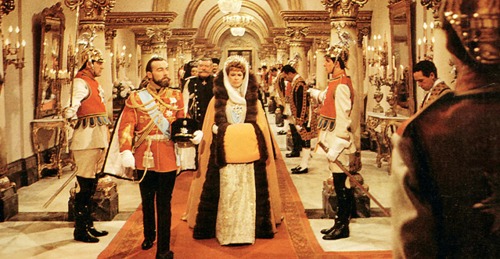
That said, Nicholas and Alexandra does work as a spectacle, as a showcase for beautiful clothing and ornate scenery.  As a character study, Nicholas and Alexandra largely fails but, as a fashion show, it’s actually a lot of fun.    Early on in the film, there’s a lengthy sequence in which Nicholas and Alexandra walk down the red-carpeted hallways of their palace.  It’s shot through Nicholas’s eyes and we see a collection of guards and noblemen and women standing to the side and bowing their heads as the Tsar and his wife walk past.  It’s a good scene and one that perfectly shows not only the life that Nicholas is used to but also why Nicholas doesn’t want to change that life.

baktna03

Perhaps not surprisingly, the first two hours of Nicholas and Alexandra work best when they focus on the flamboyant character of Rasputin.  Baker does a really go job as Rasputin, delivering all of his lines with a ferocious intensity while staring with obviously unhinged eyes.  When he’s with Alexandra, Rasputin is calculating and coldly conniving, providing just enough comfort to keep her under his control.  When he’s with Nicholas or any of the other male members of the court, he reveals himself to be an arrogant libertine, making profane jokes and bragging about his conquests.  It’s a really good performance but, as with so many other good performances in this film, it occasionally gets lost in the film’s dense production.

The best moments of Nicholas and Alexandra come towards the end, with the humbled Nicholas finally revealing his humanity and the Tsar’s family struggling to maintain their dignity even as their inevitable fate approaches.  At this point, the performers came to life.  The film suddenly had an emotional resonance.  It finally became about something!  For those final 20 or so minutes, Nicholas and Alexandra suddenly seemed worthy of being awarded.

In fact, based on those final 20 minutes, I would even be willing to see a sequel called Nicholas and Alexandra and Rasputin Makes Three.  

(Though I’m not sure how that sequel could ever be made.  As @Kev1Media pointed out when I suggested it on twitter, Adam Sandler would have to be somehow involved.)

As for Nicholas and Alexandra, it’s not a great film but if you’re into history or you’re an Oscar completist like me, the film has its occasional charms.  You just have to be willing to look for them.

Nicholas and Alexandra