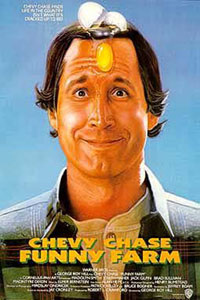
Funny Farm (1988, directed by George Roy Hill)


Andy Farmer (Chevy Chase) is a New York sports writer who leaves the city and moves to the small town of Rosebud, Vermont so that he can work on his novel.  He and his wife, Elizabeth (Madolyn Smith), struggle to adjust to living in a small town.  The delivery of their furniture is delayed by the collapse of a covered bridge.  When they try to make a phone call from inside their own house, the local operator tells them to deposit ten cents.  They were expecting a Norman Rockwell-type town and instead, they find themselves having to pay for the funeral of a man who was buried on their property long before they moved in.  When Elizabeth makes more progress writing a children’s book than Andy does with his heist novel, their marriage starts to feel the strain.

Chevy Chase is now so much better known for the stories of his unprofessional and diva-like behavior on film and television sets that it’s easy to forget that he was, at his peak, a very funny actor.  Chase may be playing a variation of his put-upon everyman but, compared to the first two Vacation movies, most of the humor in Funny Farm is very mild.  George Roy Hill was a classy director who had been making movies since the 50s and Funny Farm feels like a throwback to the type of family-friendly comedies that Disney would make in the 60s.  That I laughed as much as I did was largely due to Chase’s performance.  Whether he was tripping over a Dutch door, reacting to his wife’s dislike of the first few chapters of his new novel, or offering to pay the townspeople $50 to pretend to be nice for a weekend, Chase was consistently funny and even likable.  I don’t know if this is the type of performance that Chevy Chase could give today.  There’s a bitterness that’s now integral to screen persona and it’s made him into someone who audience want to laugh at instead of with.  It’s too bad because Funny Farm is a reminder of the type of comedic actor that Chevy Chase used to be and who he probably still could be if not for the failed talk show and the infamous Friar’s Club roast.

As for Funny Farm, it’s an amusing and likable comedy and it still holds up well today.  Chase is the key to the film’s success but he’s not the only reason that the film works.  I liked the scene where Mike Starr and Glenn Plummer, as the two movers, watch as the bridge they tried to drive over collapses.  I even liked the running joke about the two ducks who refused to leave the Farmers’s property.  Funny Farm may not have been a hit when it was first released but it’s since built up a cult following.  There will always be a place for a funny comedy that leaves you in a good mood.

Love on the Shattered Lens: Something Wild (dir by Jonathan Demme)


1986’s Something Wild opens with Charlie Driggs (Jeff Daniels) eating lunch in a New York diner.

Charlie is a stockbroker.  He wears a suit.  He’s quiet and mild-mannered.  He just got a promotion at work.  He carries a picture of his kids in his wallet.  Everything about Charlie shouts that he’s a nice guy who is extremely conventional in his outlook and behavior.  But then, Charlie sneaks out of the diner without paying and is spotted by a woman (Melanie Griffith) who says that her name is Lulu.

Dressed in black and with a brunette bob that makes her look like Louis Brooks (and which is later revealed to be a wig), Lulu chases after Charlie.  She offers him a ride back to his job, downtown.  However, when Charlie gets in the car, Lulu instead speeds off towards New Jersey.  Lulu grabs Charlie beeper and throws it away.  (I guess that was the 80s equivalent of stealing someone’s phone.)  She stops off at a liquor store and robs the place while Charlie unknowingly waits out in the car.  She takes him to a motel and, after handcuffing to the bed, has sex with him and calls his office….

And then the film takes an unexpected turn.  What started out as one of those NSFW stories that occasionally cropped up on Internet message boards suddenly turns into a quirky slice of Americana.  Lulu and Charlie head to Pennsylvania for Lulu’s high school reunion.  Lulu reveals that her real name is Audrey and she’s actually blonde.  Audrey introduces Charlie to her family as being her husband and Charlie plays along with her.  At the reunion, Charlie turns out to be just as skillful a liar as Audrey.  But there’s nothing particularly mean-spirited about their lies.  Audrey wanted to be able to brag about having a wonderful husband at her reunion and Charlie, whose wife left him for a dentist, wanted to pretend that he was still married and still a regular part of his children’s lives.  The reunion itself is a masterful set piece, one in which director Jonathan Demme balances his trademark quirky humor with a genuine love for small town American.  With the old school bands playing in front of an American flag, Demme transforms the reunion into a metaphor for everything good about this country.  It’s a place where two lonely people can find each other.  The weekend may have started out like a middle-aged man’s fantasy but Charlie finds himself falling in love with the real Audrey.  It’s very sweet and humorous and it makes you feel good about life in general….

And then Ray shows up and the film takes another unexpected turn.  Played by Ray Liotta, Ray is Audrey’s ex-husband.  He’s a charmer, as one might expect from a character played by a young Ray Liotta.  Ray is friendly with Charlie, telling him stories about how wild Audrey was in high school.  It’s only as the night progresses that it becomes obvious that Ray is a sadistic sociopath and he wants Audrey back.

The violence in the film’s second half is a bit jarring.  After the good-natured, screwball comedy of the film’s first 50 minutes, it’s shocking to suddenly see Ray pistol-whipping a clerk and then breaking Charlie’s nose.  At the same time, meeting Ray allows us to know what it was that attracted Audrey to Charlie.  Charlie is the opposite of Ray, a good man who truly cares about other people.  Ray is the type of bad boy who is very attractive when you don’t know any better.  Charlie is the guy who seems conventional but, underneath it all, turns out to be something wild as well.

Directed by Jonathan Demme, Something Wild has a good eye for the quirkiness of America.  It portrays the world out of New York with love and none of the condescension that tends to show up in so many other road trip movies.  Daniels, Griffith, and the much-missed Ray Liotta all gives performance that take the viewer by surprise.  None of them are who we originally assume them to be and Griffith’s deconstruction of the type of character who would later be termed a “manic pixie dream girl” is probably her best and most honest performance.  Even Ray, for all his violent tendencies, has moments of humanity.  Something Wild is a celebration of life, rebellion, and love.  Like Charlie and Audrey, it’s more than worth taking a chance on.

White Mile (1994, Directed by Robert Butler)


In this HBO movie, Alan Alda plays the biggest asshole in the world.

Alda is cast as Dan Cutler, an ad exec who books a corporate retreat to Canada’s White Mile.  He tells the nine men who accompany him, some of whom are clients and some of whom work for him, that it’s going to be a weekend of fishing and male bonding.  What he doesn’t reveal is that the trip is also going to require whitewater rafting.  Despite the fact that the majority of the men are out-of-shape and hardly any of them have any rafting experience, Dan insists that they all take part.  When their guide says that they’re going to need to take two boats, Dan refuses.  He wants everyone in one boat, the better so they can all work together to prove their manhood by conquering the river.

The trip starts out well but, when the raft hits a rock and turns over, five of the men end up dead.  Despite injuring his leg, Dan survives and, when he returns to work, he’s hailed as a hero.  However, one of the widows of the men who didn’t survive is now suing the company.  While Dan tries to cover his own ass, one of the survivors — Jack Robbins (Peter Gallagher) — is faced with a dilemma of his own.  As one of the few people who knows that Dan demanded that the guide only use one boat, will Jack testify to the truth at the trial or will he follow Dan’s orders and keep quiet about what really happened?

Based on a true story, White Mile features some brief but exciting (and harrowing) rafting scenes but the film is less about what happened in the wilderness and instead about what’s happening behind the closed doors of corporate America.  White Mile does a good job of taking Alda’s sensitive male persona and pushing it through the looking glass.  As played by Alda, Dan is the type of tyrannical boss who we’ve all had to deal with.  His friendly smile barely disguises a bullying streak.  Even after the accident leaves five of his colleagues dead, Dan is still convinced that the trip was a good idea and that everyone was having the best day of their lives until they hit that rock.  When the river guide initially finds Dan stranded on a rock, Dan makes a show of telling the guide to come back for him later and to find the others.  When Dan later comes across one of the dead men, he says, “He must have had a bad heart,” as he grasps at any way to avoid taking responsibility.  Though White Mile is dominated by Alda’s villainy, it also features good performances from Gallagher, Robert Loggia, Bruce Altman, and Jack Gilipin.  When Gilpin demands to know if anyone at the ad agency has shown any true remorse for what happened, he is speaking for the entire audience.

White Mile was an early HBO film and, because it was released before HBO became known for its original programming, it’s often unfairly overlooked.  When it was released on DVD, it was advertised as being an action-adventure film, which it definitely is not.  Instead, it’s a look at the type of head games that far too often act as a substitute for responsible and ethical management in corporate America.  It’s a good movie and you’ll never look at Alan Alda the same way again.

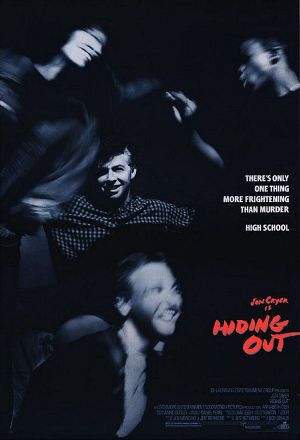
A Movie A Day #342: Hiding Out (1987, directed by Bob Giraldi)


Andrew Morenski (Jon Cryer) is a stockbroker in the 1980s.  What could be better than handling large amount of money during the decade of excess, right?  The only problem is that Andrew and two of his colleagues have gotten involved with Mafia.  And now, the Mafia wants them all dead.  On the run from both the FBI and the Mob, Andrew tries to change his appearance.  He shaves off his beard.  He gives himself a bad dye job.  No sooner has Andrew traded clothes with a homeless person than he is mistaken for a high school student.

What better place could there be for Andrew to hide than a high school?  Despite being 29 years old, Andrew fits right in and soon becomes one of the most popular students at the school.  Andrew not only gets a girlfriend (Annabeth Gish) but he is even nominated to run for student body president.  As Andrew discovers, the mob may be ruthless but they’re nothing compared to the student council.

Hiding Out may begin like a violent action thriller but it quickly reveals itself to be yet another John Hughes-influenced high school movie.  Andrew starts out as a sleazy stockbroker but, by the end of the movie, he has transformed himself into Ferris Bueller.  After spending his teenage years as a self-described “short, horny, hopeless dork,” Andrew is finally getting his chance to be cool.  (“Well, I’m not short,” Andrew says.)  The best scenes are the ones where Andrew occasionally forgets that he’s just supposed to be an apathetic teenager, like when he gets into a fierce argument with his history teacher over whether Richard Nixon should have been forced out of office or when he meets his girlfriend’s father and ends up giving him stock advice.  There’s no denying that the plot is frequently dumb and features some massive plot holes but, largely due to Jon Cryer’s likable and energetic performance, Hiding Out is also a breezy and enjoyable movie.