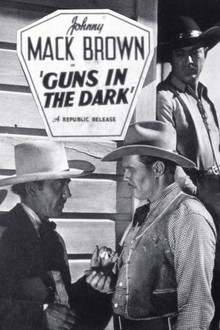
Guns In The Dark (1937, directed by Sam Newfield)


In Mexico, two American cowboys, Johnny Darrel (Johnny Mack Brown) and Dick Martin (Julian Madison) join a poker game to try to win some money and help out their buddy, Oscar (Sid Saylor).  When they discover that cantina owner Manuel Mendez (Ted Adams) has rigged the game, a fight breaks out.  The lights turn off.  In the darkness, several guns are fired.  When the lights come back up, Dick is dead.  Mendez convinces Johnny that he accidentally shot his friend in the fight.  Guilt-stricken, Johnny tosses aside his guns and returns to Texas.

Johnny has sworn that he will never shoot another gun but when he’s hired to work at a ranch owned by Joan Williams (Claire Rochelle), he finds himself in the middle of a range war between Joan and Brace Stevens (Dick Curtis), with Mendez also making an unwelcome return to Johnny’s life.  Even after Johnny discovers the truth about what happened that night at the cantina, he doesn’t pick up a gun.  Instead, Johnny fights the bad guys with lassos and plates.

Guns In The Dark is only 54 minutes long and it features actors who will be familiar to any fan of the old B-westerns.  Sidekcick Sid Saylor’s stuttering schtick gets old quickly but Johnny Mack Brown is as likable as always in Guns In The Dark and he comes across as being an authentic cowboy even when he’s not carrying a gun  Given that this film features even more horse chases than the typical Johnny Mack Brown b-western, it’s good that Brown is so convincing.  What isn’t convincing is how stupid Johnny Darrel is required to be in order for him to fall for Mendez’s lie in the first place.  I appreciated the change of pace from Brown just using a gun to stop the bad guys but I wish the reason behind it had been more convincing.  This isn’t one of Johnny Mack Brown’s more memorable westerns though, as always, it’s easy to see why he was one of the early stars of the genre.


Roaring Rangers (1946, directed by Ray Nazarro)


Another frontier town is in trouble.

Sherriff Jeff Conner (Jack Rockwell) is having trouble ridding his town of outlaws so his son, Larry, (Mickey Kuhn) writes a letter to his hero to ask for help.  He addresses the letter to “Durango Kid, Texas.”  That’s all it takes for Steve Randall (Charles Starrett) and his sidekick, Smiley Burnette, to show up in town.

Steve and Smiley apply to be deputies but Sheriff Conner explains that someone is circulating a petition to get him fired.  Steve dresses up as the Durango Kid and pressures the citizens to give the Sheriff another chance.  Realizing that the Durango Kid is making them look bad, the outlaws decide to dress up one of their own as Durango and make the Kid look bad.  With the town turning on Durango, will Durango and Smiley be able to save Sheriff Conner from an assassination attempt?

This Durango Kid film is different from the rest of the series in that, for once, Steve is hired to be a deputy instead of a sheriff.  This really is Sheriff Conner’s story, as he tries to win the respect of the town and keep its citizens safe, even while his own brother (Ed Cassidy) is working with the outlaws.  There are all the usual horse chase and shootouts but this time, Durango and Smiley are mostly around to provide support to a man who is trying to do the right thing.  B-western fans will enjoy it.

Smiley sings a few songs, as always.  This time, musical accompaniment is provided by Merle Travis and his Bronco Busters.

The Desert Horseman (1946, directed by Ray Nazarro)


Steve Godfrey (Charles Starrett) is in trouble again.  He has been accused of stealing another payroll and the only man who can clear his name has just been murdered.  Steve thinks that he is being set up by outlaws who want to take control of the dead man’s ranch, which is now owned by Mary Ann Jarvis (Adele Roberts).

Luckily, Steve’s old friend, Smiley Burnette, is working as a cook at the Jarvis Ranch.  When Smiley isn’t singing songs with the Colorado Hillbillies, he tries to help Steve clear his name.  He explains that Mary Ann Jarvis won’t listen to Steve but maybe she’ll listen to Steve’s alter ego, The Durango Kid!

Durango rides again in this movie, though, the majority of the hour runtime is made up of Smiley Burnette singing songs and making jokes.  Smiley Burnette is not for everyone.  I enjoy the broad humor he brought to these films but I can understand why others might not.  Whenever Smiley sings a song, it does bring the action to a halt but that’s true of every Durango Kid film.  If you’re a fan of the series, you either like Smiley or you can at least tolerate him.  Smiley does do more than just sing in this movie.  He also throws black pepper in the eyes of one of the bad guys.

Even with all of the attention paid to Smiley, The Desert Horseman delivers all of the expected horse chases and gunfights.  The story is a little more interesting than usual.  Steve has been framed for not one but two crimes that he didn’t commit and that adds some urgency to the proceedings.  Charles Starrett, as always, is a believable western hero and he takes the role seriously.