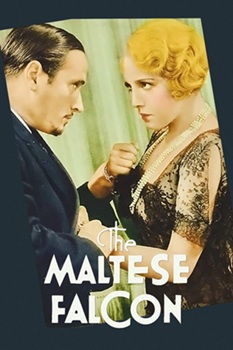
The Maltese Falcon (1931, directed by Roy Del Ruth)


Detective Sam Spade (Ricardo Cortez) may be an immoral lech but when his partner, Miles Archer, is murdered, Sam sets out to not only figure out who did it but to also eliminate himself as a suspect.  Sam was having an affair with Miles’s wife, Ivy (Thelma Todd).  Sam’s investigation leads to him falling for the mysterious Miss Wonderly (Bebe Daniels) and getting involved with a trio of flamboyant criminals who are searching for a famous relic, the Maltese Falcon.  Dudley Digges plays Casper Gutman.  Otto Matieson plays Dr. Joel Cairo.  Dwight Frye plays the gunsel, Wilmer, who Gutman says he “loves … like a son.”

The first film adaptation of Dashiell Hammett’s classic detective novel is overshadowed by the version that John Huston would direct ten years later.  That’s not surprising.  There’s a lot of good things about the first version but it’s never as lively than John Huston’s version and neither Dudley Digges nor Otto Matieson can compare to Sydney Greenstreet and Peter Lorre.  Of the supporting cast, Dwight Frye makes the best impression as the twitchy Wilmer and Bebe Daniels and Thelma Todd are both sexy as the story’s femme fatales.  That doesn’t mean that they’re better than their counterparts in John Huston’s film.  It just means they all bring a different energy to their roles and it’s interesting to see how the same story can be changed by just taking a slightly different approach.  Elisha Cook, Jr. was perfect for Huston’s version of the story.  Dwight Frye is similarly perfect for Roy Del Ruth’s version.

Needless to say, Ricardo Cortez can’t really compare to Humphrey Bogart.  But, if you can somehow block the memory of Bogart in the role from your mind, Cortez actually does give a good performance as Spade.  Because this was a pre-code film, Cortez can lean more into Spade’s sleaziness than Bogart could.  Also, because this was a pre-code film, the first Maltese Falcon doesn’t have to be as circumspect about the story’s subtext.  Spade obviously tries to sleep with every woman he meets and is first seen letting a woman out of his office.  (The woman stops to straighten her stockings.)  Gutman and Cairo’s relationship with Wilmer becomes much more obvious as well.  What’s strange is that, even though this Maltese Falcon is pre-code, it still ends with the type of ending that you would expect the production code to force onto a film like this.

If you’re going to watch The Maltese Falcon, the Huston version is the one to go with.  But the first version isn’t bad and it’s worth watching for comparison.

30 Days of Noir #22: Woman On The Run (dir by Norman Foster)


Like many film noirs, this 1950 film opens with a murder.

On a dark night in San Francisco, a man attempts to blackmail an unseen person called “Danny Boy” and gets shot for his trouble.  The gunshot is heard by a frustrated painter, named Frank Johnson (Ross Elliott), who is out walking his dog.  Frank sees the dead body being pushed out of a car and then catches a shadowy glimpse of the killer.  When the killer open fires on him, Frank runs for it.

Like a good citizen, Frank goes to the police but, when he learns that the victim was due to testify against a local gangster, Frank panics and vanishes.  When Inspector Ferris (Robert Keith) goes to see Frank’s wife, Eleanor (Ann Sheridan), he’s shocked to discover that Eleanor isn’t shocked by Frank’s disappearance and that she doesn’t seem to care one way or the other.  As Eleanor explains it, Frank is a notorious coward and, years ago, their once strong marriage became a loveless charade.  Frank’s vanished and Eleanor doesn’t care.

Or does she?

While it quickly becomes obvious that Eleanor is telling the truth about not knowing where Frank is, she’s not being totally honest about no longer caring about him.  For instance, when she learns that Frank has been hiding a heart condition from her, Eleanor goes to the doctor to pick up his medicine, just in case he should happen to come by the house.  Of course, it’s not always easy to get out of the house, especially now that the police are watching Eleanor.

Eleanor wants to track down Frank without involving the police and it seems like there’s only one person who is interested in helping he do that..  Played by Dennis O’Keefe, this person is a tough reporter and he says that he wants to do an exclusive story on Frank.  He offers to help Eleanor track him down and he even says that he’ll pay $1,000 for the chance to interview Frank.  The reporter and Eleanor are soon searching San Francisco, retracing Frank’s day-to-day life and discovering that Frank loved Eleanor more than she ever realized….

What’s that?  Oh, did I forget to mention the reporter’s name?

His name is Danny.

That’s right.  Eleanor is trying to find Frank so that she can save his life and working with her is the one man who wants to kill him!

Needless to say, this leads to a great deal of suspense.  On the one hand, you’re happy that Eleanor is rediscovering how much she loves Frank.  On the other hand, you spend almost the entire movie worried that Eleanor is going to lead Danny right to him.  Shot on location in San Francisco and featuring all of the dark shadows and tough dialogue that one could possibly hope to get in a film noir, Woman On The Run is an underrated suspense gem.  Full of atmosphere and steadily building suspense, Woman on the Run features a great and acerbic performance from Ann Sheridan and a genuinely exciting climax that’s set at a local amusement park.  Seriously, roller coasters are super scary!

Woman on the Run was directed by Norman Foster.  If you’ve recently watched The Other Side of the Wind on Netflix, you might recognize the name.  A longtime friend of Orson Welles, Foster played the role of Billy Boyle in Welles’s final film.

Lisa Marie Reviews An Oscar Nominee: In Old Arizona (dir by Raoul Walsh and Irving Cummings)


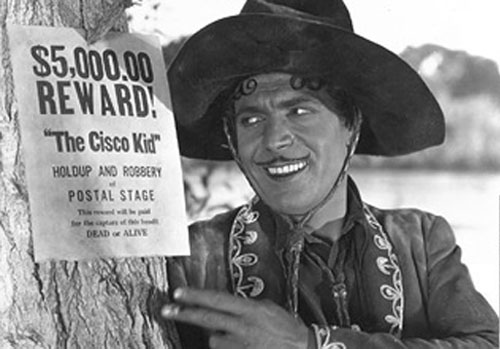
in-old-arizona-warner-baxter

Since the Oscars are approaching, I thought I would devote February to continuing my never-ending quest to watch and review every single film nominated for best picture!

With that in mind, I recently watched the 1928 film In Old Arizona.  In Old Arizona is a bit of an oddity in Oscar history.  Even though it is considered to have been a best picture nominee, it was never officially nominated.  In fact, in 1929, there were no official nominees.  Instead, the Academy simply announced the names of the winners.  The winners were selected by a small committee of judges.  The committee’s intentions are particularly obvious when you notice that not one film won more than one Oscar in 1929.  At a time when the industry was struggling to make the transition from silent film to the talkies, the 1929 Oscars were all about spreading the wealth and reassuring everyone that they were doing worthwhile work.  In Old Arizona‘s star, Warner Baxter, was named the year’s best actor while Broadway Melody was declared to have been the best picture.

(At that year’s Oscar ceremony, the second in the Academy’s history, the awards were reportedly handed out in 10 minutes and nobody gave an acceptance speech.  If this all seems strange when compared to the annual extravaganza that we all know and love, consider that Louis B. Mayer originally formed the Academy in order to give the studio bosses the upper hand in a labor dispute.  The awards were largely an afterthought.)

Years later, Oscar historians came across the notes of the committee’s meeting.  The notes listed every other film and performer that the committee considered.  Before settling on Broadway Melody, the committee apparently considered In Old Arizona.  For that reason, In Old Arizona is considered to have been nominated for best picture of the year.

If it seems like I’ve spent a bit more time than necessary discussing the history behind the 1929 Oscars, that’s because In Old Arizona isn’t that interesting of a film.  It was a huge box office success in 1929 and it was an undeniable influence on almost every Western that followed but seen today, it’s an extremely creaky film.  Influential or not, there’s not a scene, character, or performance in In Old Arizona that hasn’t been done better by another western.

Based on a story by O. Henry, In Old Arizona tells the story of a bandit named The Cisco Kid (Warner Baxter).  Cisco may be an outlaw but he’s also a nice guy who enjoys a good laugh and occasionally sings a song while riding his horse across the Arizona landscape.  (California and Utah stood in for Arizona.)  The Cisco Kid may rob stagecoaches but he always does it with a smile.  Besides, he only needs the money so that he can give gifts to his girlfriend, Tonia (Dorothy Burgess).  What the Cisco Kid doesn’t know is that Tonia is bored and frustrated by his frequent absences and she has been cheating on him.  Then she’s approached by Sgt. Mickey Dunn (Edmund Lowe), the big dumb lug who has been ordered to bring the Kid in (dead or alive, of course).  Will Tonia betrayed the Kid?

If you’re watching In Old Arizona and hoping to be entertained, you’ll probably be disappointed.  Almost everything about this film has aged terribly.  Watching the film, it’s obvious that none of the actors had quite figured out how to adapt to the sound era and, as such, all of the performances were very theatrical and overdone.  Probably the easiest to take is Edmund Lowe, who at least managed to deliver his lines without screeching.  Sadly, the same cannot be said of Dorothy Burgess.  As for Warner Baxter, he may have won an Oscar for playing the Cisco Kid but that doesn’t make his acting any easier to take.

And yet, if you’re a history nerd like me, In Old Arizona is worth watching because it really is a time capsule of the era in which it was made.  In Old Arizona was not only the first Western to ever receive an Oscar.  This was also the first all-talking, all-sound picture.  Watching it today, without that knowledge, you might be tempted to wonder why the film lingers so long over seemingly mundane details, like horses walking down a street, the ticking of a clock, a baby crying, or a church bell ringing.  But, if you know the film’s significance, it’s fun to try to put yourself in the shoes of someone watching In Old Arizona in 1929 and, for the first time, realizing that film could not just a visual medium but one of sound as well.  For some members of that 1929 audience, In Old Arizona was probably the first time they ever heard the sound of a horse galloping across the landscape.

(I have to admit that, as a student of American history, I couldn’t help but get excited when one of the characters mentioned President McKinley.  McKinley may be forgotten today but audiences in 1929 would not only remember McKinley but also his tragic assassination.  By mentioning that McKinley was President, In Old Arizona not only reminded audiences that it was taking in the past but that it was also taking place during what would have been considered a more innocent time.  Much as how later movies would use John F. Kennedy as a nostalgic symbol of a more idealistic time, In Old Arizona uses William McKinley.)

In Old Arizona is no longer a particularly entertaining film but, as a historical artifact, it is absolutely fascinating.

Embracing the Melodrama, Part II: Sunrise (dir by F.W. Murnau)


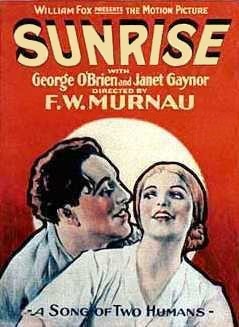
Sunrise_vintage

Last year, I published 60 film reviews under the heading of Embracing the Melodrama.  Embracing the Melodrama was one of the first review series that I had ever done and I had so much fun doing it that I figured, “Why not try it again?”

In other words, welcome to Embracing the Melodrama, Part II!

Over the next three weeks, I will posting, in chronological order, 128 reviews of films that embrace the melodrama.  As before, these reviews will be in chronological order and they will include everything from Oscar winners to grindhouse exploitation to made-for-television dramas.  It should be fun!

And, considering that we’re talking about 128 reviews here, it should at least help me make a dent in my goal to see every single movie that has ever been made.

Let’s start things off by taking a quick look at the 1927 silent film, Sunrise.  Directed by German expressionist F.W. Murnau, Sunrise is widely considered to be one of the greatest films ever made and for once, popular opinion is correct.  The film tells a simple story.  The Woman From The City (Margaret Livingston) takes a vacation out in the country.  (We know she’s dangerous because she wears black lingerie.)  She stands outside of a farmhouse and whistles.  Soon, the Man (George O’Brien) steps out of the farmhouse and joins the Woman.  Inside the farmhouse, the Wife (Janet Gaynor) can only dream of what life was like when she and the Man first fell in love.

The Man and the Woman meet at the edge of the lake and kiss as the moon shines down on them.  They’re having an affair, though the film — in its dream-like way — leaves it ambiguous as to just how long the affair has been going on.  (Indeed, the film almost seems to suggest that The Woman has sprung from the Man’s subconscious, a creation of his darkest desires.)  The Woman wants the Man to murder his wife and come back to the city with her.  At first, the Man refuses but, as the Woman talks to him, he starts to visualize the city.  And, make no mistake about it — the city that the man visualizes is a scary place that resembles the dreamworld of The Cabinet of Dr. Caligari.  But, at the same time, it’s also a lot more fun than the farm.

Now, you may be wondering why this familiar sounding tale is considered to be one of the best films of all time.  The story itself is simple and deliberately allegorical.  The film is less about the story and more about how Murnau tells it.  Murnau fills the screen with hauntingly surreal images that are both beautiful and frightening at the same time.  When the title cards appear on-screen, the lettering literally fades in and out and adds to the entire movie’s dream-like feel.  Watch the scene below where the Woman first suggests killing the Wife and the Man visualizes the city:

Infatuated with the Woman, the Man plans to drown the Wife but, at the last minute, has a change of heart.  The Wife, however, flees to the city herself.  The Man follows her and attempts to win back her love.  The city itself changes when the Man and the Wife are in it together.  What seemed dark and threatening under the influence of the Woman is now revealed to be fun and vibrant.  The film transforms from being an early example of film noir to being a screwball comedy.

How many other films can you think of that feature both a murderous femme fatale and a drunk pig?

And yet, as much joy as the Man and the Wife find in the city, both the farm and the Woman await their eventual return.  And there’s a storm coming…

Interestingly enough, at the first Oscar ceremony, two awards were given for Best Picture of the year.  The first award — for Outstanding Production — went to Wings, a big budget action spectacular about World War I.  The other award — for Unique And Artistic Presentation — went to Sunrise.  I’ve read a lot of speculation about which film the Academy meant to name the best of the year but, to me, it’s fairly obvious that the Academy meant for Outstanding Production to honor the year’s big blockbusters while Unique and Artistic Presentation would honor the “art” films.

And, to be honest, I think that, way back in 1928, the Academy had the right idea.  Why should they only give out one award for best picture, as if all films can be judged by only one standard?  Why not give out separate awards for the best comedy or the best thriller or the best film made for a certain amount of money?  Why not bring back the Oscar for Unique and Artistic Presentation?

For whatever reason, the Academy discontinued the Unique and Artistic Presentation Award after the 1st ceremony and, in the future, only one film would be named best of the year.  Since Outstanding Production eventually become known as Best Picture, Wings has been immortalized as the first film to win best picture.

And, nothing against Wings, but the Academy would have been smarter to have gone with Sunrise.  Certainly, it would have won them the respect of future film students.

You can watch Sunrise below!

http://www.youtube.com/watch?v=GnLVMREVA6M

Shattered Politics #7: Meet John Doe (dir by Frank Capra)


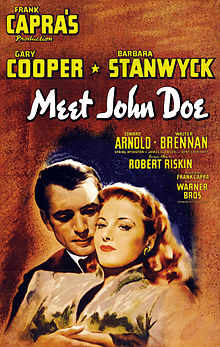
Meet John Doe

I cannot stand the phrase “pay it forward.”

The idea is that somebody does something nice for you and then they say, “Pay it forward” and suddenly, you are magically required to go out and do something nice for someone else.  For one thing, I hate the obligation of it all.  I have this fear that as soon as I finally get finished paying it forward, some stranger is going to hand me a Coke and say, “Pay it forward,” and suddenly I’ll have to do it all over again!  And really, honestly, I shouldn’t have to pay it forward just because someone  gives me a Coke.  If you’re going to tell me to pay it forward, at least give me a car or a Victoria’s Secret gift card or something.

Ultimately, “pay it forward” is something that people say to make themselves feel good but it’s actually a pretty shallow concept.

The same thing can be said about John Doeism, the philosophy that rests at the center of the 1941 film Meet John Doe, our latest entry in Shattered Politics.  John Doeism is a grassroots political movement that is based around the slogan, “Be a Better Neighbor.”  Much like “Pay it forward,” “Be a better neighbor” sounds good and it’s easy to say but its main appeal is that it doesn’t require that much thought.  If anything, it sounds like the first step on the road to serfdom…

That said, I still like the film.

Meet John Doe opens with lay-offs at a major metropolitan newspaper.  (These lay-offs are signified by a handsome young man who points at people and then runs his finger across his throat.)  Among those laid off is columnist Ann Mitchell (Barbara Stanwyck).  However, before Ann is officially let go, she is told to write one final column.  Understandably angry over her treatment, Ann responds by making something up.  She writes and prints a fake letter from a man calling himself “John Doe.”  John Doe explains that he’s unemployed and that he will be committing suicide on Christmas Eve.

Well, quicker than you can say twitter death hoax, everyone in the entire country reads John Doe’s letter and demands to know who he is.  The newspaper’s editor, Henry Connell (James Gleason), rehires Ann and puts her in charge of finding the real John Doe.

When numerous unemployed and homeless men start to show up at the newspaper, claiming to be the real John Doe, little do they realize that they are, in fact, auditioning.  Ann finally decides that Joe Willoughby (Gary Cooper) has what it takes to be the public face of John Doe.  Not only does he have a compelling personal story (he’s a former baseball player whose career was ended by an arm injury) but he looks and sounds like Gary Cooper.

(And, as I typed that last sentence, it suddenly occurred to me that Meet John Doe managed to predict American Idol…)

Joe is soon a celebrity, reading speeches that have been written for him by Ann and encouraging people across the nation to be a better neighbor.  And Ann is falling in love with Joe.  However, Joe is not comfortable with his new role.  For one thing, he doesn’t like being a hero for telling a lie.  Secondly, he knows that rival newsmen are eager to expose him as being a fraud.  And finally, there’s a sinister publisher named D.B. Norton (played by Edward Arnold, who previously played corrupt Boss Taylor in Mr. Smith Goes To Washington) who is eager to be President of the United States.  He wants to turn John Doeism into a fascist political movement and, unless Joe endorses him, he’ll reveal that Joe’s a fraud…

Meet John Doe was Frank Capra’s follow-up to Mr. Smith Goes To Washington.  It features many of the same themes as Mr. Smith, with the main difference being that Meet John Doe is a lot more preachy.  Whereas Mr. Smith saved its big speech for the end, Meet John Doe has several big speeches spread throughout its running time.  (There’s also a scene where a guy named Bert tells the story of how he was inspired by John Doe and, I swear, it literally goes on forever.)

So, no, Meet John Doe is definitely no Mr. Smith Goes Go To Washington but I still liked it, mostly because of the chemistry between Gary Cooper and Barbara Stanwyck.  I wanted to be Barbara Stanwyck’s character.  Seriously, watching a film like Meet John Doe, leaves me convinced that I was born several decades too late.  If I had been born in 1918, I could have been a quick-witted, cynical, and secretly romantic intrepid girl reporter at a major metropolitan newspaper.

Girl Reporter

Even better, I would never have to worry about ever being told to “pay it forward.”