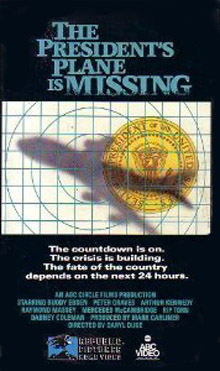
 President Jeremy Harris (Tod Andrews) has a lot on his plate. With America and China inching closer and closer to war, Secretary of State Freeman Sharkey (Raymond Massey) is advocating for diplomacy while National Security Advisor George Oldenburg (Rip Torn) feels that America must be more aggressive and ready to launch the first nuclear missile. Of course, no one pays much attention to Vice President Kermit Madigan (Buddy Ebsen). Kermit is viewed with such contempt that he’s never even been given a briefing on what’s going on with China. However, when Air Force One crashes in the California desert and the President cannot be definitively identified as one of the bodies found in the wreckage, Vice President Madigan finds himself with a very difficult decision to make.
That’s quite a crisis. Personally, though, I’m more interested in how the United States ended up with Secretary of State named Freeman Sharkey. I mean, that’s just an amazing name for a diplomat. Why didn’t they elect that guy President? No one messes with Sharkey!
The majority of 1973’s The President’s Plane Is Missing follows a reporter named Mark Jones (Peter Graves) as he tries to get to the bottom of what has happened to President Harris. As usual, Graves is likably stoic. Mark Jones doesn’t show much emotion but, at the very least, he does seem to be trying to do a good job as an old school journalist. What’s interesting is that Mark has an editor (played by Arthur Kennedy) who is constantly yelling at him and threatening to fire him. There’s something very odd about seeing Peter Graves taking order from someone who isn’t intimidated by him.
Mark Jones does learn the truth about why the President has gone missing and he also learns why he, as the reporter assigned to follow the President, wasn’t allowed to board Air Force One when it initially took off. Unfortunately, the solution is a bit anti-climatic. In fact, it’s so anti-climatic that it’s actually kind of annoying. All of the drama ultimately feels rather unnecessary and pointless.
By today’s standards, The President’s Plane Is Missing is a bit on the dull side. There are so many obvious plot holes that I get the feeling that it was probably a bit boring when it originally aired in 1973 as well. The most interesting thing about the film is that it was directed by Daryl Duke, who also directed Payday, a harrowing film about a self-destructive country-western singer. Rip Torn, the star of Payday, appears here as a calm and collected intellectual who advocates for nuclear war without a hint of ambivalence. Torn is a bit miscast as a man without emotions but it’s still always nice to see him in a film.
Who gives the best performance in The President’s Plane Is Missing? Believe it or not, Buddy Ebsen. Ebsen is totally believable as the vice president who, after years of being ignored, is suddenly thrust into a position of power. I’d vote for Kermit Madigan but only if he wasn’t running against Freeman Sharkey.


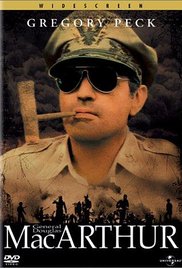 The year is 1962 and Douglas MacArthur (Gregory Peck), the legendary general, visits West Point for one last time. While he meets the graduates and gives his final speech, flashbacks show highlights from MacArthur’s long military career. He leaves and then returns to Philippines. He accepts the Japanese surrender and then helps Japan rebuild and recover from the devastation of the war. He half-heartedly pursues the Presidency and, during the Korean War, gets fired by Harry Truman (Ed Flanders).
 Through the Shattered Lens