Scenes I Love: The Vampire and The Ballerina


I don’t really know much about The Vampire and the Ballerina, other than it was released in 1960 and it’s an Italian film, but — after watching a few clips on YouTube — this movie has become my new Holy Grail.  What that means, of course, is that King Arthur will continue to weaken and Mordred shall continue to conquer England until my freaky, mismatched, Irish eyes catch sight of this movie in its entirety.

If you’ve read enough of my previous posts, you can probably guess why this movie appeals to me.  First off, it’s Italian.  Second off, it apparently features at least one vampire.  And, of course, the main reason is that apparently it’s got something to do with ballet. 

Back when I still thought I was going to grow up to be a professional dancer, I have to admit that I went through a very long period of time where my *ahem* fantasies were pretty much dominated by dark, tortured men with fangs who drank blood to survive.  So just seeing the title The Vampire and The Ballerina is like a serious jolt from the past for me.

(Though from the clips I’ve seen on YouTube, the vampire in question is not exactly material for an erotic interlude…)

Anyway, from what I’ve seen of The Vampire and the Ballerina, here’s the scene I keep coming back to.  Yes, it is a dance sequence but it’s not exactly ballet.  In fact, I have yet to see any signs of ballet in any of the clips I’ve found on YouTube but I figure it must have a ballet subplot.  I mean, titles never mislead!

As for why I like it — well, there’s the endearing quaintness of the fact that leotards and tights were once considered to be daring and risqué.  There’s a shamelessness to it as well that I think perfectly defines everything I love about Italian films.  You can almost hear the director saying, “Did we get her ass in that shot?”  And the dance itself is such a combination of stupid and brilliant that it reminds me — in a good, nostalgia-filled way, of just about every modern dance recital I was ever featured in.

I have to admit that there’s a part of me that wishes I had been alive in 1960 so I could have caught a plane to Italy and been one of these dancers.  Why not?  I love to dance, I’ve been told I have a nice ass, and occasionally, I guess, I do kinda sorta maybe act out just to get attention.   Seriously, with all of that in mind,  I would have been great for this film.  Or, seeing as how I have yet to see the entire film, this sequence.

Unfortunately, I was born a good six decades or so too late.  However, even though it’s too late for me to star in the movie, I still believe that one day soon I will sit down and I will watch an entire, uncut showing of The Vampire and The Ballerina.

And on that day, the fate of England will be determined…
A Quickie With Lisa Marie: Stagefright (dir. by Michele Soavi)


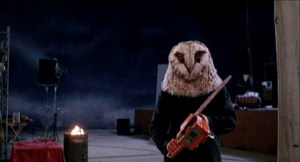
Director Michele Soavi is probably best known for directing the last great Italian horror film, Dellamorte Dellamore.  However, his word in that film has been so praised that, to a certain extent, Soavi’s earlier horror films have been overshadowed.  This is a shame because Soavi was (and is) a great director and — before he temporarily retired from films in the mid-1990s — he directed four of the greatest Italian horror films ever made.  The first of these films (and Soavi’s directorial debut) was the 1987 slasher film Stagefright.

As written by Luigi Montefiore (who, as an actor, was better known as George Eastman), Stagefright’s basic story function almost as a parody of a stereotypical 80s slasher film.  On a dark and stormy night, an eg0-crazed, cocaine-addicted theatrical director (played by David Brandon) is running a rehearsal for his latest show, a campy musical about a fictional serial killer.  However, even as his cast performs fictional mayhem on stage, a real killer escapes from a nearby mental hospital and makes his way to the theater.  After the real killer murders the production’s wardrobe mistress, the director decides it would be a brilliant idea to rewrite his show to make it about the real killer.  Not realizing that the real killer has snuck into the building, the director secretly locks his cast inside the theater and forces them to rehearse his new show.  As you can probably guess, mayhem ensues and blood (a lot of blood) is spilled.

That the film worked (and continues to work over 20 years later) is a tribute to the talent of Michele Soavi.  Obviously understanding that he was working with a genre piece, Soavi embraced the expectations of the slasher film and then pushed those expectations as far as he could.  The end result is a film that works as both an old school slasher film and as a commentary, of sorts, on the genre as a whole.  Soavi’s camera prowls every corner of the film’s theater, creating an atmosphere of truly claustrophobic dread.  To me, the most effective thing about the film is that, for once, our victims actually do the smart thing.  They stick together and try to fight off the killer as a group.  And they end up failing miserably in a scene of horrific choas that shows Soavi at his best.

Soavi started his career as an actor and appeared in a countless number of Italian horror films in the late 70s and early 80s.  (For whatever reason, Soavi always seemed to be getting killed in some awful way…)  Perhaps that’s why, of all the great Italian horror directors, Soavi always seemed to have the best instincts when it came to casting.  For a slasher film, Stagefright is well-acted by a cast made up of horror regulars.  Barbara Cupisti is a properly likable protagonist in the role of “final girl” while the great Giovanni Lombardo Radice does good work in the small role of Brett, a flamboyantly gay actor.  However, the film is dominated by David Brandon who snorts cocaine and barks out orders as if the fate of the world depended upon it.

(Soavi, himself, appears in a small role as an ineffectual policeman who, while people are dying all around, is more concerned with whether or not anyone else agrees that he looks like James Dean.  And, it should be noted, there was a resemblance.)

As opposed to a lot of other directors involved with the Italian horror genre, Soavi had (and, I hope, still has) a genuine love of film and that love is obvious in his stylish direction here.  There’s something truly exhilarating about seeing a movie made by someone who is truly in love with the possibilities of film and, because of that love, has no fear of pushing genre “rules” to their  extreme.

Scenes I Love: Burial Ground: The Nights of Terror


Old school Italian horror films are, often times, a collection of “what the fuck” moments.  Here’s one of my favorite “what-the-fuck” moments from one of the ultimate “what-the-fuck” movies, 1980’s Burial Ground: The Nights of Terror.

(By the way, contrary to rumor, Peter Bark, who plays the kid in this clip, was not a midget.  He was just a really ugly 16 year-old.)

Scenes I Love: Tenebrae


While the goth ballerina side of me will always have a special place in my heart for Suspiria and its two sequels, I think that 1982’s Tenebrae may very well be director Dario Argento’s best film.  Certainly, it was (to date) his last truly great film before he entered the current, frustratingly uneven stage of his career.

Tenebrae was a return to Argento’s giallo roots after the supernatural-themed horror of Suspiria, Zombi, and Inferno.  It was also the work of an audaciously confident director.  That confidence is fully on display in the scene below in which the film’s killer menaces a journalist and her lover.  Featuring a truly impressive tracking shot in which the camera appears to literally swoop in, out, and over a journalists house without a single cut, the scene ends with one of Argento’s more memorable murders.

The music, by the way, is from Goblin.

Scenes I Love: Inferno


Inferno is Dario Argento’s 1980 sequel to SuspiriaInferno seems to bring out the extreme reactions in Argentonians — it’s either loved or hated.  I happen to love it.

Below is one of the film’s best known sequences, the one where Irene Miracle ends up taking a surreal swim through a basement.  To me, this sequence is almost Fulciesque in it’s dream-like approach (punctuated, of course, by one sudden grotesque shock at the end).  Lucio Fulci’s The Beyond, which is often compared to Inferno, featured a similarly flooded basement. 

Words of warning: This scene lasts 6 and a half minutes.  Also, the first few minutes are nearly ruined by Keith Emerson’s bombastic score.  Fortunately, once Miracle takes her fateful dive, Mr. Emerson is silenced.

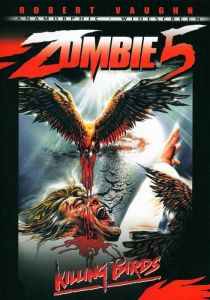
Film Review: Zombie 5: Killing Birds (dir. by Claudio Lattanzi and Joe D’Amato)


Thanks to the wonderful people at Anchor Bay, I recently watched Zombie 5: Killing Birds, one of the last of the old school Italian horror films.

Admittedly, when I first hit play on the DVD player, I was expecting the worst.  Of all the various official and unofficial sequels to Lucio Fulci’s masterpiece Zombi 2 (which, of course, was itself an unofficial prequel to Dawn of the Dead), Zombie 5: Killing Birds has the worst reputation.  While most Italian horror fans seem to agree that Zombie 4 is enjoyable on its own stupid terms and even Zombi 3 has a few brave defenders, its hard to find anyone willing to defend Killing Birds.  The general consensus has always seemed to be that Killing Birds is a generic and rather forgettable splatter film that, title aside, had absolutely nothing in common with the Fulci classic.

Having now seen Killing Birds, I can say that the general consensus, in this case, is largely correct.  Killing Birds is generic, predictable, and ultimately forgettable.  However, taken on its own terms, it’s a perfectly enjoyable way for a lover of zombie cinema to waste 90 minutes.  As long as you don’t compare it to Zombi 2, i’ts a perfectly tolerable piece of trash that actually has one or two memorable moments tossed randomly through its running time.  At the very least, its a hundred times better than Umberto Lenzi’s similar Black Demons.

The film deals with a bunch of grad students who, while searching for a nearly extinct species of Woodpecker, end up spending the night at a deserted house in Louisiana.  Many years ago, a brutal murder was committed at this house and, well, you can guess the rest.  The grad students end up falling prey to a bunch of zombies, largely because the students are all remarkably stupid.  Meanwhile, B-movie veteran Robert Vaughn shows up as Dr. Fred Brown, a blind man who spends his days studying birds.  There’s a lot of birds in this movie and its never quite clear how they link up to the living dead but they certainly do look menacing flying past the camera.

With the exception of Vaughn (who overacts just enough to keep things interesting without going so far over the top as to become ludicrous), the film’s cast is likeable but not memorable.  Everyone’s playing a stereotype (i.e., the leader, the computer geek, the slut, the girl with looks and brains) and no one makes much of an effort to be anything more than a stereotype.  While this certainly keeps Killing Birds from displaying anything resembling nuance, it’s also strangely comforting.  Its lets a neurotic viewer like me know, from the start, that there’s no need to think too much about anything she might see for the next hour and a half.  Since this movie was made in the late 80s, most of the men sport a mullet and all of the women wear those terribly unflattering khaki pants that I guess were all the rage back then.

As I stated before, the film does have its occasional strengths.  Some of the deaths are memorably nasty (even if the gore effects are decidedly cut-rate, pun not intended).  As well, the film does an excellent job at capturing the hot, humid atmosphere of the Louisiana bayous.  I’ve spent enough time in that part of the country that I can attest that the movie perfectly captures the stagnant heat and the way dehydration can cause your mind to play tricks on you.  While the zombies themselves are hardly as impressive as Fulci’s, the filmmakers wisely keep them in the shadows for most of the film and, if nothing else, this allows the viewer to imagine something scarier than what they’re actually seeing.  Finally, this movie does have one of the most effective nightmare sequences that I’ve ever seen.  Lasting barely a minute and not really having much to do with the overall plot, this nightmare still features some rather disturbing imagery.  One image, in particular, has so stuck with me that I found myself paying homage to it in a my own writing.

Though the movie’s director is credited as being Claudio Lattanzi, it is pretty much an open secret that the movie was actually directed by the infamous Joe D’Amato (who, regardless of what else he may have done during his storied life, also directed one of my favorite movies ever, Beyond The Darkness).  I’ve read a few interviews where D’Amato said that he allowed Lattanzi to be credited as director because he wanted to help Lattanzi’s launch his own career.  To judge by the movie itself, however, it seems more probable that Lattanzi wasn’t delivering the movie that D’Amato wanted and D’Amato stepped in as a result.  Regardless, Killing Birds is hardly the best example of D’Amato’s work but, at the same time, it’s hardly the worst either. 

In the end, Killing Birds is a movie that will probably be best appreciated by those who already have a good working knowledge of Italian exploitation films.  It’s hardly a masterpiece (and, despite enjoying it, I would hesitate to even call it a “good” movie) but it’s not really deserving of all the criticism that it’s received over the years either.  As a bonus, the Anchor Bay DVD come with a lengthy interview with Robert Vaughn in which he discussed his career in B-movies and, while Vaughn says nothing about Killing Birds during the interview, he’s still interesting and enjoyable to listen to.  Unlike a lot of “reputable” actors who have made B-movies, Vaughn never condescends to the films that both started and ended his movie career.

Review: Zombie (dir. by Lucio Fulci)


1979 saw the release of a film titled Zombi 2. It was suppose to be an unofficial sequel to Romero’s own Dawn of the Dead which was released in Italy under the title of Zombi. many thought this pseudo-sequel was a way to cash-in on the success of Romero’s film in Italy. This wasn’t true for the fact that it’s director and producers had already been working on their own zombie film as Romero started on Dawn of the Dead. It was by coincidence that both were released within the same year and in order to try and tie the two films together their titles reflected it.

Lucio Fulci’s Zombi 2 (or just plain Zombie in the US) has no connection whatsoever with Romero’s own Dawn of the Dead except for the zombies and the rules governing their destruction. This is not to say that Fulci’s Zombi 2 wasn’t good. In fact, I would say that Zombi 2 was, and still a great horror movie that’s been unfairly compared with Romero’s ultimate zombie classic. The two films tell different type of stories even when sharing similar plot devices and rules. Where Romero used the backdrop of the zombie epidemic as a damning visual commentary on the growing consumerism culture in the United States, Fulci’s film eschews any such social observations and goes for pure horror instead.

Zombi 2 helped begin the Italian cinema’s love of zombie movies and Fulci’s film still stands as the best of the lot. Starring Tisa Farrow as Ann, the daughter of a missing doctor working in the Carribean, and Ian McCulloch as reporter Peter West who helps Ann try to solve the mystery of her father’s disappearance in one of the Carribean Islands. The only clue they have being the mysterious reappearance of a boat belong to Ann’s father. A drifting yacht which, when inspected by NY Harbor Patrol, a disfigured, obese man violently attacks one of the patrolmen before falling overboard into the city harbor. From that moment on, Ann and Peter head off to her father’s last location on the Carribean island of Matool. Once on Matool, Ann and Peter discover that one of her father’s colleagues, a Dr. Manard, has been trying to solve the mysterious disease, or curse as the native islanders call it, which her father became afflicted with. A disease which seem to kill those it infects and then return them to life to attack the living.

These two are soon joined by a vacationing couple who seem to have arrived on Matool at the worst time. Ann and Peter soon enlist the aid of Brian and Susan, but before they could solve the island’s deadly mystery the island’s dead, both past and recent, rise up from their resting place and doom the remaining inhabitants. One sequence involving these zombies has gone down in horror history as one of the most cringe-inducing scenes on film. It involves the torturously slow sequence where a woman’s head is dragged forward toward a door splinter aimed directly at the woman’s eye. This gore-sequence in addition to the scenes of the zombies attacking and feeding on the visiting Westerners and the remaining living islanders were very well done and all due to make-up FX master Giannetto de Rossi. There’s even a spectacular sequence where a zombie tries to attack and feed on a live shark. Even to this day I still marvel at whichever stuntman volunteered for that action shot.

Zombi 2 has been called a dumbed down attempt to capitalize on Dawn of the Dead. I wholeheartedly disagree with this obeservation. Zombi 2 was never meant to be socially relevant, but one whose only goal was the scare, disgust and disturb its audience with scenes of extreme violence and gore. In this respect Fulci succeeded with the final cut of Zombi 2. The acting itself was very well done considering that half the cast spoke in English as their natural language while the other half were saying their lines in Italian. The dubbing of the Italian-spoken lines were done particularly well. A rarity when it comes to dubbed films.

The final few minutes of Zombi 2 where the Matool survivors make it back to New York through its harbor makes for a great ending. With a city radio station recounting the growing zombie crisis which seemed to have begun while Ann and Peter were on Matool, the final shot of zombies walking on the pedestrian level of the Brooklyn Bridge with cars below them seeming to be rushing out of the city to escape the crisis still makes for a haunting scene. Lucio Fulci’s Zombi 2 might not have been the iconic, cultural and societal masterpiece that was Romero’s Dawn of the Dead, but it more than holds its own when seen as a pure horror film.