During the waning days of the Civil War, Lt. Frank Hewitt (Audie Murphy) is a man without a country. A Texan, he joined the Union Army even as his home state was voting to secede from the United States. In the Army, Hewitt is viewed with distrust by his autocratic superior, Col. John Chivington (Ainslie Pryor). When Hewitt learns that Chivington has ordered a surprise attack on an unarmed local Indian tribe in order to drive them into Texas where they will attack the nearest settlement for revenge, Hewitt deserts the Army to warn the people left in his hometown.
When Hewitt arrives, he discovers that all of the men in town have left to join the Confederate Army. Only their wives, mothers, and sisters remain. Though Hewitt is, at first, accused of being a traitor, he sticks around and trains the women on how to fight not only the incoming Comanches but also any outlaws who ride into town looking to take advantage of the situation.
The Guns of Fort Petticoat is an interesting B-western that holds up well today. Even though the film ends with a Comanche attack, it’s made clear that the attack would not have happened if not for the actions Col. Chivington. Chivington, who doesn’t care that the victims of his actions would not be Confederate soldiers but instead just helpless woman and children, is the film’s true villain, even if he only appears in the first and final scenes. Audie Murphy, who was America’s most decorated World War II veteran, not only starred in but produced the movie. Murphy was a stiff actor but he looked believable in uniform and obviously knew how to convincingly shoot a rifle and that’s all this role really demands of him. Kathryn Grant plays the woman who goes from distrusting Hewitt to falling in love with him and she and Murphy work well together. The final battle between the women and the Comanches is exciting and well-shot by veteran western director George Marshall. The movie’s final scene may not be totally believable but it’s still very satisfying.
Fans of the western genre and Audie Murphy will find much to enjoy about The Guns of Fort Petticoat.
For today’s televised horror, we have the second episode of the 1960s anthology series, One Step Beyond.
In this episode, a young Englishwoman is haunted by dreams of drowning. Try as she might, she can’t get the feeling of doom out of her mind. Perhaps her upcoming trip to New York will help to relax her. Her fiancee even tells her that they’ll be traveling to New York on the most luxurious ship ever built. The name of that ship? Why, the Titanic, of course.
For the record, there actually were quite a few people who apparently did have psychic premonitions of doom when it came to the Titanic. Perhaps the most infamous example was the author Morgan Robertson, who wrote a novel in 1898 that was called The Wreck of the Titan: Or, Futility. That book managed to perfectly predict that sinking of the Titanic, right down to the iceberg and the number of lives lost.
This episode originally aired on January 27th, 1959.
For today’s televised horror, we have an episode of the 1960s anthology series, One Step Beyond. One Step Beyond was like (and aired at the same time as) The Twilight Zone, except that it often claimed that it’s stories were all based on fact.
In this episode, a young Englishwoman is haunted by dreams of drowning. Try as she might, she can’t get the feeling of doom out of her mind. Perhaps her upcoming trip to New York will help to relax her. Her fiancee even tells her that they’ll be traveling to New York on the most luxurious ship ever built. The name of that ship? Why, the Titanic, of course.
For the record, there actually were quite a few people who apparently did have psychic premonitions of doom when it came to the Titanic. Perhaps the most infamous example was the author Morgan Robertson, who wrote a novel in 1898 that was called The Wreck of the Titan: Or, Futility. That book managed to perfectly predict that sinking of the Titanic, right down to the iceberg and the number of lives lost.
This episode originally aired on January 27th, 1959.
(With the Oscars scheduled to be awarded on March 4th, I have decided to review at least one Oscar-nominated film a day. These films could be nominees or they could be winners. They could be from this year’s Oscars or they could be a previous year’s nominee! We’ll see how things play out. Today, I take a look at the 1955 best picture nominee, Love Is A Many-Splendored Thing!)
Before I talk about Love Is A Many-Splendored Thing, let’s play a little trivia game.
I’m going to list ten films. Your job is to guess what they all have in common:
Did you guess? All ten of these films came out in 1955 and not a single one of them was nominated for best picture. That’s something that I found myself thinking about quite a bit as I watched Love Is A Many-Splendored Thing on TCM last night. Of course, at this point, everyone knows that deserving films are often ignored by the Academy and that what seems like a great film during one year can often seem to be rather forgettable in subsequent years.
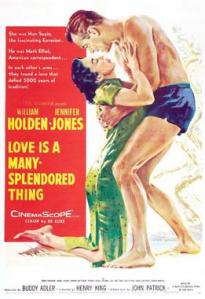
So, you can probably guess that I wasn’t terribly impressed with Love Is A Many-Splendored Thing but, before I get too critical, I want to start things off on a positive note. William Holden was, without a doubt, one of the best actors to ever appear in the movies. He started his film career in the 1930s and worked regularly until his death in 1981. Just consider some of the films in which Holden appeared: Golden Boy, Our Town, Sunset Boulevard, Stalag 17, Sabrina, Picnic, Network, and so many others. Of course, not every film in which Holden appeared was a masterpiece. He made his share of films like Damien: Omen II and When Time Ran Out. But the thing is that, regardless of the film, Holden was always good.
That’s certainly the case with Love Is A Many-Splendored Thing. It’s not one of Holden’s better films but William Holden is his usual dependable self. He plays Mark Elliott, a rugged American correspondent who is living in Hong Kong in the 1940s. While the Chinese Civil War rages nearby, Mark deals with his failing marriage. His wife is back in the States. They’re separated but not quite divorced. Mark owns a really nice car and, since he’s played by William Holden, he delivers the most world-weary of lines with an undeniable panache. He also appears shirtless for a good deal of the film. Between this and Picnic, 1955 was the year of the shirtless Holden.
The problem with Love Is A Many-Splendored Thing is not with William Holden. Instead, the problem is with the miscasting of Jennifer Jones as Han Suyin, the woman with whom Mark Elliott falls in love. Han Suyin was a real-life person, a doctor who wrote the autobiographical novel on which Love Is A Many-Splendored Thing was based. Han Suyin was Eurasian. Jennifer Jones most definitely was not. Throughout the film, Han Suyin and Mark often discuss what it’s like to be Eurasian and to be in the middle of two very different cultures. There’s even a discussion about whether Han Suying should try to pass as European. It all has the potential to be very interesting except for the fact that Jennifer Jones, who was so good in so many films, is in no way convincing in her role. Whenever she mentions being Eurasian, which she does frequently, the film come to a halt as we all stare at Jennifer Jones, one of the first film stars to ever come out of Tulsa, Oklahoma.
It all leads to a rather strained movie, one that never really drew me into its cinematic world or story. (For the record, a lot of people on twitter disagreed with me on this point.) Ultimately, the main reason to watch it was for William Holden. According to the film’s Wikipedia entry (how’s that for in-depth research), Holden and Jones reportedly did not get along during filming, with Jones apparently chewing garlic before their love scenes and there was a definite lack of chemistry between them. Maybe I got spoiled by William Holden and Kim Novak dancing in Picnic but I never believed that Mark and Han Suyin were attracted to each other. Interestingly, Jones and Holden would later both appear in another best picture nominee, 1974’s The Towering Inferno. However, they didn’t share any scenes.
Love Is A Many-Splendored Thing was nominated for best picture but it lost to a far different love story, Marty. This was also the final film directed by Henry King to be nominated for best picture. Previous King films to be nominated included State Fair, In Old Chicago, Alexander’s Ragtime Band, The Song of Bernadette, Wilson, and Twelve O’Clock High.
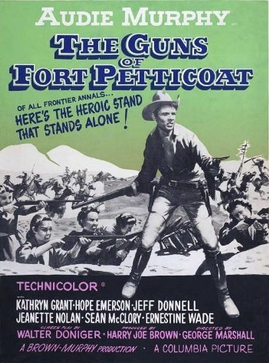 During the waning days of the Civil War, Lt. Frank Hewitt (Audie Murphy) is a man without a country. A Texan, he joined the Union Army even as his home state was voting to secede from the United States. In the Army, Hewitt is viewed with distrust by his autocratic superior, Col. John Chivington (Ainslie Pryor). When Hewitt learns that Chivington has ordered a surprise attack on an unarmed local Indian tribe in order to drive them into Texas where they will attack the nearest settlement for revenge, Hewitt deserts the Army to warn the people left in his hometown.
 Through the Shattered Lens