Film Review: Moses, The Law-Giver (dir by Gianfranco De Bosio)


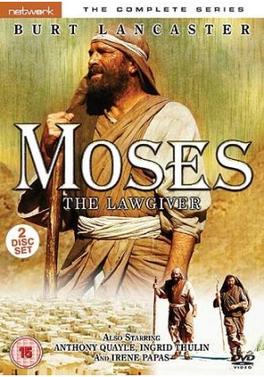
I should probably start this review by admitting that there’s a legitimate question concerning whether or not 1974’s Moses, the Law-Giver should be considered a film or a miniseries.  Though there was an edited version of Moses that ran for 141 minutes and which was apparently released in theaters, the unedited version of Moses is 300 minutes long and was broadcast on television over a period of 6 nights.  The long, unedited version is the one that I watched on Prime for five hours on Friday.  Having watched the entire thing in one sitting, I personally consider Moses, the Law-Giver to be a film, albeit a very long one.

Moses, The Law-Giver tells the story of Moses and how he was exiled from Egypt, just to return years later to demand that Pharaoh set his people free.  The first two and a half hours deal with Moses and Egypt.  The second half of the film follows Moses and the Israelites as they seek the Promised Land.  Moses covers the same basic ground as The Ten Commandments, just in a far less flamboyant manner.

For instance, Charlton Heston was a powerful and fearsome Moses in The Ten Commandments.  In Moses, the Law-Giver, Burt Lancaster is a bit more subdued in the lead role.  Even though Lancaster was far too old to play the role, he still gives a convincing performance.  He plays Moses as a man who starts out unsure of himself but who grows more confident as the journey continues.  He’s also a man who is constantly struggling to control his emotions because he knows that he doesn’t have the luxury of showing any sign of weakness.  Whereas Heston bellowed in rage at the sight of the Golden Calf, Lancaster comes across more like a very disappointed father who is about to ground his children.  Lancaster’s low-key performance pays when, towards the end of the film, Moses is told that he will see the Promised Land but that he will not enter it.  The sudden look of pain on Moses’s face is powerful specifically because we’ve gotten so used to him holding it all back.  For a brief moment, he drops his mask and we realize the toll that the years have taken on him.

In The Ten Commandments, Yul Brynner was a determined and arrogant Pharaoh.  In Moses, the Pharaoh (who is played by Laurent Terzieff) is far more neurotic.  He’s portrayed as being Moses’s younger cousin and he seems to be personally hurt but Moses’s demand that the slaves be granted freedom.  It creates an interesting dynamic between the two characters, though it also robs the film of a credible villain.  Whereas Brynner’s Pharaoh was a fearsome opponent, Terzieff plays the character as being weak and indecisive.  Even if one didn’t already know the story, it’s till impossible to be surprised when Terzieff finally relents and allows the Israelites to leave Egypt.

Most importantly, Moses, The Law-Giver devotes more time to the relationship between Aaron and Moses than The Ten Commandments does.  In The Ten Commandments, John Carradine’s Aaron was an often forgotten bystander.  In Moses, Anthony Quayle plays Aaron and he’s pretty much a co-lead with Lancaster.  The film is as much about Aaron as it is about Moses and it actually takes the time to try to logically develop how Aaron could have been duped into creating the Golden Calf.  Quayle gives the best and most compelling performance in Moses, playing Aaron as a well-meaning and loyal sibling who, unfortunately, is often too worried about keeping everyone happy.  For all of his loyalty to Moses, Aaron still struggles with feelings of envy and Quayle does a wonderful job portraying him and turning him into a relatable character.

As a film, Moses, The Law-Giver is never as much as fun as The Ten Commandments.  It’s almost too subdued for its own good.  On the one hand, it’s possible to appreciate Moses for taking a somewhat realistic approach to the story but …. well, is that really what we want?  Or do we want the spectacle of decadent Egypt and the excitement of the red sea crashing down on Pharaoh’s army?  You can probably guess where I come down on that.

Of note to fans of Italian cinema, the film’s score — which is pretty good — was composed by Ennio Morricone.  The film’s special effects are credited to none other than Mario Bava!  This was one of Bava’s final credits.  Unfortunately, the special effects are never really that spectacular and there’s a few scenes where it’s obvious that stock footage has rather awkwardly been utilized.  But, no matter!  It still made me happy to see Bava’s name listed in the end credits.

Moses, The Law-Giver has its moments but, ultimately, The Ten Commandments remains the Moses film to watch.
Lisa Reviews An Oscar Nominee: Zorba The Greek (dir by Michael Cacoyannis)


The 1964 film, Zorba the Greek, tells the story of two very different friends.

Basil (Alan Bates) is a writer.  (“Poetry, essays,” he diffidently says when asked what he writes.)  Basil is British-Greek but, having been raised in the UK, he allows his British side to dominate.  In this film, that means that Basil is very polite and very reserved.  He’s not the type to attempt to flirt with someone who he doesn’t know.  He has never spontaneously broken into dance.  When he is offered a drink, he asks for tea and is shocked to receive rum instead.  If the film was taking place a few decades later, one gets the feeling that Basil would describe Love, Actually as being an okay movie “for people who like that sort of thing.”

And then there’s Zorba (Anthony Quinn).  Unlike the wealthy and well-educated Basil, Zorba is a peasant and he’s proud of it.  He works hard but he plays hard too and there’s nothing that Zorba loves more than the sound of good music.  Zorba not only drinks rum but makes sure that everyone else gets their fill as well.  Zorba dances whenever he feels like it.  Zorba is larger than life, an unfailingly enthusiastic man who is determined to enjoy whatever time he has left in his life.

When Zorba and Basil first meet, Basil is heading to Crete where he’ll be trying to reopoen a mine that was left to him by his father.  As for Zorba, he’s looking for work and, as he explains it, he has tons of experience working as a miner.  Though Basil is, at first, reluctant to hire someone who he’s just met, Zorba talks him into it.  As quickly becomes apparent, the exuberant Zorba can talk people into almost anything.

You can probably guess where all of this is going.  Zorba teaches Basil how to embrace life, which in this film means embracing the Greek side of his heritage.  It takes a while, of course.  Basil is an extremely reluctant protegé and a good deal of the film’s humor comes from just how uncomfortable Basil occasionally gets with his newfound friend.  That said, you don’t have to be a psychic to guess that eventually, the two of them will share a dance on the beach.  It may be predictable but that’s not to say that Zorba the Greek isn’t a good film.  It’s a very good and entertaining movie, featuring a justifiably famous soundtrack and also one of Anthony Quinn’s best and most exuberant performances.

In fact, Quinn is so perfectly cast as Zorba that he occasionally tends to overshadow Alan Bates, who is equally good but in a different way.  In fact, I would say that Bates probably had the more difficult role.  Whereas Zorba (and Quinn) spends the entire movie instigating, Basil (and Bates) spends the entire movie reacting.  It’s difficult to make passivity watchable but Bates manages to do it.

Of course, Zorba isn’t just a comedy about an unlikely friendship.  About halfway through the film, there’s a moment of shocking brutality involving a young widow played by Irene Pappas.  It took me totally by surprise and it left me a bit shaken.  (It also reminded me a bit of another European film featuring Irene Pappas, Lucio Fulci’s Don’t Torture A Duckling.)  It’s a scene that serves as a reminder that 1) not every peasant is Zorba the Greek and 2) friendship and love cannot end darkness but it can make it all a little more bearable.

Zorba the Greek was nominated for Best Picture but it lost to My Fair Lady.

44 Days of Paranoia #38: Z (dir by Costa-Gavras)


(SPOILERS!)

For today’s entry in the 44 Days of Paranoia, we take a look at the 1969 political thriller, Z.

Though Z is based on events that actually happened in Greece and features a  soundtrack of Greek music that manages to be both haunting and lively at the same time, the film itself takes place in an unnamed, European country.  While the country is officially a democracy, it’s actually controlled by a cabal of politicians and military leaders who use fear and intimidation to maintain power.

As the film opens, The Deputy (played by the charismatic Yves Montand) and his aides arrive in a small city.  That night, the Deputy is scheduled to speak a rally for nuclear disarmament.  As we’re shown from the start of the film, the outspoken Deputy is considered to be a threat by both his country’s government and the United States as well.  Despite having received word that an attempt is going to be made on his life, the Deputy speaks at the rally.  After the rally, as the Deputy walks across the street, a truck comes out of nowhere.  A man in the back of the truck strikes the deputy with a club, killing him.  The official story is that the Deputy was simply hit and killed by a drunk driver but the Deputy’s followers know otherwise.

Realizing that the Deputy has the potential to be an even more powerful symbol in death than he was when he was alive, the government assigns the Magistrate (Jean-Louis Trintignat) to investigate the Deputy’s death.  Since the Magistrate is known to have political ambitions of his own, it’s assumed that he’ll simply rubber stamp the government’s story.  However, the Magistrate surprises everyone by turning out to be a man of integrity.  Working with a journalist (Jacques Perrin), his investigation uncovers a conspiracy and leads to the indictment of several high level military officials.  In a scene that will be familiar to anyone who has ever seen a movie, the Deputy’s wife (Irene Pappas) is told that the men responsible for her husband’s murder will be held responsible…

And this is where you would normally expect the film to end.

However, Z goes on for another few minutes and it’s those final minutes that elevate this film from just being a well-made thriller to being one of the most effective political films ever made.  The film’s narrator informs us that the government was subsequently overthrown by the military.  The indictments were dismissed.  The Magistrate was reassigned to other duties.  The “drunk drivers” who were officially held responsible for the Deputy’s death were given light sentences.  As for the Deputy’s loyal aides, some were forced into exile while another was killed while running from police.  Finally, we’re told:

“Concurrently, the military banned long hair on males; mini-skirts; Sophocles; Tolstoy; Euripedes; smashing glasses after drinking toasts; labor strikes; Aristophanes; Ionesco; Sartre; Albee; Pinter; freedom of the press; sociology; Beckett; Dostoyevsky; modern music; popular music; the new mathematics; and the letter “Z”, which in ancient Greek means “He is alive!”

As the film ends, a long list of everything and everyone that has been banned rolls up the screen.  It’s a devastating scene, one that firmly establishes that the greatest enemy of dictatorship (as well as the first victim) is freedom of thought.

However, even before that ending, Z had already established itself as a powerful film.  I usually dread watching politically themed films because, for the most part, I find them to be drearily heavy-handed.  Well, make no doubt about it,  Z is a very political film and it’s also a very heavy-handed film.  However, it’s so well-acted and well-directed that I hardly minded the fact that the film was essentially trying to indoctrinate me.  It’s rare that you find a polemical film that also works as entertainment but Z is one of those rare films.

Z made history in 1970 when it was the first film to be nominated by the Academy for both Best Foreign Language Film and Best Picture of the Year.  Watching it today, it’s easy to understand why Z was so honored.  It remains an exciting thriller, a powerful political statement, and a bold call to action.

Z, incidentally, won the Oscar for Best Foreign Language Film.  However, best picture was won by Midnight Cowboy.

Other Entries In The 44 Days of Paranoia 

  1. Clonus
  2. Executive Action
  3. Winter Kills
  4. Interview With The Assassin
  5. The Trial of Lee Harvey Oswald
  6. JFK
  7. Beyond The Doors
  8. Three Days of the Condor
  9. They Saved Hitler’s Brain
  10. The Intruder
  11. Police, Adjective
  12. Burn After Reading
  13. Quiz Show
  14. Flying Blind
  15. God Told Me To
  16. Wag the Dog
  17. Cheaters
  18. Scream and Scream Again
  19. Capricorn One
  20. Seven Days In May
  21. Broken City
  22. Suddenly
  23. Pickup on South Street
  24. The Informer
  25. Chinatown
  26. Compliance
  27. The Lives of Others
  28. The Departed
  29. A Face In The Crowd
  30. Nixon
  31. The Hunger Games: Catching Fire
  32. The Purge
  33. The Stepford Wives
  34. Saboteur
  35. A Dark Truth
  36. The Fugitive
  37. The Day of Jackal