Lisa Reviews An Oscar Nominee: The Guns of Navarone (dir by J. Lee Thompson)


The Oscar nominations are finally due to be announced on March 15th and the Oscars themselves are scheduled to be awarded at the end of April.  In anticipation of the big event (and the end of this current lengthy awards season), I am going to spend the next two months watching and reviewing Oscar nominees of the past.  Some day, I hope to be able to say that I have watched and reviewed every single film nominated for Best Picture.  It’s a mission that, with each passing year, I come a little bit closer to acomplishing.

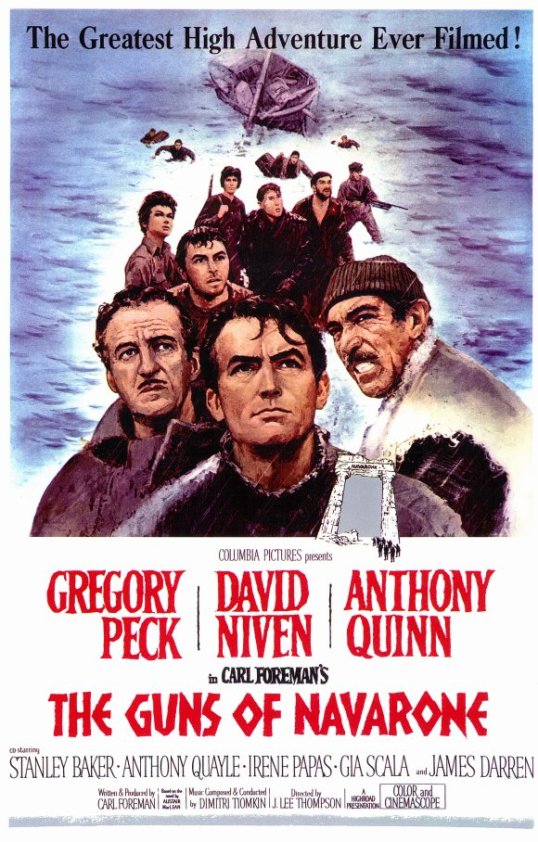
Tonight, I decided to start things off by watching the 1961 best picture nominee, The Guns of Navarone.

The Guns of Navarone takes place in 1943, during World War II.  2,000 British troops are stranded on the Greek island of Kheros and the Nazis are planning on invading the island in a show of force that they hope will convince Turkey to join the Axis powers.  The Allies need to evacuate those troops before the Nazis invade.  The problem is that, on the nearby island of Navarone, there are two massive guns that can shoot down any plane that flies over and sink any ship that sails nearby.  If the British soldiers are to be saved, the guns are going to have to be taken out.

Everyone agrees that it’s a suicide mission.  Even if a commando team manages to avoid the patrol boats and the German soldiers on the island, reaching the guns requires scaling a cliff that is considered to be nearly unclimbable.  Still, the effort has to be made.  Six men are recruited to do the impossible.  Leading the group is Major Roy Franklin (Anthony Quayle), a natural-born leader who is described as having almost supernatural luck.  Franklin’s second-in-command is Keith Mallory (Gregory Peck), an American spy who speaks several languages and who is an expert mountain climber.  Spyros Pappadimos (James Darren) and Butcher Brown (Stanley Baker) are both assigned to the team because they have fearsome reputations as killers, though it quickly becomes clear that only one of them kills for enjoyment.  Colonel Stavrou (Anthony Quinn) is a member of the defeated Greek army and he has a complicated past with Mallory.  Finally, Corporal Miller (David Niven) is a chemistry teacher-turned-explosive expert.  Waiting for the men on the island are two members of the Resistance, Spyros’s sister Maria (Irene Papas) and her friend, Anna (Gia Scala).  The mission, not surprisingly, the mission doesn’t go as planned.  There’s violence and betrayal and not everyone makes it to the end.  But everyone knows that, as tired as they are of fighting, the mission cannot be abandoned.

The Guns of Navarone was a huge box office success when it was originally released, which probably has a lot to do with it showing up as a best picture nominee.  It’s an entertaining film and, watching it, it’s easy to see how it served as a prototype for many of the “teams on a mission” action films that followed.  Though none of the characters are exactly deeply drawn, that almost doesn’t matter when you’ve got a cast that includes actors like Gregory Peck, Anthony Quinn, and David Niven.  At it best, the film works as a triumph of old-fashioned movie star charisma.  Peck is upright and determined to do whatever needs to be done to get the job done.  Quinn is tempermental and passionate.  David Niven is cynical, witty, and very, very British.  Quayle, Darren, and especially Stanley Baker provide strong support.  Before Sean Connery got the role, Stanley Baker was a strong contender for James Bond and, watching this film, you can see why.

Seen today, there’s not a lot that’s surprising about The Guns of Navarone.  It’s simply a good adventure film, one that occasionally debates the morality of war without forgetting that the audience is mostly watching to see the bad guys get blown up.  Some of the action scenes hold up surprisingly well.  The scene where the team is forced to deal with a German patrol boat is a particular stand-out.

The Guns of Navarone was nominated for 7 Academy Awards, including Best Picture.  Though it lost the top prize to West Side Story, The Guns of Navarone still won the Oscar for Best Visual Effects.
Cleaning Out The DVR, Again #8: Anne of the Thousand Days (dir by Charles Jarrott)


Anne

After I finished writing my review of Rolling Thunder, I continued the process of cleaning out my DVR by watching the 1969 film, Anne of the Thousand Days.  How does a film like Anne of the Thousand Days compare to a film like Rolling Thunder?

They might as well have been conceived, written, directed, and released on different planets.

I recorded Anne of The Thousand Days off of TCM on March 26th.  The main reason that I set the DVR to record it was because Anne was a best picture nominee.  It may seem strange to think that this rather conventional film was nominated the same year as Butch Cassidy and the Sundance Kid, Z, and Midnight Cowboy.  It gets even stranger when you consider what wasn’t nominated that year: Medium Cool, If…, Last Summer, They Shoot Horses, Don’t They?, Alice’s Restaurant, The Wild Bunch, Once Upon A Time In The West, and a long list of other films.  In fact, if I wanted to, I could probably spend this entire review listing all of the 1969 films that feel like a more appropriate best picture nominee than Anne of the Thousand Days.

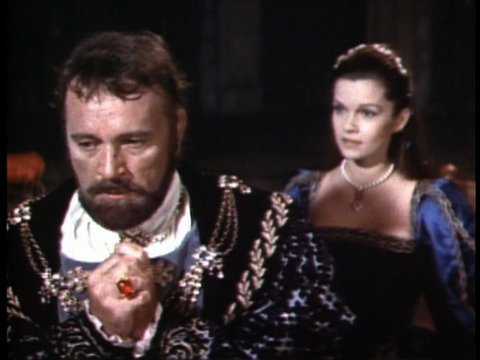
And yet, Anne was nominated for best picture.  In fact, it received a total of 10 Oscar nominations, the most of any film that year.  Tellingly most of the nominations were in the technical categories and the only Oscar that it won was for its costumes.  Genevieve Bujold received a nomination for playing the title character and Richard Burton became the third actor to receive a nomination for playing King Henry VIII.

As for the film, Anne of the Thousand Days tells the oft-told story of King Henry VIII and his marriage to Anne Boleyn.  Told in flashback as both Henry and Anne wait for her to be executed on charges of adultery, the film shows us how middle-aged Henry VIII first met and fell in love with 18 year-old Anne Boleyn.  Standing in the way of Henry’s pursuit of Anne was the fact that 1) Anne intensely disliked him, 2) Anne was already engaged, 3) Anne’s sister was already Henry’s mistress, and 4) Henry was already married to Catherine of Aragon (Irene Papas).

Fortunately, Henry happens to be king and being king comes with its perks.

For instance, as king, he can order Anne and her fiancée to break up.  As king, he can casually dismiss his former mistress.  And, as king, Henry has the power that Anne finds to be the ultimate aphrodisiac.  At first, Anne merely loves the fact that Henry is obsessed with her.  But slowly, she comes to love Henry as a man as well…

The only problem is that Henry is still married and Catherine is still popular with the people.  Even after Henry divorces her and marries Anne, the common people refuse to accept Anne as their queen.  When Sir Thomas More (William Squire) refuses to recognize Anne as queen, Anne demands that More be executed.  When Henry initially shows reluctance, Anne announces that she will not sleep with him until More is dead.

Needless to say, Thomas More is quickly executed.

However, Henry’s attention has already moved on to Jane Seymour (Lesley Paterson) and, desperate to get Anne out of his life, he arranges for Cardinal Cromwell (John Colicos) to frame Anne on charges of adultery and incest.  With Anne facing a humiliating trial and the possibility of execution, Henry makes her an offer.  If she agrees to an annulment, he’ll free her.  However, their daughter — Elizabeth — will lose her claim to the throne…

It’s telling that Charles Jarrott did not receive an Oscar nomination for his work as Anne of the Thousand Day‘s director.  There are a lot of technically good things about Anne of the Thousand Days but, despite all of the melodrama and sex and historical detail to be found in Anne, it never comes to life as a movie.  The costumes are to die for, the sets are impressive, and the cast is full of talented British character actors but the whole movie just feels oddly flat.  Try as it may, it can never convince us that either Henry VIII or Anne Boleyn is worth all the trouble.

Anne of the Thousand Days was obviously a big production, which probably explains all the Oscar nominations.  But otherwise, it’s one of the more forgettable best picture nominees.

The Movie That Nearly Killed The Godfather: The Brotherhood (1968, directed by Martin Ritt)


Brotherhood_1968Once upon a time, Paramount Pictures released a movie about an Italian-American organized crime family.

It was a self-styled epic that used the Mafia as a metaphor for both business and politics.  The movie mixed scenes of violent death with family and community ceremonies.   The main mafioso was played by a famous actor who was a big box office draw in the 1950s and another character, a war hero who was initially reluctant to get involved in the family business, was played by an up-and-coming young actor.   The majority of the movie took place in New York but there were several scenes that were set in Sicily.

It may sound like The Godfather but actually, it was The Brotherhood, a film that flopped so badly that Paramount executives nearly passed on the chance to make a movie out of Mario Puzo’s bestselling novel.  According to Peter Biskind’s The Godfather Companion, Francis Ford Coppola frequently cited The Brotherhood as being exactly the type of movie that he did not want to make while he was directing The Godfather.

Kirk Douglas, who both produced and starred, plays Frank Ginetta.  Frank, an old-fashioned and honorable mobster, is hiding out in Sicily with his wife, Ida (Irene Pappas).  Frank knows that a rival gangster, Jim Egan (Murray Hamilton), has put a price on his head.  When Frank’s brother, Vinnie (Alex Cord), shows up in Palermo, Frank is overjoyed at first.  But Ida reminds him, “They’re going to send someone.”

Most of the film is taken up with flashback to Frank and Vinnie’s old life in New York.  When Vinnie returns from serving in the army, he marries Emma Bertolo (Susan Strasberg), the daughter of Don Bertolo (Luther Adler who, as a stage actor and director, served as an early mentor to the future Don Corleone, Marlon Brando).  Frank grew up idolizing their Sicilian father and, at first, he is happy when Vinnie announces that he wants to enter the “family business.”  But then Vinnie starts to side with non-Sicilian gangsters like Egan and Sol Levin (Alan Hewitt).

The scenes in Sicily work the best, with Frank unsure as to whether or not Vinnie has arrived to visit or to murder him.  But the scenes in New York are such a mess that it took me a while to realize that they were even supposed to be flashbacks.  It is hard to keep track of how much time has passed from scene to scene and Alex Cord and Kirk Douglas are two of the most unlikely brothers imaginable.

The main problem with The Brotherhood is that it is impossible to watch it without thinking about The Godfather.  The Brotherhood has much in common with The Godfather but it has none of its authenticity and does not come close to matching its epic scale.  Kirk Douglas tries his best and puts a lot of effort into talking with his hands but he is miscast from the moment he first appears.  Robert Evans once said that he chose Coppola to direct The Godfather because he wanted to “smell the pasta.”  The Brotherhood was directed by Martin Ritt and you never smell the pasta.

The Brotherhood is an interesting footnote in the history of The Godfather but ultimately, it’s an offer you can refuse.

1374000145_4