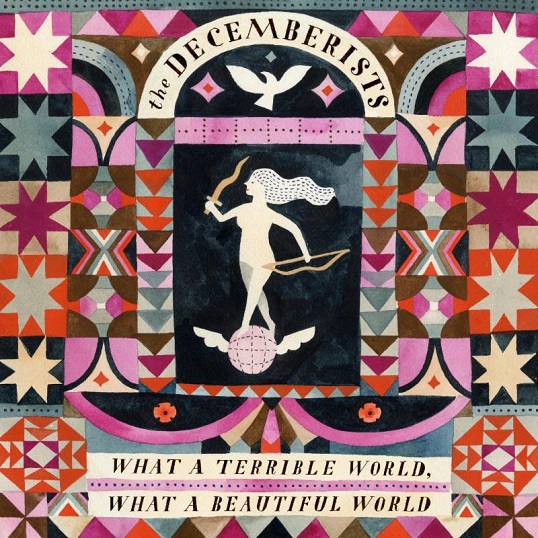
Review: The Decemberists – What a Terrible World, What a Beautiful World


I was basking in the golden glow of San Francisco’s Great American Music Hall when I first laid eyes on The Decemberists. It was Summer 2004, and it was a day I still remember well. I arrived alone, but I ended up befriending two girls about my age from Sacramento. It was a pretty thing–three kids too young to buy drinks and too engaged to harbor ulterior motives, thrilled to witness a band that seemed to capture every novelty of a world we were only barely old enough to traverse independently. It wasn’t particularly crowded–we walked right up to the front of the stage–but there wasn’t a stranger in the audience. “Billy Liar” was a hall-wide sing-along. On “Red Right Ankle” you could hear a pin drop. Chris Funk dawned a fake beard and marched through the audience pounding a drum strapped to his chest for “A Cautionary Song”. “California One / Youth and Beauty Brigade” was a swaying dream that will resonate in me until the day I die. I wanted to marry those girls by the end of it–both of them, and I never bothered asking their names.

Austin Texas, fall 2006, I stumbled into Stubb’s BBQ in a daze. “Indie rock” had become the musical movement of the decade, and I felt like a king in the middle of it all. It was a crazy two-week stretch: The Album Leaf, The Mountain Goats, a trek out to Houston for Built to Spill, a return to my metal roots for Between the Buried and Me, and somewhere in the midst of it all I found my sleepless self in a sea of humanity as Colin belted “Culling of the Fold” outdoors to a sold-out crowd. He was exhausted but elated, grinning from ear to ear the whole set, and so was I. The irony of “I was Meant for the Stage” was not lost on either of us.

Pittsburgh, 2009, I took my seat at the Byham Theater to witness The Decemberists in a traditional performance hall. I had traded in faded proofs of attendance for garb with actual buttons, and the band was decked out in full suit and tie. The Hazards of Love was larger than life–Shara Worden striding across the stage like a spidery temptress to a majestic display of lights and an unprecedented rock opera. The Decemberists rose to their fame as only they could, and the result was in one breath a self-aware mockery of their grandiose ambitions and a brilliant realization of the same.

…I wrote of The King is Dead‘s simple folk rock sound that it seemed like The Decemberists were “coming down off their own high. I imagine it’s difficult to be as… musically intelligent as they are without some fear of becoming pretentious.” The album title might even hint at this, and the band’s subsequent three year hiatus seemed to confirm it. Now it is 2015, more than a decade since that wonderful night in San Francisco, and What a Terrible World, What a Beautiful World is due out in just over a week. I don’t really know what I expected, but I know what I was feeling. It certainly wasn’t the grandeur of The Hazards of Love, nor epic ballads reminiscent of “The Mariner’s Revenge Song” and “The Island”. I was waxing nostalgic on Colin at his sweetest. “Grace Cathedral Hill”, “Shiny”, “Red Right Ankle”, “Of Angels and Angles”… Because The Decemberists were no longer a novel in their own right. That beautiful rise ended with The Hazards of Love, and the hiatus laid it all to rest. Theirs was a tale to look back on fondly; the story had come to an end.

What a Terrible World, What a Beautiful World gives me that sweetness, in a way. Tracks like “Lake Song”, “Make You Better”, and “12/17/12” are absolutely beautiful. All of the songs fall somewhere between these mellow numbers, blues/folk tracks like “Carolina Low” and “Better Not Wake the Baby”, and upbeat pop like “The Wrong Year”, “Cavalry Captain”, and “Philomena”. I could live without the latter three, but suffice to say the album is generally pleasing to listen to, though Jenny Conlee’s accordion has sadly all but left us. “Lake Song”, “Make You Better”, and “12/17/12” definitely steal the show for me, but I won’t soon forget the catchy choruses of “Anti-Summersong” or “Mistral”, nor the lulling blues melancholy of “Till the Water is All Long Gone”.

But this album breaks my heart. Through it all, I can’t escape the feeling that some fell force sucked away Colin’s joie de vivre, substituting mellow content to lead a normal life where once the world had been a playground. The music is still great, but I can’t feel the synergy between it and the lyrics anymore. At least “Lake Song” has been spared this fate. Here is what I can understand of “Mistral”: “So we already wrecked the rental car, and I’ve already lost my way. I feel entombed in this tourist bar, for a day anyway. So lay me out on the cobblestone, and unfurl this aching jib. The streets are built on ancient bones, and the crib of the rib. Won’t a mistral blow it all away? Won’t a mistral blow away? So it’s me and you and the baby boy, and a ? shed away, reeking out a little joy. What a waste. Bad mistakes. Won’t a mistral blow it all away? Won’t a mistral blow away?” I don’t know. It’s just… kind of shallow–a bit of babbling around the surface of a theme–and it’s pervasive through much of the album. “Better Not Wake the Baby” is packed with creative one-liners, all tied by a refrain of “but it better not wake the baby“. What does that mean? Plenty of Decemberists tracks have sent me to Wikipedia in the past, but I’m not going to find an answer here, and for that the song means nothing to me. “12/17/12”, my favorite track, still totally jars me out of my happy daze when Colin appears to rhyme “grieving” with “grieving” and “belly” with “belly”.

Go ahead. Crucify me. Point out the most obvious meanings; remind me that Colin still has a robust vocabulary; explain how it’s none of my business to criticize someone else’s creativity; note that it’s still better than 90% of popular music; tell me to shut my mouth and go listen to something else if I don’t like it. I don’t care, because the sad fact is I will go listen to something else. I spent more time on Castaways and Cutouts than on What a Terrible World, What a Beautiful World while writing all this. I don’t want that. I want to love this album and hold it dear, but I can’t. I listen to the lyrics and more often than not I just hear Colin going through the motions without any of the magic. From the 5 Songs EP all the way to The Hazards of Love it was a constant indulgence, and now it is gone.

The opening track, “The Singer Addresses His Audience”, is the reason I can still listen with a faint smile. It is not one for the album, but for the memory of all that The Decemberists have meant to me over the years. In almost a parting farewell to Colin’s old stage persona, he sings in classic form: “We know, we know we belong to ya. We know you built your lives around us. Would we change? …We had to change some. We know, we know we belong to ya. We know you threw your arms around us in the hopes we wouldn’t change… But we had to change some, you know, to belong to you.”

And they still do, and I still love them, and I still look forward to catching them on their upcoming tour, but What a Terrible World, What a Beautiful World is a bittersweet experience.
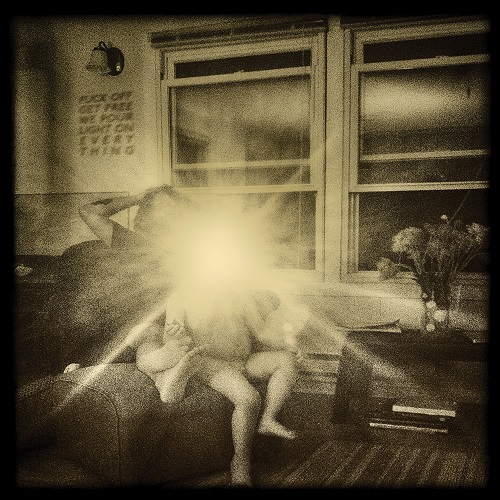
Review: Thee Silver Mt. Zion Memorial Orchestra – Fuck Off Get Free We Pour Light on Everything


I don’t normally step beyond the threshold of metal these days, but I was no stranger to post-rock in the late 90s and 2000s. It and indie were the defining musical genres of the last decade, and I gobbled them up for a time. I lost touch with ex-Godspeed You! Black Emperor legends A Silver Mt. Zion shortly after Horses in the Sky (2005), though “God Bless Our Dead Marines” was my favorite song by them until now.

I guess that wasn’t a very subtle hint of what’s to come. I picked up Efrim Menuck and company’s newest album because of its name. (Not the band name, presently on its fifth incarnation as “Thee Silver Mt. Zion Memorial Orchestra”.) Their seventh LP, released this January, is titled Fuck Off Get Free We Pour Light on Everything. That was just too delicious to pass up.

http://www.youtube.com/watch?v=WfPXY6mtq4U

Thee Silver Mt. Zion Memorial Orchestra – Fuck Off Get Free, from Fuck Off Get Free We Pour Light on Everything

I stumbled into one of the most novel and delightful sounds I had heard since, well, the days of post-rock and indie. It is in effect a merger of the two, utilizing classic GY!BE post-rock instrumentation and techniques in songs with distinctly indie structures and vibes. The opening title track sold me instantly with its warbling, almost unidentifiable instrumentation fused to a rock beat. These are sounds you would expect in some 20-minute build-up from silence, and they sound totally unique in their new environment. I suppose A Silver Mt. Zion had been heading this way for a while, but this is the first time I’ve listened to them that they’ve fully embraced the merger.

It’s not just the sounds themselves that make this song so convincing. The lyrics are paramount, infusing a crafty title with a great deal of depth and rendering the sounds relevant to the message. It shouts a pseudo-cryptic political/social statement with a keen eye we haven’t seen since the 60s and a punk rebel’s spirit, rocked back at the haters with a power to counter Ted Nugent’s whole discography. It begs the establishment and their drones to hate it. Need some harsh, gravely vocals to waggle your cock to? Sorry, voices don’t get more sissy than Efrim’s. They slam “wide white men” where a country star cries “freedom”, and the rejection of coherent grammar and sentence structure from a group totally fluent in English is an affront to the many that view their proper American English with some odd sense of pride. And it has a cuss word in the title! *gasp*

It’s a totally harmless song with a positive message, but I know a lot of people who would feel really insulted by it, and you probably know some too. I could easily see my mother showcasing this song in one of her Sunday School lessons about the corruption of youth, totally oblivious to the fact that it’s pushing her buttons on purpose. It’s what this song is all about: not letting the outdated, self-serving values of the ruling class tone down a message of peace and equality. Fuck off. Get free. We pour light on everything we see.

And how about that drop down into a stoner metal chug at 6:40? Last thing I saw coming, and I love it.

Thee Silver Mt. Zion Memorial Orchestra – What We Loved Was Not Enough, from Fuck Off Get Free We Pour Light on Everything

The album never really drops the slack the whole way through. It’s edgy, it’s angry, it’s indie in spirit, it’s eclectic as hell, and the message is great. There is really no down time at all–not something you might expect from the descendents of post-rock’s favorite son. “Take Away These Early Grave Blues” is especially intense and makes compelling use of a melody that I have to think came from some old country western film. I’m not going to go into detail on any of it; it’s hard to even begin to describe what’s going on with their odd choices of instrumentation. Suffice to say the first 34 minutes of the album pass very quickly, holding my attention all the while. It all leads to a grand finale with “What We Loved Was Not Enough”. This song is mind-blowing. With the sort of lengthy, escalating waltz common to many indie album closing tracks, the build-up is glorious and the lyrics cut deep.

This song uses a lot of excessively dramatic, over-the-top lines that remind me of The Decemberists, only A Silver Mt. Zion’s purpose is not all tongue-in-cheek fun and games. It has an apocalyptic flare, positioning the band at some breaking point where modern society crumbles in self-destruction: We can try to teach people to be open and understanding–to abandon their bigotry and love one another–but this vision will never come to pass. “What we loved was not enough. The day has come when we no longer feel. All our cities gonna burn. All our bridges gonna snap. All our pennies gonna rot. Lightning roll across our tracks. All our children gonna die. And the west will rise again.”

The band has tried their best. They pour light on everything they see. But in the end, it is up to the masses to let go of their pride and embrace a future of peace and love. Efrim knows they won’t, and he calls upon them mockingly: “So goodnight vain children. Tonight is yours. The lights are yours, if you’d just ask for more than poverty and war.”

This is an album for those of us who want to make a difference but know we can’t do shit to dent a machine that has mastered every art of cultivating people’s fears and hatreds. It’s an album to make you feel good about yourself, and to let you know you aren’t alone. I like that. “Kiss it quick and rise again.”

Fuck Off Get Free‘s only shortcoming is that they plugged a seemingly pointless four minute post-finale track after “What We Loved Was Not Enough”. I can easily forgive that.

Ten Years #19: The Shins


Decade of last.fm scrobbling countdown:
19. The Shins (1,344 plays)
Top track (75 plays): Pink Bullets, from Chutes Too Narrow (2003)
Featured track: Gone For Good, from Chutes Too Narrow

When I leave my heavy metal tunnel vision behind and consider what properly ought to be regarded as the most significant musical movement of the first decade of this century, the answer ultimately resolves to indie rock. What that means is, of course, no clear-cut, formulaic sound, any more than grunge or classic rock constitute a style. Indie rock was a particular attitude towards music–a love affair between earth and sky that saw bands fundamentally rooted to rationality float among the clouds. It is unfortunate that my last.fm charts for that era could not make room for the likes of Built to Spill, Ted Leo & the Pharmacists, and The Fiery Furnaces, but those bands that did grind their way into my top 50 represent, I think, one of the finest eras music has to offer. I wouldn’t call The Shins my favorite indie rock band–I’ll reserve that title for an entry a little nearer the top–but I do think they orbit closer the core of what indie rock stood for than any band before or since them.

James Mercer’s genius rests foremost in his lyrics. From the opening lines of Oh, Inverted World on, his ability to paint the simple, mundane concerns of life in lush metaphor–“I think I’ll go home and mull this over, before I cram it down my throat. At long last it’s crashed; its colossal mass has broken up into bits in my moat.”–has defined the indie attitude. It’s permeated with a smug wit, perpetually aware of the trite contrivances of standardized rock that it revels in. Mercer knows his lyrics are extravagant, overreaching their subject matter, and the sort of tongue-in-cheek arrogance of it all is what makes the music so delightful. You can fall in love with it and laugh at the same time.

I chose “Gone For Good” to represent The Shins in this post even though it’s stylistically a bit out of character, because I think it perfectly captures what I love about this band. The lyrics are deliciously pretentious, paired with a comically simple tune that nevertheless successfully pleads for the same pretty appeal as Mercer’s more creative melodies. And now, in an era permeated with the same lack of awareness that tortured the 1980s, it’s a relieving reminder that every dark cloud over the landscape of creative expression is followed by a bit of wit and sunlight.

Untie me, I’ve said no vows.
The train is getting way too loud.
I’ve got to leave here my girl, and get on with my lonely life.
Just leave the ring on the rail for the wheels to nullify.

Until this turn in my head,
I let you stay, and you paid no rent.
I spent twelve long months on the lam.
That’s enough sitting on the fence for the fear of breaking dams.

It took me all of a year,
to put the poison pill to your ear.
But now I stand on honest ground, on honest ground.
You want to fight for this love, but honey you cannot wrestle a dove.
Baby it’s clear.

You want to jump and dance,
But you sat on your hands and lost your only chance.
Go back to your home town, get your feet on the ground, and stop floating around.
I found a fatal flaw in the logic of love and went out of my head.
You love a sinking stone that will never elope,
So get used to the lonesome, girl you must atone some.
Don’t leave me no phone number there.

Ten Years #32: Elliott Smith


Decade of last.fm scrobbling countdown:
32. Elliott Smith (946 plays)
Top track (95 plays): Southern Belle, from Elliott Smith (1995)
Featured track: St. Ides Heaven, from Elliott Smith

This October will mark ten years since Elliott Smith’s tragic death. I remember hearing the news only a few months after I started listening to him. The Royal Tenenbaums was my favorite movie at the time, and I picked up his self-titled album after hearing Needle in the Hay in the suicide scene. As if the album’s lyrics weren’t bleak enough already, the relevance of my first experience of Elliott Smith to his death added a whole new weight. It’s a pleasant if odd coincidence that the album soon became intimately tied with one of the most positive experiences of my life.

Smith died in October, and I shipped off to basic training the following month. Music deprivation–the only really challenging aspect of the whole three month process–came to an end when I was marched out of my barracks with my confiscated cd collection back in tow and shipped off to my year-long advanced training. I hopped on a plane in a bitter sub-zero St. Louis February and fell back off in the palm-tree coastal paradise of Monterey, California. Elliott Smith was spinning all the while, and it kept on playing until I left that strange and beautiful place for good. Something about the juxtaposition of Smith’s depressing lyrics and ethereal performance perfectly captured the simultaneous homesickness and bewilderment that I experienced as a rural 19 year old alone and out of his element with an enormous Army pay check, left to roam the hills of one of America’s most affluent coastal cities every night. That otherworldly vision of a serene Pacific bay surrounded by city lights will always go hand-in-hand with this album for me, and I can’t bring myself to listen to any other Elliott Smith recording without being overcome by a desire to put his self-titled back on, close my eyes, and relive the experience. It might not be exactly what Smith had in mind when he recorded it, but I would rather like to remember him for the beauty lying beneath his depression than for his death.

Ten Years #36: The Mountain Goats


Decade of last.fm scrobbling countdown:
36. The Mountain Goats (846 plays)
Top track (37 plays): Home Again Garden Grove, from We Shall All Be Healed (2004)
Featured track: Fault Lines, from All Hail West Texas (2002)

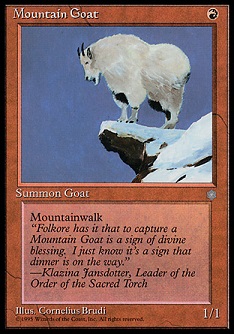
Back in my later high school days, when my early obsession with metal music coexisted with an active participation in games like Magic: The Gathering and Dungeons & Dragons, I remember stumbling across a 1/1 beast in Ice Age that I became bound and determined to name a pseudo-grim heavy metal band after:

I was very briefly disappointed to find that a band had already beaten me to the punch on that one. One of the things that makes John Darnielle an awesome person, though, is the very real possibility that this is no coincidence and he took his band name from M:tG too. (Probably not, given that his first album came out in 1994, but you never know.) This guy has made a guest appearance on an Aesop Rock hip-hop album and written an acoustic love song set to a Marduk black metal concert in the same year; his appreciation for the awkward and out-of-place couples with an above-average awareness of other musical scenes to conjure a constantly befuddling self-image. The first time I saw him live, before I was very aware of his works, I wasn’t sure if I ought to take the dialogue between each track as stand-up comedy or legitimate commentary by someone who was hopelessly socially inept. In retrospect, it was more the former, but the heart-felt sincerity Darnielle packs into everything he says or writes is both a quintessential part of the act and a reflection of who he really is–someone both incredibly aware and controlling of his public image and just a little bit legitimately weird. He has made his claim to fame writing sentimental solo acoustic songs with over-the-top lyrics and awkward subject matters that are simultaneously heart-felt and tongue-in-cheek. He has cultivated his awkwardness into some of the best solo acoustic albums recorded since Bob Dylan.

Lately, The Mountain Goats have evolved from a solo project to more of a full band. Last time I went to their show the audience had expanded from about a hundred to a few thousand, and Darnielle was hamming up the rock-star image with a shit-eating grin on his face the whole time. I absolutely love this guy and his works, and while I can’t say that I’ve kept up with him consistently over the years (his discography is massive), I’ve certainly listened to him enough to rank in my top 50 most played artists of the past decade. Here are the lines to Fault Lines, to give you some idea of his brilliantly bizarre lyrics:

Down here where the heat’s so fine
I’ll drink to your health and you drink to mine
As we try to make the money we scored out in Vegas hold out for a while
We drink vodka from Russia
We get our chocolates from Belgium
We have our strawberries flown in from England
But none of the money we spend seems to do us much good in the end
I got a cracked engine block, both of us do
Yeah the house, the jewels, the Italian race car
They don’t make us feel better about who we are
I got termites in the framework, so do you
Down here where the watermelon grows so sweet
Where I worshiped the ground underneath of your feet
We are experts in the art of frivolous spending
It’s gone on like this for three years I guess
And we’re drunk all the time, and our lives are a mess
And the deathless love we swore to protect with our bodies
is stumbling across its bleak ending
But none of the rage in our eyes
Seems to finish it off where it lies
I got sugar in the fuel lines, both of us do
Yeah the fights and the lies that we both love to tell
Fail to send our love to its reward down in hell
I got pudding for a backbone, and so do you
La la la la! Hey hey!

Ten Years #39: Camera Obscura


Decade of last.fm scrobbling countdown:
39. Camera Obscura (786 plays)
Top track (228 plays): Country Mile, from Let’s Get Out of This Country (2006)
Featured track: Razzle Dazzle Rose, from Let’s Get Out Of This Country (2006)

The presence of Camera Obscura on my decade-spanning last.fm charts might be the only fluke in this series. They basically got here because I listened to “Country Mile” on repeat for about 12 hours one day. Let’s Get Out of This Country is the only album I’ve really listened to extensively in their discography (they just released their fifth last month), and while I did get the pleasure of seeing them live once, I can’t say I know much about the band. But I do think this album is absolutely delightful–a little hidden ray of light in my mostly heavier music collection that warmed my heart the first time I heard it and still does today. Its retro vibe feels oddly more authentic than any of the actual classic pop sounds it replicates, made fresh by a heavy dose of 2000s indie aesthetics and Tracyanne Campbell’s angelic vocals. Let’s Get Out of This Country takes me back in time so vividly that I swear I remember growing up surrounded by the wallpaper on the album’s cover. It’s flooded with innocent ennui, played out in front of a kitchen window on a rainy Saturday afternoon. Its depression is refreshing and nostalgic, replaying some childhood memory in which boredom seemed to be the worst thing life had to offer.

Ten Years #43: Neutral Milk Hotel


http://www.youtube.com/watch?v=h2NJ-alquqM

Decade of last.fm scrobbling countdown:
43. Neutral Milk Hotel (727 plays)
Top track (81 plays): Holland, 1945, from In the Aeroplane Over the Sea (1998)
Featured track: In the Aeroplane Over the Sea (full album)

When you listen to a really diverse and enormous catalog of music, terms like “favorite” can seem more cheap than they really are. We are bombarded, after all, with trite Rolling Stones style top 100 whatever lists for which half the entries are predetermined without any serious consideration whatsoever and the remainder are entirely arbitrary. I like to think that this Top 50 series contains sufficient factual restraints to avoid these shortcomings–that the inclusions are genuine in a manner that avoids momentary whims and degeneration to name recognition. (You won’t find any Led Zeppelin, Beatles, or Pink Floyd in this house.) But I also like to think that that the dozens–maybe hundreds–of musical entities I have described as a “favorite” here on Shattered Lens have been sufficiently qualified to bear weight. I don’t typically speak of unequivocal favorites. I point out what I like best under a well-defined set of conditions.

So read this as it stands: In the Aeroplane Over the Sea is my favorite album. At some point in the late 1990s, Jeff Mangum became possessed by some superhuman muse long enough to compose 40 minutes of poetic euphoria.

I don’t know that any prose description could fully capture the depth of this album. It is a mesh of beautiful poetic metaphors that only slowly begin to reveal themselves over dozens of listens. It does follow a loose chronology that is sufficiently cryptic to allow for multiple but similar interpretations. The album begins with a reflection on an innocent childhood and the narrator’s first sexual experience (presumably with her–or possibly his–step-brother, the “King of Carrot Flowers”) in an environment of domestic tension that they were at the time oblivious to. The scene then fades into the past like a movie, the The King Of Carrot Flowers Pts. Two And Three presenting a bizarre first-hand account of the experience of being born–some sacred moment followed by an explosion of chaos as the narrator first boldly proclaims her existence in total disregard to the good and bad around it. (Garbage bins? Dead dogs?) The title track which follows seems to hark back to the scene of the opening song from the perspective of the innocent in awe of the mysteries of life, embracing her young lover and dreamily “laughing out loud” at “how strange it is to be anything at all.” Two-Headed Boy is the first track in which the lovers start to grow up. The childish “King of Carrot Flowers” has become a metaphorical misfit, one head clinging to youth and the other being forced into the hardships of adulthood. Their physical love is expressed in passionate desperation, aware that their innocence is fleeting: “In the dark we will take off our clothes, and they’ll be placing fingers through the notches in your spine and when all is breaking everything that you can keep inside.” The narrator ultimately assures him that their innocence is eternal, lying in wait for the moment that he can overcome his recognition of the hardships of life, and then she gets up and leaves: “Two-Headed Boy, there’s no reason to grieve. The world that you need is wrapped in gold silver sleeves left beneath Christmas trees in the snow. I will take you and leave you alone, watching spirals of white softly flow over your eyelids, and all you did will wait until the point when you let go.”

At this point, an instrumental interlude marks the passage of time into the middle third of the album. A blundering plod titled The Fool, it seems to capture the cast’s development into typical adults, overcome by petty concerns and squabbles. This new stage is not immediately spelled out, however. Instead, Mangum introduces the elusive ‘voices in his head’ characters in the plot, beginning with Anne Frank and her friend or lover. Holland, 1945 rocks out in a peculiarly up-beat fashion. It seems to be narrated by a holocaust survivor reflecting on the loss of Anne. Unlike the Two-Headed Boy, the narrator here is peculiarly optimistic and remains positive even while presenting such cutting lines as “it’s so sad to see the world agree that they’d rather see their faces filled with flies, all when I wanted to keep white roses in their eyes.” Prevented by tragedy from ever experiencing a traditional passage into mundane adulthood, the narrator remains at once innocent and fully aware of one of the 20th century’s greatest atrocities. The next track is beautiful but hard to place in context. We meet the “Communist Daughter”, a woman placed in another 20th century nightmare, and the imagery is completely inverted. The ocean is filled with seaweed and the white mountain peaks are not blanketed in snow but stained with semen, while the industrial wasteland around her is beautiful–the “cars careen from the clouds”, and “the bridges burst and twist about”. Oh Comely presumably returns to the original cast, and it hits rock bottom. Narrated, I think, by the adult successor of the Two-Headed Boy, it captures an intense bitterness towards some former lover–probably not the step-sister–and towards life in general. The narrator describes Comely as having been raised by a broken family in a trailer park and blundering into one bad relationship after another in search of elusive happiness, sleeping with men who make shallow promises in order to take advantage of her: “Oh Comely, all of your friends are now letting you blow, bristling and ugly, bursting with fruits falling out from the holes of some bratty bright and bubbly friend you could need to say comforting things in your ear. But oh Comely, there isn’t such one friend that you could find here standing next to me; he’s only my enemy. I’ll crush him with everything I own. Say what you want to say and hang for your hollow ways.” The narrator goes on to reflect on his own relationship with Comely and those moments when their love felt sincere, and then the song gives way from bitterness to lament. Voices of the past speak out in the narrator’s head: Anne’s lover describes her miserable death and regrets being unable to save her, while another voice calls to his dear Goldaline, claiming to be trapped “inside some stranger’s stomach” and promising to return her to a place where “there is sun and spring and green forever”.

The album then moves on to what I would consider its third and final movement–three tracks of inspiring beauty that describe the narrator–possibly the adult King of Carrot Flowers/Two-Headed Boy–reaching that “point where you let go” described in Two-Headed Boy and abandoning his bitterness to embrace life again. Ghost is something of an awakening. The narrator realizes that the ghost of Anne lives within him with her youthful spirit intact, and with it a sort of universal, eternal innocence shared among all of us though often forgotten with age. Suddenly the optimism of Holland, 1945 makes sense. “One day a New York city baby, a girl, fell from the sky from the top of a burning apartment building fourteen stories high. When her spirit left her body, how it split the sun. I know that she will live forever. All goes on and on and on. She goes, and now she knows she’ll never be afraid to watch the morning paper blow into a hole where no one can escape.” Her spirit will never fall into that hole of adult drudgery–and the narrator can at last climb back out of it. The next track is an instrumental celebration of this. The closing track, Two-Headed Boy Pt. 2, is by far my favorite on the album. The narrator finally grasps what is important in life. He makes amends with the people who were once close to him–his misguided father, a wayward brother, perhaps a former sister-in-law–acknowledges the breaking point where the innocence of their relationships was lost, and encourages the Two-Headed Boy to appreciate the simple things in life while they last and not be bitter at their parting:

Daddy please hear this song that I sing. In your heart there’s a spark that just screams for a lover to bring a child to your chest that could lay as you sleep and love all you have left, like your boy used to be, long ago, wrapped in sheets warm and wet.

Blister please, with those wings in your spine, love to be with a brother of mine. How he’d love to find your tongue in his teeth, in a struggle to find secret songs that you keep wrapped in boxes so tight, sounding only at night as you sleep.

In my dreams you’re alive and you’re crying, as your mouth moves in mine, soft and sweet. Rings of flowers ’round your eyes, and I’ll love you for the rest of your life.

Brother see, we are one in the same. And you left with your head filled with flames, and you watched as your brains fell out through you teeth. Push the pieces in place. Make your smile sweet to see. Don’t you take this away. I’m still wanting my face on your cheek.

And when we break we’ll wait for our miracle.
God is a place where some holy spectacle lies.
When we break, we’ll wait for our miracle.
God is a place you will wait for the rest of your life.

Two-Headed Boy, she is all you could need. She will feed you tomatoes and radio wires, and retire to sheets safe and clean. But don’t hate her when she gets up to leave.

Ten Years of Music: Introduction


On May 16th, 2003, I entered an email address and password into a little known site called Audioscrobbler and clicked join. Having always derived an enormous kick from statistics, the novelty of being able to track everything I listen to seemed like the best idea on the entire internet. Ten years and approximately 180,000 songs later, that opinion hasn’t much changed. Most of you are probably familiar with what is now Last.fm, but I doubt as many have diligently kept up with it over the years. From my car cd player to everything I listen to at home, I’m willing to wager that a good 90% of the music I’ve enjoyed over the past decade has been accurately logged. This creates some pretty interesting possibilities. I’ll never know what I listened to most as a kid. Wishful thinking tells me Pearl Jam, Tool, Nirvana, and the Smashing Pumpkins would have topped that list. (Honesty admits with some embarrassment that Korn ranked just as high.) But I do know what I have listened to the most as an adult. It’s not biased speculation; it’s a fact.

Most of my entries here on Shattered Lens have dealt with either reviews of new albums or ramblings and investigations isolated to the fairly particular subgenres of folk, metal, and video game music that excite me most. While my last.fm charts reflect this, they are substantially more diverse. What I would like to do over the following two months is introduce some of you to a range of stellar bands and songs by allowing the numbers to speak for themselves. I intend to count down the top 50 bands I have listened to in the past decade and feature my most played track from each. I’ll start with the highest five bands that didn’t quite make the cut:

55. The Microphones (551 plays)
Top track (60 plays): The Moon, from The Glow, Pt. 2 (2001)

54. Amorphis (561 plays)
Top track (45 plays): Divinity, from Tuonela (1999)

http://www.youtube.com/watch?v=vCT_9tcdQcI

53. In Flames (562 plays)
Top track (39 plays): Embody the Invisible, from Colony (1999)

52. Converge (585 plays)
Top track (87 plays): Concubine, from Jane Doe (2001)

51. Iron Maiden (600 plays)
Top track (52 plays): The Trooper, from Piece of Mind (1983)

http://www.youtube.com/watch?v=2G5rfPISIwo

necromoonyeti’s 10 Favorite Songs of 2011


I want to hop on the bandwagon. It would be a little silly for me to post my real top 10; for one thing, it would include four Krallice tracks. That aside, nearly everything I’d put on it I’ve either posted on this site as a Song of the Day or included in both my review of its album and my top albums post. So to make this a bit different from my past posts, I’m going to limit myself to one song per band, stick to stuff that I imagine might appeal to people who aren’t interested in extreme metal, and keep it on the catchy side. I’ll list a more honest top 10 at the end.

10. Powerwolf – Son of a Wolf (from Blood of the Saints)

As such, my tenth place selection is about as metal as it’s going to get. Powerwolf’s Blood of the Saints might be simple and repetitive, but it’s about the catchiest power/heavy metal album I’ve ever heard. It indulges the same guilty pleasure for me as Lordi and Twisted Sister–two bands that inexplicably pump me up despite being entirely tame. It also offers some amazing operatic vocals and Dracula keyboards, the cheesiness of which can be easily forgiven. Son of a Wolf might be one of the more generic tracks in a sense, but it’s the one most often stuck in my head.

9. Alestorm – Barrett’s Privateers (from Back Through Time)

The only thing I love more than traditional folk and sea chanties is folk punk and metal. When the latter covers the former, I’m in bliss. Alestorm are emerging as the sort of Dropkick Murphys of metal with all their covers lately, and I hope they keep it up. I loved Barrett’s Privateers before what you’re hearing ever happened, and the metal version delights me to no end.

8. The Decemberists – Rox in the Box (from The King is Dead)

The Decemberists really toned it down this year. Where The Hazards of Love could be described as an epic rock opera, The King is Dead sticks to simple, pleasant folk. But Colin Meloy thoroughly researches pretty much every subject he’s ever tackled, and The King is Dead pays ample homage to its predecessors. Rox in the Box incorporates Irish traditional song Raggle Taggle Gypsy with delightful success.

7. Nekrogoblikon – Goblin Box (from Stench)

With a keen eye towards contemporary folk metal like Alestorm and Finntroll, melodic death classics like In Flames and Children of Bodom, and much else besides, former gimmick band Nekrogoblikon really forged their own unique sound in the world of folk metal in 2011. At least half of the album is this good. Stench is the most unexpected surprise the year had to offer by far.

6. Korpiklaani – Surma (from Ukon Wacka)

Korpiklaani almost always end their albums with something special, and 2011 is no exception. The melody of Surma is beautiful, and Jonne Järvelä’s metal take on traditional Finnish vocals is as entertaining as ever.

5. Turisas – Hunting Pirates (from Stand Up and Fight)

I couldn’t find a youtube video that effectively captured the full scope of Turisas’s sound in such limited bitrates, but believe me, it’s huge. Go buy the album and find out for yourselves. Unlike Varangian Way, not every track is this good, but on a select number Turisas appear in their finest form. Adventurous, exciting, epic beyond compare, this band delivers with all of the high definition special effects of a Hollywood blockbuster.

4. The Flight of Sleipnir – Transcendence (from Essence of Nine)

Essence of Nine kicks off with a kaleidoscope of everything that makes stoner metal great, while reaching beyond the genre to incorporate folk and Akerfeldt-esque vocals. A beautifully constructed song, it crushes you even as it floats through the sky. I could imagine Tony Iommi himself rocking out to this one.

3. Boris – Black Original (from New Album)

From crust punk to black metal, there’s nothing Boris don’t do well, and 2011 has shown more than ever that there’s no style they’ll hesitate from dominating. I don’t know what’s been going on in the past few years with this popular rise of 80s sounds and weird electronics. I don’t listen to it, so I can’t relate. But if I expected it sounded anything nearly as good as what Boris pulled off this year I’d be all over it.

2. Tom Waits – Chicago (from Bad as Me)

Bad as Me kicks off with one of my favorite Tom Waits songs to date. It’s a timeless theme for him, but it feels more appropriate now than ever, and his dirty blues perfectly capture the sort of fear and excitement of packing up and seeking out a better life.

1. Dropkick Murphys – Take ‘Em Down (from Going Out in Style)

In a year just begging for good protest songs, Flogging Molly tried really hard and fell flat. Dropkick Murphys, another band you’d expect to join the cause, released perhaps their most generic album to date (still good mind you, but not a real chart topper). Take ‘Em Down is kind of out of place on the album, but it’s DKM to the core, and as best I can gather it’s an original song, not a cover of a traditional track. If so, it’s probably the most appropriate thing written all year. (The video is fan made.)

If you’re interested in my actual top 10, it runs something like this:

10. Falkenbach – Where His Ravens Fly…
9. Waldgeflüster – Kapitel I: Seenland
8. Liturgy – High Gold
7. Endstille – Endstille (Völkerschlächter)
6. Blut aus Nord – Epitome I
5. Krallice – Intro/Inhume
4. Liturgy – Harmonia
3. Krallice – Diotima
2. Krallice – Telluric Rings
1. Krallice – Dust and Light

And that excludes so many dozens of amazing songs that it seems almost pointless to post it.

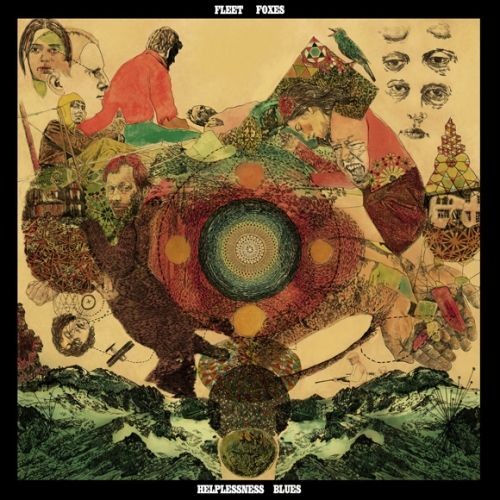
Review: Fleet Foxes – Helplessness Blues


I’m sure nice things can be said about Helplessness Blues, the new album by Fleet Foxes. You won’t hear them here. The amount of praise and acclaim this album has received makes me want to puke, and it’s high time someone pointed out its potential mediocrity.

The confusion arises from the fact that their 2008 debut was brilliant. I was hoodwinked the same as everyone else up front, buying their new album without even downloading it first. The other misleading factor–the one I didn’t personally succumb to–is the fact that they’re still trying. I have no reason to believe Fleet Foxes did not attempt to create a good album. They aren’t sell-outs in the classic sense. Sure, it sounds like over the past three years they quit showering and traded an indie song-writing mindset for feelings-sharing stories around a campfire, but becoming a hippy is like contracting a deadly disease. That’s different from selling out.

When you desperately want an album to sound good and you know the band is still trying I guess it’s easy to ignore your ears and pretend you like it. But I’m a metal fan at heart; I don’t have to make apologies for a style I don’t obsess over. So let me quit immaturely bashing Helplessness Blues and get on with why I don’t like it.


Helplessness Blues

The vocal melodies aren’t melodic. Oh, that might be a mathematically false statement; I don’t concern myself with such things. But just listen to what’s going on in this song. I can’t think of any kind way of putting it; Helplessness Blues just consistently fails to resolve any of its melodies on appealing notes, and that’s 90% of the problem. Try to take this in context. After a half dozen listens today I started to kid myself into thinking the album was fairly decent (and I really have grown hopelessly fond of this particular song’s chorus), but it only took a listen to Ragged Wood and Blue Ridge Mountains to go “Oh, yeah, that’s what I meant” on the proof-read. This is Fleet Foxes we’re talking about. Their self-titled had some of the most subtly beautiful vocals I’ve ever heard, and they always, always rewarded the listener even at their most depressing points. By comparison, Pecknold sings all over the place on Helplessness Blues with no real guidance–without any real ear for making it all work. In a lot of cases there’s no resolution whatsoever. Listen from the transition at 2:50 on, then go listen to Blue Ridge Mountains, and I’m confident you’ll understand what I mean.

This isn’t the criticism. This is the problem. It opens the door for the criticism to come pouring in. See, from start to finish, certainly not just in this one instance, Helplessness Blues is a softy. It always chooses the path of least resistance, not the happy, upbeat resolve. That’s fine. But if you do nothing with it, then it’s also very boring. In order for Helplessness Blues to be an above-average album, if the choruses and focal melodies are not rewarding in their own right, then you have no choice but to ask how they play off their surroundings–how they fit in to the big picture productively. How do they serve to make this the album of the year contender so many sites consider it to be? Or if they don’t, then what makes it so great in spite of them?

It’s not the lyrics, that’s for sure. When they aren’t generic lines about being lonely or sad or having relationship issues, they’re often borderline nonsense. The song Lorelai especially stands out. Up until the chorus it hangs on the brink of greatness, and then he starts cooing “I was old news to you then, old news, old news to you then” over and over again ad nauseam to such a painful extent that you soon forget the song was about anything at all. Or take the second half of the song currently featured–the title track (long after the rubbish about the singer realizing he was not “unique among snowflakes”.) There’s nothing clever or creative about repeating “If I had an orchard, I’d work till I’m sore” a half dozen times. And it’s too odd and repetitive to be heartwarming. Sure, he throws in “And you would wait tables and soon run the store”. Like, we’d work hard for each other out of love and soon accomplish something, maybe, but I’m still thinking “An orchard? Really?” and wondering how many times he’s going to say the same strange thing over again. And then the end line, again musically unresolved and unsatisfying, “Someday I’ll be like the man on the screen,” might be intended as a twist, something thought-provoking, if the common association of celebrities with unauthentic lives can be applied, but the irritable melody doesn’t really incline me to put much thought into it, and in any case I’m still thinking “An orchard? Really?”

The lyrics on average are only insightful in that “I don’t get it” sort of way. That is, they only inspire those thoughtful enough to derive deep meaning out of just about everything and those thoughtless enough to think their inability to derive meaning out of something is a sign of its brilliance.


Someone You’d Admire

Not all of the lyrics are dull. Someone You’d Admire, for example, is decent enough. Perhaps if the song didn’t fall victim to my complaint about the melody I’d think it clever. And that’s what we’re looking for, right?: Something that makes the weak vocal melodies appropriate or makes the songs good in spite of them. Maybe if the lyrics were coupled with really good instrumentation it would all come together. But they aren’t. The dude’s just strumming basic chords on a guitar devoid of emotion. Oh, he alters the intensity a little here and there, but there’s never any fire in his strumming. It’s little more than variant degrees of volume. And that’s what you get with the bulk of the instrumentation on this album–moments that are loud and moments that are quiet, typically not transitioning so much as switching at random. Oh, and the ending is unresolved again.


The Cascades

The instrumental track The Cascades is a good example. The acoustic guitar in the first minute isn’t playing anything particularly melodic, and it doesn’t compensate with emotion. It’s just kind of there–the sort of bedroom recording I’d create in one take and delete soon after. Around 55 seconds something awesome happens, and for a brief moment the song feels like what I actually expected a new Fleet Foxes album to sound like, dreamy, beautiful, crea—wait, it’s over. By 1:18 it’s over, and it doesn’t even fade or transition. It just ends, and we’re solo acoustic guitar again. Oh wait, here, it’s coming back again at 1:35. Oh nevermind, it’s gone again at 1:45, erm, did this song just end?

The comings and goings, the ins and outs, whether it’s merely from quiet to loud and back again or from boring to beautiful and back again, it’s all borderline random. You never feel the transition. Nothing is natural. And with the average song clocking in at only about four minutes, there’s almost never time for something coherent to develop out of it all. Just like the vocal melodies, the instrumental dynamics pretty much never develop into or resolve on an appealing sound.

So their new approach to vocals is out. Their new approach to instrumentation is out. The lyrics demand more attention and aren’t sufficient to satisfy. Basically, none of their new ideas work. Not one, in the big picture. I will leave you with the one counterexample that I felt utilized them all successfully (perhaps in part because it’s not such a decisive break from their old material.) If the whole album was more like this next one, well, then I could really appreciate it:


The Plains/Bitter Dancer

Now I was being blatantly mean to the band in my introduction, and that’s quite unfair. If Helplessness Blues hadn’t gotten such rave reviews I would have been content to call it fairly uninspiring, harmless folk. As a pretty piss-poor musician myself, I have strong reservations against criticizing bands for the music they produce (at least if it doesn’t pretend to be awesome.) The frontman Robin Pecknold even so much as stated that he intended the album to be “less poppy, less upbeat and more groove-based.” He succeeded, for better or worse. There’s no sense in pointing out how direct yet subtle, uplifting and beautiful, the vocals and instrumentation all were (and unobtrusive the lyrics) on their self-titled release, if Helplessness Blues was expressly intended to be different. That it’s not what I wanted to hear is no excuse to slander them.

If I’m starting to sound apologetic now, make no mistake. I think Hopelessness Blues is pretty bad, and I would even absent the disappointment of expecting a repeat of 2008. I just want it to be clear that my accusative tone is a product of the Pitchfork and co “way to go champs, you were struggling but it paid off, 11/10” type reviews, not Fleet Foxes themselves. It didn’t pay off. It resulted in something dubious–something you might find a great deal of merit in–hell, something I hope you can appreciate a lot more than I can. But to think it’s unquestionably brilliant is just stupid. It’s ambitiously, recklessly experimental, and you can love it or hate it with equally good taste.