Love On The Shattered Lens: The Bitch (dir by Gerry O’Hara)


“Joan Collins is THE BITCH” announced the opening credits of the 1979 film, The Bitch.  Seriously, how can you not love a film that opens that way?

Joan Collins returns of Fonatine Khaled, the character that she previously played in The Stud.  Once again based on a novel by Jackie Collins, The Bitch follow Fontaine as she adjusts to life as a freshly divorced woman.  Though she received a good deal of money in the divorce and she has her own personal fortune as well, Fontaine is struggling to maintain her extravagant lifestyle.  A new disco has opened and is taking away the crowds that used to populate her club.  She’s running out of cash and soon, she might not even be able to fly first class!

It’s on an airplane that she meets Nico (Michael Colby, who is not particularly charismatic but still isn’t quite as dull as Oliver Tobias was in The Stud).  In an amusing in-joke, the movie that they watch on the plane is The Stud.  Nico says that he can’t decide if the movie is funnier with the sound or without.  “It’s not meant to by funny,” Fontaine replies.  Nico claims to be a wealthy Italian businessman, which immediately gets Fontaine’s attention.  Of course, Nico’s lying.  He’s actually a con artist and a jewel thief.  Fontaine figures that out when Nico tries to use her to smuggle a diamond through customs.  Fontaine is angered but she’s intrigued.

Nico is in debt to the Mafia.  The head of the British mob is a man named … and I’m not making this up …. Thrush Feathers (Ian Hendry).  Thrush Feathers demands that Nico cause a horse to lose an upcoming race.  The horse belongs to Fontaine’s friends from the first film, Vanessa (Sue Lloyd) and Mark Grant (Mark Burns).  Thrush Feathers also offers to help Fontaine keep her club open but his help comes with a price.  Whatever the price is, could it possibly be worse than being named Thrush Feathers?  Seriously, in what world is someone with that name going to take over a London crime syndicate?  How do you go from the Kray Brothers to Thrush Feathers?

Anyway, the plot really isn’t that important.  There’s a lot of double crosses and manipulation as Fontaine lives up to the title of the film.  The plot is really just an excuse to tease the viewer with visions of the decadent rich.  The clothes are expensive.  The mansions are ornate.  The conversations are always arch and full of double entendres.  This film is less about how the rich live and more about how middle class like to imagine the rich live.  It’s also about sex, though none of it quite reaches the lunatic abandon of The Stud’s swimming pool orgy scene.  The important thing is that whole thing is scored to a disco beat.

As with The Stud, it’s Joan Collins who holds the film together, giving a fierce and uninhibited performance in which she gleefully embraces the melodrama and delivers her lines with just enough attitude to let the viewer know that she’s in on the joke.  “Bitch” may have been meant as an insult but, as played by Joan Collins, Fontaine wears the title as a badge of honor.  She understands what had to be done to survive in a male-dominated world and she makes no apologies for it.  Even more importantly, she knows that once you fly first class, you can never go back.

The Bitch is not necessarily good but it is definitely fun in its sordid way.

Horror On The Lens: Tales From The Crypt (dir by Freddie Francis)


For today’s Horror on the Lens, we have 1972’s Tales From The Crypt, a British anthology film which features The Crypt Keeper (Ralph Richardson) informing five strangers of how they will die.  This classic, all-star film was based on stories that originally appeared in the Tales From The Crypt comic book.

In general, I’m not a huge fan of anthology films but Tales From The Crypt is an exception to that role.  It’s an entertaining collection of macabre stories and the cast is to die for …. maybe literally!

This Amicus-produced movie is probably best remembered for the segment in which Joan Collins is menaced by an evil Santa but the whole thing is good.

Film Review: The Passenger (dir by Michelangelo Antonioni)


The 1975 film, The Passenger, tells the story of David Locke (Jack Nicholson).

Locke is a television news journalist.  From what we can gather, he’s respected from his colleagues, even though he doesn’t seem to be extremely close to anyone, including his wife (Jenny Runacre).  Everyone thinks that Locke is dead.  They believe that he was found dead in a hotel room in Africa, the victim of a heart attack.  What they don’t know is that Locke is actually alive.  He switched identities with Robertson (Charles Mulvehill), the man who actually was found dead in the hotel room.  After years of reporting on a world that appears to be going insane, Locke has decided that it’s time for a fresh start.  He no longer wants to deal with his marriage, his career, or anything else that used to define David Locke as a person.  He now just wants to be Robertson.

Of course, the problem with this plan is that Robertson had a life before Locke appropriated it.  Locke discovers that Robertson was not only a gun runner but he was also supplying weaponry to the same rebels that Locke, in his previous life, traveled to Africa to do a story on.  Since Locke has Robertson’s appointment book, he decides to keep all of Robertson’s meeting across Europe.

Meanwhile, Locke’s wife is curious to know about her husband’s final moments and, for that reason, she wants to speak with this mysterious Robertson, who was the last person to reportedly see her husband alive.  Locke’s friend, Martin (Ian Hendry) sets out to try to track down Robertson.  Locke, meanwhile, has met an architecture student (Maria Schneider), with whom he embarks on a passionate affair despite not ever learning her name.

The Passenger famously ends with a seven minute tracking shot, one that begins in a hotel room and then moves out into the hotel’s courtyard before then returning to the hotel room.  While the audience is watching the action unfold in the courtyard, something very important happens inside of that hotel room.  In fact, what happens in the hotel room is probably the most important moment of the entire film and yet director Michelangelo Antonioni only shows us the events leading up to the moment and the events immediately afterwards.  Antonioni leaves it up to the audience to determine exactly what happened inside of that hotel room.  It’s a bold move on his part and it’s also the perfect way to end this film.  The Passenger is a film about detachment and it only makes sense that the film would end with the ultimate statement of detachment, with the emphasis being less on what’s happening in the hotel room and more on the fact that life, in all of its random and confusing messiness, will continue regardless of how the story of David Locke turns out.

It’s definitely not a film for everyone.  Those who watch the film excepting a typically explosive Jack Nicholson performance will probably be surprised to discover that Jack plays a rather quiet character in The Passenger, one who is often so introverted that it’s a struggle to figure out what exactly is going on inside of his mind.  Locke thinks that, as a journalist, he understands the world but, when he becomes Robertson, he discovers that there’s a big difference between reporting a story and actually being a part of that story.  It’s an odd experience, watching Jack Nicholson play a character who is essentially in over his head.  And yet, this is is also one of Nicholson’s best performances.  Freed up from his usual tricks, Nicholson gives a vulnerable and ultimately rather sad performance as a man who realizes too late that he’s grown so detached from the world that he no longer really has an identity.

The Passenger‘s a difficult but intriguing film.  It’s a classic of the 70s and features Jack Nicholson at his best.

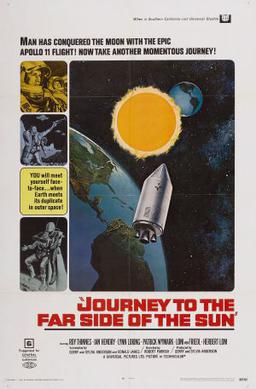
Journey to the Far Side of the Sun (1969, directed by Robert Parrish)


In the year 2069, the European Space Exploration Council discovers that there is a planet on the other side of the Sun, one that orbits the same path as the Earth.  Unfortunately, a spy transmits this information to the communists so America and Europe team up to make sure that they reach the planet before the Russians!

(Remember, production started on this movie in 1967, when America and Soviet Union were still competing to see who would be the first to land on the moon.  Of course, by the time Journey to the Far Side of the Sun was released in 1969, America had already landed on the moon and the Russian space program was no longer taken seriously.)

Two astronauts are assigned to a manned mission to explore the new planet.  Glenn Ross (Roy Thinnes) is American.  John Kane (Ian Hendry) is British.  After spending three weeks in suspended animation, Ross and Kane awaken to discover themselves orbiting a planet that appears to have much the same atmosphere as Earth.  When their ship crashes into the planet, Kane is fatally injured and Ross is retrieved by a human rescue team!  He’s told that the ship crashed in Mongolia.  Kane and Ross were orbiting Earth all along!

Or were they?  Even though Ross is reunited with his wife and debriefed by Jason Webb (Patrick Wymark), the head of the mission, he soon discovers that things are different.  People who were once right-handed are now left-handed and text is now written from right-to-left instead of left-to-right.  People drive on the wrong side of the road and, after Ross makes love to his wife, she feels like something was different about him.  Ross realizes that he’s on a counter-Earth!

It’s an intriguing premise but, unfortunately, Journey to the Far Side of the Sun doesn’t do much with it.  It’s not as if Ross has landed on the Bizarro world, where people say, “Bad Bye” and root for the bad guys at the movies.  Instead, it’s just a world where right-handed people are now left-handed and everyone drives on the opposite side of the road.  Ross theorizes that everything that happens on Earth also happens on Counter-Earth, which means that the other Ross is on Earth, realizing the exact same thing that the first Ross is realizing but who cares because there’s not really any major differences between the two Earths.  Maybe if Counter-Earth had an alternate history where Rome never fell or the Germans won World War II, the movie would be more interesting or at least more like an old episode of Star Trek.  Instead, the movie is all about Ross trying to convince the people on Counter-Earth that he didn’t intentionally abort the mission and that he should be given a chance to return to his Earth.   It’s the driest possible way to approach an interesting premise.

I will say that Journey to the Far Side of the Sun also has one of the strangest endings that I’ve ever seen.  I won’t spoil it here, other than to say that I wonder if the ending was written before or after 2001 made confusing conclusions cool again.

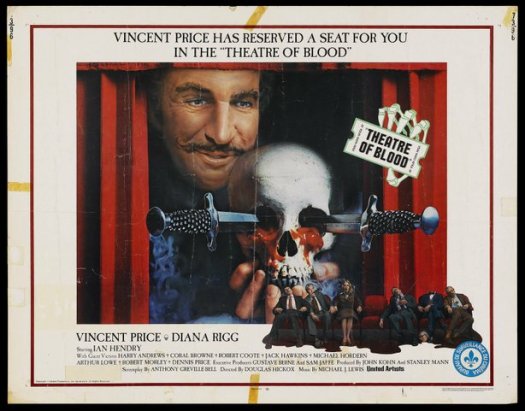
Outrageous Fortune: Vincent Price in THEATER OF BLOOD (United Artists 1973)


gary loggins's avatarcracked rear viewer

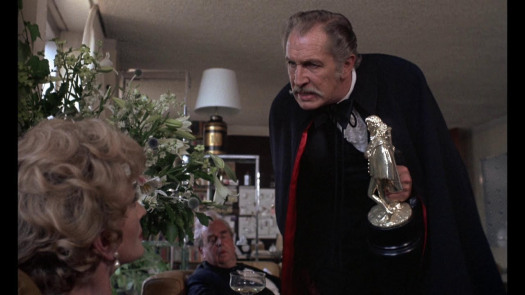
Vincent Price  traded in Edgar Allan Poe for William Shakespeare (and American-International for United Artists) in THEATER OF BLOOD, playing an actor’s dream role: Price not only gets to perform the Bard of Avon’s works onscreen, he gets to kill off all his critics! As you would imagine, Price has a field day with the part, serving up deliciously thick slices of ham with relish as he murders an all-star cast of British thespians in this fiendishly ingenious screenplay concocted  by Anthony Greville-Bell and directed with style by Douglas Hickox.

Edward Lionheart felt so slighted by both scathing criticism and once again being stiffed at the prestigious Critics’ Circle award, he broke up their little soiree by doing a swan dive into London’s mighty Thames. His body was never found, and everyone assumed they had seen Lionheart’s final performance, but unbeknownst to all he was fished out of the river…

View original post 535 more words

Horror Film Review: Damien: Omen II (dir by Don Taylor)


DamienomenII

The first sequel to The Omen was 1978’s Damien: Omen II.  Damien: Omen II is an odd film, one that is not very good but yet remains very watchable.

Damien: Omen II takes place 7 years after the end of the original Omen.  Antichrist Damien Thorn (now played by Jonathan Scott-Taylor) is now 12 years old.  He lives with his uncle Richard (William Holden) and Richard’s 2nd wife, Ann (Lee Grant).  His best friend is his cousin Mark (Lucas Donat).  In fact, the only problem that Damien has is that his great-aunt Marion (Sylvia Sidney) can’t stand him and views him as a bad influence.  Fortunately, as usually seems to happen whenever someone puts an obstacle in Damien’s life, there’s always either a black dog or a black crow around to help out.

Damien and Mark are cadets at a local military academy where Damien deals with a bully by glaring at him until he falls to the ground, grabbing at his head.  In history class, Damien shocks his teacher by revealing that he knows the date of every battle ever fought.  Damien’s new commander, Sgt. Neff (Lance Henriksen), pulls Damien to the side and tells him to stop showing off and to quietly bide his time.

Meanwhile, Richard is busy running Thorn Industries.  One of his executives, Paul Buhler (Robert Foxworth), wants to expand Thorn’s operations into agriculture but his plans are opposed by Richard’s executive vice president, Bill Atherton (Lew Ayres), who considers Paul to be unethical.  However, during an ice hockey game, Bill falls through the ice and, despite the efforts of everyone to break through the ice and save him, ends up floating away.  Paul is promoted and pursues his plans to make money off of world famine.  In between all of this, Paul finds the time to speak to Damien and tell him that he has a great future ahead of him.

Along with Thorn Industries, Richard also owns the Thorn Museum in Chicago.  The museum’s curator is Dr. Charles Warren (Nicholas Pryor) who was a friend of the archeologist Karl Bugenhagen (Leo McKern) who, in the first film, revealed that not only was Damien the antichrist but that the only way to kill him was by stabbing him with the Seven Daggers of Meggido.  Dr. Warren is also friends with Joan Hart (Elizabeth Shepherd), a reporter who both knows the truth behind Bugenhagen’s death and who has also seen an ancient cave painting that reveals that the Antichrist looks exactly like a 12 year-old Damien Thorn.

Much as in the first film, just about everyone who comes into contact with Damien ends up getting killed in some odd and grotesque way.  Crows peck out eyes.  Trucks run over heads.  One unfortunate victim is crushed between two trains.  Another is chopped in half by an elevator cable.  At times, Damien: Omen II feels less like a sequel to The Omen and more like a forerunner to Final Destination.

Damien: Omen II is one of those films that I like despite myself.  It’s bad but it’s bad in a way that only a film from the 1970s could be and, as such, it has some definite historical value.  The script is full of red herrings, the acting is inconsistent, and the film can never seem to make up its mind whether Damien is pure evil or if he’s conflicted about his role as Antichrist.  As I watched the film, I wondered why the devil could so easily kill some people but not others.

And yet, Damien: Omen II is so ludicrous and silly that it’s undeniably watchable.  If the first film was distinguished by Gregory Peck’s defiant underplaying, the second film is distinguished by the way that William Holden delivers every line through manfully clenched teeth.  Everyone else in the cast follows Holden’s lead and everyone goes so far over-the-top that even the most mundane of scenes become oddly fascinating.

For me, the film is defined by poor Lew Ayres floating underneath that sheet of ice while everyone else tries to rescue him.  On the one hand, it’s absolutely horrific to watch.  I’m terrified of drowning and, whenever the camera focused on Ayres desperately pounding on the ice above him, I could barely bring myself to look at the screen.  But, at the same time, we also had William Holden screaming, “OH GOD!” and Nicholas Pryror enthusiastically chopping at the ice with a big axe and dozens of extras awkwardly skating across the ice.  Somehow, the scene ended up being both horrifying and humorous.  It should not have worked but somehow, it did.

And that’s pretty much the perfect description of Damien: Omen II.  It shouldn’t work but, in its own way, it does.