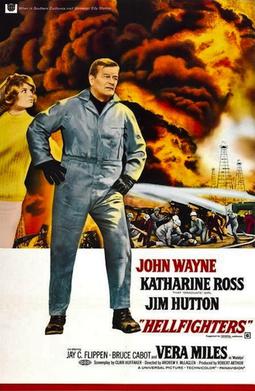
Hellfighters (1968, directed by Andrew McLaglen)


Chance Buckman (John Wayne) is the best there is when it comes to fighting oil fires.  Along with Greg Parker (Jim Hutton), Joe Horn (Bruce Cabot), and George Harris (Edward Faulkner), Chance travels the world and puts out fires that the regular authorities can’t handle.  Chance loves his job but he also loves his ex-wife, Madelyn (Vera Miles).  When Madelyn indicates that she wants to remarry Chance but only if he pursues a less dangerous line of work, Chance retires from firefighting and becomes an oil executive.  He leaves his firefighting company to his new son-in-law, Greg.  When Greg and Chance’s daughter (Katharine Ross) head down to Venezuela to battle a fire and find themselves not only having to deal with the flames but also with a band of revolutionaries, Chance is the only one who can help them.

When I was growing up, Hellfighters was one of those movies that seemed to turn up on the local stations a lot.  The commercials always emphasized the idea of John Wayne almost single-handedly fighting fires and made it seem as if the entire movie was just the Duke staring into the flames with that, “Don’t even try it, you SOB” look on his face.  As a result, the sight of John Wayne surrounded by a wall of fire is one of the defining images of my childhood, even though I didn’t actually watch all the way through until recently.  When I did watch it, I discovered that Hellfighters was actually a domestic drama, with an aging Wayne passing the torch to youngster Jim Hutton but then taking it back.

The fire scenes are the best part of Hellfighters and I wish there had been more of them.  The movie gets bogged down with all of Chance’s family dramas but it comes alive again as soon as John Wayne and his crew are in the middle of a raging inferno, putting their lives at risk to try to tame the fire.  Wayne was always at his best when he was playing strong, no-nonsense men who were the best at what they did.  Hellfighters is slow in spots but the fire scenes hold up well.  There’s no one I’d rather follow into an inferno than Chance Buckman.
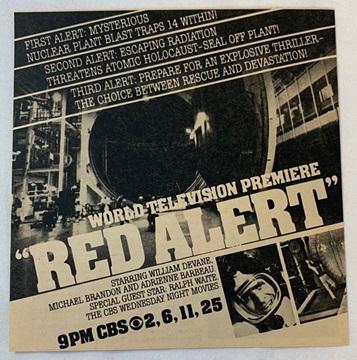
Made-For-Television Movie Review: Red Alert (dir by William Hale)


The 1977 made-for-television movie, Red Alert, opens with a man walking through a cemetery on a rainy day.  As we watch Howard Ives (Jim Siedow) move amongst the tombstones, we hear his thoughts.  He’s a sad and bitter man, wondering why he’s wasted so many years of his life at work.  He thinks about someone close to him who has died.  He’s obviously very troubled.

(Of course, any horror fans in the audience will immediately recognize Jim Siedow from his role as the Drayton Sawyer in the the original Texas Chainsaw Massacre.  He was troubled in that film as well!)

Howard works at the local nuclear power plant.  Ominously, when the film cuts to the plant, the first thing we see is a leak of very hot water.  I don’t know much about nuclear power plants but I imagine any type of leak is not a good thing.  The water leak causes the computer that runs the plant assuming that a nuclear disaster is minutes away from happening.  The compound is automatically sealed off, trapping fourteen men (including Howard), inside the reactor.  As Commander Stone (Ralph Waite) tries to keep a possible nuclear disaster from occurring, two investigators (played by William Devane and Michael Brandon) try to determined whether the accident was the result of a malfunction or of deliberate sabotage.  When the local sheriff (M. Emmet Walsh) informs them that Howard Ives’s wife has committed suicide, the investigators look into the troubled man’s history.  Eventually, the two investigators realize that the only way to prevent a nuclear disaster is by risking their lives by entering the sealed-off power plant.  The two investigators attempt to do their work under the cover of night and without causing a panic.  Needless to say, it doesn’t work.  One of them calls his wife (Adrienne Barbeau) and tells her that she needs to leave the area.  She tells her mother, who then tells her neighbor and soon the airport is crowded with people looking to get out of town.

Red Alert contrasts the intuitive approach of the two inspector with Commander Stone’s insistence that every bit of a data be fed to his computer before any decisions are made.  Stone’s hands are so tied by protocol and red tape that he stands by while the fourteen men who are trapped in the nuclear power plant die.  Wisely, though, the film doesn’t turn Stone into a cardboard villain.  He’s very much aware of what will happen if the plant suffers a core meltdown.  When one of his assistants mentions that he hasn’t been given any instructions on how to evacuate the town in case the plant does explode, Stone tells him that no plans have ever been drawn up because the plans would be useless.  There would be no way to evacuate everyone in time.

In the end, Red Alert is scary not because it deals with nuclear power but because it presents us with a world where no one — not even Devane and Brandon’s heroic investigators — seems to know what to do.  Everyone is slowed down by a combination of red tape and their own personal angst.  Devane is a strong investigator because, as a widower whose only son died in Vietnam, he has no family to worry about.  Unlike everyone else in Red Alert, he has nothing left to lose.  In the end, the film suggests that the only way to save the world is to cut yourself off from it.

Red Alert is a compelling and intelligent thriller, one that is well-acted by the entire cast and which builds up to strong conclusion.  The film’s anti-nuclear message is a bit heavy-handed but I imagine it was an accurate reflection of the fears that people were feeling at the time.  Today, the film works best as a warning about bureaucracy and depending too much on AI to make important, life-or-death decisions.  In the end, it’s human ingenuity that saves the day and that message is timeless.